गुरुर्ब्रह्मा गुरुर्विष्णुः गुरुर्देवो महेश्वरः।
गुरुः साक्षात् परं ब्रह्म तस्मै श्रीगुरवे नमः॥
(Gururbrahmā gururviṣṇuḥ gururdevo maheśvaraḥ |
Guruḥ sākṣāt parabrahma tasmai śrī gurave namaḥ || )
In the sacred conceptualization of Bharatavarsha, the Guru transcends the role of a mere educator, embodying the divine presence of Brahma, Vishnu, and Maheshwara. Among the enigmatic manifestations of this eternal Guru is Śrī Dattatreya, the triune deity born from the devotion of Anasuya and the grace of the Trimurti. Śrī Dattatreya is recognized not only through scriptures but also through numerous leelas recounted by generations of devotees. These narratives describe his appearances in response to devotees’ calls, his protection of the vulnerable, his guidance to the lost, and his silent transformation of lives. To his devotees, Datta is perpetually accessible; he is the Guru who arrives unexpectedly and remains when others have departed. His compassion transcends temporal and situational boundaries. This enduring faith in the omnipresent Guru Datta renders his sacred presence extraordinary. At Chattarki, this devotion assumes a particularly unique form: the Ekamukhi Śrī Guru Dattatreya.
Sometimes the Guru Calls You Himself
Some journeys are deliberately planned, while others appear to be orchestrated by external circumstances. My introduction to Chattarki Dattatreya occurred unexpectedly during my attendance at a Yuvagoshthi in Vijayapura. At this event, I encountered Śrī Rang Puranik, a young organiser whose enthusiasm for the history and heritage of Vijayapura was compelling. He shared several of his own videos and mentioned a relatively unexplored temple dedicated to Ekamukhi Śrī Guru Dattatreya. This piqued my interest, prompting me to visit the site. Consequently, I decided to arrive a day early and undertake the journey with my parents, as visiting a Punyakshetra with one’s parents is considered a blessing. By a fortunate coincidence, we encountered Rang ji again. Upon learning that the temple was approximately 50 kilometres away, he recommended travelling by car. To our satisfaction, the organisers allowed him to accompany us despite his busy schedule. Thus, what began as a casual suggestion evolved into a meaningful journey, which, in hindsight, seemed less like my own decision and more like an invitation from Guru Datta.
Throughout the exploration, Śrī Rang Puranik ji consistently demonstrated enthusiasm as a storyteller. His narration of Vijayapura’s history vividly animated the surrounding landscape. He posed the question, “When we think of Vijayapura, how far back do we actually go?” For many, the response is confined to the Adil Shahi Sultans and the renowned Gol Gumbaz. The Adil Shahi dynasty indeed established Vijayapura as its capital from 1489 to 1686, leaving a legacy of significant monuments, mosques, mausoleums, literature, and music. However, Rang ji emphasized that history did not commence with the Sultans. Prior to their reign, the region was influenced by the Kalyani Chalukyas and various other dynasties and communities. His inquiry lingered: What about the histories preceding them? This reflection perhaps explains why many visitors view the Gol Gumbaz, capture photographs, and depart, without delving into the deeper layers of Vijayapura’s civilizational history. This contemplation heightened my curiosity about the lesser-known shrine we were approaching.
Upon reaching the village, Sri Rang ji promptly instructed the driver to halt and take a specific turn. Notably, even our driver, a native of Vijayapura, was unaware of the temple’s location. The absence of signboards or directions provided no indication of the significant shrine concealed within. We navigated through what seemed to be a remote and relatively underdeveloped village, relying solely on Rang ji’s guidance. At the village’s far end, almost hidden from external view, we finally observed the Chattarki Dattatreya Temple. The temple’s presence, after a lengthy journey and the uncertainty of locating it, appeared almost surreal. This sacred shrine, steeped in centuries of history, remained seemingly untouched by the attention typically afforded to more renowned monuments.
The Hidden History of Chattarki Dattatreya
Upon entering the temple complex, the security guard immediately recognized Śrī Rang Puranik ji, greeting him with a warm smile and noting Rang ji’s frequent visits. This interaction highlighted the relationship he had cultivated with this overlooked heritage site. It was not merely a monument he had studied; it was a location for which he held genuine affection. My parents were equally pleased to discover such an extraordinary temple situated in a village. My mother, in particular, was captivated by the architectural beauty and intricate carvings. As I stood there, I began to comprehend Rang ji’s message during our journey: the history of Vijayapura extends significantly beyond the well-known monuments.
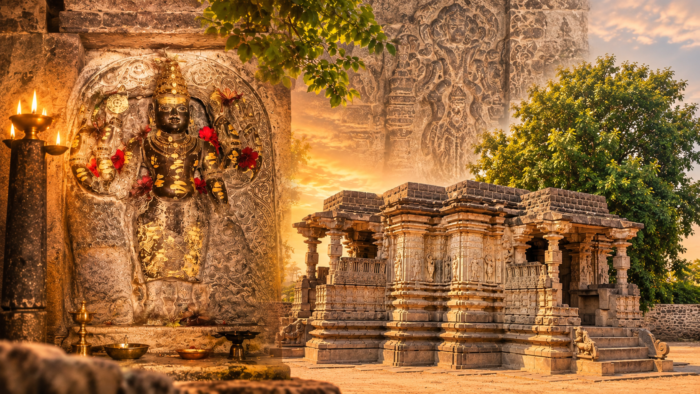
The temple is representative of the architectural style of the Kalyani Chalukyas, whose temple construction activities were prominent in Karnataka during the eleventh and twelfth centuries. The Chattarki Dattatreya temple is typically attributed to the twelfth century, with inscriptional evidence from the site enhancing its historical significance. An inscription located on the outer wall of the Dattatreya temple, dated to approximately the thirteenth century, makes reference to Rudra-loka. Additionally, another record associated with the village preserves an earlier name for the settlement, known as Chatturage. These inscriptions indicate that the village, which we entered quietly, was once part of a significantly larger cultural and sacred landscape.
Local historical accounts associate the region with Mahamandalika Gunadevarasa, who reportedly engaged in battle against an adversary with the assistance of the local populace and, upon victory, bestowed generous grants upon them. These memories, whether encountered through inscriptions, oral traditions, or extant architecture, illustrate a landscape where temples were integral to political authority, community life, patronage, learning, and artistic activity, rather than isolated structures. The temple before us was an Ekakuta shrine, primarily constructed of basalt stone, exhibiting the distinctive architectural style of the Kalyani Chalukyan period. Its design and ornamentation demonstrate an exceptional mastery of geometry and stone craftsmanship. The surviving structure is particularly noteworthy, as much of its sculptural language remains visible despite centuries of change. Architectural studies recognize the Chattarki Dattatreya shrine as one of the notable stepped-diamond temples of the Kalyani Chalukya tradition.
As we approached the temple, the Nandi Mantapa became visible. Although the temple is dedicated to Dattatreya, the mandapa is integral to the ongoing sacred activities of the complex, with the utsava murti linked to the shrine’s ritual traditions. Subsequently, we entered the Mukhamantapa, where the intricate stonework immediately drew our attention. Along the sides were broad, elevated stone seating platforms—referred to in Kannada as jaguli or katte—designed for congregation and seating. Beyond the Mukhamantapa was the exquisite Navaranga, or Rangamantapa. This space can be easily envisioned as vibrant with activity during temple festivals, featuring devotees, music, rituals, and possibly performances of dance and other traditional arts. Its elevated architectural design imparts a sense of grandeur, while the ceiling, known as bhuvaneshwari, is an artistic masterpiece. The sculptural details appear to emerge organically from the stone. The Kirtimukhas, with their fierce expressions, seem to bear the structure’s weight upon themselves.
The temple features multiple entrances, including those on the eastern, western, northern sides. Each transition between architectural spaces unveils additional details. The craftsmanship is exceptionally refined, with pillars, ceiling panels, mouldings, and sculptural elements exemplifying the sophistication of medieval Karnataka’s temple architects. This architectural style is characteristic of a period when Chalukyan craftsmen extensively experimented with temple plans and ornamentation, with the Chattarki shrine holding particular significance within this tradition.
Adjacent to the sanctum are exquisite sculptures of the Saptamatrikas, each carved with meticulous attention to form and expression. These include depictions associated with Bhairava and a dancing Shiva, accompanied by an image of Ganesha. Another finely executed Ganesha relief is located near the garbhagriha. These sculptures are not merely decorative; they reflect the theological and artistic imagination of the era, illustrating a world where various manifestations of the divine coexisted within the same sacred architectural space.
The Antarala features images of Vishnu associated with dhyana, highlighting the Vaishnava aspect of the temple. Additionally, a Shiva linga is situated near the sanctum, and a Lakshmi-sahita Vishnu image further enriches the sacred iconography. This coexistence illustrates that medieval temple traditions cannot always be comprehended through the rigid categories applied today. Notably, the sculptural work on the pillars is remarkable. Five prominent pillars stand within the mandapa, showcasing intricate craftsmanship across their surfaces. The temple also includes notable ubba shilpas—relief sculptures—featuring animal forms, elephants, and other decorative motifs. The outer walls and surviving horashilpas further demonstrate the sculptors’ skill. Even the ancient Ashvattha tree near the temple veranda appears to have become an integral part of the shrine’s living landscape.
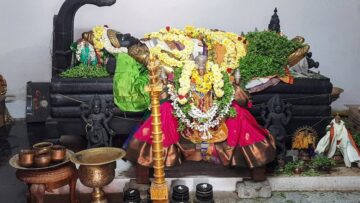
Ultimately, we stood before Śrī Guru Dattatreya. The murti, carved from dark stone, exudes a notable presence. Unlike the common three-faced depictions of Dattatreya, this is the uncommon Ekamukhi form, characterized by a single face, six arms, and a unique combination of attributes. The hands hold the shankha, chakra, trishula, damaru, and kamandalu, integrating Vaishnava and Shaiva symbols within the Guru’s form. The crown, karna-kundalas, sacred thread, and other ornaments are intricately crafted. The face bears a gentle mandahaasa, a subtle and compassionate smile, which left a lasting impression. The figure does not convey conventional imposingness; rather, there is a quiet assurance in the expression, as if the deity is not demanding anything from the devotee but simply offering reassurance: I am here. The temple priest, Śrī Sridhara Joshi, hails from a family that has perpetuated the worship and pourohitya of this shrine for generations. He recounted his ancestors’ long-standing relationship with Guru Datta. As he spoke, the temple transcended its archaeological identity, becoming a living shrine.
The temple has not been immune to the violence and neglect throughout history. According to local accounts, a significant phase of its destruction is linked to the aftermath of the Battle of Talikota in 1565, during which the Karnataka Samrajya (Vijayanagara Empire) was decisively defeated by the Deccan Sultanates. The fall of Vijayanagara led to widespread destruction and incursions across various parts of the region, with Chattarki also reportedly suffering during this turbulent period. The remnants that survived these centuries of conflict have subsequently faced neglect. Local narratives recount attempts to break or steal sculptures due to the belief that treasures might be concealed within them, and a Ganesha idol has reportedly been stolen. These incidents highlight the vulnerability of monuments that are physically remote and insufficiently recognized. Although the Archaeological Survey of India has undertaken the protection of the monument, a larger challenge persists: how to preserve not only the physical structure but also the living memory associated with it.
The route from Vijayapura to Chattarki, via Sindagi and Indi, is accessible; however, the lack of clear signage and sufficient visitor infrastructure complicates access to the shrine. Improvements are needed in basic facilities, cleanliness, and lighting. Surrounding the village are additional sculptural remnants, including damaged images of deities and women, fragments of architectural ornamentation, and exquisite horashilpas. The current deteriorated state of these artifacts starkly contrasts with the artistic excellence they once embodied. Nevertheless, the temple endures. In a video by Sri Rang Puranik Ji, Historian Dr. Devarakonda Reddy expressed astonishment at the monument’s survival over the centuries. This resilience is perhaps the most significant aspect of Chattarki—not only that a beautiful Kalyani Chalukyan temple still stands, but that it remains an active shrine, worshipped and remembered, awaiting rediscovery. Standing with my parents before the Ekamukhi Guru Datta, it became apparent that our journey transcended a mere visit to an obscure temple. We had engaged with a neglected chapter of Karnataka’s history, and perhaps, through the grace of Guru Datta, we were privileged to uncover it.
The Question Guru Datta Left Behind
We were nearly prepared to depart. My father, despite his old age, traversed the entire temple with notable enthusiasm. His expression reflected a childlike joy as he observed the sculptures, pillars, and the sacred presence of Guru Datta. I too felt a sense of gratitude for having been able to bring my parents to such a Punyakshetra. However, upon exiting, our joy was abruptly interrupted. Adjacent to the temple walls was a substantial garbage mound—a Tippe Gundi. The waste from the surrounding village appeared to have accumulated almost against the very walls of a monument that had endured for centuries. I stood there in silence. Momentarily, my thoughts returned to Gol Gumbaz. If the Archaeological Survey of India can protect and maintain a monument of such renown, would we accept similar surroundings for Gol Gumbaz? Certainly not. Then why should Guru Datta receive any less consideration? This question was troubling. We often express pride in Karnataka’s heritage, its Chalukyas, its Vijayanagara, its temples, and its magnificent architecture. However, heritage is not preserved solely by celebrating what is renowned. At times, it requires acknowledging what remains neglected. Perhaps Guru Datta brought me to Chattarki not merely for darshan, but to recognize this overlooked treasure—and to pose a fundamental question: If we cannot care for the places where our heritage still thrives, what exactly are we preserving? We departed from Chattarki, yet I could not leave that question behind.
Disclaimer: The opinions expressed in this article belong to the author. Indic Today is neither responsible nor liable for the accuracy, completeness, suitability, or validity of any information in the article.