
As Thondaradippodi Alwar beautifully expresses:
‘Pachai maamalai pol meni pavala vaay kamala sengaN
Achutha amaraR eerae aayar tham kozhunthae ennum
Ichuvai thavira yaan poi indhira logam aalum
Achuvai peRinum vendaen aranga maa nagar uLaanae
“Oh Lord of Srirangam! You have a complexion resembling a lush green mountain, coral-red lips, and beautiful red eyes like a lotus. Oh, Achyutha, the Lord of the celestials and the jewel of the cowherds! This sweet devotion I have for you is so fulfilling that even if I were granted the joy of ruling over Indra’s heaven, I would not desire it over being near you in Srirangam.”
I felt the same way when I visited the world’s largest Hindu temple, Sri Rangam, especially during Adhika Maasa.
I recently had the opportunity to visit Sri Rangam, marking my first experience at this sacred Kshetram. During my trip to Tiruvannamalai, I initially planned to continue on to Chidambaram. However, when I inquired about the bus services to Chidambaram, the locals informed me that only a few buses were available from Tiruvannamalai. As I was waiting for the bus to Chidambaram in the sweltering afternoon sun, a bus suddenly arrived with “Trichy” written on it. Among the many buses that passed by, this was the only one that displayed its name in English; the others were all in Tamil. At that moment, I felt a strong connection to this bus and, without hesitation, boarded it for Trichy. Once online, I discovered that the famous Sri Rangam temple is located in Trichy. Suddenly, it dawned on me that this is where the Antya Ranga lies. I had already visited the two among three sacred places, or Kshetras: Adi Ranga in Srirangapattana and Madhya Ranga in Shivanasamudra, and now I had the chance to complete this spiritual journey. Sri Ranga was right in front of me, and without a second thought, I boarded the bus.
The Eternal Island of the Reclining Ranganathaswamy
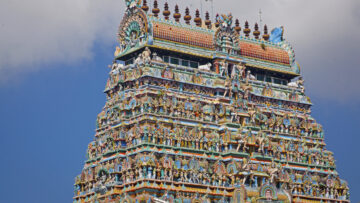
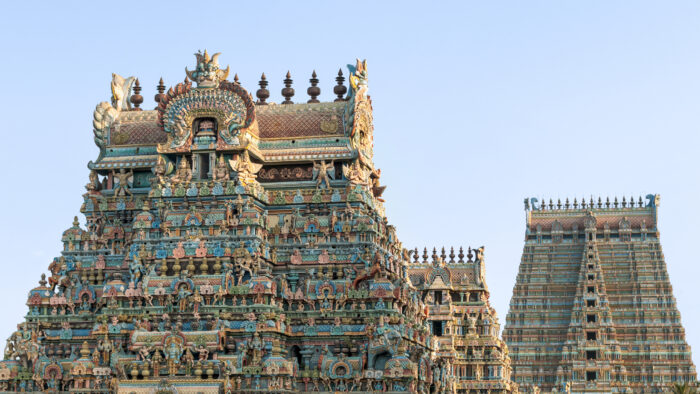
Srirangam stands as a monumental convergence of antiquity and living faith, situated on a natural island carved by the Kaveri and Kollidam rivers in Tamil Nadu. As the world’s largest functioning temple complex, spanning 156 acres, its origins are rooted in the Itihasa of the Treta Yuga; local tradition holds that the central deity, Sri Ranganatha, was the family heirloom of the Ikshvaku dynasty and Sri Rama, eventually settled here by Vibhishana during his journey to Lanka. Historically, the temple’s evolution is a timeline of imperial patronage, with its earliest brick foundations dating to the Sangam period (c. 1st–4th century CE) under the Cholas. It was later expanded into a sprawling stone citadel by successive waves of the Pandya, Hoysala, and Vijayanagar empires between the 9th and 16th centuries. Governed by the administrative reforms established by Jagadguru Ramanujacharya in the 11th century, Srirangam remains a vibrant “temple town” where seven concentric walled enclosures symbolize the layers of the universe. To visit during the Adhika Maasa (the extra lunar month) is to witness the site at its most potent, where the ancient hymns of the Alvar saints and the towering 236-foot Rajagopuram remind travelers that they are standing at the absolute heart of Sri Vaishnava culture.
A Personal Encounter with Divinity
In the early hours of the morning, around 5 AM, I embarked on a pilgrimage to the illustrious Srirangam Temple, known to be one of the largest temples globally. As I approached the main entrance, a long queue of devotees stretched before me, a testament to the temple’s significance and the allure it holds in the hearts of many. The moment we were permitted to enter, a wave of excitement washed over me, igniting my curiosity to witness the beauty and grandeur of this sacred Kshetram.
Stepping inside, I was immediately captivated by the exquisite carvings adorning the temple walls and the vibrant paintings that depicted ancient stories and legends. The Vigrahas, or idols, resonated with a spiritual energy that made me feel as though I had transcended the material realm and entered a mystical dimension, akin to Vaikuntha itself. The atmosphere was electric, with a multitude of devotees from across Bharat gathering for darshan. The presence of ISKCON sannyasis added to the spiritual ambiance, their chants weaving through the air, creating a tapestry of devotion and reverence. In the midst of this vibrant setting, I purchased a special darshan ticket for 100 rupees, eager to catch a glimpse of the main deity, Sri Ranganathaswamy.
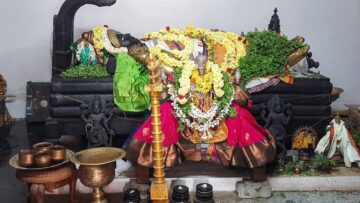
As I approached the sanctum, my heart raced with anticipation. However, upon my first glimpse illuminated only by a dim light, I was met with a moment of confusion. The sight revealed three small murtis against a backdrop of shadowy darkness, leaving me momentarily uncertain if this was indeed the revered Sri Ranganathaswamy for whom so many had gathered. Just as disappointment threatened to overwhelm me, a fellow devotee, sensing my perplexity, gestured towards the reclining deity, who was hidden behind the smaller murtis. Enlightened by this intervention, I hurriedly returned to the inner sanctum. To my relief and elation, as I peered through the throng of devotees once more, I caught a glimpse of His cheeks and eyes, appearing ethereal in the faint glow of the deepam.
Overwhelmed by emotion, I found myself shedding tears of joy; I realized that my devotion had not gone unnoticed. It felt as though Sri Ranganathaswamy had indeed granted me darshan, affirming my faith. However, a twinge of frustration lingered as I considered the archakas responsible for the illumination. A brighter light, I mused, would have certainly enhanced the experience for countless devotees who had traveled great distances for this divine sight.
Nevertheless, I felt profoundly fortunate to have witnessed even a part of His visage, an image etched permanently in my memory. My encounter with Sri Ranganathaswamy underscored a deeper connection to the divine, awakening a sense of wonder and spiritual fulfillment that would continue to resonate long after my return from this sacred journey. When I came outside, I opened my mobile and saw that my article on Sri Madhya Ranganathaswamy was published on the same day I took darshana of Sri Ranganathaswamy at Sri Rangam. All was his Krupa! I then went to pay my respects to the other deities in the temple. While going across the temple I remembered this story of Vipranarayana
The Story of Vipranarayana and Lord Ranganatha
Once upon a time, by the serene banks of the Kaveri River in Srirangam, there lived a man named Vipranarayana. A deeply pious soul, he dedicated his life to a singular purpose—tending to a beautiful garden filled with sacred tulasi and fragrant jasmine. Each morning, he would weave exquisite garlands from the blooms, offering them with unwavering devotion to Lord Ranganathaswamy. Vipranarayana was untouched by worldly desires; he sought no wealth, had no family, and yearned for nothing but the sweet solace of his service.
But one fateful day, everything changed. Deva Devi, a stunning court dancer from a neighboring kingdom, happened upon Vipranarayana’s garden. Captivated by this man who seemed entirely indifferent to her beauty, she felt a challenge stir within her. Determined to break his vows of asceticism, she disguised herself as a helpless woman in need of shelter and approached him. With her feigned piety and diligent work in his garden, she slowly earned his trust. The spell of her charm worked its magic, leading Vipranarayana to abandon his beloved rituals, his flourishing garden, and eventually, his devotion to Lord Ranganatha—all for the allure of Deva Devi.
As time passed, Vipranarayana found himself empty, both of heart and purse. With no more riches to offer, Deva Devi, having won her wager, callously cast him aside. Broken and humiliated, he lay outside her gates, consumed by despair.
In his darkest hour, Lord Ranganatha could no longer bear to witness the plight of His devoted servant. Taking on the guise of a young temple assistant named Azhagiyamanavala Daasan, the Lord ventured forth to Deva Devi’s dwelling under the veil of night. In His hands, He held a brilliant golden vessel, one that had been taken from His own sacred treasury. With a gentle knock, He presented the shimmering gold to Deva Devi, claiming it was a gift from the desperate Vipranarayana.
Tempted by the promise of wealth, Deva Devi welcomed Vipranarayana back into her home, unaware of the divine nature of her guest’s intentions.
The following morning, when the temple priests unlocked the sanctum sanctorum, they discovered that the sacred golden vessel was missing! A frantic search revealed its location inside Deva Devi’s residence. When questioned about its arrival, she truthfully stated that it had been brought to her by Vipranarayana’s servant. Misunderstanding the divine orchestration at play, the local guards arrested Vipranarayana, charging him with theft, and cast him into a dark dungeon.
In this shadowy cell, Vipranarayana wept—not out of fear of punishment, but from a dawning realization of how far he had strayed from his pure devotion. That night, the Lord manifested in a dream to the ruling king, revealing the truth of the situation:
“Vipranarayana is blameless. I broke my own treasury and brought the vessel to Deva Devi myself, merely to free my devotee from the chains of worldly attachment and guide him back to my feet.”
Awakened by this revelation, the king acted swiftly. He released Vipranarayana with royal honors, and in that moment, the broken man understood the depth of the Lord’s unfathomable mercy—a mercy so vast that the master of the universe had stolen for the sake of a humble servant.
Transformed by this grace, Vipranarayana adopted an entirely new identity—he became Thondaradippodi Alvar, which means “the saint who is the dust at the feet of the Lord’s devotees.” Returning to his quiet garden once more, he resumed weaving his garlands. With a heart filled with gratitude, he composed the immortal Thirumalai hymns, reminding all who would listen that no soul is too lost for divine grace to find and rescue. And so, in the beauty of devotion, the story of Vipranarayana and Lord Ranganatha became a timeless tale of redemption.
The Shield of Srirangam: The Legacy of Pillai Lokacharya
In the bustling town of Srirangam, where the echoes of devotion resonate through time, there lies a small temple dedicated to Pillai Lokacharya. As I wandered through this sacred space, the archaka, filled with enthusiasm, captivated pilgrims with tales of the temple’s rich history and the revered Acharya. One story, in particular, stands out as a testament to resilience and sacrifice—an epic saga of divine preservation in the face of dire adversity.
The storied past of Srirangam is not merely an account of its architectural wonders; it is a narrative steeped in spirituality, bravery, and the unbreakable bond between the deity, Sri Ranganatha, and His devoted followers. However, the temple town faced its darkest chapter during the early 14th century, between 1311 and 1323 CE. As the expansionist forces of the Delhi Sultanate, led by Malik Kafur and Ulugh Khan, swept through the south, Southern India’s cultural and spiritual integrity hung in the balance.
In this moment of crisis, the heart of Srirangam, with its sacred icons, needed a guardian. Enter Pillai Lokacharya, a figure of both wisdom and unwavering devotion. When word reached the river island that invading armies were ravaging nearby territories, the temple authorities devised a daring preservation strategy that hinged on courage and ingenuity.
The challenge was immense. The Moolavar, the temple’s revered presiding deity, Sri Ranganatha, was an enormous stone monolith, immovable on short notice. To shield Him from impending danger, devoted priests constructed a thick brick-and-stone wall, artfully camouflaging it within the temple’s architecture. To the casual observer, the inner sanctum appeared as a solid, unyielding structure, concealing the divine presence within.
Meanwhile, the Utsavar, Namperumal, the beautiful processional deity cast in a rare five-metal alloy, faced an even graver threat. This precious icon was at risk of being looted and melted down. The responsibility of safeguarding Namperumal fell squarely on the shoulders of the aged Pillai Lokacharya, who, despite having already surpassed his centennial mark, was resolute in his mission. In an act of profound bravery, he disguised the deity within a closed palanquin and, accompanied by a steadfast group of disciples, ventured into the perilous terrain just as the invaders penetrated the outer defenses.
What followed was a harrowing odyssey that would last decades. As the group traversed the dense wilderness toward Madurai, they fell victim to bandit ambushes. In a moment that would haunt history with its selflessness, Pillai Lokacharya surrendered all the hidden temple’s gold and jewels, his only request being for the safety of the palanquin. Although the deity was spared, the toll of this journey proved to be too much for the venerable Acharya. At the village of Jyotishkudi, weary and worn from his labor, he drew his last breath, forever focused on safeguarding Namperumal.
For sixty long years, the deity roamed from one refuge to another, finding brief sanctuaries in the fortresses of Gingee, the hills of Tirupati, and the hallowed grounds of Melukote. It was not until 1371 CE, when the Karnataka Samrajya (Vijayanagara) prince Kumara Kampana emerged victorious over the Sultanate forces, that Srirangam was liberated. The concealed wall was dismantled, unveiling the untouched Moolavar, while Namperumal was triumphantly escorted back to His rightful place on the throne.
The masterstroke of strategic concealment and the sacred legacy of Pillai Lokacharya ensured that the heart of Srirangam endured. In this way, the Acharya has forever etched his legacy as the true savior of the world’s largest functioning temple complex, a symbol of devotion and sacrifice that continues to inspire the faithful to this day.
Sri Ramanujacharya: The Architect of Bhooloka Vaikuntha
After that, they said the temple of Sri Ramanujacharya is closer, so I went there. To understand Srirangam is to understand Sri Ramanujacharya (1017–1137 CE). While he didn’t start the Vaisnavite thought from scratch—preceded as he was by the ecstatic Tamil Alvars and thinkers like Nathamuni and Yamunacharya—Ramanujacharya was the monumental systematizer of the Sri Vaishnava Sampradaya (lineage). Before him, the tradition was a loose collection of brilliant hymns and fragmented rituals. Ramanujacharya took the reins of Srirangam and turned it into the beating heart of a structured, inclusive, and philosophically unshakeable movement.
He standardized the temple administration (Kovil Olugu), broke down rigid caste barriers by granting administrative and spiritual duties to all sections of society, and philosophically balanced the Sanskrit Vedas with the Tamil Divya Prabandham of Nammalvar, establishing them as equal scriptural authorities (Ubhaya Vedanta). Central to the philosophy Ramanujacharya institutionalized at Srirangam is the concept of Vibhuti Dvayam—the dual realms under divine sovereignty. Ramanujacharya mapped this cosmic architecture directly onto the physical layout of Srirangam:
- Leela Vibhuti (The Realm of Cosmic Play): This is our material universe, governed by time, change, and physical laws. Ramanujacharya treated the outer rings of Srirangam—where everyday life, commerce, and human struggle occur—as a microcosm of this earthly playground.
- Nitya Vibhuti (The Eternal Spiritual Realm): This is Vaikuntha, the changeless spiritual sky composed of pure goodness (Suddha Sattva), entirely free from decay.
Ramanujacharya designed the inner sanctum of Srirangam to be a literal rip in the fabric of space and time—a physical anchor where Nitya Vibhuti manifests inside Leela Vibhuti. By passing through the temple’s seven concentric walls (Saptha-Prakaram), a devotee symbolically leaves the material cosmos behind, step by step, until they reach the Garbhagriha. There, looking upon Lord Ranganatha, they experience Bhooloka Vaikuntha—Vaikuntha brought down to Earth.
The most staggering testament to Ramanujacharya’s bond with Srirangam is that he never truly left it. In 1137 CE, at the age of 120, he decided it was time to depart the earthly plane. Instead of the traditional cremation mandated for sanyasis, Lord Ranganatha Himself reportedly ordered that Ramanujacharya be interred right inside the temple complex.
Today, inside his dedicated shrine in the fifth enclosure, sits his actual, naturally preserved physical body (Thiruvarasu). Unlike Egyptian mummies or embalmed saints, his body has never undergone any chemical preservation. For over 850 years, his eyes, nails, and life-like seated posture have remained fully recognizable. Twice a year, the priests perform a sacred preservation ritual using only natural ingredients:
The Preservation Paste: A specialized blend of camphor, saffron, and herbal ash application (Vibhuti / sacred clay mixture) is applied directly to the body. This paste naturally prevents bacterial decay, dries out tissue moisture, and gives the Acharya’s physical form a distinctive, life-like ochre-golden appearance.
By leaving his physical self seated forever in Srirangam, Ramanujacharya completed his theological mission: he became a permanent fixture of the sacred geography, eternally watching over the temple he built to bridge heaven and earth.
My Eyes Seek None but Sri Ranganathaswamy
Finally, I saw the Thousand Pillars Temple, but unfortunately, it was closed. After taking darshan of Ranganayaka, I went to take darshan of Sri Ranganayaki Thayar. After all that, I sat in the temple for more than an hour, reflecting on how the lives of the great Alvars and devotees of Sri Ranganathaswamy might have been inspired by this Bhoovaikuntham.
As Thiruppan Alvar says in one of his verses:
“Amalan ādi pirān aḍiyārkkennai āṭpaḍutta vimalanviṇṇavar kōn viraiyār pozhil vēṅgaḍavan nimalanninmalan nīdi vānavan nīḷ madhil araṅgaththammānthirukkamala pādam vandhu en kaṇṇinuḷḷana okkinradhē.“
The Lord, who possesses the deep complexion of a dark, water-laden rain cloud, is the cowherd boy whose mouth tasted the stolen butter. He has completely captivated and stolen my heart. He is the supreme King of the celestials and the beautiful jewel residing in Srirangam. Having looked upon Him, my ultimate nectar, these eyes of mine will never look upon anything else in this world again.As Thiruppan Alvar even I do not wish to see anything else apart from Him.
Yes, I still feel like I’m in his presence. I carry my Swamy with me, my Paramashaiva, Sri Ranganathaswamy.
Disclaimer: The opinions expressed in this article belong to the author. Indic Today is neither responsible nor liable for the accuracy, completeness, suitability, or validity of any information in the article.