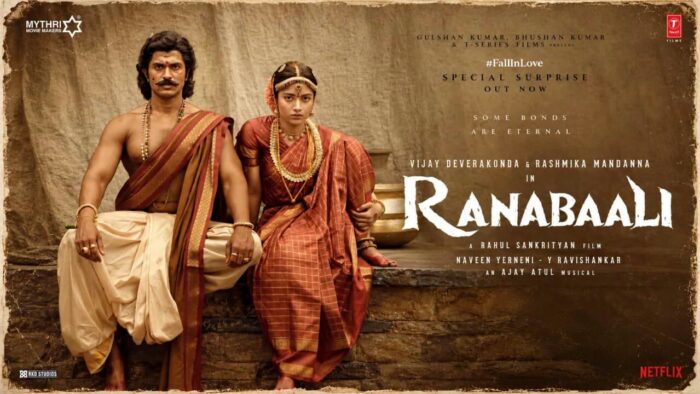
Directed by Rahul Sankrityan
Written by Rahul Sankrityan and Pramod Tammineni
As someone who grew up in the region during the 80s and 90s, I found the worldbuilding of Ranabaali nothing short of an onslaught of nostalgia. The spatial memory is so precise that the village square of Singanamala in the movie feels almost identical to a certain square of Tadipatri where my relatives lived during my childhood, complete with the ancient temple ratham towering over the dust. The dialect, the customs, and the raw valour which remain a faint echo of erstwhile Vijayanagara, the film brought them all together choosing reverence over caricatures. The customs of Jaatara and annual Bali, Polikoodu, etc have been portrayed as is without the shadow of cliched (and unnecessary) reformistic messaging marring the narrative.
Beyond its sensory authenticity, the Ranabaali offers one of the most authentically Indian takes on the Hero’s Journey on celluloid. Moving distinctly away from Joseph Campbell’s reluctant hero, typical of western monomyth, the storyteller behind Ranabaali presents a true-blue Indian son-of-the-soil arc: a primal evolution from Pashu (the brute beast) to Pashupati (the divine lord of all creatures). Vijay Devarakonda ceases to be just an actor here; he becomes a vessel, manifesting this intense spiritual transformation with visceral gravity, just as the character Ranabaali becomes a medium for the mystical Bhadra Mallanna and Potharaju.
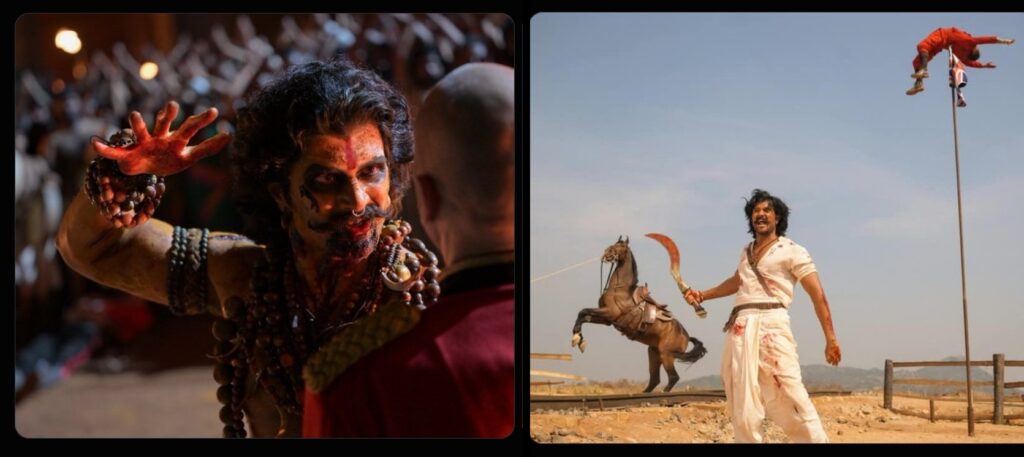
(The hero’s journey from Pashu to Pashupati, where primal fury finds its divine purpose)
This internal metamorphosis of the male protagonist is brilliantly catalysed by the character of Jayamma. As the unapologetic bride who refuses the ‘beast’, Jayamma serves as an uncompromising mirror. She forces him to confront his reality at precisely the right moment, stripping away his primal defence mechanisms to unlock the leader within. Rashmika Mandanna puts a series of navarasas into motion here as Jayamma’s own reflection of Ranabaali transform from Bībhatsa to Adbhuta, making way for Śṛṅgāra.
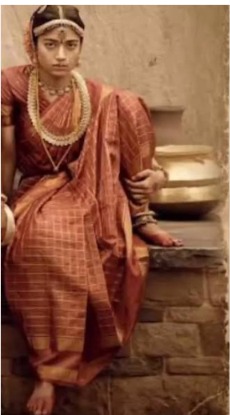
(Jayamma, the unapologetic bride, becomes the mirror that awakens the leader in Ranabaali)
When the microcosm of Ranabaali’s village collides with the macro-crisis of the Madras Famine, the narrative escalates dramatically (Much has been said about the historical context of the story. Hence, I choose to focus on the storytelling). The chance call of crisis places our village hero at direct odds with the cold, extractive cruelty of the East India Company. Perhaps, the exposition taking three of the six or seven acts before the inciting conflict takes place has made some viewers view the first half as slow. But the native of Rayalaseema in me enjoyed every moment of this exposition.
The story is set in the background of the Madras Famine of 1876-78. The picturization of the famine hits painfully close to home. Having witnessed my own family’s transition from an agrarian life to an urban one during the 80s and 90s, the portrayal of agrarian uncertainty felt intensely real, compounded in the film by a drought-driven disaster weaponized by colonial grain-looting.
The storytelling refuses to gloss over the horrors of the famine fallout:
We see the harrowing scenes of desperate migration of small farmers who end up constructing Railway infrastructure for the British, unknowingly accelerating their own impoverishment, for the railways was only constructed to transport the already scarce grain to Madras port and then to Britain.
We see a teenage girl numbly entering a lecherous Nawab’s harem just to secure half a sack of grain for her starving younger brothers as her father breaks inside.
We see scores of dying elders and emaciated women.
This reaches a heart-wrenching crescendo in the unbearable visual of an infant suckling at the breast of its deceased mother. Confronted with this sheer magnitude of human suffering, Ranabaali’s war against the British ceases to be a personal vendetta—it becomes an inevitable call of destiny.
While the director does not sanitize the brutality of the conflict, the artistic choices behind the depiction of that violence elevate it into something sacred. The action sequence inside the Belum Caves stands out as a breathtaking tribute to the spirit of the Sanyasi Rebellion, driven by a thunderous, high-energy rendition of the Shiva Chamara Stotram. Another subtle message that war for a larger cause is always fought with a renunciate mindset and not a bloodthirsty mindset.
As the narrative complication reaches its fever pitch in a near-supernatural confrontation, where the antagonist’s head symbolically replaces the ceremonial sacrifice, I was left awe-struck not just by the spectacle, but by the profound philosophical and spiritual journey that brought us there.
A special moment that struck me which is worth mentioning is the confrontation at Madras port where the protagonist in his raw rage, vows to make the British Officer, his Queen and her tribe lay flat on the ravines of Puttaparthi. This rather poetical insertion made me smile as the place later in history became a major spiritual centre drawing reverent crowds from the western part of the world as well.
The multi layered narrative with its reverence to the locale and what defined it, brings a welcome change to the caricature that the larger Telugu film world made out of Rayalaseema region. If one contrasts Ranabaali with a film set in similar space and time, like Sye Raa (based on the legendary warrior Uyyalawada Narasimha Reddy and a well-made one), the makers of this film stayed boldly loyal to the dialect of Rayalaseema Telugu instead of giving into the commercial filmy Telugu. And that boldness elevates the work to a piece of art than being a mere commercial craft.
The fact that the whole story is narrated as a Burrakatha, a celebrated folk art of storytelling makes the world linger in the viewer for long. The story of Gadekal Bobbili Nagireddy, main inspiration for the character of Ranabaali apart from Budda Vengal Reddy and Uyyalawada Narasimha Reddy is largely preserved in the oral tradition of Burrakatha. The tribute to the content and the art form feels fitting as opposed to the commercial approach of a background narrator. The music by Ajay-Atul resonates with this grounded vibe.
Ranabaali is an epic of soil, suffering, and sacred fury, an emotion that lingers long after the screen shuts down. What stays back is the reminder that this intense, unyielding spirit is what we want to retain within us as we uncover forgotten pieces of our history.
Disclaimer: The opinions expressed in this article belong to the author. Indic Today is neither responsible nor liable for the accuracy, completeness, suitability, or validity of any information in the article.


 [1]