The festival of Karthigai Deepam, one of the oldest festivals observed predominantly among the Tamil people across the world, falls in the Tamil month of Karthigai[1]. It is celebrated on that day of the Karthigai month, when the Krittika[2] star coincides with Pournami[3]. Observed a few weeks after Deepavali’s dazzling display of light and fireworks, this is another festival of lights, redolent in the ancient charm of beautiful earthen lamps quietly lighting up homes, streets and temples. Like its grander predecessor, this festival also carries forward the timeless message of the eternal victory of Light over darkness. Let us have a brief look at the ancient history of Karthigai Deepam, along with the associated legends and stories.
The Legend of the Infinite Pillar of Fire or Light
The best-known legend associated with the festival recounts a story involving all the Trimuthis – Bhagavan Brahma, Vishnu and Siva. According to legend, Bhagavan Brahma and Vishnu had a conflict about who was the greater of the two. To settle this conflict among the greats, Lord Siva appeared before them as Lingodbhava or the Infinite Pillar of Fire and challenged them to find the Pillar’s limits. Bhagavan Vishnu assumed the form of a boar and descended into the earth to search for the pillar’s base, while Bhagavan Brahma ascended upwards, taking the form of a swan to search for its summit.
Though both of them searched for ages, neither could find what they were looking for – the pillar truly seemed limitless, with no beginning or end. They then finally realized that the pillar was Bhagavan Siva himself – who is formless and limitless, and is the ground of all beings. Karthigai Deepam celebrates the day in which Bhagavan Siva revealed himself as the Infinite Pillar of Fire or Light.
In a popular version of the legend, Bhagavan Siva also molded the pillar of fire to create the sacred hill of Arunachala, which is located at the town of Tiruvannamalai in modern day Tamil Nadu. To this day, this hill is worshipped as the very embodiment of Bhagavan Siva by thousands of devotees. The name Arunachala itself means “the mountain of red-dawn fire”. To commemorate the divine act of Bhagavan Siva revealing himself as the Pillar of Light, a Maha Deepam[4] is lit, each on the summit of the Arunachala Hill on the day of the Karthigai Deepam festival.
The Legend of Shri Murugan and the Krithika Stars
The name of the festival is derived from this equally popular legend. According to this story, Bhagavan Siva’s third eye emitted six divine sparks, which were carried by Bhagavans Agni[5] and Vayu [6] to the celestial lake of Saravana Poigai. Six beautiful infants were born out of the sparks, which were nursed and cared for by the six stars of the Krithika[7] cluster. In a moment of Divine Motherhood, Devi Parvati, the consort of Bhagavan Siva embraced the six infants, fusing them into the six faced Kuzhandhai Deivam[8]; Arumugan[9] or Murugan. The day of this divine manifestation is tied to the day of the Krithika Star of Karthigai month and is remembered and celebrated alongside the legend of Bhagavan Siva and the Pillar of Fire.
The two different legends reveal two different faces of the Divine. The Pillar of Fire illustrates Bhagavan’s limitless nature and serves as a reminder that our individual egos cannot measure up to Him. The birth of Shri Arumugan from the sparks from his third eye, on the other hand, reveals His innate warmth and compassion. The lamps lit during this festival reflect both these natures of the Divine – the light reflects reverence and awe for Bhagavan, while their warmth reminds us of His compassion.
Let us now explore references to this ancient festival in puranic texts and literature.
References in Ancient Literature
The practice of celebration by the communal lighting of lamps is determined to be about two thousand years old. This is because the festival finds mention in the ancient Tamil Sangam text of Ettuthokai. Ettuthokai or The Eight Anthologies is one of the other two major collections of Sangam literature, the other being Patthupaatu (The Ten Idylls). Together, the two collections provide a window into the lives of the ancient Tamil people – by offering glimpses into everyday life, agriculture and trade, social customs and traditions and religious practices, among other things. Specific references to the Karthigai Deepam festival can be found in the Akananuru anthology of the Ettuthokai – Verses 141 and 185 describe the celebration by communal lighting of lamps during the month of Karthigai.
Post-Sangam period works such as those by the Tamil poet Avvaiyar or by the Jain poet Thiruthakka Thevar, are also known to contain references to the festival. Most scholars consider this continuity of mention as evidence of the festival’s long history in Tamil culture. Let us now look at how the festival is celebrated at the town of Tiruvannamalai, home to the sacred Arunachala Hill.
Karthigai Deepam at Tiruvannamalai
At the town of Tiruvannamalai, home to the sacred Arunachala Hill and the famous Arunachaleshwarar temple, located at the foot of the hill, Karthigai Deepam is not a one-day affair. Rather, it stretches across many days of the Karthigai month, beginning with a ten-day Brahmotsavam,[10] during which the temple deities are taken in processions through the surrounding streets on their vahanams[11]. Townspeople and outsiders gather in large numbers to have a darshan[12] of the deities.
Bharani Deepam and The Maha Deepam
On the day of the festival, inside the sanctum of the Arunachaleshwarar temple, before dawn, a single flame known as the Bharani Deepam is kindled. This is done while the moon is still associated with the Bharani Nakshatram, which precedes the Krittika Nakshatram, the actual festival star. From this flame, five lamps are lit which are carried through the temple precincts. Devotees associate the five lamps with the Panchaboothas[13]. This is especially significant since Tiruvannamalai is regarded as the Agni Sthalam (shrine of Fire) w.r.t. the Panchaboothas. The Bharani Deepam is preserved throughout the day and is associated with the lighting of the Maha Deepam on the summit of the Arunachala Hill at sunset.
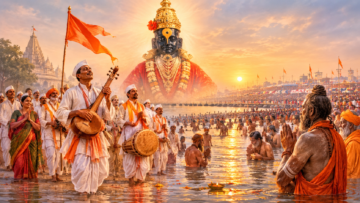
The festivities come to a grand climax at sunset with the lighting of the Maha Deepam at the summit of the Arunachala Hill. As the day comes to a close, a giant beacon fuelled by ghee is lit, creating a huge flame, which is visible across a large area surrounding the hill. In recent times, this event is also being telecast live on Television and Internet platforms like YouTube, so that devotees located outside the town may witness it. For the devotees, the Maha Deepam symbolizes Bhagavan Siva’s manifestation as Lingodhbhava.
The Bharani Deepam is intimately linked to the Maha Deepam. Together, the two rituals weave a visual story of illumination beginning with the light kindled within the devotee’s heart (the Bharani Deepam), and culminating in a magnificent spectacle that symbolically lights up the world beyond (the Maha Deepam).
Girivalam
Of late, the practice of circumambulating the sacred hill of Arunachala has gained traction among visitors and pilgrims alike. Since the hill is a manifestation of Bhagavan Siva himself, devotees perform the 14 km journey around it on foot, completing a Pradhakshina[14]. On the evening of the Maha Deepam, the circuit around the hill is thronged by thousands of devotees performing the Girivilam. The light from the Maha Deepam, together with the light from Deepams lit in the surrounding town and the streams of devotees around the Arunachala Hill combine to create a grand, visual and divine spectacle.
Let us now take a look at how this festival is celebrated across households.
Household Celebrations
As indicated earlier, this is one of the earliest known communal festivals celebrated across the Tamil population – the festival has been referred to as Peruvizha (The Great Festival) in later Tamil literary works, emphasising its importance and scale. Historically and through the ages, the festival has been celebrated by illuminating homes and surroundings with oil lamps, creating an atmosphere of festivity, devotion and joy. Even in modern cities and towns, people use earthen lamps to light up their homes and where possible, common areas like apartment lobbies, balconies or porches.
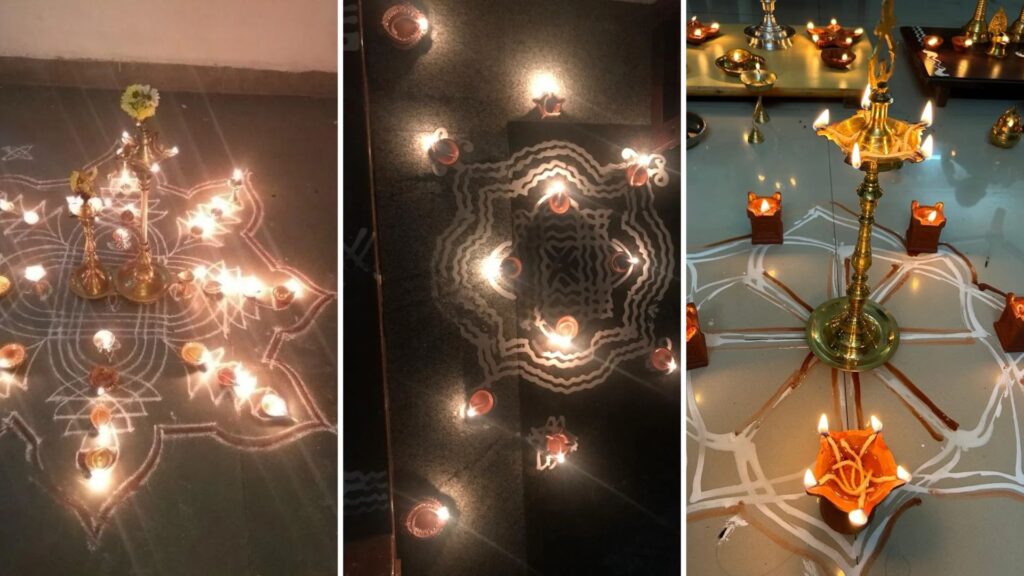
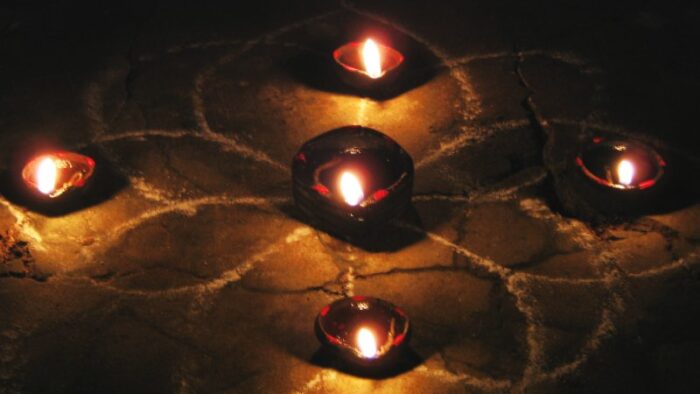
(Figure 1: Kolams decorated with Lamps)
Homes are cleaned and decorated as a preparation for the festival. Beautiful and creative Kolams (Rangolis) and a thoranam (string) of Mango Leaves adorn the entrance of homes. From the afternoon onwards, lamps are brought out, cleaned, decorated with Chandanam [15] and Kumkumam [16] and prepared by adding oil and placing wickers in them. Sweets and snacks such as Karthigai pori, aval (Sweets made using jaggery syrup and puffed rice), appam (Sweet made using jaggery syrup and rice), and Karthigai Adai (Savory pancakes made from a mix of rice and dal) are prepared for Neivedhiyam.[17]
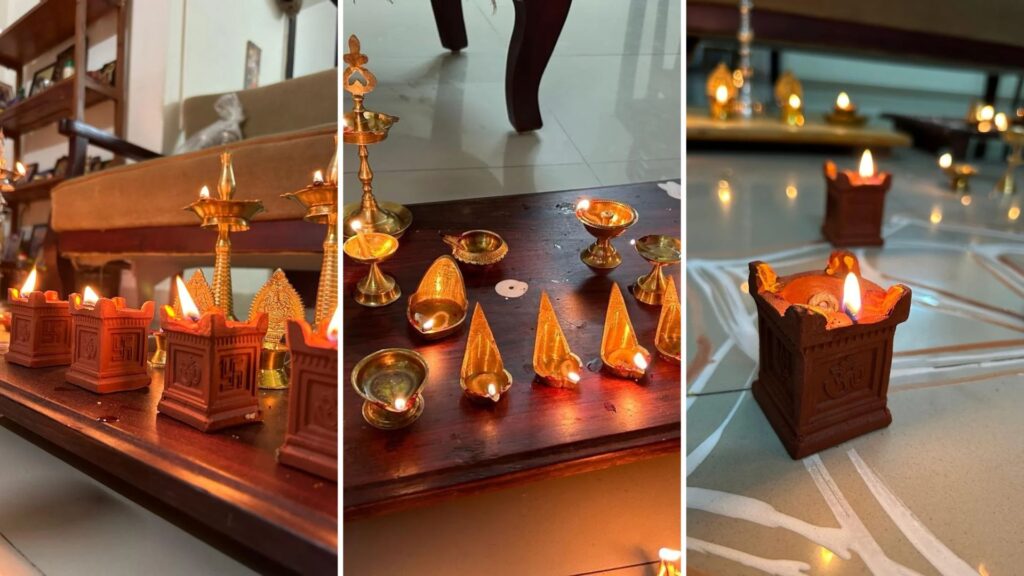
(Figure 2: Lamps lit as part of the celebration)
Every year, during the day of the Karthigai Deepam festival, around dusk, the Maha Deepam (great lamp) is lit atop the sacred Arunachala hill, as described above. Many households light their prepared lamps after the Maha Deepam is lit, symbolically adding to the Divine Pillar of Fire. Entire families gather together for the celebration – they light all the lamps, offer prayers and Neivedhiyam to the lit lamps and then arrange them in beautiful patterns across the house, doorsteps, courtyards, windowsills, balconies and the Puja room. The Prasadam is then enjoyed with family, friends and neighbours.
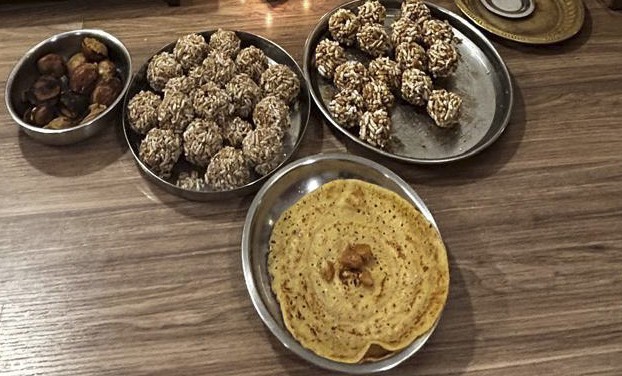
(Figure 3: Neivedhiyam prepared for the festival)
Together, the Bharani Deepam, the Maha Deepam and the humble household lamps weave a powerful story of illumination. They symbolize the ancient messages of the triumph of light over darkness, knowledge over ignorance and good over evil. This festival’s popularity through the ages leads us to one enduring lesson – even the smallest spark of light has the power to dispel profound darkness.
Om Arunāchaleśvarāya Namaḥ.
Murugā, Saraṇam!
Footnotes
[1] The eighth month of the Tamil calendar (November-December), named after the Krittika (Pleiades) star cluster.
[2] The third of the twenty-seven Nakshatrams (lunar mansions) in the Ancient astrological tradition.
[3] The full-moon day in the Lunar Calendar.
[4] A grand beacon or lamp.
[5] Divine manifestation of the Panchabootha Fire.
[6] Divine manifestation of the Panchabootha Wind.
[7] Pleiades star cluster in the constellation of Taurus in modern astronomy.
[8] Child deity
[9] The Six-Faced One.
[10] A major annual temple festival involving elaborate rituals and processions.
[11] Animal Consorts
[12] Sacred act of viewing a Deity
[13] The five primordial elements of Ancient Cosmology – earth, water, fire, air, and space.
[14] The sacred act of going around a shrine in the clockwise direction.
[15] Sandalwood paste
[16] Sacred Vermillion Red Powder traditionally used in Puja
[17] A ritual offering of food to a deity during worship, later distributed as prasadam.
References
- The History and Legends of Karthigai Deepam – Karthigai Deepam History & Story: Origin of the Festival
- Tamil Nadu Tourism Department, Karthigai Deepam – Karthigai Deepam | Festivals in Tamil Nadu
- Tiruvannamalai Temple Guide, Tiruvannamalai Temple Festivals – Tiruvannamalai Temple Festivals — Deepam & Girivalam
- Arunachalam Temple, Karthigai Deepam at Tiruvannamalai- Karthigai Deepam Tiruvannamalai: Maha Deepam Guide
- Wikipedia, Karthika Deepam – Karthika Deepam – Wikipedia
Feature Image Credit: Wikicommons
Disclaimer: The opinions expressed in this article belong to the author. Indic Today is neither responsible nor liable for the accuracy, completeness, suitability, or validity of any information in the article.