
Dusshera or the Sharad[1] Navaratri is the longest and arguably the biggest festival, lasting ten days, celebrated across Bharata in vibrant, joyous and colorful ways. Over the past few years, I have been intrigued to discover that this festival is celebrated in different regions in markedly different ways, though it is observed on the same Calendar days throughout the country. Also, there are also many lesser-known traditions and folk tales associated with each locality. In this article, I will attempt to detail the ways in which the festival is predominantly celebrated in the South, West, North and Eastern regions of Bharata. I will also try to bring out the commonalities among them, highlighting the maxim of “Ekam Sat Vipra, Bahudha Vadanti” from the Rig Veda.
Ekam Sat Vipra, Bahudha Vadanti
This celebrated verse from the Rig Veda roughly translates to “Truth is One, the wise call it by many names.” It urges us to acknowledge the oneness or unity of the ultimate or supreme reality of Bhagavan while acknowledging his many forms and expressions. This is equated to the much-celebrated principle of “Unity in Diversity” across Bharata – it affirms that all deities and spiritual paths are manifestations of the same truth. It encourages respect for different traditions, rituals and names of Bhagavan and is echoed in the Upanishads and the Advaita philosophy as the principle of One Brahman. The verse was also quoted by Swami Vivekananda in his much-celebrated speech in the 1893 Parliament of Religions.
In this article, I will attempt to bring out another illustration of this principle – by highlighting how Navaratri, one of the biggest festivals of our land, is celebrated in different ways, in different regions. Next, I will draw out the commonalities and core principles across the celebrations.
The South Indian tradition of Gombe Habba[2] or Bommai Kolu[3]
Across the South Indian States of Karnataka, Andhra Pradesh, Telangana and Tamil Nadu, it is a fairly common practice in temples and homes to arrange dolls and figurines (bommai or gombe) in a multi-layered display across the nine days of Navaratri. This is not an aesthetically pleasing display alone; it has a profound mythological, spiritual and historical significance as we shall note in the sections below.
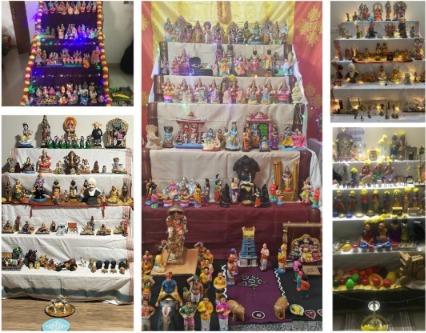
(Figure 1: A few Bommai Kolu Displays)
A puranic origin story – the Devas’ sacrifice.
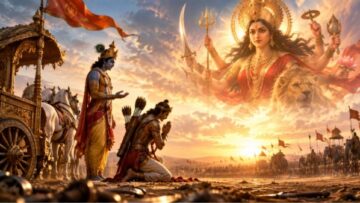
This story, rooted in the Devi Mahatmyam[4], is the most prominent origin story of the Navaratri festival itself. According to the ancient text, the fierce demon Mahishasura acquired a boon that made him invincible to any man or God. In a bid to save all of creation, the supreme Trinity – Brahma, Vishnu and Shiva joined forces to create the supreme Devi Mahishasuramardini (Durga). To empower her to face Mahishasura in an epic battle, all the lesser gods and goddesses or Devas voluntarily surrendered their divine weapons, energies and weapons to her. The tiered arrangement of the Kolu is said to symbolize this sacrifice of the Devas – they literally stood still like toys to enable Devi Durga to restore the divine cosmic order, by defeating Mahishasura in an epic battle.
The spiritual and philosophical connection – the journey of a soul.
Kolu typically requires building an odd number of steps or tiers – 3,5,7, 9 or 11. This is said to symbolize the evolutionary journey of the soul. It is usually arranged in a hierarchical fashion-
- The lower tiers are reserved for dolls depicting everyday human existence – like vendors (eg. The Chettiar[5] shopkeeper dolls), farmers, musicians, laborers or weddings. The lowest of the tiers are populated with birds and animals.
- The middle tiers are dedicated to enlightened saints, gurus (e.g. Shri Adishankara and Shri Guru Raghavendra), spiritual scholars and poets, and epic heroes who bridge the gap between humans and the divine.
- The top tiers are reserved for supreme deities like Bhagavan Shiva and Maha Vishnu and Devis Durga, Lakshmi, Saraswati.
The story a set of Kolu steps represents is highly symbolic. It visually represents the journey of a human soul as it transcends to higher layers of consciousness through the practices of Dharma[6] and Bhakti[7].
A bit of history of the tradition
The practice of displaying dolls during Navaratri was popularized by the Vijayanagara Empire in the 14th Century. The word Kolu itself hints at a king holding a royal court (Bommala koluvu in Telugu roughly translates to a “court of dolls”). Kings of the empire used the Navaratri festival to showcase prowess and agricultural wealth by commissioning highly talented artisans for the creation of the dolls, often resulting in elaborate displays. The practice then seems to have extended into the royal courts of Tanjavur and Pudukottai, finally finding its way to ordinary households.
Overall, the Kolu display acts as an ancient visual story book – many households curate story telling zones which usually feature a story or a famous incident from an epic like the Mahabharata. Eg. The childhood leelais of Bhagavan Shri Krishna form a major part of many Kolus. The Dashavatharam is another common doll set featured. The Kolu is revered and worshipped as part of the house’s Pooja room or Mandir – it is decorated each day with flowers, lamps are lit, a kolam is drawn and Neivedhyams[8] are prepared and offered both in the mornings and evenings. Most households also invite neighboring ladies for thamboolam[9]. The visits are usually accompanied by prayers, songs and prasadham[10], resulting in a festive neighborhood gathering.
Next, let us explore some more famous Navaratri festival traditions from our Eastern states.
Garbi and Garba
While Garba evokes images of energetic, festive dancing in colorful attire, many households across Gujarat setup the sacred Garbi during Navaratri.
Origin and setup
The term Garbi is explicitly derived from the Sanskrit word Garba which means womb. Gujarati folklore tells us that before Devi Durga embarked on her nine-day battle with Mahishasura, she contained the absolute energy of the universe unmanifested within herself. To represent this, a small clay pot is perforated with holes and a single source of light (a Deep[11]) is placed inside. This is known as the Garba Deep or Garbi. The clay or earth signifies the human body/earth, the holes signify the stars and planets of the cosmos, while the inner flame represents the pure unchanging soul of the Devi.
Tradition
Families keep this glowing clay pot on a pedestal surrounded by a circle of wheat grass grown over the nine days. The pot is worshipped with an Aarti[12] every evening before the commencement of dancing and community feasting.
The Garba dance
The dance is traditionally performed with the dancers moving in a counter clockwise direction in concentric circles, around the Garba Deep or the image of the Devi. The unmoving lamp in the center, represents Devi – the absolute, ultimate truth. The dancers moving around in circles represent the eternal cycle of Samsara– including birth, life, death and eventual rebirth. The dance reminds us that while the world around us continuously changes, shifts and spins, the divine truth at the center, the supreme reality represented by the Devi, remains unchanged.
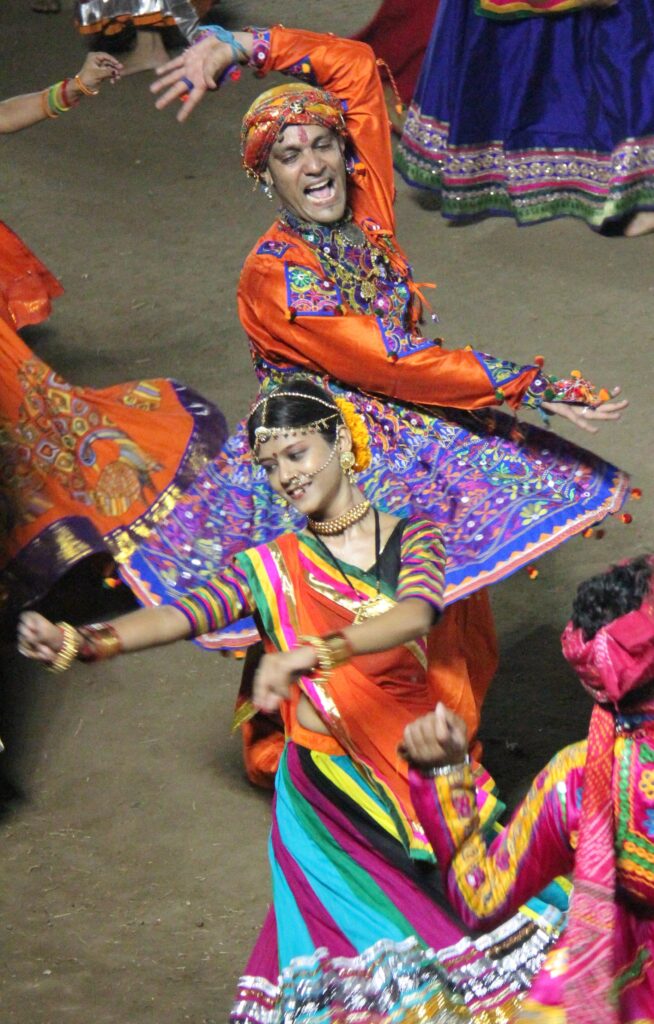
(Figure 2: Image Credit: Wikicommons, Garba Dance of Gujarat)
Traditional Garba is performed purely with hands and feet, utilizing Taali (rhythmic clapping), sweeping arm gestures and bending. This is distinct from Dandiya Raas, which uses traditional decorated wooden sticks or dandiyas clacked together in pairs.
Moving on, let us look at how some of our Northern states celebrate the festival.
Uttar Pradesh and Ramlila
In the Northern states of Bharata, especially Uttar Pradesh, the festival splits its devotion between the fierce energy of Devi Durga and a celebration of the righteous life of Bhagavan Shri Rama. Hordes of people come together under the night sky to watch theatrical adaptations of the ancient epic of Ramayana.
Ramlila: A Grand Tradition
The cities of Varanasi, Ayodhya and Vrindavan come alive with actors donning traditional costumes, elaborate masks and make up as they enact scenes out of the epic for the 9-10 nights of Navaratri. Based on the Ramcharitmanas by Tulsidas, the scripts are divided into daily episodes, moving sequentially through the life of Shri Rama. While the daily episodes draw out devout members of the audience, specific episodes act as massive crowd pullers. Some big hits include the dramatization of the episodes of Sita Swayamwar[13], Lanka Dahan[14] and of course, Ravan Dahan[15] on the day after the nine days of Navaratri, Vijayadashami.
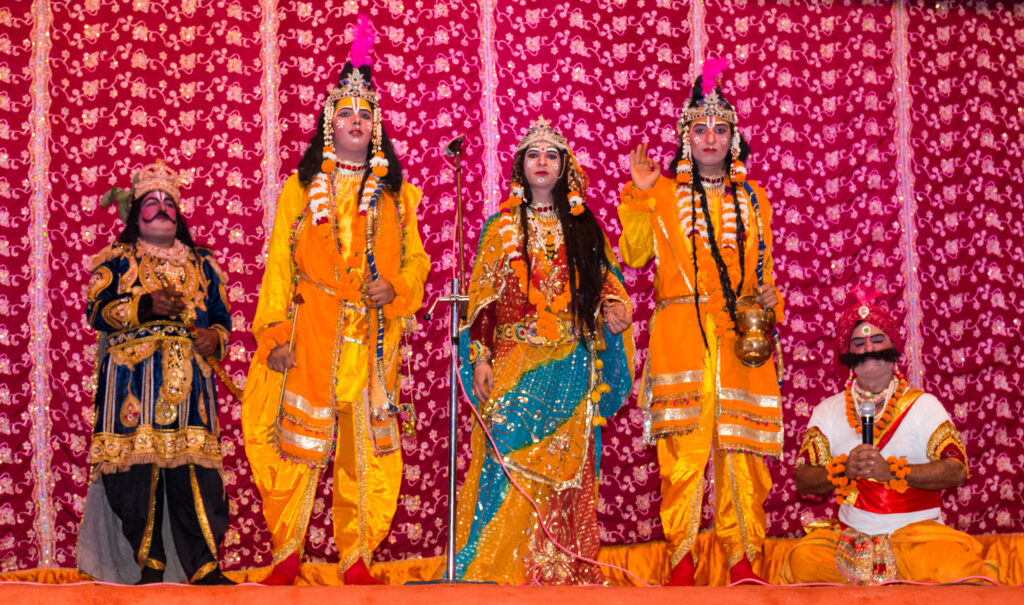
(Figure 3: Artists Playing Ramayana character in a Ramlila fair)
Ritualistic preparation: invoking the divine
The performers of a traditional Ram Lila are usually not full-time professional actors; they are instead chosen from the local community. The cast is made of local volunteers of all age groups depending on the role. Specific roles like the Svarupas[16]
are played exclusively by young pre-pubescent brahmin boys, chosen for their purity. The Vanar sena is composed of local neighborhood children. Irrespective of their roles, the core actors undergo extensive training in voice modulation.
The core actors also have to take up strict vows – for 10-30 days before and during the performance, they completely abandon their normal lives – they sleep on the floor of the green room, practice celibacy and consume only strictly vegetarian sattvik[17] food. The preparation for each performance itself is elaborate – often taking place in 4–5-hour windows. The climax of the preparation for the Svarupas happens when the actor is completely dressed except for the Mukut (crown). In a divine ceremony, the head priest chants mantras, performs an aarti and finally places the Mukut on the actor’s head. The actor is then no longer considered human; he is now a divine incantation of the role he represents. Before stepping onto the stage, the actors are also carried around in the festival grounds on chariots or on the shoulders of volunteers, allowing the gathered audience to have a darshan[18].
After each performance a separate set of rituals are conducted to mark the descent back into ordinary life. The final scene of each night always closes with a grand public aarti on stage. Hundreds of audience members line up to gather the blessings of Bhagavan, who has descended upon the actors. Back in the green room, the priest ritualistically removes the Mukut of each divine actor and carefully stores them away. Only then can the actor return to normal life.
Ravan Dahan
The ceremony of burning Ravana on the tenth day serves as the grand, theatrical climax of Dusshera, the day of Vijayadashami; this marks the absolute conclusion of the multi-day Ramlila plays. The giant effigy of Ravan is constructed long before the 10th night by highly skilled artisans. Traditionally the skeletons of the effigies are made from eco-friendly, flexible bamboo poles along with supporting layers of newspapers and gunny bags. The inside of the hollow structures is packed with clay pots filled with mixtures of firecrackers, sparklers and colored smoke bombs.
The final act occurs on the main stage as the actors playing Rama and Ravana engage in their final, high-energy dialogue and sword fight. The climax occurs when the actor playing Rama lifts a specialized bow, pulls back a flaming arrow and aims it directly at the towering effigy of Ravana. The effigy erupts in a deafening symphony of cackles and cheers and collapses into a heap of ash.
This ritual carries significant spiritual and cultural meaning. The ten heads of Ravana represent ten negative human emotions – Lust (Kama), Anger (Krodha), Delusion (Moha), Greed (Lobha), Pride (Mada), Envy (Matsarya), Selfishness (Swaratha), Injustice (Anyaaya), Cruelty (Amanavta), and Ego (Ahankara). The burning of the heads, represents an individual’s inner journey as he or she strives to overcome them. Also, the fire itself is viewed as an ultimate purifier – cleansing the community and restoring a new cosmic order (Dharma) to welcome the autumn season.
Apart from the Ramlila, the day of Ashtami (8th day) also holds special significance in the northern states.
Kanya Puja
Across the states of Punjab, Haryana, Delhi, Himachal Pradesh and Uttar Pradesh, the eighth day of Navaratri (Maha Ashtami) is defined by a beautiful, deeply emotional ritual known as Kanya[19] Puja. On this morning, families welcome young girls into their homes, treating them not as children but as the physical, living embodiments of Devi Durga. A sattvik Bhog (feast) made of puris, kala chana and sooji[20] halwa is prepared and offered first to Devi Durga and then to the young girls.
Families usually invite nine young girls between the ages 2 and 10 and a young boy of the same age from the neighborhood. The girls represent the 9 cosmic forms of Durga while the boy represents Langura or Batuk Bhairava, Lord Shiva’s protective guardian, who must accompany the Devis. The children are welcomed by a ceremonial Pakhalan (feet washing) and are seated in a row of Aasan (clean cloth runner) laid out on the floor. The host applies a tilak (mark) on their foreheads using vermillion and rice and then performs an aarti for the children. The children are then served the meal. Once fed, they are given a Dakshina (token amount of money) along with a gift item. The ceremony concludes when the adult host touches the little girls’ feet asking them to bless the household with peace and protection, before sending them on their way.
Let us now look at one of the most vibrant and colorful celebrations of the festival – the Durga Puja tradition from West Bengal.
Durga Puja
In West Bengal, Durga Puja or Pujo is much more than just a festival – it represents a grand Carnival of community bonding, generous gastronomy and public performances. The festival spans five main days (Shashti[21] to Dashami[22]) and transforms the entire state into an open-air art gallery.
A daughter’s homecoming
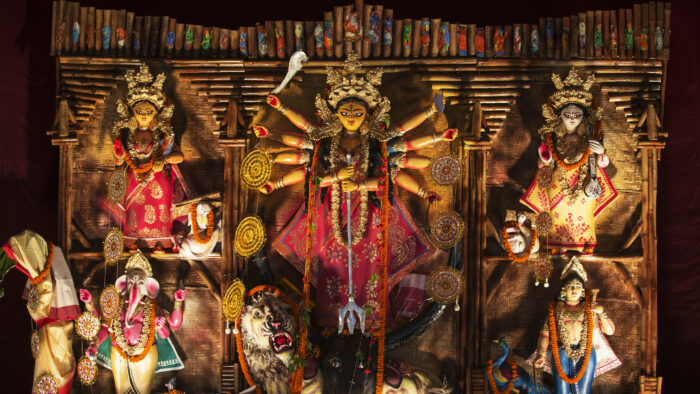
Aside from the legend of Devi Durga and the battle against Mahishasura, there is a tradition unique to Bengal. In the state, Devi Durga is not treated as a divine ruler, but as a beloved daughter. The festival marks her annual four-day homecoming to Earth from her celestial abode bringing along her four children – Lakshmi, Saraswati, Ganesha and Karthikeya. Most pandals depict the Devi in the center as a colossal figure, with the other gods and goddesses mentioned above as smaller figures flanking her, showcasing the mother-daughter relationship.
The tradition also signifies and celebrates the homecoming of a wedded daughter to her paternal home along with her children.
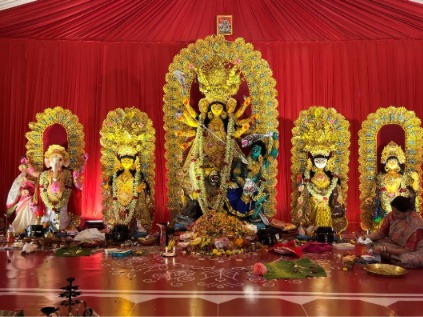
(Figure 4: Devi Durga and her children inside a Pandal)
Religious practices and rituals
Many rituals make up the period between Saptami and Dashami-
- A week before the main festival, Chokku Daan is performed by senior artisans – this is the ritual of painting the Devi’s eye, symbolically infusing the idol with life.
- Before sunrise on Saptami, Kola Bou Snan is performed – a young banana tree representing the vegetative energy of the goddess, is bathed in the Hooghly River, draped in a red bordered white saree and placed next to Ganesha as his bride.
- On Maha Ashtami, devotees wear traditional attire and offer Pushpanjali to the Devi. This culminates in the Sandhi Puja which marks the transition window between Ashtami and Navami. During this period, devotees and priests together honor the Devi’s victory over Mahishasura by lighting 108 lamps, offering 108 lotus flowers and chanting powerful mantras.
- On VijayaDashami, Sindhoor Khela, is celebrated by married ladies – they smear Devi’s face with vermillion and then they apply it to each other in a joyous ritual, wishing each other marital bliss and a long life.
Community Practices
- Pandal Hopping – Temporary structures erected from cloth, bamboo and plaster called Pandals house the Devi and the other gods and goddesses. Pandals usually recreate well known monuments or address socio-cultural themes. Eg. A modern Pandal could recreate Shri Rabindranath Tagore’s house. They attract people in large numbers, who queue up to glimpse the Devi.
- Dhunuchi Naach – This is a high-octane traditional dance set to the hypnotic rhythm of the Dhak or traditional Bengali drums. In this dance, men and women balance clay pots filled with burning coconut husks and fragrant husks (dhuno) in their hands or teeth and execute a frenetic dance before the Devi.
- Bhog (Culinary feast) – The Bhog is a sacred community meal served in the afternoons consisting of Kichuri, Labra and Payesh[23]. It is a sattvic meal and is served as a Prasad to the community after first being offered to the Devi on the days of the Puja.
- Bisarjan – This ritual marks the culmination of the festivities. After the performance of a few rituals by the priest and the accompanying married women, the Devi and her children are immersed into a lake or pond. The Bisarjan is immediately followed by the Sindhoor Khela ritual.
Now that we have seen how four different regions across Bharata observe the festival, let’s look at the commonalities between the celebrations and traditions.
Bridging diverse traditions – common themes and practices
- The core theme of Good Over Evil – Every single of these festivities celebrates the victory of Dharma (righteousness) over negative or wicked forces. The Bommai Kolu, Garba and Durga Puja embody this theme by celebrating the victory of Devi Durga over the demon Mahishasura. The Ram Lila meanwhile, celebrates the victory of Bhagavan Shri Rama over the Asura king Ravana.
- Reverence for the Divine Feminine (Shakti) – The underlying devotional energy across these festivities is centered on Shakti – the divine Devi. While Durga Puja centers entirely on the Devi, the Garbi represents the divine womb and the highest step in the Bommai Kolu is reserved for the Devi. Even in the Ramlila, Shri Rama’s victory is attributed to his intense Chandi Path (worship of Devi Durga) before the final battle.
- Storytelling and Public Performance – Each of these festivals serves as a medium for passing down epics and folklore from one generation to the next. Artistic displays during Durga Puja, devotional and rhythmic dances during Gharba, the theatrical performances of Ramlila and the doll display in Bommai Kolu that recreate scenes from the epics strive to accomplish this.
- Community bonding – Pandal hopping during Durga Puja, open air dancing during Gharba, community gatherings at Ramlila maidans and the tradition of inviting neighbors for thamboolam during Bommai Kolu all embody the spirit of community bonding by prioritizing the community over the individual.
- Final day or Vijayadashmi traditions – All four traditions culminate in a grand manner on Vijayadashmi or the tenth day – Bisarjan during Durga Puja, burning of the Ravana effigy in Ramlila, dimming of festival lights, marking the end of Gharba and putting a couple of dolls in the Bommai Kollu “to sleep” – laying the dolls down, all symbolize the completion of the festival.
Thus, the festival of Navaratri shows us the true meaning of the celebrated Rig Vedic verse of “Ekam Sat Vipra, Bahudha Vadanti” by embracing diverse, vibrant and colorful ways of honoring Shakti or the Divine Feminine. All the traditions honour Devi’s boundless power, celebrate the inevitable triumph of light over darkness, and dissolve social boundaries to bring communities together. Even as the drums quiet down, the effigies turn to ash, the clay dissolves back into the river, and the courtly dolls are carefully packed away until next autumn, they all leave behind the exact same enduring truth: goodness prevails, harmony sustains us, and the divine rhythm of life continues, united in spirit across every corner of the Bharata.
या देवी सर्वभूतेषु शक्तिरूपेण संस्थिता।
नमस्तस्यै नमस्तस्यै नमस्तस्यै नमो नमः॥[24]
Notes and References
[1] Autumn season in the Indian Calendar
[2] Doll Festival in Karnataka
[3] Doll festival in Tamil Nadu
[4] A key text within the Markandeya Purana which narrates the triumph of the Devi over various demons.
[5] A mercantile community from South India known for trade, finance and philanthropy
[6] Virtue
[7] Devotion
[8] A food offering to the deity
[9] A traditional offering to guests consisting of Betel leaves, areca nut and optionally fruit and gifts.
[10] Consecrated food offering, later shared among devotees.
[11] Traditional oil lamp usually made of clay or metal
[12] Traditional offering of light in worship
[13] Episode from Ramayana where Rama wins Sita’s hand by stringing Bhagavan Shiva’s bow.
[14] Episode from Ramayana where Shri Hanuman burns Lanka with his tail
[15] Ritualistic burning of Ravana’s effigy
[16] Consecrated children embodying deities in Ram Lila – often Sita, Ram, Lakshman and Hanuman
[17] Derived from Sattva, one of the three guṇas (qualities), meaning purity, harmony, and balance
[18] Sacred viewing of Bhagavan
[19] Maiden or young girl
[20] Semolina
[21] Sixth day of the Lunar Calendar
[22] Tenth day of the Lunar Calendar
[23] A Puja offering of rice, vegetables, and sweet pudding
[24] From Devi Mahatmyam – To that Goddess who abides in all beings in the form of Shakthi, my repeated salutations to Her.
- Wikipedia, Navaratri – Navaratri – Wikipedia
- Art of Living, How is Navaratri Celebrated in Different Parts of India – How is Navaratri Celebrated in Different Parts of India? | The Art Of Living Ghana
- Giri traders, Golu Dolls, Golu Dolls
- Brindaban Matri Mandir, Durga Puja Rituals Explained- Durga Puja Rituals Explained: A Simple Guide to the Sacred Traditions of Bengal | Brindaban Matri Mandir
- Narthaki, Connecting to Ramlila through its rituals – Prism – Connecting to Ramlila through its rituals – Sunil Sunkara
Feature Image Credit: IStock
Disclaimer: The opinions expressed in this article belong to the author. Indic Today is neither responsible nor liable for the accuracy, completeness, suitability, or validity of any information in the article.