
Bhishma had drawn up the Kaurava army.
Across Kurukshetra stood the Pandava forces. Chariots were in position, standards flew above the ranks, horses and elephants waited with the men. The battle was about to begin.
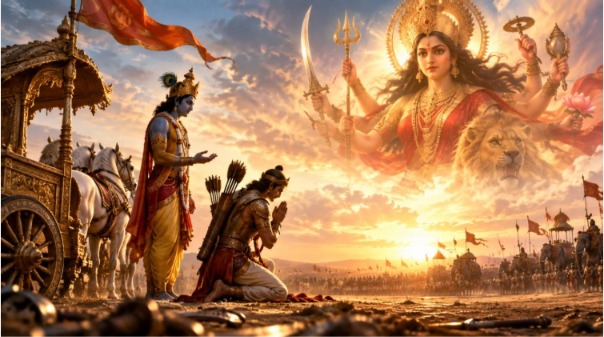
At this point, Krishna asked Arjuna to recite a stotra to Durga before taking up arms.
His instruction was unusual.
श्रीभगवानुवाच
शुचिर्भूत्वा महाबाहो संग्रामाभिमुखे स्थितः ।
पराजयाय शत्रूणां दुर्गास्तोत्रमुदीरय ॥
– Mahābhārata, Bhīṣma Parva 23.2, Gita Press recension
O mighty-armed one, purify yourself as you stand facing the battlefield. For the defeat of your enemies, recite the hymn to Durga.
The words leave little room for ambiguity: दुर्गास्तोत्रमुदीरय – durgāstotram udīraya. Recite the Durga Stotra.
Sanjaya tells Dhritarashtra what happened next:
संजय उवाच
एवमुक्तोऽर्जुनः संख्ये वासुदेवेन धीमता ।
अवतीर्य रथात् पार्थः स्तोत्रमाह कृताञ्जलिः ॥
– Mahābhārata, Bhīṣma Parva 23.3, Gita Press recension
Thus addressed on the battlefield by the wise Vasudeva, Partha descended from the chariot and, with folded hands, began the hymn.
So, for a few moments, Arjuna left the chariot.
Arjuna got down from the chariot and stood with folded hands on the battlefield.
Then he began invoking the Goddess by name.
अर्जुन उवाच
नमस्ते सिद्धसेनानि आर्ये मन्दरवासिनि ।
कुमारि कालि कापालि कपिले कृष्णपिङ्गले ॥
– Mahābhārata, Bhīṣma Parva 23.4, Gita Press recension
Salutations to you, leader of the hosts of Siddhas, noble one who dwells on Mandara; Kumari, Kali, Kapali, Kapila, Krishna-Pingala.
The next verse gathers still more familiar names:
भद्रकालि नमस्तुभ्यं महाकालि नमोऽस्तु ते ।
चण्डि चण्डे नमस्तुभ्यं तारिणि वरवर्णिनि ॥
- Mahābhārata, Bhīṣma Parva 23.5, Gita Press recension
Salutations to you, Bhadrakali; salutations to you, Mahakali. Salutations to you, Chandi, fierce one; to you, Tarini, radiant Goddess who carries one across.
Kali. Bhadrakali. Mahakali. Chandi. Tarini.
Arjuna continues:
कात्यायनि महाभागे करालि विजये जये ।
शिखिपिच्छध्वजधरे नानाभरणभूषिते ॥
- Mahābhārata, Bhīṣma Parva 23.6, Gita Press recension
O greatly blessed Katyayani, O Karali, O Vijaya, O Jaya; you who bear the peacock-feathered banner and are adorned with many ornaments.
Katyayani, Vijaya, Jaya – the names fit the hour. The two armies faced each other, and the battle had yet to begin.
The martial imagery grows sharper. The Goddess carries spear, sword and shield. Then comes a line that is particularly arresting when read during Durga Puja:
महिषासृक्प्रिये नित्यं कौशिकि पीतवासिनि ।
अट्टहासे कोकमुखे नमस्तेऽस्तु रणप्रिये ॥
– Mahābhārata, Bhīṣma Parva 23, Durgāstotra
O Kaushiki, clad in yellow, ever fond of the blood of the buffalo; you of the great laugh and fierce visage, salutations to you who delight in battle.
महिषासृक्प्रिये – mahiṣāsṛkpriye: she who delights in the blood of the buffalo.
For Bengalis familiar with the Durga Puja iconography of Mahishasuramardini, the reference to the buffalo is instantly recognisable. The same line appears in the version of the hymn I had first come across. A few verses later, the stotra takes up a different set of names and attributes.
त्वं ब्रह्मविद्यानां महानिद्रा च देहिनाम् ।
स्कन्दमातर्भगवति दुर्गे कान्तारवासिनि ॥
– Mahābhārata, Bhīṣma Parva 23, Durgāstotra
Among forms of knowledge you are Brahmavidya; among embodied beings you are Mahanidra. You are Bhagavati, Mother of Skanda, Durga who dwells in difficult and inaccessible places.
And immediately afterwards:
स्वाहाकारः स्वधा चैव कला काष्ठा सरस्वती ।
सावित्री वेदमाता च तथा वेदान्त उच्यते ॥
– Mahābhārata, Bhīṣma Parva 23, Durgāstotra
You are Svaha and Svadha; Kala and Kashtha; Saraswati. You are Savitri, Mother of the Vedas, and you are called Vedanta.
These two verses are worth reading twice.
The same Durga whom Arjuna has just called Kali, Mahakali, Chandi, Katyayani and raṇapriyā is now Brahmavidya.
She is Saraswati.
She is Savitri.
She is Vedamata.
She is Vedanta.
The names follow one another in Arjuna’s prayer.
Eventually Arjuna comes to what he has sought from her all along:
स्तुतासि त्वं महादेवि विशुद्धेनान्तरात्मना ।
जयो भवतु मे नित्यं त्वत्प्रसादाद्रणाजिरे ॥
– Mahābhārata, Bhīṣma Parva 23, Durgāstotra
O Mahadevi, I have praised you with a pure heart. By your grace, may victory always be mine on the battlefield.
There is something wonderfully direct about that prayer.
त्वत्प्रसादात् – tvatprasādāt.
By your grace.
Arjuna has Gandiva. Krishna himself is beside him. Yet standing before the armies of Kurukshetra, he asks the Goddess for victory.
His prayer is answered.
Durga appears in the sky.
Sanjaya records her assurance to Partha: his enemies will soon be defeated. Arjuna is Nara and Narayana is with him. With Krishna beside him, even Indra cannot defeat him. The older version of my article preserved the same sequence – Durga’s appearance, her assurance of victory, her disappearance and Arjuna’s return to the chariot.
Then comes a wonderfully abrupt line:
इत्येवमुक्त्वा वरदा क्षणेनान्तरधीयत ।
– Mahābhārata, Bhīṣma Parva 23.19, Gita Press recension
Having spoken thus, the boon-giving Goddess disappeared in an instant.
क्षणेन – kṣaṇena.
In an instant.
Arjuna had stepped down from the chariot to pray. He now climbed back onto it, assured of victory. Krishna was again at the reins. The two sounded their celestial conches.
The narrative moved on.
That is where the placement of this small episode becomes fascinating.
We normally approach the beginning of the Bhagavad Gita through another sequence: the armies assemble, the conches sound, Arjuna asks Krishna to take the chariot between the two forces, he looks across and sees Bhishma, Drona, relatives, teachers and friends. His certainty drains away. Gandiva slips. Krishna begins to speak.
In this recension of the Mahabharata, immediately around that famous threshold lies another scene.
Arjuna has already stepped down from the chariot once.
He did so to invoke Durga.
The Goddess in Arjuna’s Stotra
The names in the hymn deserve attention because they give us a remarkably crowded picture of the Goddess.
She is Kali, Bhadrakali and Mahakali.
She is Chandi.
She is Katyayani and Kaushiki.
She is Skandamata.
She is associated in another verse with Nanda’s cowherd family.
She is Brahmavidya, Saraswati, Savitri and Vedamata.
Later come Maya, Hri and Shri.
The hymn has no difficulty holding all these names together.
That becomes particularly interesting when one remembers that this is the Mahabharata, rather than a much later standalone Durga manual being retroactively read into the epic. At the very least, it tells us something about the communities through which this recension of the epic travelled and the Durga they knew.
There is physical manuscript evidence for that journey.
SAMHiTA lists two manuscripts titled Durgāstotra (Bhīṣma Parva of Mahābhārata) in the University of Pennsylvania collection. One is dated 1793 Śaka (1871 CE); the other is from the nineteenth century. Both preserve the episode of Krishna asking Arjuna to praise Durga on the battlefield, followed by the stotra and its phalaśruti.That last part – the benefits of recitation takes us beyond Kurukshetra.
What the Phalaśruti Promises
After Durga disappears and Arjuna returns to his chariot, the text turns to the future reciter.
य इदं पठते स्तोत्रं कल्य उत्थाय मानवः ।
– Mahābhārata, Bhīṣma Parva 23.21, Gita Press recension
The person who rises at dawn and recites this stotra…
The verses that follow describe what such recitation brings. Among them:
न भयं विद्यते तस्य सदा राजकुलादपि ।
विवादे जयमाप्नोति बद्धो मुच्येत बन्धनात् ॥
– Mahābhārata, Bhīṣma Parva 23.23, Gita Press recension
He has no fear, even from royal authority. In disputes he obtains victory; if bound, he is released from bondage.
Then comes a line I find particularly interesting:
दुर्गं तरति चावश्यं तथा चौरैर्विमुच्यते ।
संग्रामे विजयेन्नित्यं लक्ष्मीं प्राप्नोति केवलाम् ॥
– Mahābhārata, Bhīṣma Parva 23.24, Gita Press recension
He surely crosses difficulty; he is delivered from thieves. In battle he is victorious, and he attains prosperity.
The earlier version of the article also records protection from Yakshas, Rakshasas, Pisachas, snakes, wild animals and enemies, followed by freedom from bonds, victory, prosperity, health and strength.
One expression in the Sanskrit is difficult to pass over:
दुर्गं तरति – durgaṃ tarati.
He crosses the difficult passage.
Earlier Arjuna had addressed the Goddess as:
तारिणि – Tāriṇī.
She who carries across.
The connection is already sitting there in the words. It hardly needs embellishment.
A Note on the Text
The episode is not found uniformly across editions and manuscript traditions of the Mahabharata.
The chapter belongs to the received Northern tradition represented by editions such as Gita Press. The Bhandarkar Oriental Research Institute’s Critical Edition does not retain the passage in its constituted main text. Critical scholarship treats it as material transmitted in only part of the manuscript tradition.
That distinction should be made clearly. It would be unsafe to take this passage and announce that these exact verses necessarily belonged to the earliest recoverable form of the Mahabharata.
Manuscripts do exist, however, in which it was copied specifically as the Durgāstotra of the Bhīṣma Parva. SAMHiTA’s records describe Arjuna reciting it on Krishna’s instruction and list several of the same Goddess names found in the received text—Katyayani, Bhadrakali, Kaushiki, Chandi, Mahadevi, Skandamata and Savitri.
So, two questions need to be kept apart.
Was this passage part of the earliest reconstructable text of the Mahabharata?
Was Arjuna’s Durga Stotra part of the Mahabharata tradition through which the epic was copied and transmitted?
These are different questions. For the second, we have manuscript evidence.
That, for me, makes the episode more interesting.
Somewhere in the long life of the Mahabharata, readers, reciters and scribes preserved a Kurukshetra in which Krishna, before the battle, asked Arjuna to invoke the Goddess.
They preserved Arjuna calling her Kali.
Bhadrakali.
Katyayani.
Kaushiki.
Chandi.
Brahmavidya.
Saraswati.
Savitri.
Vedamata.
And they preserved the prayer with which the warrior finally turned to her:
स्तुतासि त्वं महादेवि विशुद्धेनान्तरात्मना ।
जयो भवतु मे नित्यं त्वत्प्रसादाद्रणाजिरे ॥
– Mahābhārata, Bhīṣma Parva 23, Durgāstotra
O Mahadevi, I have praised you with a pure heart. By your grace, may victory always be mine on the battlefield.
Durga gave him her blessing.
Arjuna climbed back onto the chariot.
The conches sounded.
And Kurukshetra went on.
References
- Mahābhārata, Bhīṣma Parva, Adhyāya 23, Durgāstotra, received/Gita Press recension. The online Gita Press text consulted here preserves Krishna’s instruction, Arjuna’s descent from the chariot, the stotra, Durga’s appearance and the phalaśruti.
- SAMHiTA — South Asian Manuscript Histories and Textual Archive, Durgāstotra (Bhīṣma Parva of Mahābhārata), University of Pennsylvania Collection, Ms. Coll. 390, Items 2182 and 2453.
- The Mahābhārata, Critical Edition, Bhandarkar Oriental Research Institute, Bhīṣmaparvan — for comparison with the constituted critical text and supplementary material.
- Earlier working text of “Durga Stuti by Arjuna,” from which the present essay has been substantially revised and expanded. The source preserves the thirteen-couplet stotra and its English rendering.
Disclaimer: The opinions expressed in this article belong to the author. Indic Today is neither responsible nor liable for the accuracy, completeness, suitability, or validity of any information in the article.