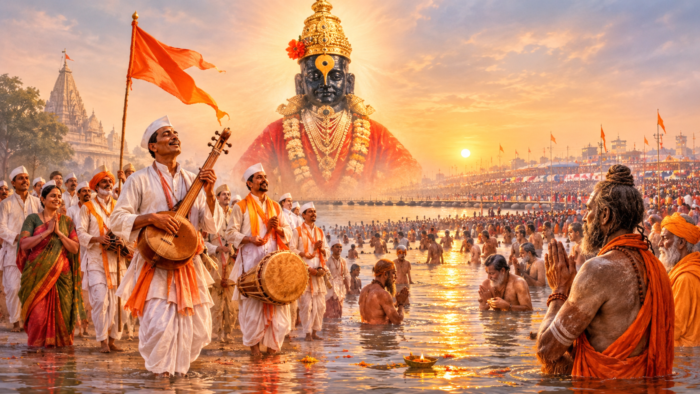
The Alandi–Pandharpur Wari is an important annual pilgrimage observed in Maharashtra, culminating on Ashadhi Ekadashi. Each year lakhs of people walk approximately 250 km over a few weeks from Alandi to Pandharpur with devotion to Sant Dnyaneshwar and Sant Tukaram. I was fortunate to join the Wari from Alandi on the starting day and walked for around 22 km up to Pune and being part of it was an amazing experience. Considering the large gathering of devotees, the procession was fairly orderly. In Mumbai you can see such hordes of local train commuters on a daily basis. But the faces have expressions which are indifferent, stressed and weighed down by unknown burdens. Here in contrast there was happiness and joy all around.
Dindis or groups of people were walking in organized groups chanting praise to Sant Dynaneshwar and Lord Vithoba. The Wari lays no conditions and hence there were people of all ages. Little children dressed as adults, old people, some barefeet and some with walking sticks, women with Tulsi plants on their heads. It was all a lot to absorb mentally. The ocean of faith made one feel small and experience the presence of the divinity with ‘Jai Hari Vitthala, Jai Hari Vitthala’… echoing in Pune and adjoining areas.
Contrast this with the Maha Kumbh Mela held in 2025. While the Wari was largely composed of people from Maharashtra, the Kumbh saw people from all parts of the country and the world. The Maha Kumbh is held at Prayagraj, the confluence of three major rivers of India – Ganga, Yamuna and Saraswati. The focus here is to take the holy dip as Prayaschita for our own wrongdoings which is discussed a bit more later. Here also people walk from various locations to congregate on specific days like Amavasya during the specific period.
The Wari is physically more challenging since the complete walk is around 250 km. However, reaching Prayagraj and attempting the holy dip among the multitude of people has its own challenges too.
So what is common in both these events? There are two commonalities – one is the practical concern of hygiene and cleanliness in contemporary times, while the second, more fundamental, is the immense and implicit faith of the people.
If we talk about the first one – large crowded places in India still don’t have the readiness to regulate cleanliness and hygiene. However, things have been improving steadily and with sponsors and donors these issues can be handled with forward looking schemes and arrangements.
Now let’s turn to the second commonality – more fundamental and interesting – the implicit faith. The most beautiful point to note is that these sampradayas have been in vogue for the past several centuries. How did they sustain? We are an oral tradition and the passing on of information leaves me simply astounded. Considering that a lot of distortion can happen when spoken information is transmitted, it is simply a puzzle as to how the tradition is alive after so many generations. The aspect of surrendering to a higher entity, the humility and feeling of being small and flawed human beings aspiring for something higher, is a commonality. The Maha Kumbh is interesting because of the underlying premise that we make mistakes, commit sins or pāpa and we need to wash off the negative doings by dipping in the Prayag.
The questions to be asked are (1) how does the personal need for spiritual upliftment translate to a collective demonstration of faith and (2) what makes one disregard personal inconveniences, challenges and discomfort to do something which cannot give measurable results within any fixed temporal bounds.
Both the Wari and Kumbh hence appear to emphasize the importance of losing our misdeeds or pāpa and ego and taking refuge in the divine. This is the core of our Sanskriti that we have to aspire for our higher selves by casting off arrogance and our past wrong doings. It is ingrained that the way forward is to take shelter in the divine and become better human beings. The Chapter 14 of the Bhagavad Gītā emphasizes that we need to aspire to become guṇātītaḥ, meaning transcending or getting relieved of the three gunas – sattva, rajas, tamas. One of the ways to do this is through Bhakti. So it is truly amazing that this thought, albeit not in any formal effort, has percolated to the masses that Bhakti is the way to reach the ultimate.
Thus it is certainly striking that the aspiration for betterment with Bhakti as a central theme has been passed on through centuries. The names of the four siblings in the Warkari Sampradaya are Nivṛtti, Jñāneśvar, Sopāna and Muktābāī. The picturization is beautiful. First we renounce, then we achieve knowledge or Jñāna, then we ascend higher via the Sopāna or ladder and finally we achieve Mukti. Whether these names are coincidental or were truly historically accurate is tough to fathom, however the analogy of the names is simply beautiful and makes the Wari worth being part of.
While the above path is well defined though extremely difficult, reality is that humans make mistakes small or big and the path forward depends on the individuals’ choice as to whether to continue the same wrongdoings. Many, however, genuinely regret such actions leading to paścātāpa. But it is not enough to only regret, an actionable mode is required for genuine atonement which is prāyaścitta. This comes in various forms like penance, fasting, japa, tapas, dāna, and vedic rituals like yajña and homa. There are also specific rivers, especially confluences which used to be difficult to reach in the past and one of the ways to achieve prāyaścitta was to travel arduous routes and “purify” oneself by the holy dips.
So, in a sense somewhere in the path to Mukti, human fallacies which can hinder the path to progress have a possibility of redemption through purification modes and earning puṇya by doing dāna and other selfless deeds. By achieving such redemption one can again traverse the path of Jñāna and travel from Sopāna to Mukti. This is an interesting connect between the Wari and the Kumbh with the end goal remaining the same.
The other lesser commonality is the presence of divine rivers at both places. At Prayagraj, of course the greatness of the Ganga knows no bounds and its merging with the Yamuna and Saraswati has evoked creativity in several poets and mystics in the past few centuries. The Indrayani at Alandi is also considered sacred and invokes images of the Saints and Lord Vitthala.
So look at the picture of commonality – rivers with specific forms of the divine associated with the lore of the local place and huge congregations of people all to achieve the higher goal of mukti or moksha. This thought process, traditions and community based efforts consistently carried out over the past several centuries is in fact mind boggling. For the duration of these events at least many barriers like wealth, education, caste etc. seem to recede. The faith is a common binder and the wish to surrender to the ultimate the main driver.
Thus, a closer analysis reveals that this faith and the aspiration for “mukti” and freedom from the cycle of rebirth are common threads among large sections of the population. Perhaps this is what has kept us united through the many upheavals the region has witnessed over time. Can we say that a collective effort towards the ultimate gives strength to individual aspirations? Can we say that personal faith draws strength from the collective which is also seen in Satsangs and Bhajan groups? What do such collective demonstrations of faith contribute from the nation’s perspective? They foster a sense of belonging, reinforce shared regional symbols, encourage tolerance of differences through collective participation, and strengthen values of service and humility.
While the Bhagavad Gītā and Upaniṣads may be difficult for the general masses to absorb, practices and traditions such as the Wari and Kumbh Mela appeal to people across all strata of society. This is our strength and can keep us united as a country despite the modern challenges we face. This is our uniqueness and could be the secret behind how we have survived as a nation, because it may not be oil, weapons or minerals that make a nation, but its underlying character and common, unified thought process. It is imperative to harness this unified approach for continued harmony and strength, so that we not only survive but thrive as a unique nation
Disclaimer: The opinions expressed in this article belong to the author. Indic Today is neither responsible nor liable for the accuracy, completeness, suitability, or validity of any information in the article.