Abstract
Śṛṅgāra, the rasa of love, has been praised for more than a millennium as rasarāja, the king of the rasas. This paper argues that śṛṅgāra, including the śṛṅgāra of union and not only that of separation, is a form of duḥkha, and that this claim follows from premises shared by several schools of Indian thought. Taking as its point of departure the principle sarvaṁ paravaśaṁ duḥkham (Manusmṛti 4.160), “whatever depends on another is sorrow”, the paper reads together three analyses of duḥkha: the Nyāya inclusion of pleasure among the twenty-one forms of sorrow, the Buddhist account of the sorrow of change (vipariṇāma-duḥkhatā), and the Sāṁkhya critique of remedies that are neither certain nor final. It then brings these analyses into rasa theory. It argues that Abhinavagupta’s account of generalisation (sādhāraṇīkaraṇa) confirms the thesis rather than refuting it, since aesthetic relish is possible precisely because dependence on a particular other is suspended. The paper traces the thesis through the debate over śāntarasa and the Gauḍīya Vaiṣṇava theology of prema-vaicittya, where separation is felt inside union. Finally, it tests the thesis against the strongest objection available, Emmanuel Levinas’s claim that the insurmountable duality of love is its ethical dignity, and answers three further objections: philological, aesthetic and anti-pessimist. The paper concludes that the praise of śṛṅgāra and the diagnosis of pleasure as sorrow are two descriptions of one fact, and that the Gauḍīya doctrine of acintya-bhedābheda offers a third position between Advaitic dissolution and Levinasian duality.
Keywords
Śṛṅgāra; duḥkha; rasa theory; Nyāya; Sāṁkhya; śāntarasa; Gauḍīya Vaiṣṇavism; Abhinavagupta; Levinas; non-duality
1. Introduction
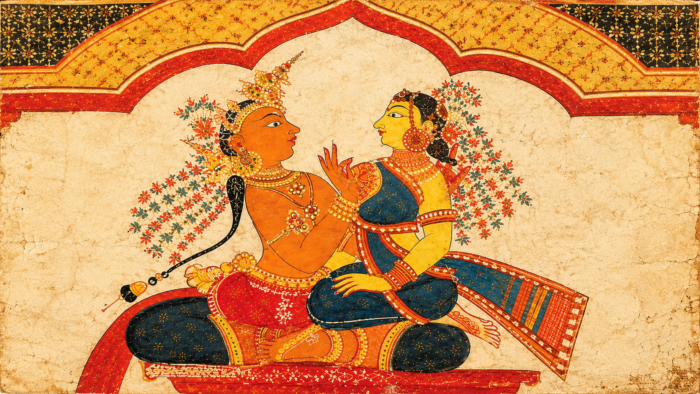
Śṛṅgāra, the rasa of love, is called the king of the rasas. Poets have said so for more than a thousand years, and the theatre, the temple and the songs of Bengal have agreed with them. I want to propose something that sounds, at first, like an insult to that king. Śṛṅgāra is sorrow. Not only the śṛṅgāra of separation, which everyone already admits is painful, but the śṛṅgāra of union too, the play of longing and approach in which two people turn towards each other. It is sorrow in literature and it is sorrow in life.
The reason can be stated in one line of Sanskrit, and the rest of this paper is an attempt to show that the line is not a cynic’s slogan but a conclusion that several schools of Indian thought reached by different roads.
sarvaṁ paravaśaṁ duḥkhaṁ sarvam ātmavaśaṁ sukham
(Whatever depends on another is sorrow; whatever depends on oneself is happiness.)
(Manusmṛti 4.160; cf. Olivelle, 2005)
Śṛṅgāra never happens alone. It needs another, and it hands the lover over to that other: to their glance, their delay, their mood, their absence. By the definition in that verse, a state that is placed in another’s power is duḥkha. That is why the poets of non-duality said that in love there can be no two. When love reaches its end, the beloved remains and the lover disappears. Unless love becomes non-dual, even śṛṅgāra is sorrow. And this is precisely why, in the Nyāya philosophy, even happiness is counted among the forms of sorrow.
This is my hypothesis. The method of the paper is textual and comparative. I do not claim that Manu, the Naiyāyikas, the Buddha, Īśvarakṛṣṇa, Abhinavagupta and Rūpa Gosvāmī held a single doctrine; they plainly did not. I claim that their analyses converge on one structural point, the link between dependence and sorrow, and that this point, once seen, changes how the praise of śṛṅgāra should be read. Section 2 situates the argument in modern scholarship. Sections 3 to 7 reconstruct the analyses of duḥkha in Nyāya, Buddhism and Sāṁkhya and their echo in the Bhagavad Gītā. Sections 8 to 11 carry the result into rasa theory: the rival claims for śṛṅgāra and karuṇa as the one rasa, Abhinavagupta’s theory of aesthetic relish, the debate over śāntarasa, and the Gauḍīya Vaiṣṇava theology of love. Section 12 states the thesis in its full, non-dualist form. Sections 13 and 14 test it against the objection of Emmanuel Levinas and propose a refinement. Section 15 answers three further objections: that the argument misreads Manu, that it confuses rasa with ordinary emotion, and that it is merely pessimistic. Section 16 concludes.
2. Duḥkha and Rasa in Modern Scholarship
The two halves of this argument have each received extensive scholarly attention, but they have usually been studied in different places and for different purposes.
On the side of rasa theory, the modern discussion of how many rasas there are, and whether one of them is fundamental, begins in earnest with V. Raghavan’s The Number of Rasa-s (1940). Raghavan surveyed the long debate over whether the canonical eight rasas should be supplemented, and he documented the competing claims made for a single master rasa: Bhoja’s śṛṅgāra, Bhavabhūti’s karuṇa, the śānta of Abhinavagupta’s school and, later, the bhakti-rasa of the Bengal Vaiṣṇavas. His later study of Bhoja’s Śṛṅgāraprakāśa (Raghavan, 1963) remains the essential account of Bhoja’s argument that śṛṅgāra, understood as a form of self-regard or abhimāna, is the one root of all aesthetic feeling. Sheldon Pollock’s A Rasa Reader (2016) has since made the primary sources of this debate available in translation and has traced the historical movement of rasa theory from an account of the dramatic text to an account of the responding spectator.
The question most directly relevant here, why painful emotions become relishable in art, has been treated principally through Abhinavagupta. Raniero Gnoli’s The Aesthetic Experience According to Abhinavagupta (1968) and J. L. Masson and M. V. Patwardhan’s Aesthetic Rapture (1970) translated and analysed the key passages of the Abhinavabhāratī on generalisation (sādhāraṇīkaraṇa) and on aesthetic relish (carvaṇā) as a resting of consciousness in itself. Masson and Patwardhan’s earlier Śāntarasa and Abhinavagupta’s Philosophy of Aesthetics (1969) showed how closely Abhinavagupta’s aesthetics is tied to his soteriology, and how the claim that śānta is the basic rasa depends on a theory of liberation. Kathleen Higgins (2007) brought this material into conversation with the Western “paradox of tragedy”, arguing that rasa theory explains the enjoyment of negative emotion without denying its negativity. Arindam Chakrabarti (2009) described rasa as the experience of “ownerless” emotions, a formulation that bears closely on the argument of Section 9, and his edited handbook (Chakrabarti, 2016) gathers the contemporary philosophical discussion.
On the side of devotional aesthetics, the Gauḍīya Vaiṣṇava transformation of rasa theory has been studied historically by S. K. De (1961), theologically and dramatically by Donna Wulff (1984) and Neal Delmonico (1990), and in terms of devotional practice by David Haberman (1988), whose translation of Rūpa Gosvāmī’s Bhaktirasāmṛtasindhu (Haberman, 2003) is now standard. Edward Dimock’s The Place of the Hidden Moon (1966) remains indispensable for the Bengali songs and for the place of separation in the erotic theology of Bengal, and his translation of the Caitanya Caritāmṛta (Dimock & Stewart, 1999) is the authoritative English version of the text on which Section 14 relies.
On the other side, the analysis of duḥkha has been studied as a problem of soteriology: by Gerald Larson (1979) for Sāṁkhya, by the contributors to Karl Potter’s encyclopaedia volume on Nyāya-Vaiśeṣika (Potter, 1977), and, in a vast literature, for Buddhism, where Bhikkhu Bodhi’s translation of the Saṁyutta Nikāya (2000) provides the canonical texts used here.
What has received comparatively little attention is the relation between these two bodies of work. Studies of rasa ask why sorrow becomes delight in art. Studies of duḥkha ask why delight is sorrow in life. The two questions are mirror images, and the debate over śāntarasa is the place where they come nearest to each other, because there an aesthetic category is explicitly defined by a soteriological one. The present paper tries to make the mirror explicit. It argues that the concept of paravaśa, dependence on another, explains both directions at once: why pleasure in life is sorrow, and why sorrow in art can be relished. It then asks what follows for the rasa of love, which is the rasa of dependence on another par excellence. The comparative turn to Levinas at the end of the paper follows the hermeneutic principle articulated by Wilhelm Halbfass (1988), that the encounter between Indian and European thought is most fruitful where each is allowed to question the other, rather than where one is used merely to illustrate the other.
3. A Word That Is Wider Than Pain
We usually translate duḥkha as pain or suffering, and the translation makes the hypothesis sound perverse. Who would call a lover’s delight a kind of pain?
But the Indian schools did not use the word that narrowly. For them, duḥkha was not a list of unwelcome events, an illness here, a loss there. It was a relation between a living being and the conditions of its existence: a relation of limitation, dependence and exposure. From birth to death a person meets lack, separation, failure, bodily pain and mental collapse, and these are not separate accidents. They belong to the shape of a life that is lived through a body, through senses, through other people and through time. Duḥkha names that shape.
The schools agreed, more or less, that this shape is there. They did not agree about its cause, its meaning or the way out of it. Nyāya looked for release through right knowledge of the categories of reality. Sāṁkhya looked for it in the discrimination of consciousness from matter. The Buddha’s teaching looked for it in seeing impermanence, dependent arising and craving for what they are. Three different maps of the same country. I want to walk through each of them, because each, in its own way, explains why delight belongs to sorrow, and then bring them to bear on the rasa of love.
4. Nyāya: Why Happiness Is Counted as Sorrow
Nyāya is often remembered as the school of logic: of valid knowledge, inference and debate. But its founding text does not present logic as an end in itself. The Nyāya Sūtra begins by promising that right knowledge of its categories leads to the highest good, and it describes that good as liberation, apavarga. The second sūtra gives the chain in reverse: when false knowledge goes, faults go; when faults go, activity goes; when activity goes, birth goes; when birth goes, sorrow goes; and the going of sorrow is liberation (Nyāya Sūtra 1.1.2; Jha, 1939). Later the sūtra defines sorrow simply as that which is marked by bādhanā, by obstruction or vexation (1.1.21), and liberation as the absolute freedom from it (1.1.22).
Notice the word absolute. Nyāya is not interested in relief, in the end of one particular sorrow while the possibility of the next remains. A headache cured is still a body that can ache. Apavarga is the state in which even the possibility of sorrow’s return is gone.
To make that demand intelligible, the commentators of the tradition widened the idea of duḥkha far beyond everyday pain. In a count that later Nyāya authors give, sorrow is of twenty-one kinds (see Potter, 1977). The body is one, because it is the seat in which pain is experienced. The six senses are six more: sight, hearing, smell, taste, touch and the mind, because through them we are drawn towards or away from things. The six kinds of objects are six more: form, sound, smell, taste, touch and the objects of the mind, because we cling to them, fear to lose them and suffer when they are gone. The six kinds of cognition that arise from senses meeting objects are six more. And the last two are pleasure and pain themselves.
The last pair is the surprising one. That pain should be counted as sorrow needs no argument. But pleasure? The answer the tradition gives is careful. Worldly pleasure is not pain in the moment it is felt. It is counted among the forms of sorrow because it does not last, because the attachment it breeds is the seed of the next sorrow, and because it is never entirely separable from the fear of its loss. Pleasure is sorrow by association, by consequence, by the shadow it casts forward.
Nyāya does not speak of love as a separate emotion in the modern sense. It speaks instead of rāga, attachment or passion, as one of the three great faults alongside dveṣa, aversion, and moha, delusion. Vātsyāyana’s commentary on the sūtras explains how rāga binds: it is the wish to obtain something, and once obtained, the wish to make one’s relation to it permanent. That binding concerns not only external things but one’s own expectation of happiness and the states of mind that go with it. Faults arise from false knowledge; they drive action; action keeps the wheel of saṁsāra turning.
Put śṛṅgāra into this scheme and the hypothesis begins to look less strange. The play of love is made of everything on the list of twenty-one. It is bodily. It lives entirely in the senses: in the glance, the voice, the scent of a garland, the touch of a hand. It fastens on objects, the beloved’s form, the beloved’s words. It produces cognitions, each of which is coloured with longing. And it yields, at its height, a pleasure that is, in Nyāya’s precise sense, a form of sorrow, because it is not self-sufficient, it cannot be kept and it is bound up with the dread of its end.
5. The Buddha’s Teaching: The Sorrow of Change
The Buddhist account of duḥkha arrives at the same place by another road, and it adds something that Nyāya leaves implicit: time.
The first of the four noble truths is the truth of duḥkha. The Buddhist tradition is careful to say that this is not a declaration that life is nothing but agony. It is an invitation to see experience as it is: impermanent, changing and dependent on conditions. The tradition distinguishes three kinds of duḥkha (Saṁyutta Nikāya 45.165; Bodhi, 2000). The first, duḥkha-duḥkhatā, is sorrow as we ordinarily feel it: pain, illness, ageing, death, separation from what we love, meeting with what we do not. The second, vipariṇāma-duḥkhatā, is the sorrow of change. Every pleasant state we take as our own, every relationship we want to keep, is changing. The joy that seems complete now carries in itself the condition of its ending, and so the pleasant becomes a source of sorrow simply by being temporal. The third, saṁskāra-duḥkhatā, is the subtlest: the sorrow of conditioned existence as such. A person is a composite of five aggregates, form, feeling, perception, mental formations and consciousness, none of which is permanent or self-standing. Instability is built into the very structure of what we are.
The second noble truth names the origin of sorrow as tṛṣṇā, thirst or craving, and the tradition distinguishes three kinds: craving for sensual pleasure, craving for being and craving for non-being (Saṁyutta Nikāya 56.11). Thirst is not a passing wish. It is the movement that wants to obtain, then wants to keep, then wants to escape what it does not like, and so binds a person to an endless round of attachment and dissatisfaction.
What does this add to the hypothesis? It explains why the śṛṅgāra of union is sorrow even at its sweetest. Vipariṇāma, change, is not something that happens to love afterwards. It is present inside the moment of delight, as the knowledge, felt even when it is not thought, that this moment will pass. Love’s union is lived in time, and time is the medium of loss.
6. Sāṁkhya: The Question That Sorrow Asks
The Sāṁkhya school puts sorrow at the very beginning of philosophy. The first verse of Īśvarakṛṣṇa’s Sāṁkhya Kārikā reads:
duḥkhatrayābhighātāj jijñāsā tadabhighātake hetau
dṛṣṭe sāpārthā cen naikāntātyantato ’bhāvāt
(From the blows of the threefold sorrow arises the desire to know the means of ending it. If it is said that this inquiry is pointless because visible means exist, no: for they do not end sorrow with certainty or for ever.)
(Sāṁkhya Kārikā 1)
The two adverbs at the end are the point. Ordinary remedies do not remove sorrow aikāntika, with certainty, or ātyantika, absolutely, so that it never returns. Medicine cures a disease; it cannot promise that you will never fall ill again (Larson, 1979).
Vācaspati Miśra’s commentary, the Sāṁkhya Tattva Kaumudī, explains the threefold sorrow (Jha, 1934). Ādhyātmika sorrow arises within one’s own body and mind: disease, and the mental afflictions of desire, anger, greed, delusion, fear, envy, grief and the failure to obtain what one wants. Ādhibhautika sorrow comes from other beings: people, animals, serpents. Ādhidaivika sorrow comes from forces beyond human control, which the old texts associate with the gods, the planets and other powers. The scheme is not a list of three pains. It is a way of sorting all sorrows by where they come from.
Then the Kārikā takes up the two kinds of remedy people actually try. The first is the visible, worldly remedy: medicine for illness, the satisfaction of desire for mental distress, a safe place against external danger. Sāṁkhya does not deny that these work. It denies only that they are final. One cure makes room for the next illness; one want satisfied makes room for the next.
The second remedy is the one taught by scripture, ānuśravika: Vedic ritual undertaken to obtain heaven and its pleasures. Here the second verse is decisive:
dṛṣṭavad ānuśravikaḥ sa hy aviśuddhikṣayātiśayayuktaḥ
tadviparītaḥ śreyān vyaktāvyaktajñavijñānāt
(The scriptural means is like the visible one, for it is joined with impurity, decay and inequality. Its opposite is better: the discriminating knowledge of the manifest, the unmanifest and the knower.)
(Sāṁkhya Kārikā 2)
The three defects are worth pausing over, because each of them describes love as well as ritual.
Aviśuddhi, impurity, refers in the commentary to the harm that some sacrifices involve. The commentary cites a saying attributed to Pañcaśikha that the result of such acts is mixed with a little unwanted fruit, that the unwanted part can be partly remedied and that what remains must be borne. There is no action directed at another that is perfectly clean of harm. Love too has its small cruelties, its necessary wounds.
Kṣaya, decay, means that whatever is produced by action must end. Heaven earned by ritual is a result, and results run out. So does the delight of union.
Atiśaya, inequality or excess, is the most interesting. Different rites yield different heavens; some confer more glory than others. Wherever there is more and less, there is comparison, and wherever there is comparison there is the wish for more and the sense of having less. Vācaspati’s point is that even heavenly happiness is spoiled by the knowledge that someone else’s is greater. It is hard to find a better description of what jealousy does to love. A love that measures itself, against a rival, against a memory, against what it was last year, can never be at rest.
Sāṁkhya’s own answer is discriminating knowledge, viveka: the clear understanding that puruṣa, pure consciousness, the witness, is distinct from prakṛti, the changing matter of the three guṇas from which every modification arises. Bondage is the confusion of the two, so that the pleasures, pains and changes of prakṛti appear to belong to the witness. When the confusion ends, the witness stands alone, kaivalya. Liberation is not a new and better pleasure. It is the end of the mistake by which pleasure and pain were ever taken to be one’s own.
7. Three Roads, One Question
These three schools must not be blurred into one doctrine. Nyāya affirms an enduring self; the Buddha’s teaching denies one; Sāṁkhya posits two ultimate principles. Their accounts of release differ accordingly: apavarga through right knowledge of the categories, nirvāṇa through the ending of thirst, kaivalya through discrimination.
Yet they share one movement. In each, sorrow is not only something to be escaped. It is the beginning of a question. The first verse of the Kārikā says it most clearly: from the blow of sorrow arises the desire to know. Sorrow forces a person to ask whether the cause of suffering lies only in circumstances, or also in the way one understands oneself and the world. That question is the root of philosophy in all three.
And in all three, pleasure is suspect for the same reason: not because it is evil, but because it is dependent, transient and binding. It is paravaśa, in the power of something other than oneself.
The Bhagavad Gītā, which every Hindu reader will have in mind by now, gathers the same insight into two verses. “The contacts of the senses with their objects, O son of Kuntī, give rise to cold and heat, pleasure and pain; they come and go and are impermanent; endure them” (Bhagavad Gītā 2.14). And more sharply: “The enjoyments that are born of contact are wombs of sorrow alone; they have a beginning and an end, and the wise do not delight in them” (Bhagavad Gītā 5.22).
Duḥkhayonaya eva te: they are wombs of sorrow. The Gītā does not say that sensual pleasures are painful in the moment they are enjoyed. It says that sorrow is born from them, as a child is born from a womb. They carry it. That is exactly the Nyāya claim that pleasure is a form of sorrow, put in an image that no reader forgets. And it describes śṛṅgāra with uncomfortable precision, because śṛṅgāra is, before it is anything else, the delight of contact: of eyes meeting, of voices answering, of hands. Krishna’s teaching to Arjuna is not a condemnation of that delight. It is a description of what it carries, and a counsel not to rest one’s happiness there.
Now I want to bring this conclusion into the place where it seems least welcome: the theory of rasa, and the rasa of love above all.
8. The King of the Rasas
In the sixth chapter of Bharata’s Nāṭyaśāstra, the foundational text of Indian aesthetics, śṛṅgāra is the first rasa listed (Ghosh, 1950). Bharata divides it into two kinds: sambhoga, love in union, and vipralambha, love in separation. Later theorists made śṛṅgāra the greatest of all. King Bhoja of Dhārā, in the eleventh century, went further and argued in his Śṛṅgāraprakāśa that there is in truth only one rasa, and that it is śṛṅgāra, understood not narrowly as erotic love but as the deepest form of self-feeling from which all other emotional savour flows (Pollock, 2016; Raghavan, 1963).
But the same tradition contains a counter-voice, and it is a great one. In the Uttararāmacarita, the playwright Bhavabhūti puts into the mouth of one of his characters the line: eko rasaḥ karuṇa eva, there is only one rasa, and it is karuṇa, compassion, the rasa of grief; all the others are its modifications, as water takes the forms of eddy, bubble and wave and yet remains water (Uttararāmacarita 3.47; Pollock, 2007). And Ānandavardhana, in the Dhvanyāloka, tells the story that every student of Sanskrit poetry knows: when the sage Vālmīki saw a hunter kill one of a pair of mating krauñca birds and heard the cry of its mate, his grief (śoka) became verse (śloka), and poetry was born (Dhvanyāloka 1.5; Ingalls et al., 1990).
Look at what that origin story says. The first poem in the tradition was not born from love in union. It was born from the sight of love broken, of two who had been together and were now torn apart. The rasa of love and the rasa of grief meet at the very birth of poetry. Bhoja says there is only śṛṅgāra; Bhavabhūti says there is only karuṇa. My hypothesis is that they are describing the same thing from two sides. Śṛṅgāra is the king of the rasas, and its crown is made of sorrow.
It is worth noting that Bhoja’s own understanding of śṛṅgāra supports this reading rather than resisting it. For Bhoja, as Raghavan (1963) showed, the one rasa is rooted in abhimāna or ahaṅkāra, a heightened sense of self that makes a person capable of feeling at all. The king of the rasas is thus, in Bhoja’s own terms, a form of self-regard that must go out towards an object in order to be realised. It is a self that needs another. That is exactly the structure that Manu’s verse calls paravaśa.
9. Why Grief Can Be Tasted
There is an obvious objection from inside the theory of rasa itself, and I should meet it before going further. If śṛṅgāra is sorrow, and karuṇa is grief, why do audiences seek them out? Why do we weep at a play and call the weeping delight?
The great Kashmiri philosopher Abhinavagupta gave the answer that most of the later tradition accepted. Building on Bhaṭṭa Nāyaka’s idea of sādhāraṇīkaraṇa, generalisation, he argued in his commentaries on the Nāṭyaśāstra and the Dhvanyāloka that in aesthetic experience emotions are freed from their attachment to particular persons (Gnoli, 1968; Masson & Patwardhan, 1970). The spectator does not feel Sītā’s grief as Sītā’s, nor as his own private loss. The feeling is lifted out of the circle of “mine” and “his”, and in that impersonal state it is relished. That relish, Abhinavagupta held, is a form of bliss, a resting of consciousness in itself, even when the emotion tasted is sorrow.
At first this seems to refute my hypothesis. If even grief becomes bliss in rasa, then surely śṛṅgāra, the sweetest rasa, is bliss and not sorrow.
But look at what makes the transformation possible. Grief becomes relishable only when it is no longer owned, no longer bound to a particular other on whom I depend. Chakrabarti’s (2009) description of rasa as the savouring of “ownerless” emotion names exactly this condition. Generalisation is precisely the removal of paravaśa. In the theatre I do not need this beloved to stay, this face to turn towards me, this hand to remain in mine. The love I taste there belongs to no one in particular, and so it cannot be lost. Manu’s verse says that whatever depends on oneself is happiness; Abhinavagupta’s rasa is happiness because, for the time of the performance, the emotion depends on nothing outside consciousness itself.
So the theory of rasa does not contradict the hypothesis. It confirms it from the other side. Śṛṅgāra in life is sorrow because it is dependent on another. Śṛṅgāra in art can be bliss because art suspends that dependence. Rasa is a small, temporary non-duality: for a few hours the lane of love is narrow enough that the particular lover and the particular beloved fall away, and only the savour remains. When the lamps are put out and we go home to the people we actually love, the dependence returns, and with it the sorrow.
This also clarifies what Higgins (2007) calls the transformative character of rasa. The paradox of tragedy, in its Western form, asks how painful emotions can be enjoyed. The Indian answer, read in the light of the analyses of duḥkha above, is that what is painful in an emotion is not its content but its ownership. Grief owned is sorrow; grief generalised is rasa. The same must hold for love. Love owned, love that hangs on this particular other, is sorrow; love generalised is rasa. The aesthetic theory thus presupposes the soteriological diagnosis: it can explain the pleasure of tragic and erotic art only because it already accepts that dependence on a particular other is what makes feeling painful.
10. Śānta: The Rasa of the End of Thirst
If generalisation is a temporary suspension of dependence, is there a rasa in which that suspension is not temporary but complete? The tradition’s answer is śānta, the rasa of peace, and the long debate over its status is the place where the argument of this paper comes closest to the existing scholarship.
Bharata’s canonical list contains eight rasas, and the inclusion of a ninth, śānta, was contested for centuries (Raghavan, 1940). Ānandavardhana argued that śānta is the principal rasa of the Mahābhārata, the great epic whose final teaching is the futility of worldly striving (Dhvanyāloka 4.5). He characterised śānta by the happiness that comes from the destruction of thirst, tṛṣṇākṣayasukha, and quoted a verse that ranks all the pleasures of desire in this world and all the great pleasures of heaven as not worth a sixteenth part of that happiness (Ingalls et al., 1990). The word tṛṣṇā is the same word that the second noble truth names as the origin of duḥkha. Here, within the aesthetic tradition itself, the end of craving is named as the highest happiness, and the pleasures of desire, śṛṅgāra’s own domain, are placed beneath it.
Abhinavagupta went further. In the section of the Abhinavabhāratī devoted to śānta, he argued that its abiding emotion (sthāyibhāva) is knowledge of the truth, or of the self, and that śānta is not simply one rasa among nine but the ground from which the others arise and into which they return (Masson & Patwardhan, 1969). The image is strikingly close to Bhavabhūti’s water and waves, with the roles reversed: for Bhavabhūti the water is grief; for Abhinavagupta it is peace.
The significance of this for the present argument is considerable. If śānta is the ground of the rasas, and if śānta is defined by the end of thirst, then the aesthetic tradition at its most philosophical has already conceded the hypothesis. Śṛṅgāra is a wave on the water of śānta. Its delight is real, but it is the delight of a disturbance, a movement of desire towards another, and its repose is found only when the movement stops. Masson and Patwardhan (1969) emphasised that Abhinavagupta’s aesthetics cannot be separated from his metaphysics of liberation; the present argument adds that this inseparability is exactly what one would expect if the rasa of love were, in the soteriological sense, a form of sorrow.
But the Bengal Vaiṣṇavas reversed this ranking, and the reversal is instructive. In the Bhaktirasāmṛtasindhu, Rūpa Gosvāmī recognises five primary modes of devotional rasa: śānta, dāsya</span> (servitude), sakhya (friendship), vātsalya (parental love) and madhura (the love of lovers). Śānta stands at the bottom of this scale, and madhura, devotional śṛṅgāra, at the top (Delmonico, 1990; Haberman, 2003). For Rūpa, the peace of the knower is real but thin, because it lacks the intimacy of relation. The higher the rasa, the more fully the devotee is given over to the beloved, and the more fully, in Manu’s terms, the devotee is paravaśa.
The two rankings, Abhinavagupta’s and Rūpa’s, thus correspond exactly to the two judgements that this paper will later attribute to Advaita and to Levinas. One says that dependence on another is the sorrow from which peace is release. The other says that dependence on another is the very substance of the highest love. The Vaiṣṇava ranking does not deny that this dependence is painful. On the contrary, as the next section shows, it makes the pain of love the centre of its theology.
11. Separation Inside Union
Nowhere is this clearer than in the Vaiṣṇava tradition of Bengal, which gave the rasa of love a theology.
In the sixteenth century, Rūpa Gosvāmī, a disciple of Śrī Caitanya, composed two great treatises on devotional rasa, the Bhaktirasāmṛtasindhu and the Ujjvalanīlamaṇi. In them the love of Rādhā and Kṛṣṇa, madhura rasa, becomes the highest form of devotion. And it is striking how much of that theology is devoted not to union but to separation: the stages of longing, the ten conditions of the lover in absence, the many shades of viraha (De, 1961; Wulff, 1984).
The ten conditions themselves deserve a moment, because they did not originate with the Vaiṣṇavas. Bharata had already listed, in the Nāṭyaśāstra, the ten stages through which a lover passes in the absence of the beloved: longing (abhilāṣa), anxious thought (cintā), recollection (anusmṛti), the recounting of the beloved’s qualities (guṇakīrtana), agitation (udvega), lament (vilāpa), madness (unmāda), fever (vyādhi), stupor (jaḍatā) and, finally, death (maraṇa) (Ghosh, 1950). Set this list beside the Nyāya list of twenty-one forms of sorrow and the correspondence is plain. The first stages belong to the mind and its cognitions; recollection and the recounting of qualities are cognitions fastened on an object; agitation and lament belong to the senses deprived of their object; fever and stupor belong to the body. The dramaturgical list describes, stage by stage, what the philosophical list describes category by category: a self that has placed its happiness in another and is now discovering, through every faculty it has, what that placement costs. That the last stage is death, which the stage convention never shows directly, only confirms the point. The logical end of complete dependence on another is the loss of oneself.
Rūpa names one condition that goes to the heart of my argument. In the Ujjvalanīlamaṇi he calls it prema-vaicittya: a state in which the lover, though in the very presence of the beloved, is seized by the anguish of separation, as if the beloved were absent. Union does not cancel separation. Separation lives inside it.
The Bengali Vaiṣṇava songs say the same thing with a simplicity no treatise can match (Dimock, 1966). In a line of the padāvalī that every singer of kīrtana knows, the two lovers lie in each other’s arms and both weep, thinking of the parting to come:
duhũ kore duhũ kā̃de bicched bhābiyā
(Each in the other’s arms, each weeps, imagining separation.)
There is the whole of my hypothesis in six words. This is not the śṛṅgāra of separation. It is the śṛṅgāra of union, and it is weeping. Why? Because the embrace is paravaśa. Each holds what is not theirs to keep. The more complete the union, the more vividly the mind sees its end. This is vipariṇāma-duḥkhatā, the sorrow of change, felt in the arms of the beloved. It is the Nyāya insight that pleasure is sorrow by its shadow. It is the Sāṁkhya insight that whatever is produced decays.
Haberman’s (1988) study of rāgānugā practice shows that this was not merely a poetic sentiment but a discipline. The practitioner was to cultivate, through imaginative identification with the companions of Rādhā, precisely these emotions of longing and separation. The tradition, in other words, did not try to cure the sorrow of love. It deliberately entered it.
12. The Lane That Is Too Narrow for Two
Is there, then, any śṛṅgāra that is not sorrow? The hypothesis says yes, but only one: the love in which there are no longer two.
The saint-poet Kabīr put it in a couplet that is still sung across North India (cf. Vaudeville, 1974):
prem galī ati sā̃krī, tā meṁ do na samāhi
(The lane of love is very narrow; two cannot fit in it.)
And elsewhere:
jab maiṁ thā tab hari nahīṁ, ab hari haiṁ maiṁ nāhiṁ
(When I was, Hari was not; now Hari is, and I am not. The beloved remains; the lover disappears.)
This is not only the language of mystic poetry. The Upaniṣads had already used the image of lovers’ union to describe the non-dual Self. The Bṛhadāraṇyaka Upaniṣad says that as a man in the embrace of his beloved knows nothing of without or within, so the person embraced by the Self knows nothing of without or within; that is the state in which desire is fulfilled, in which the Self is the only desire, and in which there is no sorrow (Bṛhadāraṇyaka Upaniṣad 4.3.21; Olivelle, 1998). The same Upaniṣad gives the reason why duality and sorrow go together. At the beginning, it says, the Self was alone and was afraid; then it reflected, “Since there is nothing other than me, of what should I be afraid?”, and its fear departed, for dvitīyād vai bhayaṁ bhavati, fear arises only from a second (Bṛhadāraṇyaka Upaniṣad 1.4.2).
Fear arises from a second. That is Manu’s paravaśa translated into metaphysics. Where there is another, there is dependence, and where there is dependence, there is the fear of loss. And in the famous dialogue between Yājñavalkya and Maitreyī, the same Upaniṣad says that it is not for the love of the husband that the husband is dear, nor for the love of the wife that the wife is dear, but for the love of the Self (Bṛhadāraṇyaka Upaniṣad 2.4.5). Read through Advaita Vedānta, the school of Śaṅkara, this means that every love is a love of the one Self misrecognised as another (Madhavananda, 1950). Śṛṅgāra is sorrow as long as it is love of another. It ceases to be sorrow only when the other is known to be no other.
Here, then, is the hypothesis in its full form. Unless love becomes non-dual, śṛṅgāra is sorrow, in exactly the sense in which Nyāya counts pleasure as sorrow, the Buddha’s teaching calls change sorrow and Sāṁkhya calls every produced result decaying. Non-duality is not a heightening of śṛṅgāra. It is its end, the point at which the lane becomes too narrow for two and only the beloved remains. In the language of rasa theory, it is the passage of śṛṅgāra into śānta.
13. An Objection from Levinas
A hypothesis earns its keep by meeting its strongest objection. The strongest objection I know comes not from India but from France, from the philosopher Emmanuel Levinas, and it is worth hearing at length, because it accepts every premise of my argument and draws the opposite conclusion.
Levinas agreed that love is not possession. In his lectures Time and the Other he described the erotic relation as neither a struggle, nor a fusion, nor a knowledge, and wrote that “the pathos of love consists in an insurmountable duality of beings” (Levinas, 1987, p. 86); he returned to the same formulation when reflecting on that early work in conversation with Philippe Nemo (Levinas, 1985). Later, in the section of Totality and Infinity devoted to the phenomenology of eros, he described the caress as “seizing upon nothing”: it does not grasp the beloved but solicits what ceaselessly escapes it, reaching towards a future that never arrives (Levinas, 1969, pp. 257–258).
Notice how closely this matches the Indian analysis. Love, for Levinas, is exactly paravaśa. The lover is given over to someone who cannot be held, who always slips away, who remains other however close she comes. The caress seizes nothing. The embrace weeps, imagining separation. Even Levinas’s account of the temporality of eros, a reaching towards a future that is never future enough, reads like a phenomenological description of what the Buddhist tradition calls the sorrow of change.
But for Levinas this is not the defect of love. It is its dignity. The other’s escape is what makes her other, not an object, not a part of me, not something I can consume. Fusion, the disappearance of the lover into the beloved or of both into one, would not be the fulfilment of love. It would be its abolition, because it would abolish the other. For Levinas, the pathos of love is not a sorrow to be cured. It is the shape of an ethical relation in which I am exposed to someone I can never possess, and in that exposure I learn responsibility.
So the Advaitin and Levinas describe the same experience and judge it in opposite ways. Both say that love, so long as it remains love of another, is dependence, non-possession, the reaching of a hand that closes on nothing. The Advaitin calls that duḥkha and seeks its end in non-duality. Levinas calls it the pathos of love and refuses to end it, because to end it would be to lose the other.
The disagreement is not merely one of temperament. It turns on what each takes the self to be. For the Advaitin, the self that suffers in dependence is not the true Self; dependence is suffered only by a self mistakenly identified with body, senses and mind, the very items on the Nyāya list of twenty-one. For Levinas, the self that is exposed to the other is the only self there is, and its exposure is not a mistake but the origin of ethics. Halbfass (1988) warned against comparative readings that settle such disagreements by translating one tradition’s terms into the other’s. The disagreement should be allowed to stand as a real one.
14. Between Dissolution and Duality
Must we choose? I do not think the choice is as simple as it looks, and the Bengal tradition itself suggests why.
The Gauḍīya Vaiṣṇava theology of Caitanya’s followers does not accept Śaṅkara’s Advaita without remainder. It speaks of acintya-bhedābheda, an inconceivable difference-in-non-difference. In the Caitanya Caritāmṛta, Kṛṣṇadāsa Kavirāja says that Rādhā and Kṛṣṇa are one Self who have taken two bodies (Caitanya Caritāmṛta, Ādi-līlā 4.56; Dimock & Stewart, 1999). They are one, so that their love is not mere dependence on a stranger; they are two, so that love remains possible at all. The two bodies are taken on precisely so that there can be the play, the līlā, of love. And the play, as we have seen, is full of weeping.
This suggests a refinement of my hypothesis rather than a retreat from it. Śṛṅgāra is sorrow wherever the other is merely other, wherever love is paravaśa in Manu’s sense, dependence on what one does not control. It ceases to be the sorrow of bondage where the lover knows that the beloved is not finally other. But in the Vaiṣṇava vision, that knowledge does not end the tears. It changes their meaning. The weeping of the two in each other’s arms is no longer the weeping of creatures afraid of loss. It is the weeping of a love that has freely taken on duality in order to taste itself.
Seen this way, the Gauḍīya position does something that neither Advaita nor Levinas does. It accepts the Advaitin’s metaphysical claim that the lovers are ultimately one, and it accepts Levinas’s phenomenological claim that love requires an insurmountable duality. It reconciles them not by argument but by the concept of līlā: the duality is real, but it is chosen, and what is chosen is, in Manu’s terms, ātmavaśa, dependent on oneself. The sorrow of love remains, but it is no longer the sorrow of a creature handed over to a stranger. It is the sorrow of the one Self playing at being two.
Levinas would not accept this. For him, any unity behind the two would threaten the otherness that gives love its ethical weight. And the strict Advaitin would not accept it either, because any duality that remains, even a playful one, is still the place where fear can enter. The Vaiṣṇava position is a third way, held between them, and it is held there by devotion rather than by argument.
I do not claim to settle that disagreement. What I claim is narrower and, I think, defensible. The ancient praise of śṛṅgāra as the king of the rasas, and the ancient diagnosis of pleasure as a form of sorrow, are not in contradiction. They are two descriptions of one fact: that love, so long as it is love of another, is the most exquisite form of dependence a human being can know. That is why it is the king of the rasas. And that is why it is sorrow.
15. Three Further Objections
The objection from Levinas is the most serious, but it is not the only one. Three others should be answered, because each, if left standing, would weaken the argument at its foundations.
15.1 Does the argument misread Manu?
The first objection is philological. Manu’s verse does not occur in a treatise on love. It occurs in the fourth chapter of the Manusmṛti, among the rules of conduct for a householder, and its immediate context is practical. The preceding verse advises that one should carefully avoid every undertaking that depends on others and carefully pursue every undertaking that depends on oneself; the verse quoted at the start of this paper then gives the reason, and the next half-verse adds that this, in brief, is the definition of happiness and sorrow (Manusmṛti 4.159–160; Olivelle, 2005). Manu is speaking of livelihood, obligation and servitude, not of the beloved’s glance.
This is true, and the paper should not pretend otherwise. But the objection proves less than it seems to. Manu offers the verse explicitly as a lakṣaṇa, a definition, of happiness and sorrow in general, and a definition is meant to apply beyond the case that occasions it. Moreover, the use made of it here does not depend on Manu’s authority. The verse serves as a compact statement of a principle that the paper then establishes independently, from Nyāya, from the Buddhist analysis of change and craving, from Sāṁkhya and from the Bṛhadāraṇyaka’s claim that fear arises from a second. If Manu had never written the line, the argument would still stand on those foundations; the line simply names, more economically than any of them, the hinge on which they all turn. Extending a definition from servitude to love is, in any case, not foreign to the tradition itself. The vocabulary of service, dāsya, is one of Rūpa Gosvāmī’s five primary devotional rasas, and the Bengali songs repeatedly describe the lover as the beloved’s servant, bought and sold.
15.2 Does the argument confuse rasa with ordinary emotion?
The second objection comes from within rasa theory. Rasa, strictly speaking, is not an emotion that anyone has. It is an aesthetic experience produced in a qualified spectator by the combination of determinants, consequents and transitory states on the stage. Bharata’s śṛṅgāra is a rasa; the love that people feel in life is, at most, its sthāyibhāva, the abiding emotion of rati. To say that śṛṅgāra is sorrow, the objection runs, is to confuse an aesthetic category with a psychological one.
The distinction is sound, and the argument of Section 9 depends on it. It was precisely because rasa is not an ordinary emotion that it could be relished even when the emotion was grief. But the distinction cuts in both directions. If śṛṅgāra as rasa is bliss because it is generalised, then the love that is not generalised, the rati of a particular person for a particular person, is what remains when the generalisation is taken away. The thesis of this paper is that this remainder is sorrow, and that the rasa is bliss only because it is not this remainder. The paper’s claim that śṛṅgāra is sorrow “in literature and in life” should therefore be read with that precision: in literature it is sorrow as content, the content that generalisation transforms; in life it is sorrow as condition, because there is no generalisation to transform it. Moreover, the Gauḍīya theorists themselves refused to keep the two strictly apart. For Rūpa Gosvāmī, the devotee does not merely watch the love of Rādhā and Kṛṣṇa as a spectator watches a play; the devotee takes up a role within it, and the rasa is lived, not only witnessed (Haberman, 1988; Wulff, 1984). In devotional rasa, the boundary between the stage and life is deliberately made porous.
15.3 Is the argument merely pessimistic?
The third objection is the most common and the least precise. To call love sorrow, it is said, is to adopt a world-denying pessimism alien to the affirmative spirit of the Hindu traditions, which count kāma among the legitimate aims of human life and celebrate the love of Śiva and Pārvatī, of Rādhā and Kṛṣṇa, in temple and song.
The reply is that the argument does not deny the value of love. It denies only that love is self-sufficient. Nyāya does not say that pleasure is worthless, only that it is not final; Sāṁkhya does not say that medicine is useless, only that it is not certain or absolute; the Gītā does not forbid the delight of contact, only counsels against resting one’s happiness there. In the same way, to say that śṛṅgāra is sorrow is not to say that one should not love. It is to say that love, so long as it is love of another, carries within it the condition of its own grief, and that a person who knows this loves more truthfully than one who does not. The weeping lovers of the padāvalī are not pessimists. They are lovers who know what they hold. Indeed, the Gauḍīya tradition draws from this very knowledge its most affirmative conclusion: that the sorrow of love, offered rather than escaped, is the highest form of devotion. The thesis is not that love should be abandoned because it is sorrow. It is that the sorrow is part of what love is, and that the traditions which praised śṛṅgāra as the king of the rasas already knew it.
16. Conclusion: The Crown of Sorrow
Return to the beginning. Śṛṅgāra is called rasarāja, the king of the rasas. The title is deserved. No other rasa so completely gathers the senses, the mind, the body and time into a single savour. No other rasa so fully exhibits all twenty-one of Nyāya’s forms of sorrow at once, and makes them beautiful.
But a king is also the one who is most exposed. The crown of śṛṅgāra is woven from the same threads that the philosophers named when they spoke of duḥkha: the body’s frailty, the senses’ hunger, the objects’ instability, the mind’s foreknowledge of loss, and pleasure itself, which is sorrow because it cannot be kept. Bhavabhūti was right that there is one rasa and it is grief. Bhoja was right that there is one rasa and it is love. They were speaking of the same king.
The philosophers offered three ways out: right knowledge, the ending of thirst, discrimination of the witness from what it witnesses. The poets of non-duality offered a fourth: the narrow lane in which only the beloved remains. Abhinavagupta’s śānta gave that fourth way a place within aesthetics. Levinas, from far away, refused all four, and asked us to stay in the sorrow because it is the place where another person is truly other.
The contribution of this paper, if it has one, lies in showing that the concept of paravaśa links the two directions in which Indian thought moved between pleasure and pain: the soteriological direction, in which pleasure is revealed as sorrow, and the aesthetic direction, in which sorrow is transformed into relish. Both turn on the same hinge, dependence on a particular other. Two lines of further inquiry follow. The first is historical: how far the later Bengali reception of rasa theory, from the padāvalī to modern Bengali literature, preserves the Gauḍīya understanding of separation within union. The second is philosophical: whether the Gauḍīya notion of a chosen duality can be developed into a response to Levinas that meets his ethical concern without abandoning the non-dualist insight.
Perhaps the singers of Bengal knew something that neither the philosophers nor Levinas quite said. When they sing of the two who weep in each other’s arms, they do not ask the listener to escape the tears or to endure them as a duty. They ask the listener to taste them. That is what rasa means. And a sorrow that can be tasted, shared and offered back to the divine is no longer only bondage. It is the beginning of the question that, as the Sāṁkhya Kārikā says, every sorrow opens: the question of who we are, and to whom we belong.
(Note on translations and transliteration: Sanskrit, Pali, Bengali and Hindi terms are given in IAST-style transliteration, with ṁ for anusvāra. Translations of primary passages are the author’s own unless otherwise indicated; the translations listed in the references have been consulted throughout. Following APA guidance for classical and religious works, primary texts are cited by their traditional chapter and verse numbers in the text.)
References
Bodhi, B. (Trans.). (2000). The connected discourses of the Buddha: A translation of the Saṃyutta Nikāya. Wisdom Publications.
Chakrabarti, A. (2009). Play, pleasure, pain: Ownerless emotions in rasa-aesthetics. In A. Mukherji (Ed.), Science, literature and aesthetics (History of Science, Philosophy and Culture in Indian Civilization, Vol. 15, Pt. 3, pp. 189–202). Centre for Studies in Civilizations.
Chakrabarti, A. (Ed.). (2016). The Bloomsbury research handbook of Indian aesthetics and the philosophy of art. Bloomsbury Academic.
De, S. K. (1961). Early history of the Vaiṣṇava faith and movement in Bengal (2nd ed.). Firma K. L. Mukhopadhyay.
Delmonico, N. G. (1990). Sacred rapture: A study of the religious aesthetic of Rupa Gosvamin [Doctoral dissertation, University of Chicago].
Dimock, E. C., Jr. (1966). The place of the hidden moon: Erotic mysticism in the Vaiṣṇava-sahajiyā cult of Bengal. University of Chicago Press.
Dimock, E. C., Jr. (Trans.), & Stewart, T. K. (Ed.). (1999). Caitanya caritāmṛta of Kṛṣṇadāsa Kavirāja: A translation and commentary (Harvard Oriental Series, Vol. 56). Harvard University Press.
Ghosh, M. (Trans.). (1950). The Nāṭyaśāstra ascribed to Bharata-Muni (Vol. 1). Royal Asiatic Society of Bengal.
Gnoli, R. (1968). The aesthetic experience according to Abhinavagupta (2nd ed.). Chowkhamba Sanskrit Series Office.
Haberman, D. L. (1988). Acting as a way of salvation: A study of rāgānugā bhakti sādhana. Oxford University Press.
Haberman, D. L. (Trans.). (2003). The Bhaktirasāmṛtasindhu of Rūpa Gosvāmin. Indira Gandhi National Centre for the Arts; Motilal Banarsidass.
Halbfass, W. (1988). India and Europe: An essay in understanding. State University of New York Press.
Higgins, K. M. (2007). An alchemy of emotion: Rasa and aesthetic breakthroughs. The Journal of Aesthetics and Art Criticism, 65(1), 43–54.
Ingalls, D. H. H., Masson, J. M., & Patwardhan, M. V. (Trans.). (1990). The Dhvanyāloka of Ānandavardhana with the Locana of Abhinavagupta (Harvard Oriental Series, Vol. 49). Harvard University Press.
Jha, G. (Trans.). (1934). The Tattva-kaumudī: Vācaspati Miśra’s commentary on the Sāṁkhya-kārikā. Oriental Book Agency.
Jha, G. (Trans.). (1939). Gautama’s Nyāyasūtras with Vātsyāyana-bhāṣya. Oriental Book Agency.
Larson, G. J. (1979). Classical Sāṃkhya: An interpretation of its history and meaning (2nd rev. ed.). Motilal Banarsidass.
Levinas, E. (1969). Totality and infinity: An essay on exteriority (A. Lingis, Trans.). Duquesne University Press.
Levinas, E. (1985). Ethics and infinity: Conversations with Philippe Nemo (R. A. Cohen, Trans.). Duquesne University Press.
Levinas, E. (1987). Time and the other (R. A. Cohen, Trans.). Duquesne University Press.
Madhavananda, S. (Trans.). (1950). The Bṛhadāraṇyaka Upaniṣad with the commentary of Śaṅkarācārya (3rd ed.). Advaita Ashrama.
Masson, J. L., & Patwardhan, M. V. (1969). Śāntarasa and Abhinavagupta’s philosophy of aesthetics. Bhandarkar Oriental Research Institute.
Masson, J. L., & Patwardhan, M. V. (1970). Aesthetic rapture: The rasādhyāya of the Nāṭyaśāstra (2 vols.). Deccan College Postgraduate and Research Institute.
Olivelle, P. (Trans.). (1998). The early Upaniṣads: Annotated text and translation. Oxford University Press.
Olivelle, P. (2005). Manu’s code of law: A critical edition and translation of the Mānava-Dharmaśāstra. Oxford University Press.
Pollock, S. (Trans.). (2007). Rama’s last act by Bhavabhuti. New York University Press; JJC Foundation.
Pollock, S. (Ed. & Trans.). (2016). A rasa reader: Classical Indian aesthetics. Columbia University Press.
Potter, K. H. (Ed.). (1977). Encyclopedia of Indian philosophies: Vol. 2. Indian metaphysics and epistemology: The tradition of Nyāya-Vaiśeṣika up to Gaṅgeśa. Princeton University Press.
Raghavan, V. (1940). The number of rasa-s. Adyar Library.
Raghavan, V. (1963). Bhoja’s Śṛṅgāra Prakāśa. Punarvasu.
Vaudeville, C. (1974). Kabīr (Vol. 1). Clarendon Press.
Wulff, D. M. (1984). Drama as a mode of religious realization: The Vidagdhamādhava of Rūpa Gosvāmī. Scholars Press.
Feature Image Credit: Wikicommons
Disclaimer: The opinions expressed in this article belong to the author. Indic Today is neither responsible nor liable for the accuracy, completeness, suitability, or validity of any information in the article.