
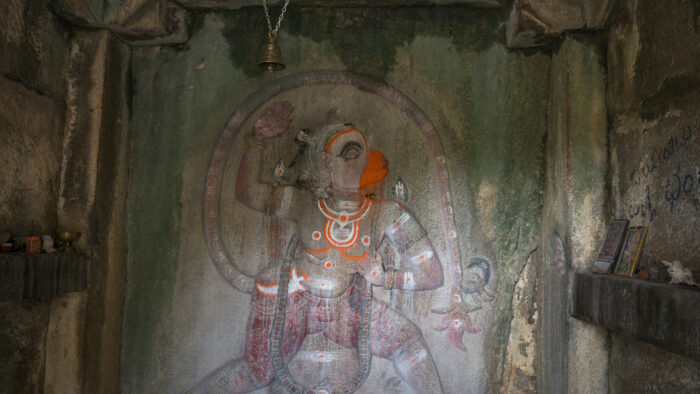
Hanuman as Pure Consciousness: Etymology, Iconography, Literary Tradition, and a Mathematical Derivation
Abstract
Hanuman, the celebrated vanara deity of the Ramayana tradition, is conventionally understood as the supreme devotee of Lord Rama. This paper argues that this reading, while true at the devotional surface, conceals a more precise philosophical function: Hanuman is a narrative and iconographic device constructed to demonstrate what consciousness looks like when the ego-constituting mind — Manas — has been dissolved. The name itself encodes this function: Han + Mana, the annihilation of ego-mind. Because pure consciousness without ego-residue cannot be sustained in a realistic human narrative form — it offers no dramatic tension, no relatable limitation, no subject-predicate grammar that language can carry — the tradition employs the vanara (monkey) form as a protected narrative space in which scale-flexible, ego-free consciousness can be shown without philosophical apology. We trace this argument through Sanskrit etymology, classical iconography, the parallel device of the Vishwarupa in the Bhagavad Gita, and cognate figures in world literary tradition including Virgil in Dante, Gandalf in Tolkien, and the Fool in King Lear. We then derive a mathematical formulation of the consciousness state Hanuman embodies: a scale-flexibility function over a logarithmic entity-scale axis, combined with a cascading logistic developmental model in which threshold-crossing events — Jambavan Moments — raise the developmental ceiling discontinuously. The article concludes that Hanuman represents not a supernatural being but the most sustained and humanely rendered portrait of consciousness operating at its natural, unobstructed capacity that any literary tradition has produced.
Keywords
Hanuman, pure consciousness, Ramayana, Bhagavad Gita, Vishwarupa, Han-Mana, scale-flexibility, narrative device, comparative mythology, logistic consciousness model, Jambavan Moment
1. The Question the Monkey Poses
He is not a monkey. He is what the monkey becomes when it stops being a monkey.
— Traditional Sundara Kanda commentary
Every tradition that has thought seriously about consciousness has encountered the same communication problem: how do you show something to someone who has never experienced it? You cannot hand it to them. You cannot argue them into it. You cannot describe it in the language of ordinary experience, because ordinary language is built from the very structures — subject, object, agency, desire, fear, the fixed viewing position of the self — that pure consciousness has moved beyond.
The Upanishads resolved this through negation: Neti Neti, not this, not this. The Bhagavad Gita resolved it once, spectacularly, through direct revelation. The Ramayana resolved it differently — and in some ways more durably. Rather than a single overwhelming moment of disclosure, it constructed a character who walks through an entire epic demonstrating, action by action, what consciousness looks like when it no longer answers to the ego’s restrictions. That character is Hanuman.
To make this work narratively — to sustain the demonstration across thousands of verses without it becoming either boring (no inner conflict) or false (inventing inner conflict the character genuinely does not have) — the tradition needed a form that was not quite human. Something that could be loved and wept over, that could be simultaneously enormous and microscopic, that could burn without burning, carry mountains and forget it had done so, and that an audience would accept without demanding a psychologically realistic account of how any of this was possible.
The monkey provided exactly this. Not because monkeys are sacred in any naive sense, but because the vanara form creates precisely the narrative distance required: emotionally close enough for love, formally non-human enough for philosophical impossibility. This paper traces the implications of that choice from its etymological root through its iconographic expression, its Gita parallel, its echoes in world literature, and finally to the mathematical structure the tradition was describing all along.
2. Han + Mana: What the Name Actually Says
The name of a thing in Sanskrit is a compressed philosophical statement, not a label.
— After Abhinavagupta, Tantraloka
2.1 Han + Mana: What the Name Actually Says
The standard philological account derives Hanuman from hanu (jaw) and the suffix -man (possessing), yielding the one with the powerful or disfigured jaw — a reference to the episode in which the infant, leaping toward the sun, was struck by Indra’s thunderbolt. This derivation is grammatically well-attested and accepted in classical commentarial tradition. It is not a derivation this paper contests. It is one this paper proposes to supplement.
Sanskrit proper names of philosophically significant figures characteristically sustain multiple valid readings simultaneously — a feature the tradition exploits deliberately. This paper proposes a philosophical hermeneutic reinterpretation of the name as Han (to dissolve) + Manas (the ego-appropriating mind), pointing not to the destruction of cognition but to the dissolution of the self-claiming function of mind. This reading is not offered as a philological correction but as a philosophical lens — one that illuminates what the figure is doing in the tradition in ways the jaw-injury etymology cannot.
2.2 The Philosophical Reinterpretation: Dissolution of Attached Mind
हन् + मनस् (Han + Manas) — Dissolution of the ego-appropriating mind
The Sanskrit root Han carries in its philosophical register the sense of dissolving completely, leaving no residue. Manas is the technical term for the cognitive faculty that constitutes and maintains the ego-self: not pure awareness, but the mental operation that says I am this body, at this scale, distinct from other things, with these preferences and these fears. In classical Samkhya-Yoga and Vedanta philosophy, Manas operates in close conjunction with Ahamkara — the ego-maker, the faculty of self-appropriation that attaches the label mine to experience — and with Asakti, the clinging that fixes the self to particular outcomes, identities, and scales of being.
Hanuman, read through this lens, is the being in whom the self-appropriating function of Manas has been dissolved: not the destruction of cognition — Hanuman is celebrated throughout the Ramayana for his extraordinary intelligence, rhetorical skill, and strategic judgment — but the dissolution of the claiming, clinging, ego-anchoring operation that ordinarily runs beneath cognition and fixes it at the scale of personal identity. What remains when Ahamkara is removed is not a diminished mind but a fully functioning one, freed from the resistance that ego-boundary generates. This is precisely the state the Bhagavad Gita describes through the doctrine of Nishkama karma — action without desire for personal fruit — and it is the state Hanuman embodies in narrative form across the entire epic.
2.3 The Monkey as Deliberate Philosophical Irony
The Sanskrit word for monkey is Markata. In the psychological literature of the tradition, Markata-manas — monkey-mind — is the standard term for Manas in its untrained state: restless, leaping from object to object, incapable of stillness, imitating without understanding, permanently agitated by the small provocations of sensory life.
The tradition places Han-u-Mana — the annihilated ego-mind — inside the body of Markata, the symbol of untrained ego-mind. This is a philosophical joke of extraordinary precision. It says: this is what happens when the monkey-nature is not suppressed or killed but transcended from within. The form remains. The frantic claiming stops. What looks like a monkey from the outside is, from the inside, the stillest thing in the cosmos.
The court fool in Sanskrit drama always speaks the most uncomfortable truth precisely because no one takes the fool seriously enough to silence him. Hanuman, wearing the face of the animal that symbolises foolishness, carries the deepest wisdom in the epic for exactly the same reason.
— Comparative observation on the Vidushaka tradition
2.4 The Curse as Philosophical Necessity
The episode in which the infant Hanuman is cursed to forget his powers appears on the surface as a narrative contrivance — an explanation for why an all-powerful being does not immediately solve all the Ramayana’s difficulties. On the philosophical reading, it is the single most important event in the story. The curse does not reduce Hanuman’s capacity. It installs Manas.
Before the curse, Hanuman acts from pre-egoic undifferentiated awareness. There is no self-scale fixing him at any particular reference point, so he leaps to the sun without effort, the way a child before ego-formation moves through experience without the defended distances that adults maintain. The curse is the birth of ordinary bounded mind. Jambavan’s later reminder is not the granting of new power. It is the removal of a restriction that was never native to Hanuman’s nature. The Sanskrit word for this operation is Smarana — remembering, not learning. The guru does not add something. They remove the obstruction.
The primary text itself provides direct evidence for this reading. When Hanuman finally locates Sita in the Ashoka grove in Lanka, Valmiki devotes an entire canto of the Sundarakanda to describing how Hanuman restrains his mind before approaching her. He reflects carefully on how to speak without frightening her, considers her state, adjusts his own scale of address accordingly, and chooses his words with complete awareness of her perspective rather than his own urgency. Rama, upon receiving Hanuman’s report, praises him not for strength but for buddhi — discerning intelligence — and for the quality of his perception. These moments in the text are not incidental. They are the tradition’s own evidence that what Hanuman embodies is not power without mind but mind purified of the distortions that ego-appropriation introduces.
Having entered Lanka and crossed the fathomless ocean, Hanuman reflected upon what words would be appropriate. Understanding the moment, he subdued his own mind, and spoke in a voice calibrated to her condition, not his own.
— After Valmiki, Ramayana, Sundarakanda 34 (paraphrase of the deliberative passage)
3. Iconography as Philosophical Argument
Every attribute of a deity is a compressed philosophical statement about the nature of reality.
— Stella Kramrisch, The Hindu Temple
Classical Hanuman iconography is remarkably consistent across two millennia and the entire Indian subcontinent. This consistency is not merely aesthetic. Each element encodes a specific philosophical claim about the consciousness state the figure represents.
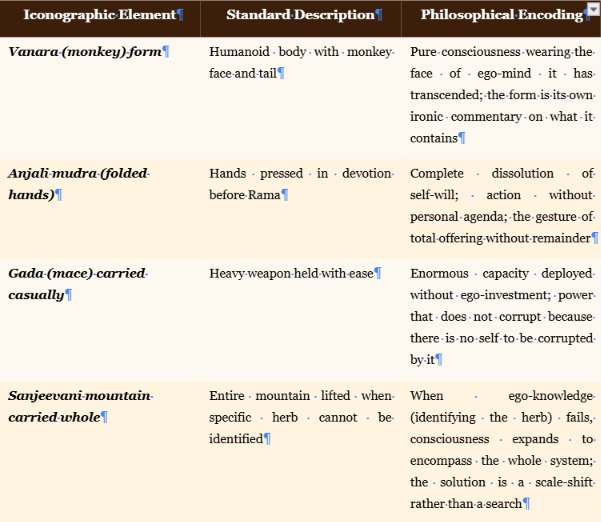
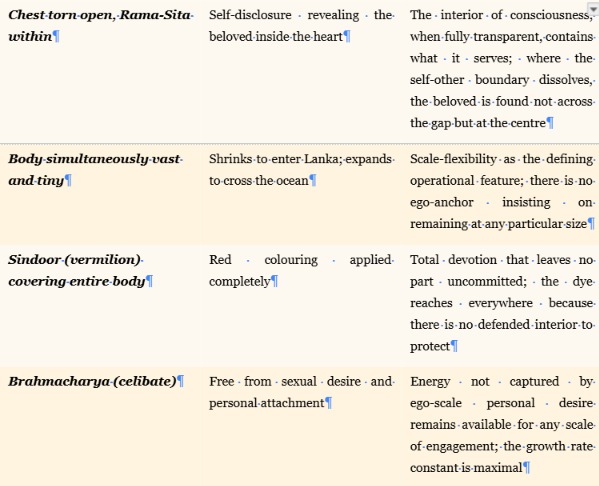

(Table 1. Classical Hanuman iconographic elements and their philosophical encodings. Each element constitutes an argument about the nature of ego-free consciousness in operation.)
The most philosophically precise of these elements is the torn-open chest. When challenged to demonstrate his devotion, Hanuman tears open his own chest to reveal Rama and Sita installed within his heart. The tradition renders this not with horror but with luminosity. What is being said is exact: the interior of consciousness, when fully transparent, contains the objects of its deepest attention. This is not a metaphor in the ordinary sense. It is a structural claim about awareness from which the self-other boundary has been dissolved. Where that boundary is intact, inside is private and outside is other. Where it dissolves, what you love is found not across a gap but woven into the fabric of your own awareness.
Hanuman can show this only because there is no ego-defended interior to protect. The traditional Indian understanding of the heart — Hridaya — is not the emotional heart of Western romanticism but the innermost cavity of awareness, the place where the self meets the Self. Hanuman’s chest opens to reveal that this innermost place contains Rama and Sita rather than Hanuman’s private world, because there is no Hanuman-as-separate-ego constituting a private world in the first place.
4. The Vishwarupa Parallel: Two Solutions to One Problem
You cannot see Me with these eyes. I give you divine eyes. Behold My power.
— Bhagavad Gita 11.8
4.1 The Same Philosophical Problem
The Bhagavad Gita and the Ramayana are working on the same problem from different directions: how to convey to ordinary human consciousness what pure, unlimited awareness looks like, and what it means for a being to operate from that awareness. Both traditions recognise that this cannot be accomplished through argument or description. Argument operates within the categories of ordinary mind; description uses the language ordinary mind has built. To show what lies beyond ordinary mind requires demonstration — something that can be witnessed directly, even if not yet embodied.
Both texts provide the demonstration. But their strategies are precisely opposite. The Vishwarupa overwhelms. Hanuman sustains.
4.2 The Vishwarupa: All Scales Simultaneously
The cosmic form Krishna reveals in Gita Chapter 11 is a total-scale simultaneous display. All entities, all times, all scales of existence appear at once within a single form. The sun and moon are its eyes. Its mouth consumes armies. Past and future are visible together. All the warriors of Kurukshetra are already entering its mouth before the battle has begun. Arjuna, given special divine eyes for the occasion, cannot sustain the vision. He is terrified. He begs for withdrawal. The Vishwarupa is withdrawn.
What it demonstrates is the ontological ground of consciousness: what reality ultimately is at the level of pure being, where every scale is present simultaneously and there is no fixed viewing position, no subject looking at objects from somewhere. The experience is unbearable for ordinary perception precisely because ordinary perception is structured by ego-consciousness, which requires that fixed position. Remove the position and ordinary awareness has nothing to hold.
4.3 Hanuman: One Scale at a Time, Over an Entire Epic
Hanuman provides the complementary demonstration. Where the Vishwarupa shows what consciousness is, Hanuman shows what consciousness does when operating freely in time. The demonstration does not require divine eyes. It does not overwhelm. It is distributed across thousands of verses, each turn revealing another facet of what consciousness can manage when ego-constraint is absent: the appropriate scale reached for each encounter, the proportionate response selected, the residue-free completion of each action.
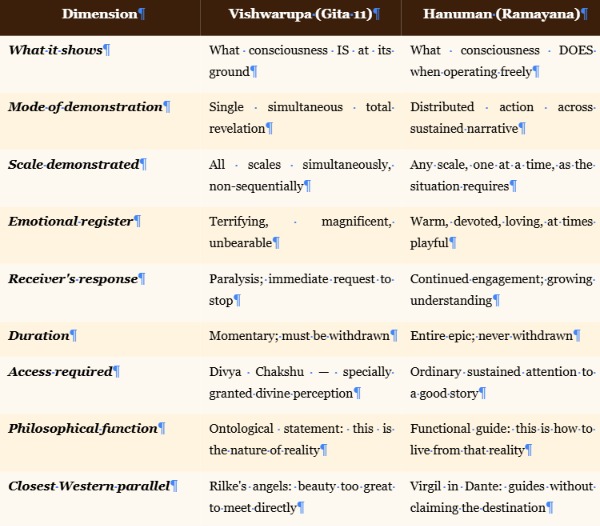
(Table 2. The Vishwarupa and Hanuman as complementary philosophical demonstrations. The Gita reveals the ground; the Ramayana demonstrates the operation.)
There is a further dimension often overlooked. The Vishwarupa requires Krishna to step outside his relational role — outside the friendship with Arjuna, outside the specific historical moment — to reveal the cosmic ground. After the revelation, Arjuna asks explicitly to see the familiar human form again. The cosmic disclosure disrupts the relationship and must be repaired.
Hanuman never disrupts relationship. His demonstrations occur within relationship, through relationship, as expressions of relationship. When he carries the entire mountain because he cannot identify the specific herb, he is not making a metaphysical argument — he is solving a problem that love has set him. The philosophy is entirely implicit in the action. This is why Hanuman is more practically instructive than the Vishwarupa. The Gita tells us what consciousness is. Hanuman shows us how to live.
5. The Indifferent Guide: Devotion Without Ownership
He has no stake in the outcome. He simply cannot stop serving.
— Traditional Ramayana commentary
The phrase that best describes Hanuman in his deepest philosophical function is the one that seems most paradoxical: the indifferent guide. Both words require careful unpacking, because each is doing exactly the right philosophical work.
5.1 What Indifference Actually Means
Indifference in ordinary usage means coldness, uninvolvement, the absence of care. This is emphatically not Hanuman. He weeps. He burns with a devotion so intense it is sometimes depicted literally, as fire. He tears open his chest. No quality of coldness attaches to any of this.
The philosophical indifference referred to here is Vairagya — not detachment from the world but freedom from ego-stake in outcome. This is precisely what the Gita’s most central verse prescribes:
Let right deeds be thy motive, not the fruit which comes from them. And live in the action! Labour! Make thine acts thy piety.
— Bhagavad Gita 2.47, Edwin Arnold translation
Hanuman is the embodied answer to the question: what does Nishkama Karma — action without desire for fruit — actually look like in a life? Not ascetic withdrawal. Not emotionless performance. Something more demanding and more human than either: total engagement without self-referential processing of the outcome. He crosses the ocean because it needs crossing, not because crossing it will make him Hanuman-the-great-ocean-crosser. Each action is complete in itself. No residue deposits in the actor.
5.2 What Guide Actually Means
Hanuman guides in the specific sense that he enables others to reach destinations he has no personal stake in reaching. He does not need to find Sita — he is not separated from her. He does not need to defeat Ravana — he has no personal grievance. He does not need Rama’s victory validated.
He guides because guidance is what consciousness naturally does when ego-agenda has been dissolved. With no personal destination to pursue, all available capacity becomes available for whoever stands before him. The Sanskrit term is Sakshi — the witnessing awareness that is fully present, fully attentive, fully responsive, and entirely without self-agenda. In cognitive science terms, Hanuman operates without the enormous processing cost that self-management ordinarily consumes. The energy ordinary consciousness spends defending self-concept, calculating social position, and processing the personal implications of every event is, in Hanuman, entirely available for the task at hand.
5.3 The Paradox Resolved: Total Devotion Without Attachment
Attachment requires an ego to be attached: some outcome must be experienced as necessary for the self’s integrity. Where there is no self-structure to be compromised, there is no attachment in this psychological sense. But devotion — Bhakti at its highest — requires no ego at all. It is a structural orientation of consciousness toward its deepest nature, encountered in the form of Rama. Hanuman’s devotion is total precisely because there is no Hanuman-ego competing with it for the available psychological resources. The devotion fills the entire space because nothing else is taking up part of that space.
This is what the torn-chest image finally says: open the interior and you find not Hanuman’s private history but Rama and Sita. The interior has been entirely given over — not as a sacrifice that cost something, but as the natural consequence of the dissolution of the boundary between self and beloved. The beloved is not encountered across a distance. It is found at the centre of the awareness that was always already open.
6. Cognate Figures in World Literary Tradition
If the reading proposed here is correct — that Hanuman is a narrative device for demonstrating pure consciousness operating in the world — then structurally similar devices should appear in other traditions that faced the same communication problem. They do, and the parallels are precise enough to be philosophically instructive rather than merely evocative.
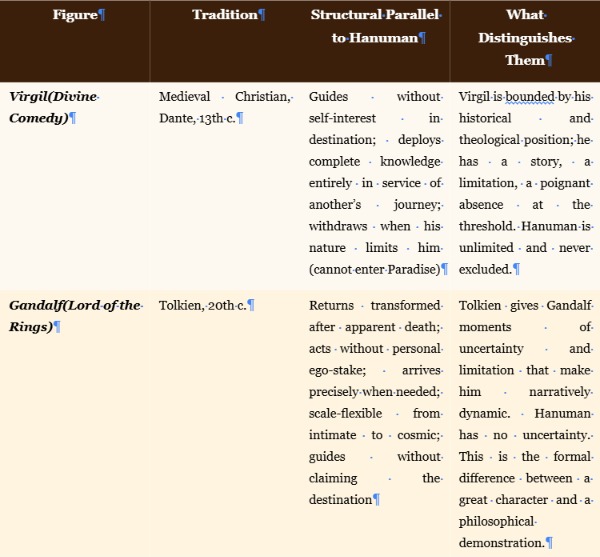
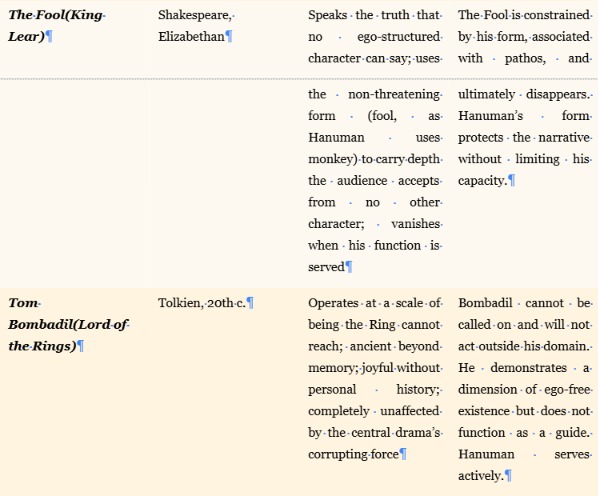
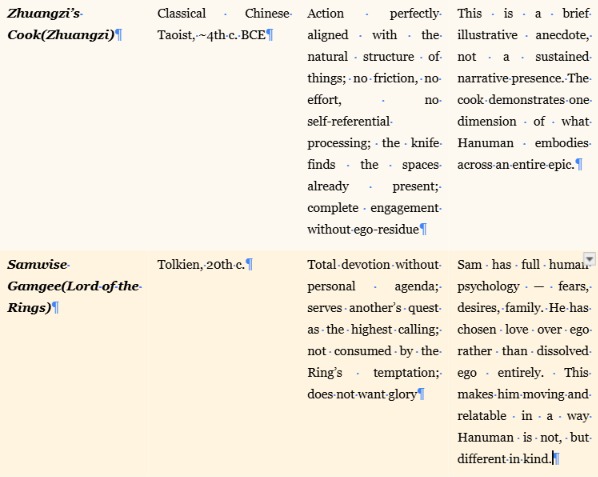
(Table 3. Structural cognates to Hanuman across world literary traditions. No single figure achieves what Hanuman achieves in its totality; each demonstrates one dimension of the complete portrait.)
What this comparative survey reveals is that no single figure in world literature achieves exactly what Hanuman achieves, because no other tradition embedded its deepest philosophical point in a character who is both fully present throughout a major narrative and entirely free from dramatic limitation arising from ego-structure. Virgil has limits. Gandalf has uncertainty. The Fool disappears. Bombadil will not act beyond his domain. Zhuangzi’s cook is a brief illustration. Sam has fears. Each demonstrates one aspect of what Hanuman demonstrates whole.
The same consciousness dynamics the Ramayana encodes in Hanuman appear across these traditions in partial form. Virgil demonstrates scale-flexible service without personal destination. Gandalf demonstrates the ceiling-raising event — death and return as a Jambavan Moment that raises Y and restores capacity. Zhuangzi’s Cook demonstrates Relational Depth at its finest: not knowing about the ox but inhabiting the structure of the ox so completely that the knife finds the spaces already present, leaving no resistance and no residue. Shakespeare’s Fool demonstrates the protective value of a non-threatening form: the monkey and the fool’s cap serve the same narrative function, permitting philosophical depth that no ego-structured character could carry without triggering defensive dismissal. What the conceptual framework developed in this paper offers is a single formal vocabulary for describing all of these partial demonstrations — and for explaining precisely why Hanuman, embedding the complete portrait in a sustained epic narrative, represents the most comprehensive literary realisation of this consciousness state that any tradition has produced.
A character who is still being actively called upon — in temples, in crisis, before examinations and journeys — has achieved something beyond literary success. He has become, for hundreds of millions of people, a genuinely available demonstration of what human consciousness looks like at its most expansive. That is the tradition’s greatest achievement in this figure: not a god to be petitioned, but a portrait to be recognised.
7. A Conceptual Mathematical Framework: From Story to Formal Structure
What the story shows without saying, the formula says without showing. Each needs the other.
— Author’s observation
The mathematical formulation presented in this section does not attempt to reduce mythological narrative to quantitative science, nor does it claim to measure consciousness empirically through the figures discussed above. Rather, it belongs to a broader conceptual framework developed by the author for describing consciousness states across literature, mythology, and contemplative traditions. Within that framework, the figure of Hanuman offers a particularly clear narrative demonstration of scale-flexible consciousness, allowing the conceptual structure of the model to be illustrated concretely and tested for internal coherence. The same framework applies, as noted in Section 6, to Virgil in Dante, Gandalf in Tolkien, Zhuangzi’s Cook Ding, and Shakespeare’s Fool — each embodying a partial form of the scale-flexibility dynamic that Hanuman embodies in its totality. What follows is therefore a conceptual formalisation, offered as a heuristic structure for thinking with precision about states that literary and philosophical traditions have long described in qualitative terms.
With this framing established, the conceptual derivation proceeds in four steps, each following from observations established in preceding sections.
7.1 Step One: The Scale Axis
Every entity exists at a characteristic scale. The human body, as the natural reference point of ordinary consciousness, can be assigned S = 0 on a logarithmic axis of spatial magnitude. We define:
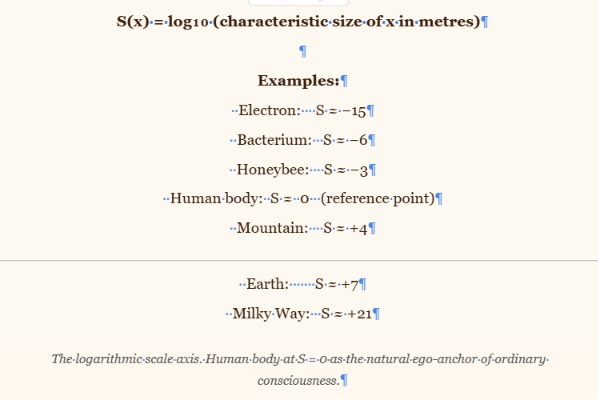
Within this conceptual framework, every entity can be assigned a representative scale value on a logarithmic axis of spatial magnitude. The human body, as the natural reference point of ordinary ego-bound consciousness, is assigned S = 0. The logarithmic treatment is chosen because the range of scales relevant to consciousness engagement spans approximately 35 orders of magnitude. On a linear scale, all biological entities would cluster invisibly near zero; the logarithm distributes them in a way that makes comparison tractable.
7.2 Step Two: The Required Shift
For genuine consciousness engagement with any entity, self-perception must reposition from its habitual anchor to the entity’s actual scale:
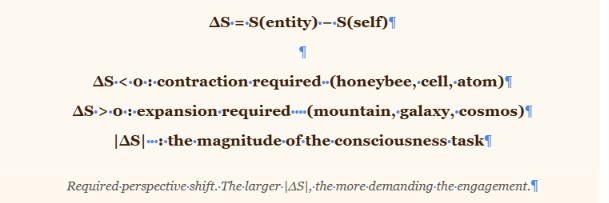
In this conceptual representation, Hanuman’s defining feature is that the magnitude of the required shift places no ceiling on his responsiveness. He shrinks to enter Lanka through a crack in the wall; he expands to carry the Sanjeevani mountain. The formal structure captures what the narrative shows: scale-flexible consciousness does not resist repositioning because there is no ego-anchor insisting on remaining at S = 0.
7.3 Step Three: Scaling Accuracy and the Consciousness Index
Scaling Accuracy (SA) measures how closely a being’s self-perception arrives at the entity’s actual scale during engagement:
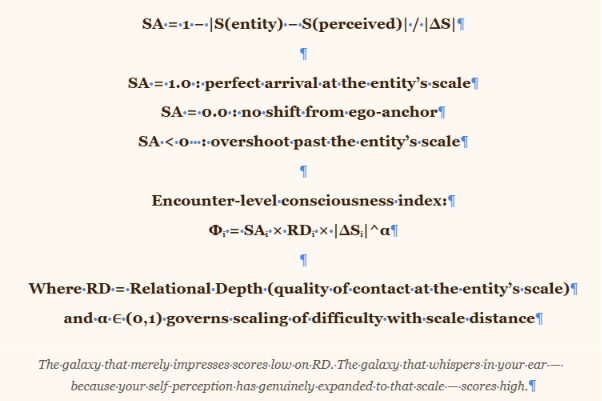
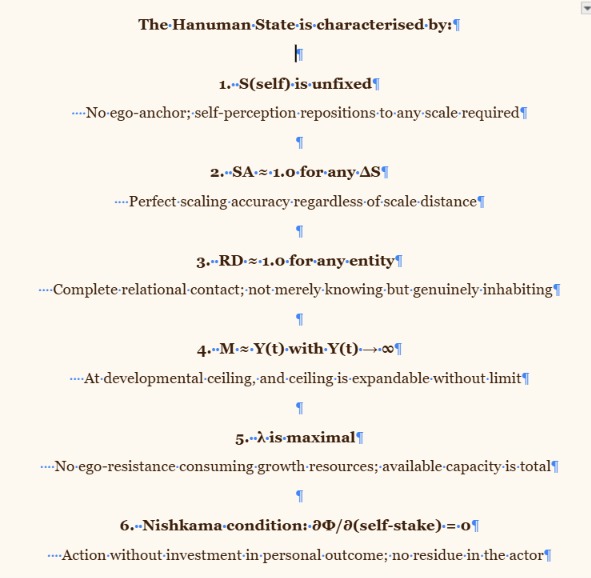
In this heuristic representation, Hanuman’s SA approaches 1.0 for any scale distance because there is no ego-anchor resisting repositioning. His RD approaches 1.0 because the absence of self-defensive structure allows complete engagement with the entity’s own nature. The conceptual result is that the consciousness index scales with the challenge itself: the more demanding the scale-shift, the higher the index value, because Hanuman meets every scale-shift fully. This is one formal way of representing what the tradition means by describing him as immortal and of inexhaustible capacity.
7.4 Step Four: The Developmental Law — dM/dt = λ · M · (Y−M)
The capacity for scale-flexible consciousness (M) develops through time according to a logistic growth equation. This is one of the most empirically robust mathematical forms in developmental biology and learning science:
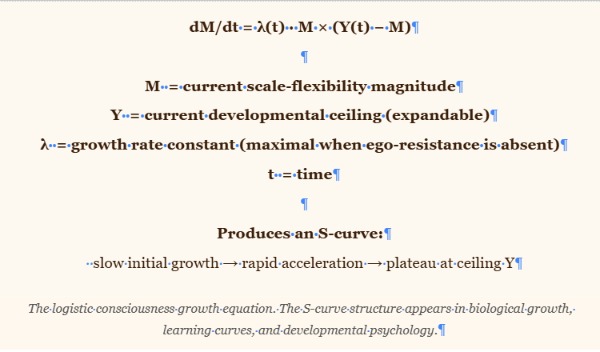
The critical insight that the Hanuman narrative reveals is that Y — the developmental ceiling — is not fixed. Each threshold-crossing event raises Y discontinuously, initiating a new S-curve. This is the Jambavan Moment: named for the episode that restores Hanuman’s access to his capacity:
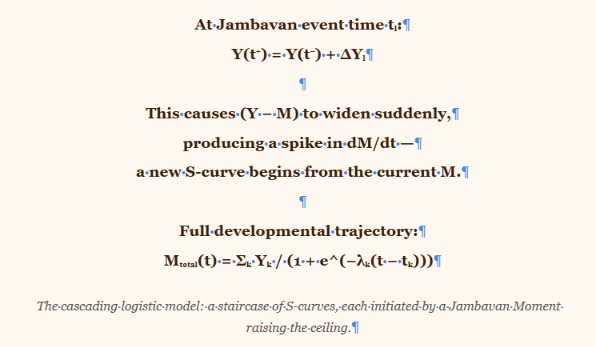
This conceptual model offers a formal representation of the Hanuman Paradox. The infant occupies M near Y1 where Y1 is the pre-egoic ceiling, naturally high because no ego-structure has formed to restrict it. The curse installs Manas — it does not reduce M directly but lowers the available ceiling Y to ego-body scale. With the ceiling at the level of M, the growth term approaches zero: development stops. The adult Hanuman is not diminished; he is plateaued beneath an artificially lowered ceiling. Jambavan’s reminder raises Y discontinuously — the Jambavan Moment — and M ascends the new S-curve rapidly. The capacity was never lost. The ceiling was the constraint.
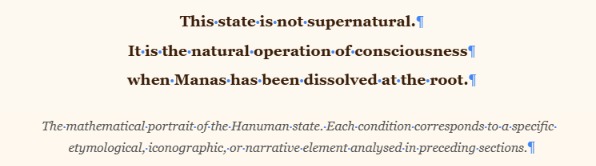
7.5 The Complete Mathematical Portrait of the Hanuman State
 8. What the Tradition Knew That We Are Rediscovering
The argument of this paper can be stated plainly: Hanuman is not a supernatural monkey-god. He is the tradition’s most sustained, most humanely rendered, and most practically instructive answer to the question of what consciousness looks like when it is no longer constrained by the ego-structure that ordinarily limits it.
The tradition knew several things about this state that contemporary consciousness research is only beginning to articulate formally. It knew that this state cannot be reached by suppressing the ego through force — that path produces not liberation but a more rigid and defended ego wearing the costume of renunciation. The dissolution must be genuine, as evidenced by the quality of Hanuman’s freedom: he weeps, he burns with devotion, he plays. None of this is the flatness of suppression.
It knew that scale-flexibility — the capacity to genuinely inhabit perspectives at very different scales from the habitual self-position — is the functional signature of this state. You cannot fake it. You can claim to care about the suffering of small creatures while remaining entirely ego-scale locked, and any person of sensitivity will detect the difference immediately. Hanuman’s credibility as a portrait of pure consciousness rests entirely on the enacted quality of his scale-shifts: always proportionate, always genuinely responsive, never performed for effect.
And it knew — perhaps most profoundly — that this state is not constitutively rare. It is not the exclusive property of a divine being who happens to be available for worship. It is a description of what ordinary human consciousness is capable of when the temporary overlay of Manas is seen for what it is: a learned restriction, installed by developmental necessity, removable by understanding.
The Jambavan who reminds you of your capacity is not always a bear-king in an ancient forest. Sometimes it is a sentence read at the right moment. Sometimes it is silence held long enough. Sometimes it is grief that finally cracks the defended interior open. The mechanism is always the same: Y rises, dM/dt spikes, and what was always present becomes available again.
Hanuman is the reminder. That is what he was always for.
9. Conclusion
We began with a monkey. We end with something considerably harder to name, but considerably easier to recognise.
The interpretive thesis of this paper can be stated plainly: Hanuman is not a supernatural monkey-god. He is the tradition’s most sustained, most humanely rendered, and most practically instructive answer to the question of what consciousness looks like when it is no longer constrained by the ego-structure that ordinarily limits it. He represents, in narrative form, four qualities that every contemplative tradition has described but few have portrayed with such sustained clarity: ego-free consciousness operating through perfectly calibrated intelligence; scale-flexible awareness that contracts toward the small and expands toward the vast with equal facility; devotion without self-appropriation, engaged with absolute totality yet leaving no personal residue; and the mind of a guide who has no destination of his own and therefore can serve any destination fully.
The etymological reading — Han + Manas, dissolution of the ego-appropriating mind — is offered as a philosophical hermeneutic, not a philological claim. It illuminates why the tradition has always understood Hanuman as something other than a powerful supernatural helper, and why the specific quality of his power — its warmth, its proportionality, its residue-free completion of every action — is inseparable from the absence of the ego-structure that ordinary power requires. The monkey form is the container that makes this philosophically impossible portrait possible: non-human enough for the narrative to permit it, warm enough for the reader to receive it.
The comparative literary analysis confirms that this portrait is universal in aspiration even when partial in achievement. Virgil, Gandalf, the Fool, Zhuangzi’s Cook, and Samwise each demonstrate one facet of what Hanuman demonstrates whole. The Vishwarupa in the Gita demonstrates the same truth from the other direction: where the Vishwarupa shows what pure consciousness is at its ground in a single overwhelming moment, Hanuman shows what it does across the span of a life and a story, in a form that never needs to be withdrawn.
The conceptual mathematical framework — the scale-flexibility index, the logistic growth model, the Jambavan Moment as a formal ceiling-raising event — is offered as one possible formal language for describing this state with precision. It does not claim to measure consciousness empirically or to reduce the Ramayana’s wisdom to equations. It claims only that the philosophical observations embedded in the Hanuman figure have a structure that can be represented formally, and that this representation may help readers trained in different disciplines to engage with insights the tradition has carried for two and a half millennia.
What the mathematics cannot capture — and should not try to — is the warmth. The weeping. The chest torn open to show what lives inside. The moment when Hanuman, asked to demonstrate his devotion, does not explain or defend or perform, but simply opens and shows.
That gesture — the opening that reveals nothing personal inside because everything personal has been given over — is older than the Ramayana and more recent than this morning. It is what consciousness looks like when it has remembered what it always was, before the useful and necessary and ultimately removable restriction of Manas settled over it like a well-fitted mask.
The monkey was never a monkey. The mask was always the point.
Jai Hanuman — जय हनुमान
The reminder is always available. The ceiling is always raiseable.
References
Primary Texts
1. Valmiki. (~500 BCE–100 CE). Ramayana [Critical Edition, 7 vols.]. (R.P. Goldman et al., Trans., 1984–2017). Princeton University Press.
2. Vyasa. (~400 BCE–400 CE). Bhagavad Gita [Mahabharata Book 6, Chs. 23–40]. (W. Johnson, Trans., 1994). Oxford University Press.
3. Tulsidas. (1574 CE). Ramcharitmanas. (F.R. Allchin, Trans., 1966). George Allen & Unwin.
4. Abhinavagupta. (~1000 CE). Tantraloka. (R. Gnoli, Trans., 1972). Istituto Italiano per il Medio ed Estremo Oriente.
5. Zhuangzi. (~300 BCE). Zhuangzi: The Complete Writings. (B. Ziporyn, Trans., 2020). Hackett Publishing.
6. Dante Alighieri. (1320 CE). La Divina Commedia. (A. Mandelbaum, Trans., 1980–1984). University of California Press.
Philosophical and Scholarly Works
1. Chalmers, D.J. (1996). The Conscious Mind: In Search of a Fundamental Theory. Oxford University Press.
2. Chinmayananda, Swami. (1982). Hanuman: The Perfect Devotee. Central Chinmaya Mission Trust.
3. Coomaraswamy, A.K. (1946). Hinduism and Buddhism. Philosophical Library.
4. Flood, G. (1996). An Introduction to Hinduism. Cambridge University Press.
5. Husserl, E. (1913/1982). Ideas Pertaining to a Pure Phenomenology. (F. Kersten, Trans.). Martinus Nijhoff.
6. Jung, C.G. (1959). The Archetypes and the Collective Unconscious. Collected Works Vol. 9. Princeton University Press.
7. Kramrisch, S. (1946). The Hindu Temple. 2 vols. University of Calcutta Press.
8. Lutgendorf, P. (2007). Hanuman’s Tale: The Messages of a Divine Monkey. Oxford University Press.
9. Patanjali. (~400 CE). Yoga Sutras. (G. Feuerstein, Trans. & Comm., 1989). Inner Traditions.
10. Ramanujan, A.K. (1991). Three Hundred Ramayanas. In P. Richman (Ed.), Many Ramayanas (pp. 22–49). University of California Press.
11. Varela, F.J., Thompson, E., & Rosch, E. (2016). The Embodied Mind (Rev. ed.). MIT Press.
Literary and Comparative Works
1. Bloom, H. (1994). The Western Canon. Harcourt Brace.
2. Campbell, J. (1949). The Hero with a Thousand Faces. Pantheon Books.
3. Shakespeare, W. (1608). King Lear. (R.A. Foakes, Ed., 1997). Arden Shakespeare.
4. Tolkien, J.R.R. (1954–1955). The Lord of the Rings. George Allen & Unwin.
Scientific References
1. Decety, J., & Lamm, C. (2007). The role of the right temporoparietal junction in social interaction. The Neuroscientist, 13(6), 580–593.
2. Galinsky, A.D., Magee, J.C., Inesi, M.E., & Gruenfeld, D.H. (2006). Power and perspectives not taken. Psychological Science, 17(12), 1068–1074.
3. Koch, C., Massimini, M., Boly, M., & Tononi, G. (2016). Neural correlates of consciousness: Progress and problems. Nature Reviews Neuroscience, 17(5), 307–321.
4. Metcalfe, J., & Wiebe, D. (1987). Intuition in insight and noninsight problem solving. Memory & Cognition, 15(3), 238–246.
5. Tang, Y.Y., Hölzel, B.K., & Posner, M.I. (2015). The neuroscience of mindfulness meditation. Nature Reviews Neuroscience, 16(4), 213–225.
6. Tononi, G. (2008). Consciousness as integrated information. Biological Bulletin, 215(3), 216–242.
Feature Image Credit: IStock
Disclaimer: The opinions expressed in this article belong to the author. Indic Today is neither responsible nor liable for the accuracy, completeness, suitability, or validity of any information in the article.