
Kunitha puruvamum kovvaicchev vaayil kuminchirippumPanitha sadaiyum pavalampol meniyil paalvenneerumInithamudaiya edutha porpaathamum kaanapetraalManithap piraviyum venduvadhe indha maanilatthe.
“The arched eyebrows; the bud-like gentle smile on the red lips resembling the ivy gourd fruit; the wet, matted locks of hair; the milky white ash smeared across a coral-red body; and the sweet, lifted golden foot… If one is blessed to see this form, then even a human birth on this vast earth is worth praying for.”
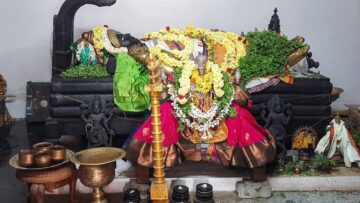
In the presence of Lord Nataraja at the revered Chidambaram Temple, I encountered an experience akin to that articulated by the esteemed Shaivite saint Thirunavukkarasar (Appar Nayanar) in his timeless hymn, Kunitha Puruvamum. Prior to this moment, his words resonated as exquisite poetry; however, within the sanctum, they transformed into a tangible experience. The elegant arch of His brows, the serene smile, the sacred ash embellishing His luminous form, and, most notably, the elevated golden foot of the Cosmic Dancer evoked a sensation transcending thought. Nataraja embodies Ananta (Infinite), Apratima (Without Equal), and Abhūtapūrva (Unprecedented). No description, regardless of its eloquence, can adequately encapsulate Him. He transcends mere understanding or explanation—He is to be experienced. In that sacred moment at Thillai, I comprehended why Appar Nayanar asserted that if one is graced with the vision of this divine form, then even a human birth on this earth is worth pursuing. As I stood before Thillai Natarajaswamy, I too perceived that this human existence had realized one of its highest purposes: to witness the Lord’s eternal Ananda Tandavam.
How Thillai Nataraja Swamy drew me to his presence
Upon returning from the spiritually enriching darshana of Sri Ranganathaswamy at Srirangam, I experienced a lingering sense of incompleteness despite the profound grace of Namma Sri Ranga. One sacred site, Chidambaram, persistently called to me. The very mention of Chidambaram evoked an indescribable curiosity. What is the “Chidambara Rahasya” that devotees revere? How does Lord Shiva manifest there? What distinguishes the Lord of Thillai, inspiring centuries of devotion from saints, philosophers, and seekers? These questions quietly persisted in my mind.
Unexpectedly, I recalled a request from my mother during my visit to Tiruvannamalai. She had asked me to bring back the sacred Vibhuti Prasadam from Arunachaleswara. Due to unavoidable circumstances, I was unable to fulfill this request, leaving a small regret in my heart. Unbeknownst to me, the prasadam I missed at Agni Lingam would eventually reach me through Akasha Lingam. Reflecting on this, I ponder whether it was Lord Thillai Natarajaswamy Himself who summoned me to Chidambaram to bless me with the Vibhuti Prasadam I could not obtain at Tiruvannamalai. Was this a mere coincidence, or was it His silent invitation to witness His presence? Perhaps some questions transcend logical explanation and are answered only through divine grace.
What Is the Itihāsa of Thillai Chidambaram Temple?
During my visits to numerous temples across Bharat, each distinguished by its unique characteristics, Chidambaram stood out as particularly distinctive. Unlike many other grand temples, it is not characterized by long queues or rushed darshanas. Instead, visitors are afforded the opportunity to walk, pause, absorb, and simply exist within the sacred space. The temple resembles a living civilization where devotion flows naturally, rather than a mere monument. It does not hasten the devotee; rather, it quietly invites participation in its timeless rhythm. Notably, within the same temple complex where Lord Nataraja performs His eternal Ananda Tandavam, Lord Vishnu is also present in His reclining form at the Govindaraja Perumal Temple, also known as Thiruchitrakoodam, one of the 108 Divya Desams. This site is among the rare locations in Bharat where both Shiva and Vishnu are venerated with equal reverence within the same sacred premises.
Prior to the construction of the grand gopurams, the area was known as Thillaivanam, characterized by a dense forest of Thillai trees (Excoecaria agallocha). This sacred forest served as a site where eminent sages engaged in tapas, aspiring to attain the ultimate truth. It was within this revered setting that Lord Shiva manifested Himself not solely as a Linga but as Nataraja, the Lord of the Cosmic Dance. The dance, termed Ananda Tandavam or the Dance of Bliss, transcends mere artistic expression, embodying the perpetual rhythm of the universe. Each movement signifies one of the Panchakrityas: creation (Srishti), preservation (Sthiti), dissolution (Samhara), concealment (Tirobhava), and grace (Anugraha). This dance illustrates that the cosmos is essentially the dynamic manifestation of Divine Consciousness.
A prominent legend associated with the temple narrates the story of a group of influential sages residing in the Daruka Forest. These sages, through their expertise in rituals and mantras, held the belief that sacrifices and karma solely governed the universe, denying the existence of a Supreme Being beyond them. To dispel their arrogance, Lord Shiva appeared as a wandering ascetic (Bhikshatana), accompanied by Lord Vishnu in the captivating form of Mohini. The sages, incensed, invoked formidable forces through their sacrificial fire. Initially, a ferocious tiger emerged, which Shiva effortlessly skinned and donned as His garment. Subsequently, venomous serpents were unleashed, which He calmly adorned as ornaments. Ultimately, the demon Muyalaka (Apasmara), symbolizing ignorance and forgetfulness, appeared. Shiva subdued ignorance by placing His right foot upon the dwarf and elevated His left foot in supreme grace. At this pivotal moment, He unveiled the Ananda Tandavam, witnessed by the entire universe. This form is presently enshrined as Sri Thillai Nataraja.
The Arrival of Sage Patanjali and Sage Vyaghrapada
Among the numerous sacred legends associated with Thillai Chidambaram, the narrative of Sage Patanjali and Sage Vyaghrapada holds particular significance, as it elucidates the revelation of the Lord’s Cosmic Dance to the world. According to the Sthala Purana, Sage Patanjali, revered as an incarnation of Adishesha—the divine serpent upon whom Lord Vishnu reclines—once observed the immense bliss experienced by Lord Vishnu while witnessing Shiva’s eternal dance. Driven by a profound desire to witness this divine spectacle himself, Patanjali sought the Lord’s guidance and was directed to the sacred forest of Thillai, where Lord Shiva had chosen to manifest His Ananda Tandavam.
Concurrently, another devoted sage, Vyaghrapada, had been engaged in rigorous penance in the forests of Thillai. His devotion was distinctive; he aspired to offer only the freshest and most untouched flowers to Lord Shiva and prayed for the ability to climb trees before dawn without disturbing the blossoms. Impressed by his sincerity, Lord Shiva granted him the claws and powerful feet of a tiger, enabling him to gather flowers untouched by bees or human hands. Consequently, he became known as Vyaghrapada, the “Tiger-Footed Sage.”
For years, both sages engaged in intense tapas with a singular aspiration: to witness the Lord’s Cosmic Dance. Their unwavering devotion ultimately culminated in Lord Nataraja manifesting in the Chit Sabha, the Hall of Consciousness, where He performed the sublime Ananda Tandavam before them. This was not an ordinary dance; it embodied the rhythm of creation, preservation, dissolution, concealment, and divine grace, expressed through every movement of the Lord. Even today, the images of Patanjali and Vyaghrapada remain within the Chit Sabha as perpetual witnesses to this divine event. Every pilgrim entering the sanctum is believed to spiritually join these two great sages, not merely as a spectator but as a seeker invited to witness the dance of Pure Consciousness.
Why Does Lord Govindaraja Perumal Reside Beside Lord Nataraja?
Long ago, there was a celestial contest that set the stage for a divine spectacle. Lord Shiva and Goddess Parvati, both masters of dance, decided to determine who among them held the title of the supreme dancer. To ensure fairness and impartially, the Devas turned to Lord Vishnu, summoning Him to act as the judge of this extraordinary event. With the utmost grace, Lord Vishnu called upon Vishvakarma, the celestial architect, to construct the splendid Chit Sabha, the Hall of Consciousness, where this divine dance would mesmerize gods, sages, and celestial beings alike. As the contest began, both Shiva and Parvati performed with incredible devotion and skill, their movements resonating with the very essence of cosmic rhythm and beauty. The atmosphere pulsed with energy as they danced, but it was during the climax when Lord Shiva executed the Urdhva Tandavam, raising His left foot high above His head, that the audience was spellbound.
Though Goddess Parvati could have mirrored this majestic movement, she chose to uphold her divine modesty and feminine grace, opting not to replicate it. In that moment, with a heart full of admiration for both dancers, Lord Vishnu ultimately declared Shiva the victor—not to diminish the glory of the Divine Mother, but rather to celebrate the unrivaled brilliance of the Cosmic Dancer. In the wake of this transcendent event, Lord Vishnu, deeply immersed in the bliss of witnessing the divine dance, decided to remain forever at Thillai, manifesting as Govindaraja Perumal. There, He would eternally observe the Ananda Tandavam of Lord Nataraja.
Where the Nayanmars Still Welcome Every Pilgrim
Crossing the Eastern Gopuram of Thillai Chidambaram presents a unique experience. Before observing the sanctum, one is captivated by the sculptures adorning the gateway, including the sculptures of the Nayanmars, revered Shaivite saints whose devotion continues to inspire devotees. These sculptures seem to welcome pilgrims into the abode of the Cosmic Dancer. Further into the temple, the Thillai Podu Deekshitars, the temple priests, draw attention. Their distinctive appearance, characterized by hair tied in a traditional knot and simple attire, reflects a life dedicated to Lord Nataraja. The Podu Deekshitars are an ancient hereditary community of Shaiva Brahmins, serving the temple for centuries and tracing their lineage through generations entrusted with the worship of Lord Nataraja. Unlike many temples where administration is managed by external authorities, the Deekshitars function as a collective body responsible for rituals, festivals, preservation of traditions, and administration of Chidambaram. Their lives revolve around the temple, performing rituals according to Agamic traditions preserved over centuries. Observing their disciplined and devoted movements within the temple is deeply inspiring. They do not merely perform priestly duties; they embody a living tradition that has endured the rise and fall of kingdoms. Over the years, they have preserved the temple’s customs and traditional administration system, even amidst legal and administrative challenges. As a pilgrim, the lasting impression is not the politics surrounding these events, but the community’s dedication to safeguarding one of Bharat’s spiritual treasures. Their unwavering devotion enhances the sanctity of the Thillai Chidambaram experience.
Experiencing the Sacred Spaces of Thillai
As I traversed the extensive sacred precincts of Thillai Chidambaram, it became evident that the temple serves as more than merely the residence of Lord Nataraja. Each mandapa, shrine, sculpture, and corridor appeared to convey a distinct narrative of Sanatana Dharma. The further I ventured into the temple, the more it became apparent that this was not solely a place of worship but a dynamic repository of Bharatiya civilization. A shrine that particularly captured my attention was that of Sri Shivakamasundari Amman, the Divine Consort of Lord Nataraja. Revered as the embodiment of Shakti, Her presence harmoniously complements the Cosmic Dance of the Lord, underscoring the inseparability of Shiva and Shakti. The walls surrounding the Amman shrine were embellished with vibrant paintings depicting the Divine Mother in Her various forms. Of particular interest were the artistic representations of several renowned Shakti temples of Tamil Nadu, celebrating the rich Devi tradition that has thrived in this sacred land for centuries. The colors, expressions, and intricate detailing of these paintings transformed the corridors into a visual pilgrimage through the many manifestations of the Divine Mother. Adjacent to the temple is the magnificent Shivaganga Theertham, the sacred temple tank. Vast, serene, and encircled by elegant stone steps, it exemplifies the grandeur characteristic of Chola temple architecture. Observing its expansive waters, one can only imagine its magnificence during major festivals. During my visit, however, devotees were not permitted to descend into the tank. While I fully respect the temple administration’s regulations, I quietly hoped for enhanced cleanliness of the surroundings, given the sanctity and historical significance of the theertham. This thought occurred to me while admiring an otherwise breathtaking sacred space. By divine coincidence, my visit coincided with the last day of the Adhika Maasam. The entire temple resonated with devotional energy. Vedic chants reverberated through the mandapas, bells rang continuously, devotees stood immersed in prayer, and elaborate rituals were conducted with extraordinary grandeur. Witnessing these celebrations made me feel profoundly fortunate, as though Lord Nataraja had chosen that very day to bestow upon me a glimpse of His festive glory. As I continued my pradakshina around the temple, I paused before a beautiful vigraha of Lord Ganesha. In that quiet moment, my mind was transported to Sasivekalu Ganesha at Hampi. Though separated by geography and centuries of history, both forms of Vighneshwara evoked the same comforting presence, reminding me that while temples may differ in architecture and tradition, the Divine lovingly accompanies the pilgrim wherever the journey unfolds.
Among the numerous shrines within the temple, the shrine dedicated to Sri Kala Bhairava was particularly striking. The atmosphere surrounding the deity exuded a quiet intensity, evoking both reverence and contemplation. Above the shrine, exquisite paintings depicted the Ashta Bhairavas, the eight manifestations of Bhairava, each symbolizing a distinct aspect of Lord Shiva’s protective and transformative power. These artistic representations contributed an additional layer of spiritual depth to the temple experience. The temple’s Goshala also provided immense joy. The sight of well-maintained cows resting peacefully within the temple grounds reflected the ancient Bharatiya tradition of Go Seva. Nearby, a majestic yet gentle elephant stood gracefully, delighting pilgrims who paused to receive its blessings. These seemingly simple moments underscored the fact that temples in Bharat have historically been comprehensive ecosystems where worship, nature, animals, and community coexist harmoniously.
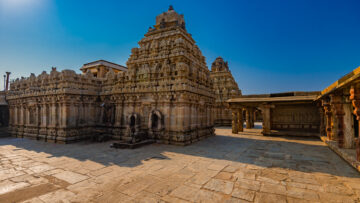
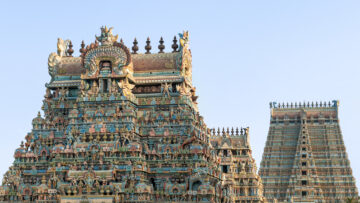
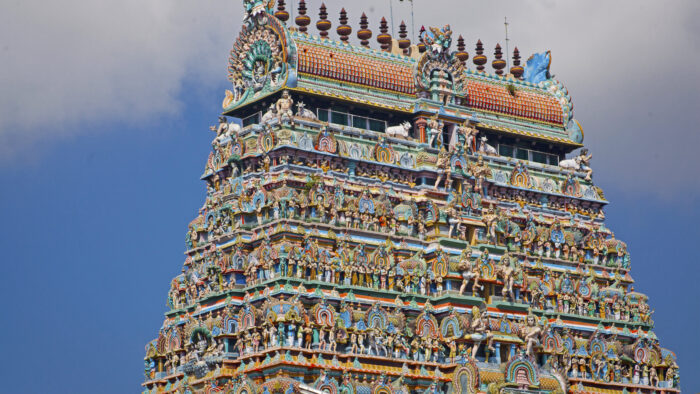
Throughout the temple, the extraordinary craftsmanship was evident. The stone pillars, intricately carved ceilings, elegant mandapas, and numerous sculpted deities demonstrated an astonishing level of artistic excellence. Many sculptures appeared almost three-dimensional, so lifelike that one could easily forget they were carved from solid granite centuries ago. Each carving reflected not only remarkable technical mastery but also profound spiritual symbolism. The towering gopurams, adorned with thousands of exquisitely sculpted figures from the Puranas and Agamas, served as silent teachers of Bharatiya philosophy, preserving stories that have inspired countless generations.
What Is the Chidambara Rahasya I Found?
Traditionally, the Chidambara Rahasya pertains to the “Secret of Chidambaram,” which signifies the revelation of the Supreme as formless Consciousness (Chit Akasha). Within the Chit Sabha, alongside Lord Nataraja, devotees observe what seems to be an empty space adorned with a few strands of golden Bilva leaves. However, this “emptiness” is symbolic of the Akasha Linga, representing the all-pervading, infinite Brahman that transcends all forms, names, and limitations. This is a significant assertion of Sanatana Dharma, indicating that the Supreme possesses both form (Saguna) and transcends all form (Nirguna). During my pilgrimage through Thillai, I encountered another aspect of the Chidambara Rahasya—one that manifested not behind a curtain, but through my journey within the temple.
For me, the Rahasya was embodied in the infinite Akasha, symbolizing the boundless grace of Lord Shiva. It was reflected in the serene presence of Sri Govindaraja Perumal, who eternally observes the Cosmic Dance, affirming the harmony between Shiva and Vishnu. It was evident in the Podu Deekshitars, whose lives are devoted to preserving centuries-old traditions with unwavering dedication. It was also present in the silent welcome of the 63 Nayanmars, whose sacrifices transformed their lives into enduring hymns of devotion. The temple’s magnificent architecture, sacred corridors, chants, sculptures, temple tank, and every stone seemed to resonate with divine consciousness.
As I traversed Thillai Chidambaram, I ceased to feel like a mere visitor. The temple invoked a profound awakening within me. Every atom of my being appeared to move in harmony with the eternal Ananda Tandavam of Lord Nataraja. In that moment, I comprehended that the Cosmic Dance is not confined to the Chit Sabha; it persists within the heart of every devotee who truly surrenders.
This may be the Rahasya that every Bharatiya should uncover—not merely the secret behind the curtain, but the living revelation that the Infinite resides in the boundless sky, in the dancing Lord, in His devotees, in the saints who dedicated their lives to Him, and in every sacred tradition that continues to uphold His presence. Chidambaram does not solely unveil the mystery of Shiva; it reveals the mystery of Bhakti itself. Once this Rahasya is experienced, it becomes evident that it cannot be fully articulated—it can only be lived.
Feature Image Credit: IStock
Disclaimer: The opinions expressed in this article belong to the author. Indic Today is neither responsible nor liable for the accuracy, completeness, suitability, or validity of any information in the article.