Arjuna, Kabir, and the Problem of Moral Authority in the Indic Tradition
The question before the answer
The Bhagavad Gītā is often remembered for its answer: follow your svadharma. Yet the text begins with a prior difficulty. Arjuna does not merely refuse to act; he says that his mind is bewildered about dharma. In 2.7 he describes himself as dharma-saṃmūḍha-cetāḥ and asks Kṛṣṇa to tell him what is truly śreyas, the better course. The dramatic force of the Gītā lies in this distinction. Arjuna knows who he is socially. He is a Pāṇḍava, a warrior, a disciple of Droṇa, a kinsman of Bhīṣma, and a claimant to a kingdom. What he does not know is which of these truths should govern action at that moment.
कार्पण्यदोषोपहतस्वभावः
पृच्छामि त्वां धर्मसंमूढचेताः।
यच्छ्रेयः स्यान्निश्चितं ब्रूहि तन्मे
शिष्यस्तेऽहं शाधि मां त्वां प्रपन्नम्॥ BG 2.7
kārpaṇya-doṣopahata-svabhāvaḥ |
pṛcchāmi tvāṃ dharma-saṃmūḍha-cetāḥ |
yac chreyaḥ syān niścitaṃ brūhi tan me |
śiṣyas te ’haṃ śādhi māṃ tvāṃ prapannam ||
(Arjuna says that his nature is overcome and his mind confused about dharma; he asks Kṛṣṇa to tell him decisively what is truly better and accepts him as teacher.)
That problem is more difficult than the familiar modern question, “What is my purpose?” Purpose can be imagined as something private: a vocation hidden within the self, waiting to be discovered. Dharma is harder because it emerges within a field of relationships, inherited duties, consequences, character, and spiritual aspiration. The question is not simply what one wants to do, but which claim upon the self deserves precedence when several claims are real.
This essay asks a narrow question with large consequences: who is entitled to tell a person what his or her dharma is? Scripture? Guru? Family? Social role? Conscience? Inner nature? The answer offered here is that the Indic tradition does not finally permit dharma to be outsourced to any single source of authority. Authority matters, sometimes decisively, but its task is to form discernment rather than abolish it.
Arjuna’s crisis is not ignorance of role
Bhagavad Gītā 3.35 gives the famous formulation: one’s own dharma, even imperfectly performed, is preferable to another’s well performed. The verse can easily be turned into a slogan of authenticity. Yet that reading overlooks Arjuna’s actual problem. If social identity alone settled svadharma, the war should present no philosophical difficulty. Arjuna is a kṣatriya; a righteous battle stands before him; therefore he must fight. But the Gītā spends eighteen chapters showing why such a conclusion cannot simply be announced.
श्रेयान्स्वधर्मो विगुणः परधर्मात्स्वनुष्ठितात्।
स्वधर्मे निधनं श्रेयः परधर्मो भयावहः॥ BG 3.35
śreyān sva-dharmo viguṇaḥ para-dharmāt svanuṣṭhitāt |
sva-dharme nidhanaṃ śreyaḥ para-dharmo bhayāvahaḥ ||
(One’s own dharma, even if imperfectly performed, is preferable to another’s well performed; remaining with one’s own dharma is presented as the safer course.)
Arjuna’s arguments in the first chapter invoke obligations to kin, teachers, family continuity, ritual order, and the social effects of civil destruction. These are not random excuses. They are competing moral descriptions of the same act. To fight is to uphold one set of obligations and violate another. To abstain is likewise not morally neutral.
This is why 2.7 matters more than many modern discussions of svadharma acknowledge. Arjuna’s problem is not, “What role have I been assigned?” It is, “When several duties converge on one action, how do I know which is dharma?” That is already a problem of moral authority. If one scriptural rule points one way, family duty another, and conscience a third, which voice adjudicates among them?
When inherited duty becomes morally difficult
The same problem appears outside the Gītā wherever inherited duties become morally costly. The Rāmcaritmānas preserves, in Anasūyā’s instruction to Sītā, an uncompromising articulation of pativratā-dharma. Even if a husband is old, ill, foolish, poor, blind, deaf, angry, or destitute, Anasūyā warns against dishonouring him; the passage soon formulates a single vow centred on devotion to the husband (Araṇyakāṇḍa 5).
The point is not to dismiss the passage with modern superiority. Its moral universe takes fidelity, endurance, and relational obligation with extreme seriousness. Those virtues are easily lost in cultures that treat every relationship as revocable when it becomes inconvenient.
But the passage also exposes a genuine philosophical problem. What if endurance becomes complicity in abuse? What if a social role is itself interpreted by those who benefit from another’s obedience? Does inherited duty remain binding merely because it is inherited? If the answer is yes, dharma collapses into power sanctified by antiquity. If the answer is no, then some faculty of moral discrimination must stand between prescription and action.
This difficulty is not a concession to a supposedly “Western” moral framework. The epics themselves are full of situations in which roles collide and moral certainty fails. The Mahābhārata is not memorable because everyone knows his dharma. It is memorable because characters repeatedly discover that dharma becomes most difficult precisely when every available action carries a moral cost.
The guru: authority or awakening?
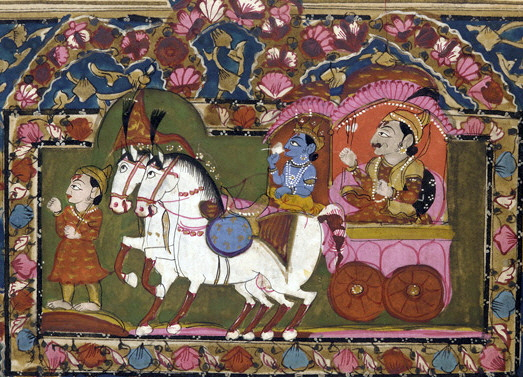
One possible answer is the guru. Arjuna himself becomes a disciple in 2.7. Yet the Gītā’s account of discipleship is subtler than obedience. In 4.34 Kṛṣṇa instructs the seeker to approach the knowledgeable through humility, service, and paripraśna: questioning, inquiry, interrogation undertaken in the right spirit.
तद्विद्धि प्रणिपातेन परिप्रश्नेन सेवया।
उपदेक्ष्यन्ति ते ज्ञानं ज्ञानिनस्तत्त्वदर्शिनः॥ BG 4.34
tad viddhi praṇipātena paripraśnena sevayā |
upadekṣyanti te jñānaṃ jñāninas tattva-darśinaḥ ||
(Knowledge is to be sought through reverent approach, sustained inquiry and service; those who know and see the truth can then instruct the seeker.)
The inclusion of paripraśna is philosophically decisive. The guru does not merely replace the disciple’s judgement with his own. A guru should reveal what the disciple cannot yet see, remove distortions, expose false premises, and train the faculty by which truth becomes recognisable.
This is why the end of the Gītā matters as much as the beginning. Having taught Arjuna, Kṛṣṇa does not close with “obey because I have spoken”. In 18.63 he asks Arjuna to reflect fully upon what has been taught and then act as he sees fit. The instruction does not convert the Gītā into modern individualism; Arjuna’s judgement has been formed through a sustained encounter with authority. But neither does Kṛṣṇa demand the permanent suspension of judgement.
इति ते ज्ञानमाख्यातं गुह्याद्गुह्यतरं मया।
विमृश्यैतदशेषेण यथेच्छसि तथा कुरु॥ BG 18.63
iti te jñānam ākhyātaṃ guhyād guhyataraṃ mayā |
vimṛśyaitad aśeṣeṇa yathecchasi tathā kuru ||
(Having taught Arjuna, Kṛṣṇa asks him to reflect fully on what has been said and then act as he judges appropriate.)
A sound guru therefore does not manufacture another person’s dharma. He makes discernment possible.
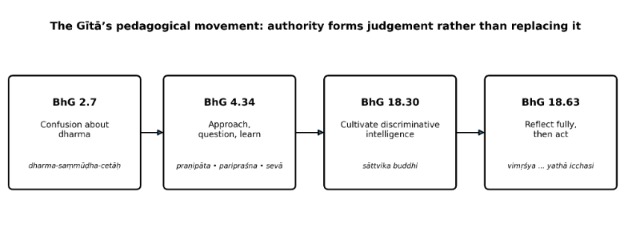 (Figure 1. The Gītā’s movement from moral confusion to inquiry, cultivated discrimination and reflective action.)
Kabir’s warning: not every authority deserves surrender
Kabir sharpens the same problem from another direction. The Bhakti tradition is often invoked as if it merely replaces institutional authority with inward feeling. Kabir is more demanding. He can exalt the satguru while simultaneously mocking false teachers, ritual pretence, and inherited claims to sanctity.
One of his bluntest couplets says: “jākā guru hai āndharā, celā kāh karāy; andhe andhā peliyā, dou kūp parāy” — if the guru himself is blind, what can the disciple do? One blind person pushes another, and both fall into the well. The image is severe because it rejects a lazy equation between authority and truth.
जाका गुरु है आँधरा, चेला काह कराय।
अंधे अंधा पेलिया, दोऊ कूप पराय॥
jākā guru hai ā̃dharā, celā kāh karāy |
andhe andhā peliyā, doū kūp parāy ||
(If the guru himself lacks discernment, the disciple cannot be saved by the mere fact of discipleship: one blind person leads another and both fall into the well.)
Elsewhere Kabir praises the true guru as one who removes the veil from the eyes. The contrast is revealing. A genuine teacher increases sight; a false teacher multiplies dependence. The criterion is not merely the institutional position “guru”, but what happens to the seeker’s capacity to perceive.
सतगुरु की महिमा अनँत, अनँत किया उपकार।
लोचन अनँत उघाड़िया, अनँत दिखावणहार॥
satguru kī mahimā anaṃt, anaṃt kiyā upakār |
locan anaṃt ughāṛiyā, anaṃt dikhāvaṇahār ||
(The true guru’s greatness lies in opening the seeker’s eyes: genuine authority enlarges vision rather than merely demanding dependence.)
This provides a powerful Indic answer to a contemporary anxiety. To resist blind obedience, one need not embrace the sovereign isolated self. The alternative is discriminating receptivity: remain teachable, but ask what the teaching does to one’s buddhi. Does it deepen clarity, responsibility, courage, and compassion? Or does it demand that one stop seeing contradictions that are plainly present?
Scripture does not interpret itself
The same applies to śāstra. To say that scripture is authoritative does not eliminate the question of interpretation. Texts speak through contexts, traditions, commentaries, hierarchies of application, and competing understandings of what is principal and what is conditional.
A person who says, “The scripture says so,” may still be selecting among scriptures, deciding which passage governs the case, determining whether an injunction is universal or contextual, and interpreting the language through a particular lineage. These acts of interpretation do not make scripture irrelevant. They make intellectual honesty necessary.
The Gītā itself contains multiple kinds of normative language: role-specific duty, universal virtues, yoga, renunciation, devotion, self-knowledge, equanimity, and concern for lokasaṃgraha, the holding together of the world. No serious reader can treat one isolated verse as though the rest of the text did not exist.
To inherit śāstra responsibly therefore requires more than quotation. It requires viveka: discrimination between principle and application, higher and lower ends, permanent and contextual claims, and the difference between using a text to illuminate a dilemma and using it to terminate thought.
The authority of svabhāva – and its danger
Modern readers often respond by moving authority inward: perhaps dharma is determined by svabhāva, one’s nature. This has a genuine basis in the Gītā. Chapter 18 links differentiated forms of work with dispositions arising from svabhāva, and 18.47 associates one’s own work with that nature.
श्रेयान्स्वधर्मो विगुणः परधर्मात्स्वनुष्ठितात्।
स्वभावनियतं कर्म कुर्वन्नाप्नोति किल्बिषम्॥ BG 18.47
śreyān sva-dharmo viguṇaḥ para-dharmāt svanuṣṭhitāt |
svabhāva-niyataṃ karma kurvan nāpnoti kilbiṣam ||
(One’s own dharma, though imperfect, is preferable to another’s; the verse connects one’s proper work with action shaped by svabhāva.)
Yet svabhāva cannot simply mean “whatever feels natural”. Human beings possess anger, fear, vanity, laziness, generosity, courage, and compassion in different mixtures. A disposition may explain behaviour without morally authorising it. The fact that a person is naturally dominant does not make domination dharmic. The fact that someone dislikes responsibility does not transform flight into renunciation.
Inner nature is therefore evidence, not verdict. It tells us something important about fit, capacity, temperament, and the kind of life one can inhabit without perpetual imitation. But nature must itself be educated. The Gītā is, among other things, a text about the transformation of the agent who acts.
This is why the modern language of “be yourself” is too thin for svadharma. Which self? The frightened self, the ambitious self, the disciplined self, the sāttvika self, or the self after years of practice and clearer knowledge? An appeal to authenticity only relocates the authority problem inside the person.
Buddhi: the authority that must be cultivated
The Gītā’s more compelling answer appears in its treatment of buddhi. In 18.30, sāttvika buddhi is described as the intelligence that knows action and withdrawal, what ought to be done and what ought not to be done, fear and fearlessness, bondage and liberation.
प्रवृत्तिं च निवृत्तिं च कार्याकार्ये भयाभये।
बन्धं मोक्षं च या वेत्ति बुद्धिः सा पार्थ सात्त्विकी॥ BG 18.30
pravṛttiṃ ca nivṛttiṃ ca kāryākārye bhayābhaye |
bandhaṃ mokṣaṃ ca yā vetti buddhiḥ sā pārtha sāttvikī ||
(Sāttvika buddhi is the intelligence that can distinguish engagement from withdrawal, what ought from what ought not to be done, fear from fearlessness, and bondage from liberation.)
That verse suggests that dharma is not always apprehended by possessing a rule. One must cultivate the capacity to see which rule, relation, consequence, and end matters in the present case. Buddhi is not an arbitrary opinion. It is judgement shaped by discipline, knowledge, detachment, and moral formation.
This is also why non-attachment matters epistemically. Attachment to prestige can make ambition appear as duty. Fear can make escape appear as renunciation. Desire for approval can make conformity appear as virtue. Resentment can make rebellion appear as authenticity. A less attached mind is not automatically correct, but it is less easily bribed by its own motives.
Dharma, on this reading, requires an educated judge. The deeper question is not only “Who told you this was your dharma?” but “In what kind of mind did you accept that claim?”
No single authority is enough
The result is not relativism. It is a layered account of moral authority.
Social role matters because we are relational beings, not self-created individuals. Śāstra matters because private moral intuition is fallible. Guru matters because the self can remain opaque to itself. Svabhāva matters because an imitative life is unstable. Consequences matter because action enters a shared world. Conscience matters because inherited institutions can become corrupt. Buddhi matters because none of these sources interprets itself.
Each source can correct another. Tradition can expose the narcissism of personal desire. Conscience can expose the cruelty hidden inside a custom. Guru can expose self-deception. Inquiry can expose a false guru. Svabhāva can expose imitation. Lokasaṃgraha can expose a supposedly spiritual choice whose costs are simply transferred to others.
This mutual correction is not a weakness of dharmic reasoning. It may be one of its deepest strengths. It refuses both the fantasy that morality can be reduced to a single algorithm and the opposite fantasy that sincerity alone makes a choice right.
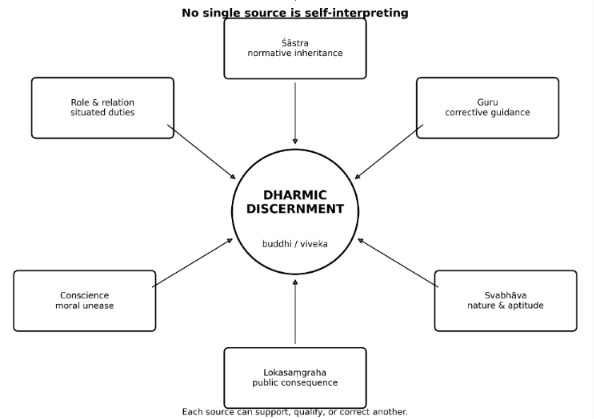
(Figure 2. A layered model of moral authority: no single source of dharma is self-interpreting; each can support, qualify or correct another )
Dharma is not outsourced
The contemporary world offers two inadequate pictures of moral adulthood. One imagines the mature person as someone who obeys the correct authority. The other imagines maturity as freedom from external authority altogether.
The Indic traditions considered here point towards a more difficult possibility. Moral maturity is the capacity to receive authority without surrendering discernment, and to exercise discernment without imagining oneself self-created.
Arjuna needs Kṛṣṇa because he cannot see clearly from within his own grief and attachment. Yet Kṛṣṇa ultimately returns the burden of action to Arjuna. Kabir needs the satguru because the veil over the eyes cannot always be removed alone; yet Kabir is merciless toward the guru who is himself blind. Tulsidas can articulate severe inherited duties, yet the wider epic and bhakti worlds continually remind the reader that no human social arrangement exhausts dharma.
Perhaps this is why dharma resists simple definition. It is not merely a command waiting to be obeyed, nor a preference waiting to be expressed. It is an order that must be discerned by a person who is simultaneously situated, fallible, teachable, responsible, and capable of moral insight.
So who tells you what your dharma is? Parents may tell you. Society may tell you. Scripture may tell you. A guru may tell you. Your temperament may tell you. Your conscience may tell you.
The Indic answer cannot be that all these voices are equal. Nor can it be that one voice is always sufficient.
The more demanding answer is that one must become capable of hearing them in the right order.
References
Abhilash Das, ed. Bījak: Pārakh Prabodhinī Vyākhyā. Kabir Parakh Sansthan, 1969. See p. 604 for “jākā guru hai āndharā”.
Bhagavad Gītā. Citations by chapter and verse. Primary verses and traditional commentaries cross-checked through Gita Supersite, Indian Institute of Technology Kanpur: 2.7, 3.20–26, 3.35, 4.34, 18.30, 18.41–48, 18.59–63.
Gowans, Christopher W. Self-Cultivation Philosophies in Ancient India, Greece, and China. Oxford University Press, 2021. See especially the chapter on the Bhagavad Gītā.
Hess, Linda, and Shukdeo Singh. The Bījak of Kabir. Oxford University Press, 2002.
Howard, Veena R. “Dharma-Saṃkaṭa: The Moral Dilemma in Hindu Ethics.” Journal of Religious Ethics, 2025.
Malinar, Angelika. The Bhagavadgītā: Doctrines and Contexts. Cambridge University Press, 2007.
Matilal, Bimal Krishna. Moral Dilemmas in the Mahābhārata. Indian Institute of Advanced Study, 1989; later reprints by Motilal Banarsidass.
Madhusūdana Sarasvatī. Gūḍhārthadīpikā on the Bhagavad Gītā. Relevant discussions at 3.35 and 18.47.
Rāmānuja. Gītābhāṣya. Relevant discussions at 3.35, 4.34 and 18.41–48; Sanskrit text and translations cross-checked via Gita Supersite, IIT Kanpur.
Śaṅkara. Bhagavadgītābhāṣya. Relevant discussions at 3.35, 4.34, 18.30 and 18.47; Sanskrit text and translations cross-checked via Gita Supersite, IIT Kanpur.
Theodor, Ithamar. The Philosophy of the Bhagavad-Gītā. Cambridge University Press, 2025. See especially Chapter 2, “Dharma, Karma-Yoga and Dharma-Yoga,” and Chapter 9 on the Gītā’s educational doctrine.
Tulsidas. Rāmcaritmānas, Araṇyakāṇḍa, Doha 5 and surrounding caupāīs (Anasūyā’s instruction to Sītā). Text cross-checked with the IIT Kanpur Rāmcaritmānas project.
Hindwi. “Jākā guru hai āndharā,” Kabir doha; source identified there as Bījak: Pārakh Prabodhinī Vyākhyā, ed. Abhilash Das, p. 604.
Hindwi. “Satguru kī mahimā anant…” in “Gurudev kau aṅg,” Kabir; used for the contrast between the sight-giving satguru and the blind guru.
Feature Image Credit: Wikicommons
Disclaimer: The opinions expressed in this article belong to the author. Indic Today is neither responsible nor liable for the accuracy, completeness, suitability, or validity of any information in the article.