
The mention of Madhugiri evokes vivid imagery of towering stone structures, sacred shrines, and a landscape where history and devotion are intricately intertwined. Located in the Tumakuru district of Karnataka, this remarkable town serves as a testament to the region’s enduring cultural and spiritual heritage. Often celebrated as the crown jewel of Tumakuru’s temple heritage, Madhugiri is not merely a geographical location but a living archive of faith, architecture, and historical memory. At an elevation of nearly 3,930 feet, Madhugiri is home to one of Asia’s largest monolithic hills—a massive rock formation that dominates the skyline and defines the town’s identity. Madhugiri was part of the domain of the Gangas and later came under the rule of the Nolambas. The hill, steep and imposing, is crowned by an ancient stronghold constructed in the 17th century by Raja Hire Gowda, a Palegara (local chieftain) under the Vijayanagara Empire. Access to its summit is marked by a sequence of gateways—Antarala Bagilu, Diddi Bagilu, and Mysuru Gate—each reflecting the strategic and architectural ingenuity of its time. The origins of Madhugiri’s name are deeply rooted in both nature and cultural imagination. Historically known as Maddagiri, the hill was believed to resemble a sleeping elephant (madda in local parlance). Over time, with the abundance of honeybee colonies in the region, the name evolved into Madhugiri—”the honey hill.” This transformation reflects not only linguistic change but also the intimate relationship between the landscape and the lives of its people. Beyond its imposing hill and historical fortifications, Madhugiri is revered for its rich constellation of temples. From the revered shrines of Sri Venkataramana Swamy and Sri Malleswara Swamy, built in the Dravidian style by Vijayanagara feudatories, to the enduring presence of the Dandina Maramma temple and a Jaina shrine within the hill precincts, the town exemplifies a vibrant tradition of religious coexistence and continuity. At the foothills of Madhugiri, the sacred landscape continues to unfold through living traditions of worship. Among these, the temple of Kote Kodandarama stands as an important spiritual landmark, anchoring the base of the monolithic hill. While the summit shelters the ruined Gopalakrishna shrine, the presence of the Kote Kodandarama temple below reflects a vertical sacred geography—where devotion spans from the base to the peak. Even amidst ruins, devotion persists—making Madhugiri a unique confluence of decline and devotion, where sacred traditions continue to thrive against the backdrop of timeworn stone.
The Defended Hill of Madhugiri
The origins of the prominent hill stronghold of Madhugiri are intricately linked to the Nada Prabhus, local chieftains who served as feudatories under the influential Vijayanagara Empire. Historical accounts recount the governance of seven brothers over various regions, establishing the political foundation that ultimately led to the construction of this strategic center:
Kaalanna Gowda – Kouravanna
Chennappa Gowda – Tereyuru
Kaalachikkappa Gowda – Gubbi and Hosahalli
Ramappa Gowda – Ennegere
Sangappa Gowda – Cheluuru
Hire Chikkappa Gowda – Bidare
Hire Gowda – Mummadi
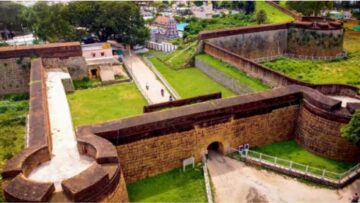
Among these figures, Hire Gowda played a pivotal role in shaping the military landscape of Madhugiri. Around 1670 CE, he erected the formidable hill stronghold atop a massive monolithic rock, which rises to nearly 3,950 feet. The location itself provided a natural defense, rendering it one of the most strategically secure structures in the region. The ascent to the summit reveals meticulous military planning, characterized by a series of gateways—Antarala Bagilu (Inner Gate), Diddi Bagilu, and Mysuru Bagilu—each designed to regulate movement and impede advancing enemies. The steep and narrow pathways further augmented its defensive capabilities, rendering the climb challenging even under peaceful conditions.
Within the enclosure, the stronghold functioned as a self-sustaining military center. Facilities for gunpowder production, weapon storage, and resource preservation underscore its preparedness for prolonged conflict. Notably, large storage jars (kanajas), still visible today at the summit, were employed to store honey—an abundant resource in the region. According to local legend, this honey was occasionally released down the slopes during enemy advances, causing attackers to slip and lose footing, exemplifying an ingenious use of natural resources in warfare. Over time, the stronghold came under the control of successive rulers. In 1678 CE the fort was captured by the Dalavayi of Mysuru Devaraja under Chikkadevaraja Wodeyar of the Mysore Kingdom, later seized by Hyder Ali, and further fortified under Tipu Sultan, who enhanced its military and architectural features.
As noted earlier, the Kote Kodandarama Temple is situated at the base within the hill enclosure of Madhugiri. Although regular rituals are no longer conducted, the structure continues to endure as a symbol of past devotion. At the top of hill, the remains of the Gopalakrishna Temple stand in a ruined state, and due to inadequate maintenance, ritual practices have ceased there as well. Today, this imposing structure stands as a silent testament to centuries of political transitions, engineering prowess, and strategic thought. However, the gradual deterioration of its walls and gateways due to natural forces and neglect raises concerns about its future. Preserving this historic stronghold is essential—not only as a relic of the past but as a vital symbol of Madhugiri’s enduring heritage.
Sri Venkataramana Swamy Temple: “Ihada Vaikuntha” (Vaikuntha on Earth)
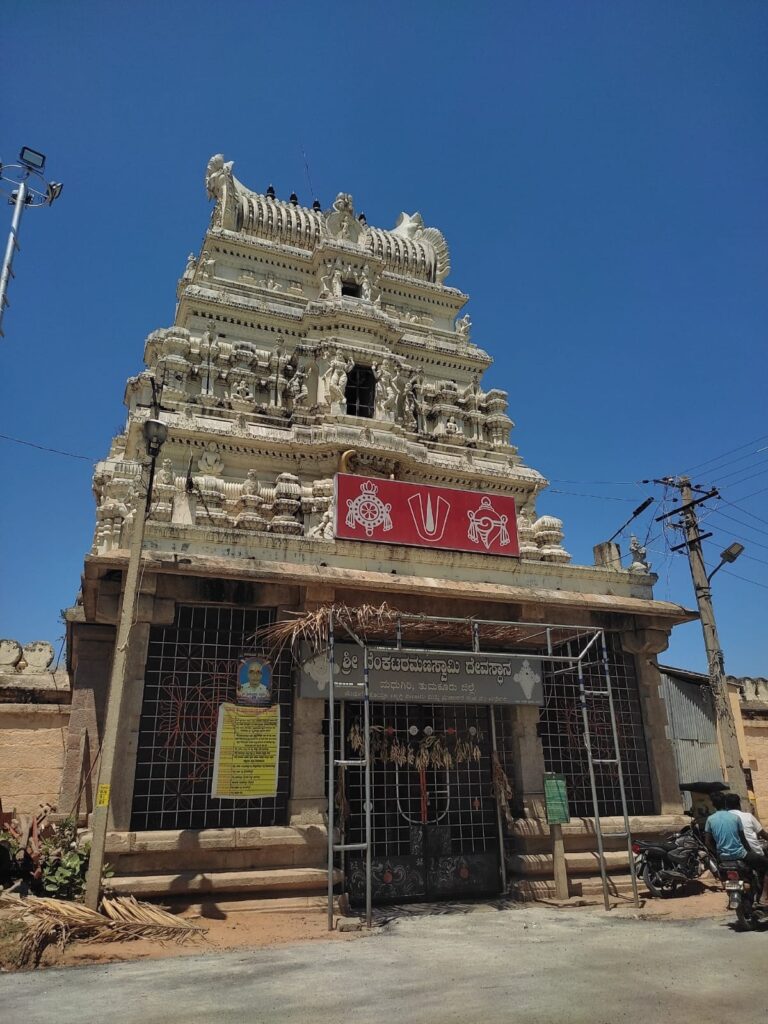
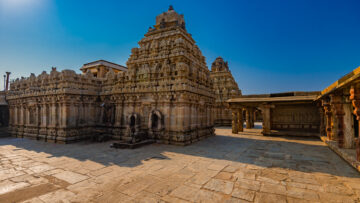
(Figure 1: Venkataramana Swamy Temple at Chikka Tirupati )
Located in the historic region of Madhugiri, the ancient temple of Venkataramana Swamy at Chikka Tirupati stands as a profound center of devotion and spiritual heritage. Revered as “Ihada Vaikuntha” (Vaikuntha on Earth), this temple embodies the sacred presence of Lord Vishnu in a form that closely resembles the iconic deity of Tirupati Temple—both in posture and divine expression. Constructed in 1690 CE in the classical Dravidian architectural style, the temple is a remarkable example of traditional South Indian temple design. It features a spacious inner courtyard, an imposing Mahadwara (grand entrance), and a sanctum sanctorum (Garbhagudi) that houses the main deity. The multi-tiered Rajagopuram, adorned with intricate carvings of gods and goddesses, rises majestically, offering a visually captivating experience that reflects both artistic excellence and spiritual symbolism. In front of the temple stands a finely carved, nearly 20-foot-tall statue of Garuda Anjaneya, adding to the grandeur of the sacred complex.
Though modest in scale compared to Tirupati, the temple is often regarded as a miniature reflection of it—capturing the same spiritual essence and architectural elegance. At the heart of the town, it serves not only as a place of worship but also as a cultural nucleus for the surrounding region. The temple’s origin is deeply rooted in a fascinating legend associated with Sappe Gowda, a local Palegar (chieftain), who aspired to build a Mukti Mandira (temple of liberation). Initially, he set out to install idols of Lord Rama, Lakshmana, Sita, and Sage Vashishta. However, during their journey, the idols are believed to have miraculously fixed themselves at a spot near present-day Dodda Hosahalli, signifying divine will. Accepting this as a sacred indication, a temple was established there, now known as the Yoga Rama Temple. Distressed yet devoted, Sappe Gowda later received a divine vision in which Lord Venkataramana revealed His presence within the waters of a nearby tank. Acting upon this vision, the idol of the Lord was discovered and consecrated at Madhugiri, along with the idols of Sri Devi and Bhu Devi. Since then, the temple has become a focal point of unwavering devotion.
Adding to its spiritual significance, the nearby Malleshwara Swamy Temple stands adjacent to it, symbolizing the unity of Hari (Vishnu) and Hara (Shiva), reinforcing the philosophical idea of divine oneness. Daily rituals and poojas are conducted with discipline and devotion, while major festivals such as Rama Navami, Kartika Deepotsava, Mukkoti Dwadashi, and Brahmarathotsava are celebrated with grandeur. A unique tradition is observed during Uttarayana, especially on Sankranti, when the northern gate of the temple is opened—devotees believe that passing through it with sincere devotion leads to spiritual liberation.
Even today, the temple continues to radiate as a living center of faith, truly embodying its title—“Ihada Vaikuntha,” the Vaikuntha on Earth.
Malleshwara Temple – An ancient abode of Mahadeva
The Malleshwara Temple of Madhugiri stands as a remarkable testament to the region’s sacred architecture and enduring devotional traditions. Built in the 17th century by Mummadi Chikkappa Gowda, a distinguished Nadaprabhu (local chieftain), the temple reflects both the political patronage and spiritual aspirations of its time. Oriented eastward, the structure is hewn entirely from granite and unfolds through a harmonious sequence of architectural spaces—the Garbhagriha (sanctum), Antarala (vestibule), Ardha Mantapa, Navaranga, Mukha Mantapa, Maha Mantapa, Nandi Mantapa, and an imposing Mahadwara—each contributing to its grandeur and ritual functionality.
At the spiritual core of the temple resides a Swayambhu Shiva Linga (self-manifested linga), established upon a finely proportioned Panipitha rising approximately 45.72 cm in height. This sacred presence anchors the temple’s identity as a center of Shaiva worship. Surrounding the main shrine is a rich constellation of subsidiary deities—Parvati, Mahishasuramardini, Subramanya, Tandaveshwara, and Krishna, alongside Veerabhadra and Kalabhairava—collectively embodying the theological diversity and symbolic depth of the tradition. Rows of smaller chambers housing multiple lingas further enrich the sacred landscape, while the elegantly designed Kalyana Mantapa speaks to the temple’s role in ceremonial and communal life.
Facing the sanctum, within the mandapa, sits a beautifully polished sculpture of Nandi, its form adorned with delicately carved bells and ornamental bands, exuding both strength and serenity. In front of the temple rises a stately Deepa Stambha (lamp pillar), nearly 6 meters in height, crowned with a small pavilion meant for the placement of lamps—an evocative feature that, when illuminated, would have once bathed the temple in a radiant spiritual glow.
A particularly significant aspect of this sacred complex is its close ritual and spatial relationship with the nearby Venkataramana Swamy Temple. Both temples share a common precinct, symbolizing a deep theological and spatial unity. During the auspicious occasion of Vaikuntha Ekadashi, a unique ritual sequence is observed that connects the two shrines.
On this sacred day, devotees first enter the Malleshwara Swamy Temple and seek the darshana of Lord Shiva. Only after this do they proceed toward the Venkataramana Swamy Temple, where the northern gate (Uttara Dvara) is ceremonially opened. Passing through this northern gate is believed to bestow divine blessings and spiritual merit upon the devotees.
This ritual order—beginning with Malleshwara and culminating in Venkataramana—beautifully reflects the philosophical unity between Shiva and Vishnu. It embodies the concept of Harihara, where both deities are understood as manifestations of the same ultimate reality. Thus, the shared sacred space and interconnected rituals of these temples stand as a living expression of harmony within Hindu devotional traditions.
Bhagawan Mallinatha Jaina Temple
The temple of Mallinatha at Madhugiri serves as a significant testament to the region’s Jain heritage and early religious history. Constructed in 1531 CE, the temple’s origins are corroborated by an inscription from the same year, which documents that the land for its establishment was generously donated by Jayamma, the wife of Govindanamayya. This act of patronage underscores the role of local elites and lay devotees in sustaining Jain religious institutions during this period. The temple, constructed in stone, embodies the simplicity and spiritual focus characteristic of Jain architecture. At its entrance stands a Manasthambha (pillar of honor), symbolizing humility and the renunciation of ego before entering the sacred space. Within the sanctum resides the idol of Bhagawan Mallinatha, crafted in Panchaloha (an alloy of five metals), depicted in the kadgasana posture—an upright meditative stance associated with ascetic discipline and spiritual steadfastness.
Dandina Maramma Temple: The Guardian Deity of Madhugiri
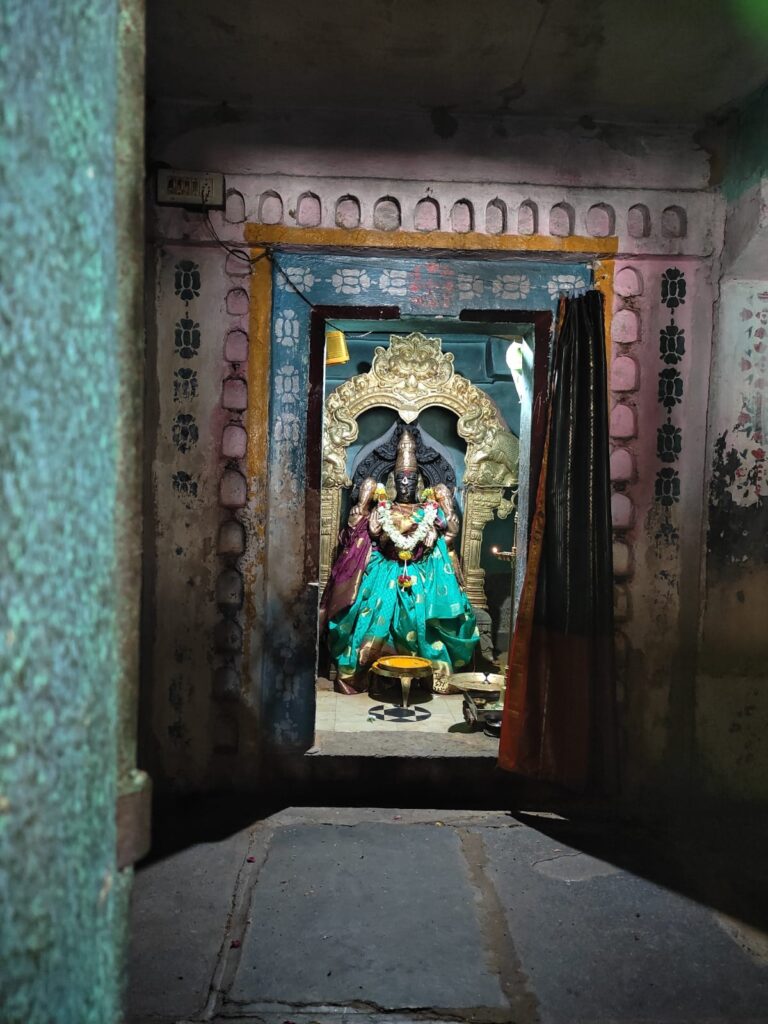
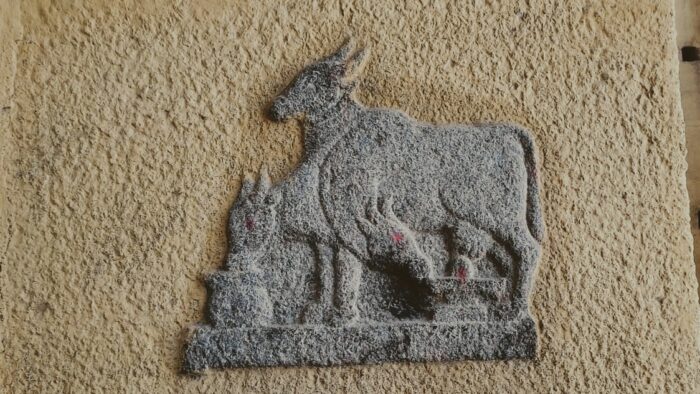
(Figure 2: Grama Devathe of Madhugiri –Dandina Maramma )
Dandina Maramma is revered as the Grama Devathe (town deity) of Madhugiri and its surrounding rural landscape, embodying the protective spirit and collective faith of the community. The temple dedicated to the Goddess was established in 1530 CE by Chikkappa Gowda, the ruler of Bijjavara, making it one of the earliest and most culturally significant shrines in the region.
Local tradition holds that the consecration of the deity took place in the presence of Vyasaraja (Vyasarayaru), the revered Rajaguru of Krishnadevaraya. While this association reflects the temple’s connection to the broader religious milieu of the Vijayanagara Empire, it remains part of local tradition rather than firmly established inscriptional evidence.
As a Grama Devathe, Dandina Maramma occupies a central place in the everyday religious life of the people. Unlike classical temple deities confined primarily to ritual spaces, she is intimately associated with the well-being, protection, and prosperity of the community. Devotees turn to her in times of distress, seeking relief from disease, protection from calamities, and blessings for social harmony—reflecting a vibrant and enduring tradition of folk religiosity.
Strategically located at the entrance of the town, the temple functions as both a spiritual threshold and a cultural marker of Madhugiri. Though modest in architectural scale when compared to the grand Dravidian temples in the region, its importance lies in its deep-rooted connection to the lived experiences of the people.
A major highlight of the temple’s ritual calendar is the annual jatre (festival), which draws large gatherings from surrounding villages. Among its most significant events are the Belli Pallakki (silver palanquin procession) and the Agnikunda (fire ritual), performed in a sequential manner on consecutive days. These rituals, rich in symbolism and collective participation, reflect deep-rooted devotional practices and reinforce the cultural cohesion of the community.
Thus, the Dandina Maramma Temple stands as a vital component of Madhugiri’s sacred landscape—bridging the historical legacy of the Vijayanagara period with continuing traditions of devotion, and reminding us that heritage is sustained not only through monuments, but through living faith.
Madhugiri as the Crown Jewel of Tumakuru’s Temple Heritage
The sacred landscape of Madhugiri reveals a remarkable confluence of history, devotion, and cultural continuity. From the towering hill and its enduring stronghold to the temples of Malleshwara Swamy, Venkataramana Swamy, Mallinatha, and Dandina Maramma, the town stands as a living embodiment of spiritual plurality and historical depth. Each shrine, whether grand or modest, contributes to a larger narrative that justifies its title as the “Crown Jewel of Tumakuru’s Temple Heritage.”
Beyond these prominent temples, the town is also home to numerous smaller shrines dedicated to Rama, Hanuman, and Raghavendra Swamy. Though modest in scale, these temples appear equally ancient in their presence and devotion. However, due to the absence of verifiable historical records or inscriptional evidence regarding their origins, they have not been examined in detail within this study. The focus here has remained on temples for which relatively reliable information is available—drawn primarily from officially displayed materials and government notices, often found within temple premises.
Yet, beyond documentation and historiography lies a more intimate dimension of Madhugiri—one that cannot be captured solely through records. For me, this town has always held a special place in the heart. Its rugged beauty, its sacred spaces, and its quiet continuity evoke a sense of timelessness. Each visit to its temples and the hill evokes an almost palpable aura of past kingdoms, as though the echoes of history continue to resonate within its stones even in the 21st century. This unique blend of antiquity and living tradition gives Madhugiri its distinct aesthetic and spiritual charm.
It is this experience—of walking through history, of witnessing devotion carved in stone, and of feeling the silent presence of a bygone era—that defines Madhugiri. And it is this very experience that I wish every reader to encounter at least once in their lifetime.
Disclaimer: The opinions expressed in this article belong to the author. Indic Today is neither responsible nor liable for the accuracy, completeness, suitability, or validity of any information in the article.