
Humanity is facing an unprecedented mental health challenge. Nearly 1.2 billion people globally are living with a diagnosable mental health disorder. This marks a staggering 95.5% increase since 1990. Anxiety and Depression remain the most common drivers of the crisis. Anxiety disorders have surged by 158% and depressive disorders by 131% over the last three decades.
The Global Burden of Disease Study, published in The Lancet Psychiatry (2020), estimated that nearly 197 million Indians were living with mental health conditions in 2017 – roughly one in every seven people! According to the recent India Health Quotient (IHQ) survey, a massive 82% of urban Indians report experiencing high stress, and 14% classify that stress as completely unmanageable.
This means millions among us struggle with anxiety, depression, chronic stress, burnout, and psychosomatic illness. Modern psychiatry and psychology have made remarkable advances in understanding and treating these conditions. Yet beneath diagnosis and treatment, a deeper question remains:
Why Does Suffering Arise in the First Place?
Most therapeutic approaches focus on symptoms – reducing anxiety, regulating mood, improving behavior, or changing patterns of thought. These interventions are invaluable. Yet beneath the symptoms lies a more fundamental human experience: our tendency to become identified with our passing thoughts, emotions, and bodily sensations.
Ancient Indian contemplative traditions diagnosed this problem thousands of years ago. They called it Avidyā – a fundamental misidentification of the Self with the body and mind.
The Ancient Diagnosis
Consider a simple example. A thought arises: “I am a failure.” Most of us do not merely observe this thought. We become it. The thought merges with identity. Similarly, when anxiety appears, we say, “I am anxious.” When grief appears, “I am broken.” When anger appears, “I am angry.”
In classical Indian psychology, this fusion is the beginning of suffering. Patañjali describes this condition with remarkable precision:
योगश्चित्तवृत्तिनिरोधः । तदा द्रष्टुः स्वरूपेऽवस्थानम् । वृत्तिसारूप्यमितरत्र ॥
(Yoga is the stilling of the fluctuations of the mind. Then the Seer abides in its own nature. At other times, it becomes identified with those fluctuations. (Yoga Sūtras of Patañjali 1.2–1.4))
The implication is profound. Suffering does not arise merely because thoughts, emotions and sensations exist. It arises because awareness becomes entangled in them, mistaking them for its very identity.
Different Indian traditions express this insight in different ways – and yet, across every lineage, the same diagnosis emerges.
Yoga Sūtras: Avidyā
The root cause of suffering is misidentification – the confusion of the witnessing Self with the fluctuations of the mind.
अिवद्याक्षेत्रमुत्तरेषां प्रसुप्ततनुिविच्छन्नोदाराणाम्
(Avidyā (ignorance) is the source field for the remaining four kleśas- asmitā (egoism), rāga (attachment), dveṣa (aversion), and abhiniveśa (clinging to life). (Yoga Sūtras of Patañjali 2.3-2.5))
Yoga is the art of stilling those fluctuations so the Seer can abide in its own nature.
Bhagavad Gītā: Kṣetra & Kṣetrajña
The Gītā distinguishes between the Field – body, thoughts, emotions, roles – and the Knower of the Field. Suffering deepens when the Knower forgets itself and merges with the Field.
इदं शरीरं कौन्तेय क्षेत्रमित्यभिधीयते । एतद्यो वेत्ति तं प्राहुः क्षेत्रज्ञ इति तद्विदः ॥
(This body, O Arjuna, is called the Field. One who knows this field is called the Knower of the Field. (Bhagavad Gītā 13.2))
Ayurveda: Prajñāparādha
Ayurveda names the root of illness as a failure of discernment – a collapse of the intellect’s capacity to distinguish what nourishes from what harms. Healing is the restoration of that clarity.
आत्मानमेव मन्येत कर्तारं सुखदुःखयोः| तस्माच्छ्रेयस्करं मार्गं प्रतिपद्येत नो त्रसेत्||
(One should hold oneself responsible for one’s happiness and misery. Therefore, one should walk the path of well-being without fear. (Caraka Saṃhitā, Nidāna Sthāna 7.22))
Tamil Siddha Tradition: The Body as Temple
Witnessing is not a rejection of embodiment. Thirumūlar teaches that awareness and the body are complementary – once the Supreme Reality is discovered within, the body itself becomes worthy of reverence.
உடம்பினை முன்னம் இழுக்கென் றிருந்தேன்
உடம்பினுக் குள்ளே யுறுபொருள் கண்டேன்
உடம்புளே உத்தமன் கோயில்கொண் டான் என்று
உடம்பினை யானிருந் தோம்புகின் றேனே
(Once I regarded the body as impure. Then I discovered the Supreme Reality within it. Realizing that the Divine had made this body Its temple, I began to care for it with reverence. (Thirumantiram 725))
Different traditions. Different vocabularies. Same diagnosis.
All point toward a single insight: suffering deepens when awareness forgets its own nature and becomes entangled in what it experiences.
The Witness Within
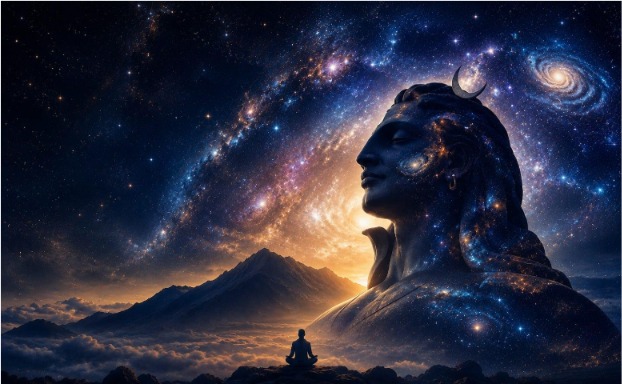
The Sanskrit term Sākṣī Bhāva is often translated as witness-consciousness. But witnessing does not mean withdrawal from life. Nor does it imply dissociation. A dissociated person disconnects from experience. A witness remains fully present while no longer becoming trapped within experience.
Consider you are watching a film in a theatre. During the movie, you laugh, cry, become anxious, feel hope, and experience suspense. For a few moments, you become completely immersed in the story unfolding on the screen. Yet throughout the entire experience, one fact remains unchanged: you are not actually the character in the film.
The moment you remember you are the observer rather than the protagonist, a subtle freedom appears. The emotions may continue, but they are no longer overwhelming. Much of human suffering follows a similar pattern. Thoughts, emotions, fears, and memories play across the mind’s screen. Problems arise when we forget that we are the one watching the movie and begin to believe that we are the movie itself.
Sākṣī Bhāva is the art of remembering the difference. The body changes. Thoughts change. Emotions change. Roles change. Yet something remains aware of all these changes. From this perspective, healing begins when we rediscover the distinction between awareness and its contents.
The Gītā does not ask us to withdraw from life. It asks us to engage with life from a place of inner balance.
योगस्थः कुरु कर्माणि सङ्गं त्यक्त्वा धनञ्जय । सिद्ध्यसिद्ध्योः समो भूत्वा समत्वं योग उच्यते ॥
(Established in Yoga, act. Remaining equal in success and failure – this equanimity is called Yoga. (Bhagavad Gītā 2.48))
In modern psychological language, we might call this resilience, emotional regulation, or cognitive flexibility. The Gītā calls it Samatva – equanimity or inner balance.
Once there is Equanimity, every cell in your body will generate Sweetness. -Sadhguru
A Meeting Point Between Ancient Wisdom and Modern Psychology
Interestingly, contemporary psychology has arrived at similar insights through different languages. Many evidence-based therapies emphasize concepts such as decentering, cognitive defusion, meta-awareness, psychological flexibility, and the observing self – approaches that help individuals step back from thoughts rather than becoming consumed by them.
Ancient Indian traditions proposed a comparable process long ago. Modern psychology generally treats witnessing as a function of the mind. Indian contemplative traditions suggest that witnessing is the very nature of consciousness itself. Whether one accepts that ontological claim or not, both traditions converge on an important observation:
Freedom begins when we stop identifying completely with our mental contents.
From Philosophy to Practice
A philosophical insight becomes meaningful only when it can be lived. One contemporary example is the Miracle of Mind meditation practice, which draws upon contemplative inquiry to cultivate Sākṣī Bhāva through a process of disidentification.
At its heart, this approach echoes the ancient Upaniṣadic method of neti neti (नेति नेति)—”not this, not this.” Rather than defining what the Self is, the seeker is invited to recognize what the Self is not. By progressively disidentifying from the body, thoughts, emotions, and mental constructs, awareness is directed toward its witnessing nature.
The contemplation begins with the inquiry, “I am not the body,” and deepens into, “I am not even the mind.” These statements are not intended as philosophical conclusions, nor do they deny the existence of the body or mind. Rather, they encourage practitioners to observe them from the standpoint of witnessing awareness, naturally giving rise to the inquiry: “Who am I, then?“
What Happens in the Brain?
Modern neuroscience offers intriguing possibilities for understanding these experiences. Research shows that meditation can gradually change how the mind and body function in a healthy way.
- Reduced activity in the Default Mode Network (DMN):
The DMN is the brain’s “thinking about me” network. It becomes active when we keep replaying the past, worrying about the future, or getting caught in endless self-talk. Meditation helps quiet this mental chatter, leading to greater calm and clarity. - Improved autonomic regulation and higher Heart Rate Variability (HRV):
The autonomic nervous system controls things like heartbeat, breathing, and stress responses. Meditation helps it become more balanced. A higher HRV generally indicates that the body can adapt more effectively to stress and recover more quickly. - Reduced stress-related inflammation:
Chronic stress can trigger inflammatory processes in the body, which are linked to many health problems. Studies suggest that regular meditation may help reduce some of these stress-related inflammatory markers. - Neuroplasticity (changes in the brain):
The brain is not fixed; it can reorganize and develop new neural pathways throughout life. Meditation has been associated with changes in brain regions involved in attention, emotional regulation, self-awareness, and learning.
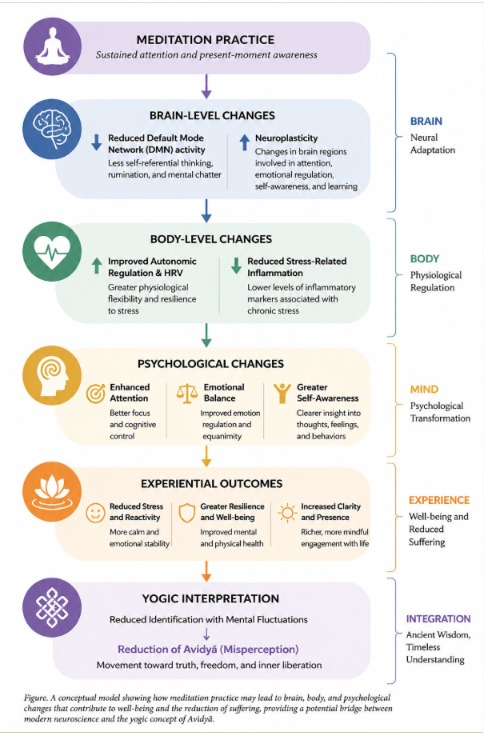
The ancient language of Avidyā and the modern language of neuroscience may be describing different dimensions of the same human reality.
Addressing the Common Roots of Suffering
Most mental health interventions are developed for specific disorders. Yet anxiety, depression, chronic stress, chronic pain, and psychosomatic illness often share common underlying processes: getting caught in repetitive thinking, becoming overwhelmed by emotions, and identifying too strongly with one’s thoughts and experiences.
Sākṣī Bhāva works at a deeper level. Rather than focusing on each condition separately, it transforms the way we relate to our inner experience. Instead of being swept away by thoughts and emotions, we learn to observe them with awareness.
This is why witness-consciousness offers a powerful approach across many forms of suffering. By addressing a common underlying process rather than isolated symptoms, it points toward a more fundamental dimension of healing.
The Road Ahead
Ancient wisdom alone is not enough. Modern science alone is not enough. The future may lie in a meaningful dialogue between the two. Indian Knowledge Systems offer sophisticated models of consciousness, suffering, and transformation. Contemporary medicine offers rigorous methods of measurement and validation. The challenge before us is neither to romanticize tradition nor to dismiss it – it is to investigate, with intellectual honesty and scientific rigor, whether these ancient insights can contribute to modern well-being.
Sākṣī Bhāva proves to be more than a philosophical concept. It becomes a bridge between contemplative wisdom and evidence-based mental healthcare – a bridge that helps us rediscover a simple yet transformative possibility: we are not merely our thoughts, emotions, memories, or experiences. We are also the awareness in which they arise, unfold, and pass away.
For the millions who continue to struggle with anxiety, depression, stress, and psychosomatic suffering, the deepest healing may not lie solely in changing what they experience through medicines, but in rediscovering who is experiencing it. In that rediscovery, the ancient wisdom of Sākṣī Bhāva holds a timeless key for modern mental health.
(Author’s note: The ideas presented in this article are adapted from one of our research presentations delivered at the Mind, Brain and Consciousness Conference, IIT Mandi, held from June 3–6, 2026).
Disclaimer: The opinions expressed in this article belong to the author. Indic Today is neither responsible nor liable for the accuracy, completeness, suitability, or validity of any information in the article.