
Introduction
Karl Popper was a philosopher of science who tried to differentiate between true science and pseudoscience. Though other theories have replaced his ideas regarding scientific method, his “falsifiability” as an important criterion remains powerful. A scientific theory should be falsifiable, and this argument was his major criticism of Marxist ideas, including history. An all-encompassing theory that can be fitted to explain any fact is likely to be pseudoscience. This was his strong criticism of both Marxist theories and Freudian theories of psychology. This non-falsifiability presently applies to string theory, which is considered the current leading theory in physics.
Marxist history, which categorises every event in the world into the binaries of “exploiter” and “exploited” or “oppressor” and “oppressed,” is flawed and lacks a scientific understanding of history. The classical Marxist position holds that only economic production and means of labor divide people into a “bourgeoisie” and “proletariat”, with revolution that obliterates the former being the only way to achieve equality.
History is a subjective process in its entirety where the process of collecting facts from the past depends on the choice of the historian. Government records, as a source, may provide biased information regarding the events and individuals of that era. The historian’s worldview, ideology, or religion could influence the interpretation of the collected facts. Thus, history is never fully objective, and multiple interpretations of the same event or person can exist, depending on who is describing them and when. A distant future may be unkind to a contemporary historian who describes current events.
Indic kingship was viewed as a feudalism akin to its European counterpart, according to the Marxist historians who gained positions of power in the academic circles. They systematically entrenched the narratives into public consciousness. The picture that emerged portrayed kingdoms engaged in perpetual warfare, with the kings maintaining a tight grip on the common population, in alliance with the powerful elite. Exploitation, hierarchy, decadence, and constant warring allegedly characterised our kings. This was the dominant theme in our textbooks, media articles, and intellectual discussions for many decades, and we internalised this story.
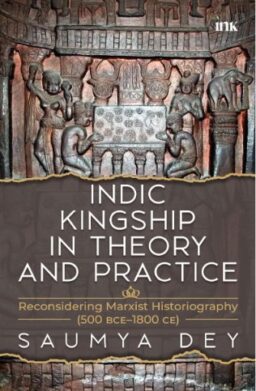
However, Indian intellectuals and serious thinkers have seriously started questioning these limited vision narratives that mold every empirical fact of our rich and complex history into the straitjackets of “exploiter” and “exploited”. Saumya Dey is one such historian who wields his pen with considerable power to counter the Marxist narratives. Despite receiving his education at JNU, a hub of Marxist narratives and even anti-nationalistic rhetoric, he has emerged as a scholar who systematically dismantles these left-liberal-secular-communist-Marxist narratives. A prolific author of many important books, the latest book, Indic Kingship in Theory and Practice, specifically aims to correct the biased views of Marxist historians, who have dominated the discourse on Indian history for too long.
What is History? The Domination of the Marxist View
Saumya Dey begins with the 5th-century Herodotus, a Greek, who is described as the “Father of History”. He wrote the Histories, which not only covered the Greco-Persian Wars but also provided a cultural, ethnographical, geographical, and historiographical background of many events. His narratives included some fanciful accounts and mythical tales that were the subject of criticisms. The notable point about Herodotus is that even while describing the non-Greeks, he was fairly neutral in his assessments.
The author writes that post-Herodotus, historians started constructing a narrative where subjectivity started making its appearance. History writing can be tricky because choosing the facts, interpreting them, and establishing causal relationships can lead to divergent opinions among historians. As Dey explains, “Since historians make varying inquiries regarding facts, sources, and causal sequences, they also, all the time, advance ever newer philosophies and imaginations of the past.”
Each historian has a favorite source for investigating the past. The sources include archival documents, religious books, dynastic histories written in contemporary times, epigraphs (inscriptions from rocks, edifices, and coins), and archaeological findings. Recently, even oral testimonies and recollections of living people are also considered important historical sources. Each of the methods suffers from biases. For example, archival records authorized by the government can become biased toward the ruling dispensation. Anyway, a reputable historian always looks at multiple sources to converge on the actual facts of history before taking it further.
The “how” of history is the trickiest part, as historians begin interpreting events to assign causal sequences to them. This phase is characterized by the highest level of subjectivity. Thus, a historian’s specific perspective of the past, influenced by their worldview, shapes a historical narrative. At multiple times, due to a combination of many factors, a particular perspective of history comes into being that is widely adopted by historians, and it also receives sanction by the ruling powers. The “historical materialism” approach to history, initiated by Karl Marx and Engels in the 19th century, thus became a dominant mode of interpretation of historical events.
Historical materialism asserts that material and economic conditions, rather than ideals or culture, primarily drive human history. There is an economic base (infrastructure) that consists of forces of production (technology, land, raw materials, and labor) and the relations of production (the social structures and ownership controlling those forces). The superstructure of the society (politics, law, religion, education, and so on) is entirely an outcome of this infrastructure. Most importantly, historical progress through different eras occurs due to the conflict between social classes vying for control of the means of production. Whenever there is a mismatch between the economic progress and condition of society, a class conflict ensues that leads to a social revolution.
In Marx and Engels’ view, human civilization passes through primitive communism, via a slave society and feudalism, to capitalism. In each stage, there is an “exploiter” and “exploited”. The latter include the “slaves”, “serfs”, and the “proletariat”. The former are the “masters”, “feudal lords”, and the “bourgeoisie”. The author writes that this historical theory was not in a vacuum but had a basis in previous intellectual thoughts of Europe, especially the Enlightenment and French historiography of the Restoration Period. A specific Enlightenment idea was the teleological view of history, where Marx visualised a final revolution that would usher in the ultimate mode of governance called socialism or communism. The outcome would be a future classless society with commonly owned means of production, effectively ending the cycle of class conflict.
However, this projected future has always remained utopian. When socialism was actually implemented in Russia and China, the harsh realities and brutalities experienced there should have led people to abandon the Marxist idea of history. That never happened. And especially so in India. Once established, the “hard core” in Lakatos’ idea of scientific progress becomes immune to any falsification. A theory of everything and anything, every facet of history across the world, could fit into its theoretical framework. Despite Marxist ideas being limited to a specific Western world, it became a universalised explanation for the entire world.
Indians adopted this approach through the likes of SA Dange, DD Kosambi, Romila Thapar, RS Sharma, DN Jha, Irfan Habib, Satish Chandra, and Bipin Chandra. This view of history, thanks to many political events leading to their active patronage, became deeply entrenched in our academia. Their views remained unchallengeable and hegemonical, which did not allow any contrarian view.
Marxist Historiography
Marxist historians gained positions of power after independence in India in academic institutions. They held a singular view of India’s past, which included a warped assessment of Indian kingship prior to the arrival of Islamic imperialism. What is the Marxist story of Indian kingship? The fundamental assertion of Indian kingship was that of suppression, exploitation, collection of taxes, and indulging in warfare using the elites and the priestly Brahmins in their quest for power. Their reading of the Indian texts made them write that kingship was essentially suppressive, beginning with the Vedic period.
Thapar and Sharma cast Indic kingship in the heroic mold, forever trying to expand their areas of control. The king had basically the role of warfare and mobilising violence. Another role of the king was to extract taxes from the suffering peasantry. Throughout Indian history, from the “ancient” to the “mediaeval” and “modern” periods, the overwhelming Marxist perspective of rigid economic determinism and the exploiter-exploited binary has examined and identified the various evolutionary stages of Indic kingship, with only slight variations. Thus, the later monarchy evolved into a “full-fledged and self-serving suppressor”. A suppressive function of the kingship was its singular interpretation of the descriptions found in the Puranas, Itihasas, and Buddhist texts. In a still later period emerged a suppressed peasantry dominated by the landlord class.
The author writes that they missed the fact that Indic textual discourse neither imagines the ruler as a suppressor nor assigns a socially parochial role. He shows that Thapar and Sharma, the intellectual progeny of Dange and Kosambi, uncritically borrow their ideas of Indian history from books like German Ideology, The Communist Manifesto, and Origin of the family, Private Property, and the StateRta to formulate their facile conclusions. These ideas are downright distortive when applied outside Europe with universal pretences, writes Saumya Dey. In summary, the author writes scathingly that the Marxist view of the Indian past and kingship is limited and tendentious with a jaundiced view of sources and facts.
Enlightened or Dharmic Monarchy: The Correct Reading of Indian texts
The overwhelming amount of textual corpus in Sanskrit and vernacular Indian languages flows from the metaphysical ideas of a singular Self, the Many in One and the One in Many, karma, rebirth, and the three deeply interlinked “quartets” of varna (Brahmin, Kshatriya, Vysya, and Sudra), ashrama (brahmacharya, grihastha, vanaprastha, and sanyasa), and purusharthas (dharma, artha, kama, and moksha). Without understanding the metaphysical and philosophical ideas underpinning the culture, any exposition of the country results only in violence.
The vast amount of literature also allows free cherry-picking of data from disparate sources that can allow free, fanciful, and ignorant interpretations antithetical to what the texts actually mean and speak. This has been the problem with the Marxist construction of the Indian kingship. A limited perspective and a strict lens result in a distorted view of the texts. Saumya Dey goes into the actual Sanskrit textual conception of the ideal ruler. He delves deep into the descriptions of the Rigveda, Ramayana, Mahabharata, Dharmasutras, Dharmashastras, and Puranas to show that the ideal ruler always maintained in our texts was a Dharmic king. The king does not rule people but is an upholder of dharma. In particular, the Shantiparvan of the Mahabharata and the dialogue between Sri Rama and Bharata articulate the duties of the king in excellent detail.
Across the chronological eras, starting with the Vedic period, Dey shows that the king was not seen as catering to a particular elite class but as a protector of all subjects in society. Dharma is the crux around which Indian philosophy or metaphysics revolves, and its important purpose is to maintain Rta, or the cosmic order of the universe. Each person, depending on his station in life, has a dharma that maintains the cosmic order. The king was thus deeply imbibed with dharma as his guiding principle and not individual whims and fancies.
Therefore, a suppressive role was not the primary function of the king; rather, Danda, or punishment, served as a means for the king to promote the overall benefit of society. The description in Indian texts, as the author clearly shows, depicts a normatively correct king, exhibits ethical conduct, and embodies the right moral and spiritual attributes. The king takes paternalistic care of the citizens, and the taxation prescribed in all texts converges on reasonableness and legitimacy and not overburdening. In short, in complete contrast to the Marxist reading, Indian texts never conceptualise a dominantly suppressive kingship in favour of an exploiter class. The Marxist interpretation is a narrow and limited view. Pluralism of views may permit such an interpretation, but it is also patently false, as a proper study of the theoretical foundations shows. How did the monarchy actually behave across the historical periods?
Indic Kingship in Practice (the First Millenium- 500 BCE to 500 CE)
Feudalism, as a crucial socio-economic formation, is an important postulate in the Marxist periodisation of Indian history. The conventionality of “ancient”, “early mediaeval”, and “mediaeval” in their historiography rests on the principles of a strict and classical economic determinism that gives rise to feudalistic societies. Thus, the ancient socioeconomic structure, to begin with, was characterised by centralised bureaucratic kingship and an independent peasantry. In the early mediaeval and mediaeval periods, there was a kingly delegation of administrative and police functions to the beneficiaries of land grants. The beneficiaries of land grants, in turn, became feudal masters who extracted, exploited, and suppressed the labour force and peasantry.
The author, Saumya Dey, rejects this postulate about feudalism being the crux of Indian periodisation, as per the Marxist formulation. In showing how the Indian kings actually practised their monarchical status, he divides the Indian historiographical temporal frames into two periods: the first millennium (500 BCE to 500 CE) and the second millennium and after (501 CE to 1800 CE).
The author dives into a profound study of the empires and kings of both periods, referencing the widest variety of sources. These parts require a slow and careful reading, where the author emphatically shows that the many sources converge on the fact that Indic kingship lacked a suppressive aspect towards society. It is astonishing that serious Marxist historians, despite their decades-long focused study, could have overlooked all these details. Either they have been dishonest about our history for all these years, or they have been so indoctrinated by their ideology that they are unable to see beyond their biases. Perhaps it is the latter, to give them the benefit of the doubt.
In the section on the first millennium kings, the author examines the Nanda dynasties, the Mauryan Empire, the Satvahana dynasty, and the Gupta Empires, the last considered to be India’s “Golden Age”. He details the administrative and other aspects of kings like Mahapadma Nanda, Chandragupta, Ashoka, Gautamiputra Satakarni, Samudragupta, and so on.
The evidence from the historical sources is clear. The monarchy addressed the society at large, and its nature was not a transfer of suppressive power to social and political elites to indulge in feudalism. The ruling was not class-exclusive, and there was participation from all groups regardless of the increasing bureaucracy and military capacity of the individual kings or empires. The power-enforcing mechanisms employed the entire social body. When conquering other kingdoms or in expanding their areas of control, instead of feudalism, they generally created a subordinate tier of ruling agents to “empathetically coopt citizens” into their sovereignty.
The taxation was legitimate and not excessive, typically amounting to one-sixth of the produce, with many exemptions available. In the land grants, there was also no evidence of a widespread suppressive function taking hold. The political and administrative frameworks were free of large-scale suppression, which Marxist scholarship is wont to construct. The author also shows that the monarchy was eager to demonstrate noble, spiritual, and model qualities as per the advice of spiritual masters. Elaborate rituals and literary means were used to place the kings within a moral and spiritual framework. Sticking to the tenets of dharma was an expression of royal will, and priestly aid was not mandatory. Despite the imperialistic ambitions of many, apart from a few instances, the king desired to rule by eliciting the social body’s approval and consent.
The Second Millenium and After: 501 CE to 1800 CE
In the second millennium period, the author looks first extensively into the Vardhana dynasty, focusing on its greatest king, Harsha Vardhana. In the South, the author examines the Pallavas, Chalukyas, Kakatiyas, and the Vijayanagara kingdoms with kings like Pulakeshin and Krishnadevaraya. In the West, the author extensively examines the Marathas and Peshwas, with Shivaji as their main representative; in the East, the Pala dynasty is analysed; and in the North, the Rashtrakutas and Gurjara-Pratiharas are similarly studied regarding their administrative and fiscal arrangements, as well as the moral and spiritual values expressed through their kingly endeavours.
The author references the scholarly works of renowned historians like Nilakanta Sastri, RC Mazumdar, and AS Altekar in this section. The evidence is clear on the elaborate administrative arrangements starting from the village level with involvement of all social groups during most of the era. Indian kingship also evoked varied notions of dharma through its moral and sacred endeavours. Periodisation by historians tends to be subjective. The two eras are distinguished by increased attempts to invoke a higher order, sacralisation, temple-centricity in many instances, and the use of rituals and spiritual authority. It is certainly not a break, as one might envision, but rather a continuous evolution that has become more sophisticated.
The kings were eager to achieve a reification solely through moral and spiritual authority. The poet kings, such as Harsha Vardhan, described uniquely worthy imperial kings in poems like Ratnavali and Priyadarsika, which can be interpreted as self-portraits or representations of ideal kingship, according to the author. The administrative arrangements do not show any arbitrary power enforcement, and the autonomous will of the social body was evident without any suppression. The judiciary and policing crucially hinged upon informal, local, or cooperative courts.
Fiscally, there were no extortive fiscal demands on the peasantry. Mostly, the kings maintained direct access to peasant production without intermediaries. The Cholas, Shivaji, and Peshwas were especially solicitous towards the peasants. However, moral, and spiritual values were crucial as a foundation for the political and administrative aspects of kingship. The evidence occasionally shows that women entered the governmental apparatus, as indicated by the Pallava inscriptions.
The author says the book is neither an apologia for Indic kingship nor claims it to be the best. The point he wants to make is that Indic kingship avoided the suppressive aspect typical of European monarchy. Indic kingship holistically co-opted the social body by involving its members in a manner that demonstrated ingenuity and sophistication. The kingship aligned in its moral, spiritual, ethical, legal, and administrative values closely with the underlying philosophy of Indian culture – dharma.
This study rejects Marxist historiography conclusively. As the author writes, “The tragic narrativisation of Indic kingship history is undoubtedly an inheritance from Marxist historicism and, by extension, an age-old pessimism underlying it.” He specifically indicts historians like Romila Thapar and RS Sharma, who gave a simplistic formulation of Indic kingship that became class-exclusive and suppressive in nature as pastoralism is gradually replaced with an agrarian economy. Saumya Dey writes that Thapar and Sharma’s scholarship fails to capture even a “bare hint” of the complex organisational ingenuity and sophistication of Indian kingship.
Concluding Remarks
The citizens, as consumers, have a right to evaluate, compare, and, if necessary, reject a historical narrative that does not meet the test of truth. The issue with our history is that nearly two generations of Indians have grown up with and internalised a single version of it that was heavily influenced by secularist and Marxist ideology. The narratives surrounding ancient India, including the mythical Aryans, the relegation of Hindu kings to mere footnotes in textbooks, the glorification of Mughal history from a predominantly Delhi-centric perspective, and the overly sanitised portrayal of our independence movement with the glorification of a single party and a few individuals—all illustrate the deeply distorted rendering of history in our textbooks. Marxist historians have been dishonest with their narratives of history. In recent memory, courts severely reprimanded the Marxist scholars in the Ayodhya temple dispute for their blatant lies and ignorance.
Today, there is a deep anger that even manifests as inappropriate verbal abuse on social media when an alternative version explodes in our faces. The hegemonic historians of the past respond to the outrage by branding them intolerant and incapable of judgment. However, rejecting this Marxist scholarship necessitates rigorous academic work. Saumya Dey is one such scholar who has been dismantling persistently and patiently Marxist historiography over the years through his books and essays. This present book under review is a must-study for all the Indians who grew up on the distorted and agenda-driven histories delivered to us for decades.
The key idea of Indic kingship in theory and practice (the ‘ought’ and the ‘is’) is that the king does not rule people but serves dharma. The texts of ancient and mediaeval India focused on qualities and duties at all societal levels, from the king to the ordinary citizen. Western traditions, in contrast, revolve more around rights than duties. Dharma is Indian culture’s foundational basis. However, our social sciences, colonised in their outlook, rejected this foundational basis of Indian culture in their narratives.
For example, Kautilya’s Arthashastra was an exhaustive political treatise covering almost all aspects of ruling a kingdom. The text makes explicit the four sciences in society from which everything concerning righteousness and wealth derives: Anvikshaki (the philosophies of Sankhya, Yoga, and materialism); Trayi (the triple Vedas); Varta (agriculture, cattle breeding, and trade); and Danda-Niti (the science of government). Philosophy gives light to all kinds of knowledge; the Vedas teach about righteous and unrighteous acts; and the Varta teaches about wealth and non-wealth. These, in turn, depend for their well-being on the science of government. Arthashastra details the obligations of each of the four varnas and the four ashramas of a domestic-spiritual life, a basis for a well-ordered and harmonious society. The overarching framework for these varnas and ashramas is dharma.
Arthashastra lays out the ideal and practical aspects of administration and the behaviour of kings, citizens, and governments to the finest detail. This includes the rules of warfare. The kinds of wars fought in Europe in mediaeval times were perhaps unusual in the Indian context. Undoubtedly, there were wars and battles, but some principles, like never attacking the common citizens, destroying temples or agricultural lands, and taking slaves, remained.
Similarly, many texts, like the Ramayana, Mahabharata (especially the Shanti Parva), and Tirukkural, focus on duties rather than rights for both the rulers and the ruled. The king is an integral part of the dharmic social body and not a separate entity. The Sukraniti has a seven-fold ‘organic theory’ of the nation-state: King is the head; minister is the eye; Mitra (friend) is like the ear; Danda (punishment process) is the power; Kosh (treasury) is the mouth; Durga, or secured town or capital, is the hand; and Janapada (people) is like the leg of the nation.
The spiritual-cultural-civilisational cement of the country was so strong that despite the many political boundaries, a bond linking rulers and people across kingdoms allowed free movement for pilgrimages and access to knowledge. Uniquely, the king’s belief systems could be independent of those of his citizens, an impossibility in European monarchies for a very long time until the Treaty of Westphalia in the 17th century. A citizen could cross kingdoms without charges of treason, and there was no concept of slavery as ‘a person ruling over another’ in Indian culture. Contemporary scholars, however, try diligently to torture our texts and the Vedas to locate evidence of slavery.
The dharma of the king, as stated in most Indian treatises, including Kautilya’s, was to maintain Rta, the cosmic order. At the social level, it was to maintain the varna and jati order of society. In summary, dharmic kingship, free citizens, and decentralised political units glued together by spiritual and cultural unity were the essence of political India in the past. The final paragraph of the book serves as a summary that directly rejects Marxist historiography in relation to Indic kingship. The author expresses in a scathing manner:
Marxist historicism is not even chiefly committed to authentically depict the past. Its real objective, as a matter of fact, is to expose what it perceives to be the accumulated follies inhering in our political and economic frameworks and usher a utopian revolutionary future. It is, thus, as Popper understands, an endeavour at ‘utopian social engineering’. Its end result shall always be totalitarianism like the erstwhile USSR or the contemporary People’s Republic of China. We must therefore ally with Popper in describing Marxian historicism as an enemy of open society.
Disclaimer: The opinions expressed in this article belong to the author. Indic Today is neither responsible nor liable for the accuracy, completeness, suitability, or validity of any information in the article.