
Will Durant famously remarked in The Story of Philosophy that man’s knowledge has become too much for him. The cumulative burden of specialized disciplines, evolved over time, has become so much, Durant argued, that it is in need of great synthesis. This is the task that Durant set upon himself and it later resulted in The Story of Civilization. Every society needs such sense making from time to time. Hindu civilization can boast that it is the greatest knowledge tradition in the world. We also call it Indian Knowledge Systems. We have produced thousands of texts and it is a matter of pride but it can also intimidate a contemporary youth, who wants to explore them but has no means to do it because the modern education system has not prepared him for it. Such a great textual tradition needs consistent attempts to make sense of it from time to time.
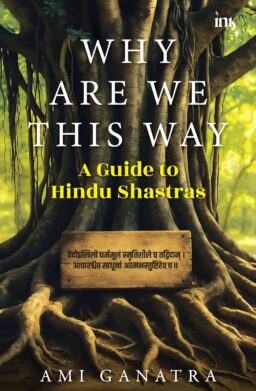
Ami Ganatra, a scholar of Shastras, has made such an attempt with her latest book “Why are We This Way: A Guide to Hindu Shastras”. The book aims to explain to the contemporary generation what their texts are about. But it is far from just a compendium of Indian texts. It is an argumentative walk-through of the Indian Knowledge Systems. Continuing in a way in the tradition of Itihasa-Puranas, Ami discusses life’s most significant questions through discussing the events and incidents of the shastras. In other words, the reader gets to argue, contemplate and reflect upon some of the most fundamental questions of life and the nature of Hindu society as Ami walks them through by discussing the finer points of the Shastras.
This is the strength of her writing style but it is also indicative of a fundamental nature of our texts. Hindu texts are not ossified commandments, written in stone. They are also not historical texts recording everyday details. They are living systems instructing upon dharma to help us resolve the dilemmas of life. It is very difficult to understand dharma from only definitions. Dharma is an instruction in lifestyle and conduct and that is something one can learn only from live examples of daily life illustrated through a narrative. Itihasas and Puranas illustrate this function the best, but almost all our texts including the Upanishads have stories that weave narratives of dharma because the purpose is to give life instruction. That is why Hindu texts are dynamic and interactive. Dynamic because they are relevant in every time and place. Interactive because they are capable of speaking to individuals about their specific problems. Like Hindu civilization, they are living, and thus not motionless. Modernists often mistake Hindu texts to be either historical records or closed texts. They are neither. Ami has written this book to illustrate from example by example, how this is so.
The book is divided in primarily two parts, the first one dealing with the Shruti literature and the second with Smriti literature. From the beginning the book asserts how Hindu civilization is continuous and living despite all odds. Commenting upon the Vivaha Sukta the author expresses how the Hindu marriage vows still follow what this ancient Vedic Sukta prescribes, proving the deep continuity of Hindu civilization. While explaining the structure of the Vedas, the author illuminates upon a point which might seem contradictory to non-Hindus but is very normal for a Hindu mind. She shows how ritual and philosophy go together in the Vedas, remarking how we never forgot the eternal pursuit of moksha or liberation while not neglecting the worldly and the ephemeral. This point about Hindu texts is very illustrative about the nature of Hindu society too. Some critics in their ignorance classify Hindus as an other-worldly civilization which never paid attention to material pursuits. Some others declare it as an overwhelmingly materialistic civilization based on some texts and their misinterpretation. Both are wrong and the Vedas themselves show how we were always a balanced society.
Ami does not recommend one approach to see the texts and does not take sides in debates like the historical vs. ahistorical origin of our texts. While telling us the importance of the ahistorical and eternal point of view, the book frequently discusses the evolution of text(s), concepts and entire knowledge tradition. Discussing the evolution of Hindu texts and cosmology from the Vedic to the Puranic era, the author tells us how same/ similar concepts and ideas were transposed from one set of deities and cosmology to another without any loss of meaning and intent. The reader may or may not agree with the historical lens that is employed in this particular case to see our texts, but the lesson drawn from such an exercise is to emphasize the continuity and eternality of the Hindu civilization. It also gives us a beautiful lesson, that to meditate upon the true nature of our text illumines the inner eye, the Indra that is within all of us as the book tells us, no matter what lens is employed.
The book does not just discuss the content and nature of texts but also the ways of their preservation. The reader gets a window into the wonderful methods like many mnemonic techniques that our ancestors devised to make sure the knowledge tradition is preserved and passed on to the future generations without corruption. It cannot help but make you admire the dedication of the individuals and the communities who made it their life’s purpose to preserve and transmit India’s knowledge tradition to future generations. Ami writes that it is a testimony to India’s guru-shishya tradition that this endures. Once again remarking on the amazing continuity and adaptability of the Hindu tradition she writes: “What amazes, nonetheless, is how the threads of continuity endure: even after centuries of disruption, the knowledge survives in a few luminous custodians – reminding us that with encouragement and care, it can flourish once again.”
The Smriti section explains not just the text known more popularly as Smritis but all other texts and systems including the Upavedas, Vedangas and Darshanas. A very educative feature of the book is where the author has produced charts to explain various aspects of the textual tradition she is describing. In the darshana section, there is a chart with core focus as one column and the modern parallels and contributions in another column. The chart on smritis lists various topics of contemporary concerns and maps various smriti texts on these principles, giving the reader a tool of comparative analysis and making it easier for him to navigate IKS.
In the chapter on Itihasas and Puranas the author shows how Sanatana dharma democratized knowledge and also maintained professional excellence at the same time. While chanting the Vedas remained the exclusive domain of the Brahmins, Itihasas and Puranas took the knowledge of the Vedas to every community, ensuring that neither exclusion nor excellence were sacrificed.
Why are We this Way is a fresh contemplation on Hindu texts in a very Hindu spirit. One may not agree with some parts, some analyses and some conclusions of the book. For example I feel that it has more historical analysis than necessary and it gives a little more importance to Charvaka darshan than is necessary, my opinion being that almost everyone seems to give Charvakas more importance than is necessary due to the contemporary fashion of atheism. But such disagreements are also core to the very spirit of Hindu tradition and Hindu texts, and this is what Ami wants to stress.
This book is more than a compendium of our texts. It tells us the very spirit of Hindu society through the nature of our texts. The bhava that we are an ancient civilization with an unbroken continuity with our past pours forth effortlessly from the words of Ami Ganatra: “The new is built upon the foundations of the old.” At the same time, we are told through various examples and discussions that this does not mean that we are a civilization living in the past. We are living and that is why we are eternally relevant. We perpetually keep changing and building new things, but not by destroying the old. In the author’s words: “Change in Sanatana is not iconoclastic but cumulative, enabling the tradition to evolve without severing its roots.”
This spirit of our society is very well reflected in Hindu texts. And it is the lesson about our texts which is the greatest message that Ami has to give to her readers. We were and are not dogmatic people. Despite having the largest gamut of literature in the world, we never got stuck on textual literalism. Our texts are designed in a way which prevents this from happening. We made sure that human nature, changing realities, and public opinion is always considered, while making sure the pursuit of that which is unchanging and eternal, is never compromised: “Living experiences shaped texts, texts shaped minds. Minds reshaped texts. A living feedback loop of thought, practice, memory and renewal.”
This is the message that “Why are we this way” drives home most potently. The Hindu civilization is rising again. In these moments, it is important that we do not abandon the core of Sanatana dharma and also make sure that we do not get bogged down in peripheral concerns. To keep contemplating on our ancient but eternally relevant texts is one of the most potent ways to do that.
Disclaimer: The opinions expressed in this article belong to the author. Indic Today is neither responsible nor liable for the accuracy, completeness, suitability, or validity of any information in the article.