Abstract
The study of Bhāratīya Jñāna Paramparā raises a fundamental methodological question: can a knowledge tradition be adequately understood through its surviving textual corpus alone, or must inquiry also engage with the structures through which knowledge is generated, validated, transmitted, and applied across generations? This paper argues that understanding the Bhāratīya knowledge system requires engaging with its Śāstric Architecture, as analysing individual texts, concepts, or domains in isolation risks fragmenting and misrepresenting the knowledge system as a whole.
The paper examines category errors that arise when Bhāratīya knowledge is interpreted through conceptual frameworks that inadequately account for its own categories, pramāṇas, modes of transmission, and architectural relationships. Such approaches can fragment interconnected domains of knowledge, impose classifications that do not adequately reflect the tradition’s organising principles, and obscure the conditions under which knowledge is established, understood, and sustained within the tradition.
As a constructive alternative, the paper proposes a conception of Śāstric Architecture articulated through five interrelated dimensions: Padārtha-niṣṭhā (fidelity to Bhāratīya categories), Pramāṇa-niṣṭhā (fidelity to the means of valid knowledge), Paramparā-niṣṭhā (fidelity to structures of transmission), Tātparya-niṣṭhā (fidelity to intended meaning), and Samagratā-Samanvaya-niṣṭhā (fidelity to the integrity and coordination of the whole). Together, these five niṣṭhās provide a framework for examining how knowledge is conceptualised, transmitted, and integrated within Bhāratīya Jñāna Paramparā.
The paper further develops Oral Architecture as a foundational dimension of Śāstric Architecture. Drawing upon the Vedāṅgas, it argues that Oral Architecture is an organised system of knowledge-preservation that safeguards the integrity and continuity of Vedic Śabda as Pramāṇa across generations. The historical case of Garikapati Annam Bhaṭṭu illustrates how texts, institutions, and scholarly lineages collectively sustain the continuity and development of knowledge.
The paper concludes that Bhāratīya Jñāna Paramparā must be understood as an integrated and living Śāstric Architecture in which knowledge, transmission, and practice are interconnected. Recognising this architecture provides the methodological foundation for understanding the knowledge system in accordance with its own organising principles and its continuity across generations.
Keywords
Śāstric Architecture; Oral Architecture; Śabda-Pramāṇa; Pañca-Niṣṭhā Framework; Padārtha-niṣṭhā; Pramāṇa-niṣṭhā; Paramparā-niṣṭhā; Tātparya-niṣṭhā; Samagratā–Samanvaya-niṣṭhā; Category Errors; Guru–Śiṣya Paramparā.
1.0 What Constitutes Bhārateeya Jñāna Paramparā?
The contemporary study of Bhārateeya Jñāna Paramparā raises a question more fundamental than the recovery of neglected texts, the redating of historical developments, or the recognition of intellectual achievements. It concerns the very nature and constitution of the knowledge tradition being investigated (Staal 1986, 2008; Witzel 1997; Patton 2005; Hiriyanna 1932; Matilal 1998).
Before asking what a particular śāstra teaches, how a mathematical rule was formulated, or when a body of astronomical knowledge emerged, we must ask: How is knowledge established within the tradition? What constitutes the knowledge tradition being studied? What is the nature of the knowledge it recognises, and where does it reside? (Staal 1986, 2008; Witzel 1997). Through what pramāṇas is knowledge established, and how is valid knowledge distinguished from error? (Hiriyanna 1932; Matilal 1991). Through what means is knowledge preserved, transmitted, and applied? What relationships connect its knowledge domains, applied practices, and standards of validation? (Staal 2008; Patton 2005; Witzel 1997).
These questions cannot be adequately answered through textual analysis alone. A text may preserve propositions, procedures, and arguments, yet understanding how knowledge is established, validated, and applied requires engagement with the pramāṇas, pedagogical practices, and practical competencies sustained within a living paramparā (Staal 1986, 2008; Witzel 1997; Patton 2005). These are integral to understanding the processes through which knowledge is established and sustained. Knowledge, in such traditions, is not exhausted by what is written; it is sustained through Śāstric inquiry, transmission, and practice.
The problem, therefore, is not simply that Bhārateeya knowledge has been insufficiently studied. It is that the knowledge system itself can be misconstrued when the categories through which it is studied are determined before its own organising principles have been examined. When interpretive frameworks developed for other intellectual traditions are applied without examining their adequacy, they can fragment interconnected domains of knowledge, privilege external classifications over Bhāratīya conceptual categories, and obscure the relationships through which knowledge acquires coherence within the tradition (Staal 1986, 2008; Matilal 1998; Garikapati 2026a).
In Category Errors in the Study of Bhāratīya Jñāna Paramparā (Garikapati 2026a), the methodological consequences of interpreting Bhārateeya knowledge through categories that inadequately represent its internal structure are examined. Indian Knowledge Systems as Epistemic Architectures: Transmission, Validation, and Ontology (Garikapati 2025a) explores the interdependent structures of transmission, validation, and inquiry through which knowledge functions. The Oral Architecture of the Vedāṅgas: Preserving the Eternal Veda (Garikapati 2025b) examines how the Vedāṅgas collectively constitute an architecture for preserving and reproducing Vedic knowledge. The Gift of Knowledge: Garikapati Annam Bhaṭṭu through the Dāna Sāsana of 1560 CE (Garikapati 2026b) investigates a historical instance of knowledge continuity sustained through scholarship, institutions, and living paramparā. Together, these works provide the intellectual foundation for the broader framework developed in the present paper.
The central proposition of this paper is that Bhārateeya Jñāna Paramparā must be understood as an integrated and living system of knowing, rather than as a collection of independently constituted knowledge domains. Its constituent domains, śāstras, and practices acquire their fuller significance through the relationships and organising principles that connect them.
The paper develops this proposition through the concept of Śāstric Architecture, understood as the integrated structures through which knowledge is organised and sustained within Bhārateeya Jñāna Paramparā. Within this broader architecture, Oral Architecture constitutes a foundational dimension through which knowledge maintains its integrity and continuity across generations. The architecture is examined through the complementary principles of samagratā (wholeness) and samanvaya (integration), which illuminate the relationships among knowledge domains, practices, and institutions.
Accordingly, the paper approaches Bhārateeya Jñāna Paramparā as an interconnected knowledge system. Identifying this Śāstric Architecture is a methodological prerequisite for understanding Bhārateeya Jñāna Paramparā on its own terms.
2.0 Toward a Conception of Śāstric Architecture
Before examining category errors, it is necessary to clarify what is meant by Śāstric Architecture. The expression refers to the integrated relationships among the constituent knowledge domains of Bhārateeya Jñāna Paramparā, their respective śāstras, and the structures through which knowledge is established and sustained. The traditional conception of the Chaturdaśa Vidyāsthānas is explicitly enumerated in the Viṣṇu Purāṇa (3.6.27):
अङ्गानि वेदाश्चत्वारो मीमांसा न्यायविस्तरः ।
पुराणं धर्मशास्त्रं च विद्या ह्येताश्चतुर्दश ॥
aṅgāni vedāś catvāro mīmāṃsā nyāyavistaraḥ |
purāṇaṃ dharmaśāstraṃ ca vidyā hy etāś caturdaśa ||
This enumeration provides a foundational framework for recognising the constituent domains of Bhārateeya knowledge. It brings together the four Vedas, six Vedāṅgas, and four other knowledge domains—Mīmāṃsā, Nyāya, Purāṇa, and Dharmaśāstra. Śāstric Architecture encompasses the organising principles and relationships through which these domains and their constituent elements function as an intelligible and integrated whole.
The significance of this arrangement lies in the functional relationships among its constituent domains. The Vedas function as Śabda-pramāṇa, while the Vedāṅgas provide the disciplines necessary for its transmission. Mīmāṃsā and Nyāya furnish methods of inquiry, interpretation, and validation, while Purāṇa and Dharmaśāstra contribute to continuity and application. Upon this foundation, numerous other śāstras develop and operate. Śāstric Architecture concerns the relationships through which these domains function as an integrated whole.
This conception extends, but is not identical with, the notion of an epistemic architecture. While epistemic architecture primarily concerns the establishment and validation of knowledge, Śāstric Architecture additionally encompasses the structures of transmission, and institutional continuity through which knowledge is sustained across generations.
The principal dimensions of Śāstric Architecture may be understood through five interrelated niṣṭhās, each addressing a distinct but complementary aspect of knowledge (Table 1).
Table 1. The Five Niṣṭhās of Śāstric Architecture
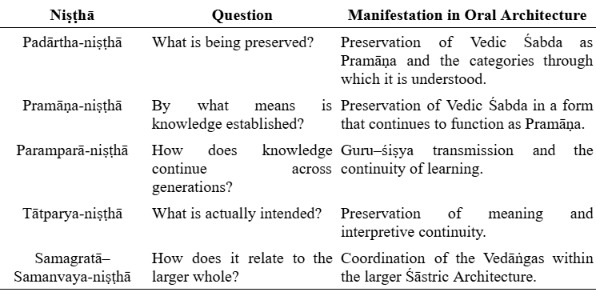
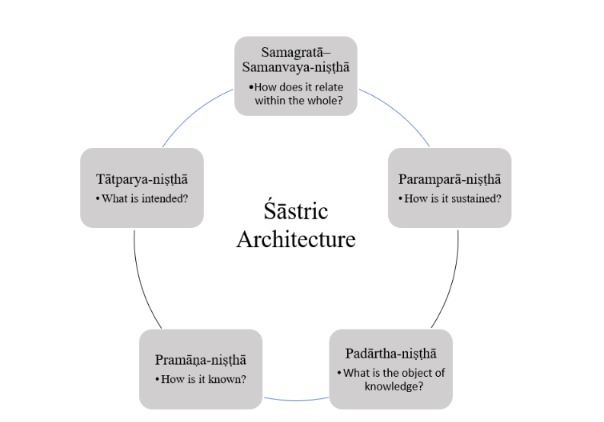
(Figure 1: The Pancha-Niṣṭhā Framework of Śāstric Architecture.)
2.1 The Pancha Niṣṭhās of Śāstric Architecture
Padārtha-niṣṭhā refers to fidelity to the recognition of objects of knowledge in their sthūla, sūkṣma, or kāraṇa dimensions (Śiva Purāṇa, 1.18.6–8; Vivekacūḍāmaṇi 74–123; Īśvarakṛṣṇa, Sāṃkhyakārikā 30–40; Patañjali, Yogasūtra 2.19 with Vyāsa Bhāṣya). Category errors arise when Bhāratīya categories are replaced by externally derived classifications or interpreted through assumptions foreign to the tradition. Bhārateeya Jñāna Paramparā recognises sthūla, sūkṣma, and kāraṇa dimensions. Sthūla denotes that which is manifest and available to observation; sūkṣma denotes that which is apprehended through the operation of the antaḥkaraṇa; and kāraṇa denotes the causal ground from which manifestation arises. Padārtha-niṣṭhā requires fidelity to these categories and distinctions before analysis, translation, comparison, or evaluation.
Pramāṇa-niṣṭhā concerns fidelity to the means through which knowledge is established and its validity ascertained (Gautama, Nyāyasūtra 1.1.1-8; Gaṅgeśa, Tattvacintāmaṇi, Pratyakṣa-khaṇḍa). The examination of pramāṇa is fundamental to Bhārateeya Jñāna Paramparā. Knowledge claims are not accepted merely on the basis of assertion; their establishment requires appropriate means of knowing (Gautama, Nyāyasūtra 1.1.1-8; Gaṅgeśa, Tattvacintāmaṇi, Pratyakṣa-khaṇḍa and Anumāna-khaṇḍa). Pratyakṣa, anumāna, and śabda are central means of knowledge, while upamāna, arthāpatti, and anupalabdhi are also recognised and elaborated within the wider śāstric discourse (Gautama, Nyāyasūtra 1.1.3-8, 2.1.18-21; Annambhaṭṭa, Tarkasaṅgraha, sections on pramāṇa; Gaṅgeśa, Tattvacintāmaṇi, Pratyakṣa-khaṇḍa and Anumāna-khaṇḍa). Their application depends upon the nature of the subject under investigation and the requirements of inquiry. Such differences in enumeration must be understood within a larger framework of knowledge rather than treated as evidence of disconnected epistemologies. The question is through which pramāṇa a conclusion is established. Different categories of padārtha may require different means of knowing. Pramāṇa-niṣṭhā therefore directs attention to the evidentiary foundations of a claim, the means by which it is established as siddhānta, and the conditions under which it may be examined within the tradition (Gautama, Nyāyasūtra 1.1.26-27, 1.1.32-39; Gaṅgeśa, Tattvacintāmaṇi, Anumāna-khaṇḍa).
Paramparā-niṣṭhā directs attention to the structures through which knowledge is transmitted and sustained across generations. Knowledge does not reside exclusively in texts; it is sustained through teachers, students, pedagogical disciplines, and institutional continuity (Taittirīya Upaniṣad 1.11.1-2). Across Bhārateeya Jñāna Paramparā, social and institutional arrangements evolved to support this continuity. The description of Kaṇvāśrama portrays an institutional setting in which scholars proficient in diverse Veda, Vedāṅga, Ṣaḍdarśana, and other śāstric disciplines coexist, suggesting an environment that transmits specialised knowledge (Vyāsa, Śrī Mahābhāratam, Ādiparva, Sambhavaparva, Śakuntalopākhyāna 70.37-47). Agrahāras were also established and endowed to support centres of learning, as illustrated by the Dāna Sāsana of 1560 CE associated with Garikapati Annam Bhaṭṭu (Garikapati 2026b). Kings sought counsel from ṛṣis and learned scholars (Vyāsa, Mahābhāratam, Sabhāparva and Śāntiparva), while educational disciplines such as brahmacaryāśrama established conditions for sustained study. These arrangements formed part of the wider environment through which knowledge was transmitted.
Tātparya-niṣṭhā concerns fidelity to intended meaning, purpose (prayojana), and interpretive continuity. The preservation of words is not identical with the preservation of meaning, nor is the preservation of meaning necessarily identical with the preservation of purpose. Knowledge remains intelligible through conventions of interpretation, commentary, and practice (Gautama, Nyāya-sūtra 1.1.1; Vātsyāyana, Nyāya-bhāṣya ad 1.1.1).
Failures of Tātparya-niṣṭhā frequently arise when terms are understood through apparently equivalent concepts whose intended meanings differ from those recognised within the tradition. For example, vāda is often translated as “debate.” Yet the tradition distinguishes vāda as tattva-bubhutsu-kathā (discussion oriented toward the ascertainment of truth) from jalpa as vijigīṣu-kathā (discussion oriented toward victory) (Śrīmad Annambhaṭṭa, Tattvacintāmaṇyālokasiddhāñjanam, preface). Fidelity to tātparya requires preserving not merely words, but the intended meaning and purpose through which they function within the tradition.
Samagratā-Samanvaya-niṣṭhā concerns fidelity to the integrity and coordination of the whole. The classical conception of the Caturdaśa Vidyāsthānas illustrates that Bhārateeya Jñāna Paramparā consists of distinct yet interrelated domains of knowledge. Samagratā draws attention to the integrity of the whole, while samanvaya draws attention to the meaningful coordination of its constituent parts. Together they require that a śāstra be understood both in terms of its specialised function and its relationship to the wider Śāstric Architecture. The Caturdaśa Vidyāsthānas provide the foundational architecture upon which specialised śāstras such as Āyurveda, Arthaśāstra, and Nāṭyaśāstra develop. These domains acquire fuller significance through their relationships within the larger knowledge tradition.
The Ṣaḍdarśanas provide a useful illustration. Modern descriptions frequently portray them as separate philosophical schools in competition with one another. Traditional study, however, has often approached them as interconnected śāstric disciplines situated within a shared śāstric framework. They accept Veda-prāmāṇya and participate in a broader śāstric tradition informed by the Vedas, Vedāṅgas, Purāṇa, and Dharmaśāstra. Their discussions employ traditions of vāda, draw upon methods of interpretation developed through Mīmāṃsā, and make use of forms of inquiry elaborated within Nyāya. Samagratā-Samanvaya-niṣṭhā seeks to understand how such distinct domains participate within a larger śāstric whole.
These five niṣṭhās constitute interrelated dimensions of fidelity inherent in understanding and engaging with Bhārateeya Jñāna Paramparā. They are neither independent criteria imposed from outside nor sequential stages in the acquisition of knowledge. Padārtha-niṣṭhā safeguards the recognition of the object of knowledge and its proper domain; Pramāṇa-niṣṭhā the means through which knowledge is established; Paramparā-niṣṭhā its continuity; Tātparya-niṣṭhā its intended meaning and purpose; and Samagratā-Samanvaya-niṣṭhā the integrity and coordination of the whole.
Together, these niṣṭhās constitute the principal dimensions of Śāstric Architecture and provide a framework for examining how Bhārateeya Jñāna Paramparā establishes valid knowledge, preserves continuity, and integrates diverse domains. Category errors arise when one or more of these dimensions are interpreted through conceptual frameworks that fail to account for the internal organisation and relationships of the tradition. The discussion that follows examines how such distortions emerge and why their correction is necessary for a fuller understanding of Bhārateeya Jñāna Paramparā.
3.0 Category Errors: When the Framework Distorts the Knowledge
A category error occurs when something is understood through a conceptual category that does not adequately represent its nature. In the study of Bhārateeya Jñāna Paramparā, such errors arise when knowledge is interpreted through frameworks that fail to account for the organising principles of the tradition itself.
The problem is not the use of external analytical tools as such. Comparative philosophy, linguistics, historiography, sociology, and textual criticism can illuminate important dimensions of a tradition. Category errors emerge when such frameworks cease to function as instruments of inquiry and instead become determinants of what the tradition is presumed to be. In such cases, the object of investigation is unconsciously reconstituted according to assumptions external to the tradition under study.
The Pañca-Niṣṭhā framework outlined in the previous section helps identify the principal sources of such distortion. A violation of Padārtha-niṣṭhā occurs when the object of knowledge is misidentified or when distinctions between sthūla, sūkṣma, and kāraṇa are ignored, collapsed, or reinterpreted through categories foreign to the tradition. Pramāṇa-niṣṭhā is compromised when knowledge claims are assessed without reference to the pramāṇas through which they are established. Paramparā-niṣṭhā is neglected when surviving texts are examined while the structures of transmission that preserve and animate them are ignored. Tātparya-niṣṭhā is violated when terms are understood through apparently equivalent concepts whose intended meanings differ from those recognised within the tradition. Samagratā–Samanvaya-niṣṭhā is undermined when interconnected śāstras are fragmented into isolated disciplines and studied independently of the larger architecture within which they function.
Category errors arise when the framework of inquiry itself obscures essential dimensions of the object being studied. Since the means of knowing are related to the nature of the object known, misidentification of the object of inquiry often leads to corresponding errors in the selection, application, and evaluation of pramāṇas.
The problem becomes particularly significant in the study of Bhārateeya Jñāna Paramparā because the tradition possesses its own categories for understanding knowledge. Terms such as śāstra, pramāṇa, paramparā, adhyayana, adhyāpana, vāda, and samanvaya are not merely linguistic labels; they identify functions within the wider Śāstric Architecture. Their significance cannot be assumed through lexical equivalence alone. When such terms are translated through externally derived concepts without examining their intended meaning, purpose, and function, the resulting interpretation may describe the tradition while simultaneously obscuring its internal organisation and relationships.
The distinction is not between traditional and modern methods, nor between Bhārateeya and non-Bhārateeya scholarship. The crucial distinction is between using an external analytical framework to understand a tradition and allowing that framework to redefine the object of inquiry in advance. The former can deepen understanding; the latter can distort it.
3.1 The Asymmetry of Intellectual Recognition
A related problem arises when intellectual traditions are evaluated through unequal standards of recognition. Knowledge produced within one civilizational context may be readily classified as scientific, theoretical, or philosophical, while knowledge produced in another is described primarily in terms of religion, culture, ritual, or social practice. Such classifications often reveal more about the framework of evaluation than about the knowledge being evaluated.
The context in which knowledge is preserved or applied does not, by itself, determine its intellectual character. A geometrical construction does not cease to be mathematical because it appears in a text concerned with altar construction. An astronomical computation does not lose its significance because it serves calendrical purposes. A discipline of linguistic analysis does not become merely ancillary because it contributes to the preservation and interpretation of a body of knowledge. Likewise, a śāstra does not cease to be systematic because its transmission occurs through oral, pedagogical, or institutional structures unfamiliar to modern academic practice.
The question is whether a body of knowledge possesses coherent methods of inquiry, valid means of knowledge, and structures of transmission. From the perspective of Śāstric Architecture, the concern is not merely what a text contains, but how knowledge is organised, sustained, coordinated, and made available as pramāṇa across generations.
Consequently, the study of Bhārateeya Jñāna Paramparā should not begin by accepting inherited classifications as definitive. It should first examine whether those classifications illuminate the tradition’s own architecture or conceal it. Only then can the nature of the knowledge under investigation be approached on its own terms.
4.0 Four Orientations Towards Bhārateeya Jñāna Paramparā
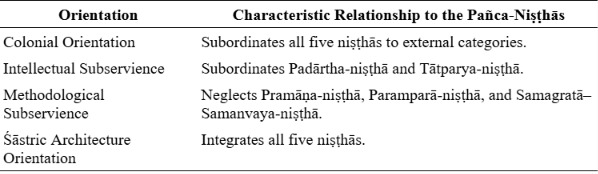
The foregoing discussion on Śāstric Architecture, the Pañca-Niṣṭhās, and category errors provides a basis for identifying distinct orientations in the study of Bhārateeya Jñāna Paramparā. These orientations are proposed as analytical categories for evaluating approaches to scholarship, not as classifications of individual scholars. A scholar’s work may exhibit more than one orientation, and an approach should be assessed through its assumptions, methods, treatment of evidence, and fidelity to the object under investigation rather than through the author’s identity or presumed motives.
These four orientations may also be understood as representing differing degrees of fidelity to the Śāstric Architecture of Bhārateeya Jñāna Paramparā. The first three introduce different forms of distortion through the neglect, subordination, or fragmentation of one or more dimensions of the Pañca-Niṣṭhā framework. The fourth seeks to understand the tradition through its own understanding of knowledge and its organisation within the Śāstric Architecture (Table 2).
Table 2. Four Scholarly Orientations Towards Bhārateeya Jñāna Paramparā
4.1 Colonial Orientation
A colonial orientation operates when externally derived hierarchies of categories, authority, and knowledge are imposed upon Bhārateeya Jñāna Paramparā in ways that subordinate, fragment, or misrepresent its internal foundations.
Its defining feature is not the use of an English term, a modern method, or a concept developed outside India. Rather, it is the uncritical assumption that externally derived categories possess greater explanatory authority than the categories through which the tradition understands itself.
Such an orientation frequently treats Bhāratīya categories as objects requiring translation, while treating the categories of the interpreter as self-evidently universal. As a consequence, distinctions central to the tradition are overlooked or redefined. Objects belonging to the sthūla, sūkṣma, and kāraṇa dimensions are collapsed into a single domain of materially observable phenomena, thereby obscuring distinctions fundamental to the tradition’s understanding of the object of knowledge. Claims concerning śabda-pramāṇa, apauruṣeyatva, paramparā, or itihāsa are dismissed before their epistemic function within the tradition has been examined.
One of the most consequential examples of such distortion is the treatment of the Vedas primarily as texts rather than as śabda-pramāṇa. Within Bhārateeya Jñāna Paramparā, the Veda is understood as śabda-pramāṇa, while the Vedāṅgas provide the disciplines necessary for its transmission. When the Veda is reduced to a textual artefact and the Vedāṅgas to auxiliary sciences, the integral relationship between pramāṇa and transmission is obscured. What appears as a collection of texts and subsidiary disciplines from one perspective functions, within the tradition, as an interconnected architecture through which śabda-pramāṇa is preserved and transmitted. Structures of transmission are subordinated to textual artefacts, and interconnected bodies of knowledge are fragmented into isolated disciplines.
The consequence is that Bhārateeya knowledge is recognised only after it has been reformulated within a framework that obscures many of its original categories, relationships, and purposes. Identifying such a pattern requires examining specific arguments, classifications, and interpretations. It should not be presumed solely from vocabulary, nationality, or institutional affiliation.
4.2 Intellectual Subservience
Intellectual subservience occurs when inherited narratives, classifications, and interpretations are reproduced without sufficient independent examination.
An author need not consciously endorse colonial assumptions to perpetuate them. Conceptual dependence may persist long after political dependence has disappeared. Interpretive frameworks are often inherited through textbooks, institutional training, disciplinary conventions, and received histories, and subsequently accepted as self-evident simply because they are familiar.
The critical question is whether the underlying assumptions of a narrative are themselves subjected to scrutiny. Does the investigator return to primary sources? Are Bhāratīya categories examined in their own right? Are established interpretations treated as conclusions to be tested or as premises to be accepted?
Intellectual subservience frequently manifests through the uncritical adoption of received categories and interpretations. Terms such as vāda, śāstra, or pramāṇa are often accepted through inherited translations without examining whether those translations preserve their intended meaning within the tradition itself. In terms of the Pañca-Niṣṭhā framework, it frequently results in failures of Padārtha-niṣṭhā and Tātparya-niṣṭhā, where both the categories and intended meanings of a tradition are replaced by explanatory frameworks derived from elsewhere.
The problem becomes particularly evident when inherited translations are accepted without examining the wider conceptual relationships within which they operate. Terms such as jñāna, yajña, niḥśreyasa, and mokṣa are frequently approached through apparently equivalent concepts whose meanings are shaped by different intellectual traditions. Within Bhārateeya Jñāna Paramparā, jñāna is not ordinarily pursued as an end in itself; it serves to align the individual with ṛta, the underlying order that sustains existence. Actions performed in accordance with ṛta are understood as yajña, while the progressive alignment of understanding and conduct with ṛta culminates in niḥśreyasa or mokṣa. When these concepts are interpreted through external categories such as knowledge for its own sake, sacrifice, or liberation, the relationships that connect them become obscured.
A similar difficulty arises in the interpretation of the Nyāya-sūtra. The opening declaration that knowledge of the sixteen padārthas leads to niḥśreyasa (tattvajñānān niḥśreyasādhigamaḥ) is often approached as the enumeration of sixteen independent categories, whereas the padārthas function within a larger process through which tattva-jñāna is attained and niḥśreyasa pursued. When the focus rests exclusively on the categories themselves, the larger purpose of the inquiry becomes obscured.
The issue is not merely one of translation, but of preserving the conceptual relationships through which meaning is established within the tradition. In terms of the Pañca-Niṣṭhā framework, such distortions frequently arise through failures of both Padārtha-niṣṭhā and Tātparya-niṣṭhā, where inherited interpretations are accepted without examining the categories and purposes through which the tradition understands itself.
Intellectual independence requires more than rejecting an established narrative. It requires the willingness to investigate evidence without allowing either inherited authority or reactive contrarianism to become the final arbiter of understanding.
4.3 Methodological Subservience
Methodological subservience arises when a method is treated as an authority independent of the object it is intended to investigate.
Every method possesses a legitimate scope. Philology can illuminate linguistic usage; textual criticism can establish relationships among manuscripts; inscriptional analysis can investigate documented transactions; ethnography can examine living practices. None of these methods is inherently problematic. The difficulty emerges when the limitations of a method are mistaken for limitations of the knowledge tradition itself.
The Vyākaraṇa tradition provides an illustrative example. Pāṇini’s Aṣṭādhyāyī, Patañjali’s Mahābhāṣya, Kaiyaṭa’s Pradīpa, and Annam Bhaṭṭa’s Pradīpoddyotana are separated by many centuries. A purely textual approach may treat them as successive literary productions belonging to different historical periods. Yet the tradition itself understands them through relationships of exposition, interpretation, pedagogy, and continuity. The Mahābhāṣya is intelligible through the Aṣṭādhyāyī; the Pradīpa through the Mahābhāṣya; and the Pradīpoddyotana through the Pradīpa. What persists across this succession is not merely a sequence of texts but the continuity of grammatical knowledge sustained through study, teaching, commentary, and paramparā.
A method becomes inadequate when it assumes that the forms of evidence recognised by the method are identical with all forms of evidence recognised by the tradition under investigation. Such assumptions often arise when the nature of the object under inquiry is not first established. If the object being studied is a living knowledge tradition, then the relationships that connect texts, teachers, students, commentaries, pedagogical practices, and lineages form part of the evidence. A method that confines itself exclusively to written documentation may become incapable of accounting for these relationships. Such limitations belong to the method, not necessarily to the tradition being studied.
Methodological subservience frequently results in failures of Pramāṇa-niṣṭhā, Paramparā-niṣṭhā, and Samagratā–Samanvaya-niṣṭhā. The means through which knowledge acquires authority are overlooked, the structures through which it is sustained are ignored, and the larger relationships through which the tradition maintains coherence become fragmented.
Methodological rigour requires the opposite approach: methods must be matched to the object of inquiry, adapted to the questions being asked, and continually tested against the evidence that emerges.
4.4 The Śāstric Architecture Orientation
The fourth orientation offers a constructive alternative grounded in the principles of Śāstric Architecture.
The Śāstric Architecture Orientation begins by investigating how a tradition understands its own categories, pramāṇas, and structures of knowledge. Rather than assuming that external classifications define the object of study, it seeks first to understand the object through the categories internal to the tradition itself.
Such inquiry asks how knowledge is established and sustained within a tradition. It investigates the relationship between the object of knowledge and the means through which it is known, between śāstra and paramparā, between texts and living traditions, and between individual disciplines and the larger Śāstric Architecture of which they form a part.
It recognises that different traditions may transmit knowledge through different combinations of textual, oral, and institutional means. The relationship among text, transmission, interpretation, and practice must be established through evidence rather than assumed in advance.
Most importantly, this orientation seeks to understand Bhārateeya Jñāna Paramparā through the coordinated application of Padārtha-niṣṭhā, Pramāṇa-niṣṭhā, Paramparā-niṣṭhā, Tātparya-niṣṭhā, and Samagratā–Samanvaya-niṣṭhā. The objective is neither to reject external scholarship nor to romanticise inherited practices. Rather, it seeks to ensure that the nature of the tradition determines the questions that must be asked, while rigorous inquiry determines the conclusions that may be drawn.
This orientation provides the foundation for understanding Śāstric Architecture, within which Oral Architecture constitutes one of the principal structures through which knowledge is preserved and made available across generations.
5.0 Oral Architecture: Preserving Śabda-Pramāṇa Beyond the Text
5.1 Oral Architecture and Knowledge Continuity
The concept of Oral Architecture begins with a distinction between the record of knowledge and the architecture through which knowledge remains available across generations.
A text may preserve statements, procedures, or arguments. Yet the preservation of the Veda as Śabda-Pramāṇa cannot be reduced to the preservation of textual content. Documentation may preserve words; it does not preserve Vedic Śabda as Pramāṇa.
A recurring category error in the study of Bhārateeya Jñāna Paramparā is the tendency to regard oral transmission as a technologically limited substitute for writing. Such a characterisation misunderstands both the problem being addressed and the solution developed within the tradition. The concern was not the preservation of information but the preservation of Vedic Śabda as Pramāṇa.
For this purpose, documentation is insufficient. The preservation of Vedic Śabda as Pramāṇa requires an oral architecture that preserves correctness of pronunciation and continuity of transmission. The issue is not merely whether words survive, but whether Vedic Śabda remains available as a valid means of knowledge.
Oral Architecture refers to the organised architecture constituted by the Vedāṅgas through which Vedic Śabda is transmitted as Pramāṇa. The term architecture is deliberate. It directs attention not to isolated practices but to a coordinated system whose constituent elements collectively make continuity possible. The term oral highlights the primacy of Śruti as the means through which the Veda is transmitted as Śabda-Pramāṇa.
Within the broader framework of Śāstric Architecture, Oral Architecture represents one of the principal mechanisms through which Paramparā-niṣṭhā is realised. It illuminates the conditions through which knowledge continuity is sustained across Bhārateeya Jñāna Paramparā.
The significance of Oral Architecture extends beyond the preservation of Vedic Śabda. Developed for the preservation and transmission of Vedic Śabda as Pramāṇa, it established enduring structures through which knowledge continuity was sustained across Bhārateeya Jñāna Paramparā. Oral Architecture therefore preserves Vedic Śabda as Pramāṇa while also illuminating the broader relationship between transmission and continuity within the tradition.
Oral Architecture may be examined through the Pañca-Niṣṭhā framework introduced earlier (Table 3).
Table 3. Oral Architecture Through the Lens of the Five Niṣṭhās
5.2 The Vedāṅgas as an Illustration of the Pañca-Niṣṭhā Framework
The preservation problem becomes especially visible in the case of the Veda. From the perspective of Padārtha-niṣṭhā, the Veda functions as Śabda-Pramāṇa, while the Vedāṅgas constitute the architecture through which that pramāṇa remains available across generations. The challenge was the preservation of Vedic Śabda in a form that continued to function as Pramāṇa.
The six Vedāṅgas are frequently described as auxiliaries to the Veda, a description that reflects the limitations of a colonial orientation. Viewed through the lens of Śāstric Architecture, their significance lies in their coordinated relationship to a common purpose: the preservation and transmission of Vedic Śabda as Pramāṇa. Together they constitute an Oral Architecture through which Vedic knowledge remains available across generations.
From the perspective of Pramāṇa-niṣṭhā, the central question concerns the continued availability of Vedic Śabda as a valid means of knowledge. Once the Veda is approached primarily as a text and the Vedāṅgas as auxiliary disciplines, the question of pramāṇa recedes into the background. The Veda comes to be treated as another textual object requiring interpretation through linguistic analysis alone. Within the tradition, however, the Veda is understood within the larger framework of the Caturdaśa Vidyāsthānas, in which Mīmāṃsā investigates the principles through which Vedic meaning and authority are established. Such displacement of the question of pramāṇa illustrates a failure of Pramāṇa-niṣṭhā and a tendency toward methodological subservience.
Paramparā-niṣṭhā directs attention to the continuity through which Vedic Śabda remains available across generations. The preservation of Vedic knowledge depends upon the guru–śiṣya tradition and the disciplines of learning through which transmission occurs. Approaches that focus exclusively upon the textual record often overlook these conditions of continuity and thereby provide only a partial account of how knowledge is sustained.
The significance of the Vedāṅga architecture also illuminates Tātparya-niṣṭhā. The preservation of Vedic Śabda involves more than continuity of sound. Meaning must remain intelligible across generations. Oral Architecture therefore preserves both transmission and the conditions through which understanding remains possible.
Finally, the Vedāṅgas provide a particularly clear illustration of Samagratā–Samanvaya-niṣṭhā. Their significance arises not from isolated functions but from their coordinated relationship to a shared objective. The preservation of Vedic Śabda as Pramāṇa is achieved through the integrity of the architecture as a whole. Approaches that fragment the Vedāṅgas into independent disciplines risk obscuring the larger purpose that gives coherence to their individual functions.
The Oral Architecture of the Vedāṅgas illustrates more than a system of preservation. It demonstrates how the five niṣṭhās operate together in sustaining knowledge continuity. It also reveals how category errors arise when one or more of these dimensions are neglected, subordinated, or fragmented.
6.0 A Historical Illustration of Śāstric Architecture: Garikapati Annam Bhaṭṭu
The conception of Śāstric Architecture developed in the preceding sections may be further illustrated through the life and scholarly tradition associated with Garikapati Annam Bhaṭṭu. Whereas Oral Architecture demonstrated how Śāstric Architecture operates in the preservation of Vedic Śabda as Pramāṇa, the Annam Bhaṭṭu case reveals how a lived Śāstric Architecture becomes visible through historical evidence. Its significance lies in the survival of multiple forms of evidence, each illuminating a different dimension of continuity within Bhārateeya Jñāna Paramparā.
In The Gift of Knowledge: Garikapati Annam Bhaṭṭu, inscriptional evidence, family histories, oral accounts, and scholarly works were brought together to investigate both a historical figure and the śāstric architecture within which he lived, taught, and composed his works. The inquiry revealed an important methodological principle: different forms of evidence illuminate different dimensions of a knowledge tradition. Inscriptional evidence may reveal institutional continuity, while scholarly works make visible methods of inquiry and pedagogical priorities. Family histories and oral accounts preserve traces of transmission that may otherwise remain hidden. Understanding emerges through the relationships among these sources, through which the larger architecture of the tradition gradually becomes visible.
Viewed through the Pañca-Niṣṭhā framework, the significance of the case becomes clearer. The works associated with Annam Bhaṭṭu immediately raise questions of Padārtha-niṣṭhā. Modern scholarship often identifies him principally through the Tarka Saṅgraha and therefore classifies him as a Naiyāyika or logician. Such classifications arise from categories external to the śāstric world within which he lived and taught. The historical evidence reveals an ācārya whose works extend across Nyāya, Vyākaraṇa, Mīmāṃsā, and Vedānta. The question is therefore not whether Annam Bhaṭṭu belongs to a particular intellectual category, but whether the categories themselves adequately describe the object under investigation. The case illustrates how category errors arise when inherited classifications are accepted without examining the śāstric architecture within which a scholar is formed.
The same evidence illuminates Pramāṇa-niṣṭhā. The significance of Annam Bhaṭṭu’s writings lies not merely in the conclusions they contain but in the modes of inquiry they presuppose. Works such as the Tarka Saṅgraha, Brahmasūtra Mitākṣarī, and writings associated with Mīmāṃsā reveal participation in traditions concerned with the establishment, interpretation, and application of valid knowledge. Their relationship becomes intelligible only when viewed against the larger pramāṇic framework within which knowledge attains the status of siddhānta.
The historical evidence also reveals the importance of Paramparā-niṣṭhā. The movement of Annam Bhaṭṭu from Mamillapalli to Kāśī and later to Garikapāḍu, his association with scholarly lineages, the role of teachers, the presence of vidvat-pariṣats, and the grant of an agrahāra together illuminate the structures through which knowledge continuity was sustained. These sources reveal more than the biography of a scholar. They reveal the conditions through which competence, learning, and intellectual traditions were transmitted across generations.
The pedagogical orientation of Annam Bhaṭṭu’s works further illustrates Tātparya-niṣṭhā. His commitment to sukhabodha demonstrates that preserving knowledge requires preserving intelligibility. The pedagogical relationship between the Tarka Saṅgraha and its Dīpikā reveals a conscious effort to make technical knowledge accessible without sacrificing precision. Technical knowledge remains available only when intended meaning continues to be accessible to successive generations of learners.
The broader significance of the case becomes apparent through Samagratā–Samanvaya-niṣṭhā. The Annam Bhaṭṭu tradition reveals a larger Śāstric Architecture within which scholarly activity, institutional continuity, and transmission participate in a shared continuity of knowledge. The same integrative character is visible in his works. Nyāya, Vyākaraṇa, Mīmāṃsā, and Vedānta emerge as interconnected domains within a common śāstric formation, illustrating how understanding arises through relationships rather than through isolated categories.
The Annam Bhaṭṭu case therefore demonstrates more than the value of multiple sources. It illustrates how the Pañca-Niṣṭhā framework enables the recovery of a living knowledge tradition from historical evidence. Oral Architecture revealed the conditions through which knowledge is preserved. The Annam Bhaṭṭu case reveals how those conditions become historically visible. Together they demonstrate the explanatory power of Śāstric Architecture for understanding Bhārateeya Jñāna Paramparā.
7.0 Bhārateeya Jñāna Paramparā as Śāstric Architecture
7.1 A Śāstric Methodology
The preceding discussions suggest that the Pañca Niṣṭhā framework is more than a conceptual model. It provides a methodological orientation for the study of Bhārateeya Jñāna Paramparā. The central task of inquiry is the integrated understanding of the śāstric architecture that sustains a knowledge tradition.
Such an inquiry begins with attention to the categories through which a tradition understands itself, the means through which its claims attain validity, the structures through which continuity is preserved, and the interpretive practices through which meaning remains intelligible across generations. Different forms of evidence illuminate different dimensions of this architecture. Their significance emerges through the relationships they disclose rather than through their independent examination.
A rigorous inquiry must also distinguish among forms of evidence without conflating their functions. Texts, inscriptions, oral traditions, institutional records, commentarial traditions, and living practices may illuminate different dimensions of a knowledge tradition. Their evidentiary significance and limitations must be understood within their respective contexts before their contributions are integrated into a larger understanding.
7.2 Samagratā and Samanvaya as Criteria of Inquiry
The case studies of Oral Architecture and Garikapati Annam Bhaṭṭu illuminate the importance of Samagratā and Samanvaya as criteria for adequate inquiry. Oral Architecture revealed that the preservation of Vedic Śabda as Pramāṇa depends upon an integrated architecture of transmission. The Annam Bhaṭṭu case revealed that the continuity of a knowledge tradition becomes visible only when texts, institutions, lineage, pedagogy, and historical evidence are examined in relationship to one another.
Samagratā concerns the extent to which inquiry has brought into view the dimensions necessary for understanding its object. Samanvaya concerns the relationships through which those dimensions become intelligible. Deficiencies in either often produce category errors, disciplinary reduction, or fragmented interpretations of knowledge traditions. Adequate inquiry therefore requires attention both to the integrity of what is being studied and to the relationships that constitute it.
Samagratā does not require every inquiry to address every dimension of a tradition; its conclusions must remain proportionate to the scope of investigation. Samanvaya does not erase distinctions or presume complete harmony among śāstras, but seeks to understand their meaningful relationships while preserving their distinct functions.
Through these principles, Bhārateeya Jñāna Paramparā becomes intelligible as an architecture of continuity rather than an accumulation of disconnected texts, institutions, or historical facts.
7.3 Conclusion
This paper has proposed Śāstric Architecture as a framework for understanding Bhārateeya Jñāna Paramparā through the structures and relationships that sustain knowledge across generations. The framework was articulated through five interrelated dimensions of inquiry: Padārtha‑niṣṭhā, Pramāṇa‑niṣṭhā, Paramparā‑niṣṭhā, Tātparya‑niṣṭhā, and Samagratā–Samanvaya‑niṣṭhā.
The discussion of Oral Architecture demonstrated how these dimensions illuminate the preservation of Vedic Śabda as Pramāṇa. The Annam Bhaṭṭu case demonstrated how the same framework enables the recovery of a living knowledge tradition through historical evidence. Together, these illustrations reveal the explanatory power of Śāstric Architecture as both a framework of understanding and a methodology of inquiry.
The central shift proposed by this paper is from studying Bhārateeya knowledge through inherited classifications to investigating it through the architecture by which it sustains itself. Bhārateeya Jñāna Paramparā becomes most intelligible when knowledge, transmission, interpretation, pedagogy, institutions, and continuity are understood as participating in a larger Śāstric Architecture. Such an approach does not replace specialised inquiry; it situates specialised inquiry within the relationships that make knowledge possible, intelligible, and continuous across generations.
Acknowledgements
I sincerely thank Prof. G. Narahari Sastry, Dean, IIT Hyderabad, for his constant guidance and for helping me balance traditional Indian thought with contemporary perspectives, which has been invaluable in shaping this paper. I am also deeply grateful to Mrs. G. Songeeta for her insightful discussions and perspectives that significantly enhanced the clarity and depth of this work. Ms. Akanksha Garikapati carefully reviewed the near-final manuscript and provided thoughtful comments and suggestions that contributed to improving its clarity and presentation.
References
Ādi Śaṅkarācārya. Vivekacūḍāmaṇi. 14th repr. Gorakhpur: Gita Press, 2013. Sanskrit text in Telugu script with Telugu tātparya.
Annambhaṭṭa. Tarka Saṅgraha with Dīpikā. Edited with notes by Swami Virupakshananda. Madras: Sri Ramakrishna Math, 1994.
Annambhaṭṭa. Tattvacintāmaṇyālokasiddhāñjanam (Maṅgalavāda). Edited by Dr. Inaganti Uma Rama Rao. Rashtriya Sanskrit Vidyapeetha Publication Series 298. Tirupati: Rashtriya Sanskrit Vidyapeetha, 2015.
Garikapati, Pavan Kumar. 2025a. Indian Knowledge Systems as Epistemic Architectures: Transmission, Validation, and Ontology. PhilArchive. Version 1, uploaded December 17, 2025. https://philarchive.org/rec/GARIKS.
Garikapati, Pavan Kumar. 2025b. “The Oral Architecture of the Vedāṅgas: Preserving the Eternal Veda.” Indica Today, November 27, 2025. https://www.indica.today/long-reads/the-oral-architecture-of-the-veda%E1%B9%85gas-preserving-the-eternal-veda/.
Garikapati, Pavan Kumar. 2026a. “Category Errors in the Study of Bhāratīya Jñāna Paramparā.” Pragyata, April 16, 2026. https://pragyata.com/category-errors-in-the-study-of-bharatiya-jnana-parampara/.
Garikapati, Pavan Kumar. 2026b. “The Gift of Knowledge: Garikapati Annam Bhaṭṭu through the Dāna Sāsana of 1560 CE.” Indica Today, June 16, 2026. https://www.indica.today/long-reads/the-gift-of-knowledge-garikapati-annam-bhattu/.
Garikapati, Pavan Kumar. 2026c. “Annambhaṭṭa: Beyond Disciplinary Labels.” Indica Today, Jan 17, 2026. https://www.indica.today/long-reads/annambhatta-beyond-disciplinary-labels/. [indica.today]
Gaṅgeśa Upādhyāya. Tattvacintāmaṇi. Digital text prepared under the project “Content Generation with a View to Develop E-Databank, E-Learning and E-Sources of Sanskrit Text,” directed by Prof. Radha Vallabh Tripathi. New Delhi: Rashtriya Sanskrit Sansthan. Accessed November 5, 2026. https://www.sanskrit.nic.in/DigitalBook/T/Tattvacintamani.pdf.
Hiriyanna, M. Outlines of Indian Philosophy. London: George Allen & Unwin, 1932.
Īśvarakṛṣṇa. Sāṃkhyakārikā of Īśvarakṛṣṇa with the Tattvakaumudī of Śrī Vācaspati Miśra: With Sanskrit Text of the Kārikā, Transliteration, Word-for-Word Meaning, and a Free Rendering into English of the Tattvakaumudī with Notes. Translated and annotated by Swami Virūpākṣānanda. Madras: Sri Ramakrishna Math, 1995.
Jha, Ganganatha, trans. The Nyāya-Sūtras of Gautama: With the Bhāṣya of Vātsyāyana and the Vārttika of Uddyotakara. Internet Archive digitization. https://archive.org/details/nyayasutrasofgautamawithvatsayanabhashyaganganathajha_202003_331_k.
Matilal, Bimal Krishna. Perception: An Essay on Classical Indian Theories of Knowledge. Oxford: Clarendon Press, 1991.
Matilal, Bimal Krishna. The Character of Logic in India. Edited by Jonardon Ganeri and Heeraman Tiwari. Albany: State University of New York Press, 1998.
Patañjali. Pātañjalayogadarśanam with Vyāsabhāṣyam. Edited by Ācārya Pariśuddhānanda Giri Svāmī. Hyderabad: Śrī Viśvanātha Kṣetram, Śrī Parāśarāśramam, 2017.
Pathak, M. M., ed. The Critical Edition of the Viṣṇupurāṇam. Vol. 1, Aṃśas 1–3. Vadodara: Oriental Institute, 1997.
Patton, Laurie L. Bringing the Gods to Mind: Mantra and Ritual in Early Indian Sacrifice. Berkeley: University of California Press, 2005.
Śiva Purāṇa. “Chapter 18 (Sanskrit Text).” Wisdom Library. Accessed November 5, 2026. https://www.wisdomlib.org/hinduism/book/shiva-purana-sanskrit/d/doc377508.html.
Staal, Frits. The Fidelity of Oral Tradition and the Origins of Science. Amsterdam: North-Holland Publishing Company, 1986.
Staal, Frits. Discovering the Vedas: Origins, Mantras, Rituals, Insights. New Delhi: Penguin Books India, 2008.
Taittirīya Upaniṣad. Telugu-script edition. 7th reprint, June 2016. Hyderabad: Ramakrishna Math.
Vyāsa. Śrī Mahābhāratam: Ādiparvamu and Sabhāparvamu. Part 1. Telugu-script edition. 3rd reprint, 2021. Gorakhpur: Gita Press. Book no. 2141.
Vyāsa. Śrī Mahābhāratam: Śāntiparvamu. Part 6. Telugu-script edition. Gorakhpur: Gita Press. Book no. 2146.
Witzel, Michael, ed. Inside the Texts, Beyond the Texts: New Approaches to the Study of the Vedas. Harvard Oriental Series, Opera Minora 2. Cambridge, MA: Department of Sanskrit and Indian Studies, Harvard University, 1997.
Disclaimer: The opinions expressed in this article belong to the author. Indic Today is neither responsible nor liable for the accuracy, completeness, suitability, or validity of any information in the article.



 [1]