
How Indian Knowledge Systems are Transforming Classrooms under NEP 2020
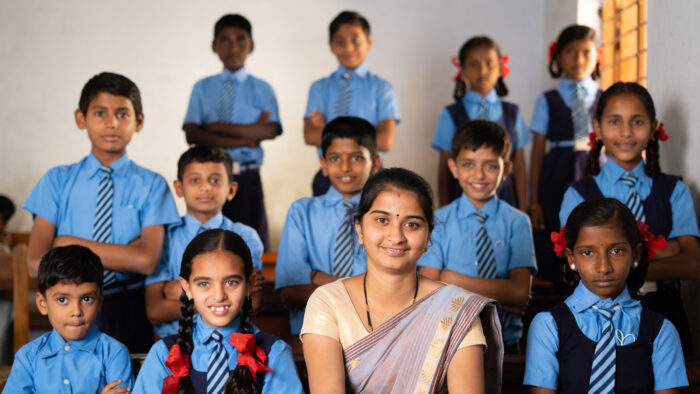
NEP 2020 and NCFSE 2023 are scripting a quiet revolution in Indian classrooms, weaving the country’s rich intellectual heritage into every subject from Grade 3 onwards. For millions of schoolchildren, learning has never felt more like home. Imagine a Class 7 student opening her mathematics textbook Ganita Prakash and discovering not just the names of Western mathematicians but also that of Aryabhata, Brahmagupta and Bhaskara and how India was the cradle in which the foundational building blocks of mathematics were shaped. Or a Class 6 student flipping through her social science textbook Exploring Society: India and Beyond and reading about the intellectual roots of Indian civilisation, not as a footnote, but as a centrepiece of the curriculum. This is the new world India’s schools are stepping into, thanks to the National Education Policy (NEP) 2020 and the National Curriculum Framework for School Education (NCFSE) 2023.
After decades of an education system shaped largely by colonial templates and post-independence policies that often treated India’s classical knowledge as peripheral or irrelevant, a profound course correction is underway. The integration of Indian Knowledge Systems (IKS) into mainstream school and university curricula is perhaps the most sweeping philosophical shift in Indian education since Independence. For the country’s 250 million schoolchildren, it could change not just what they learn, but how they see themselves and their civilisation. For generations of Indian students educated in a system where Pythagoras was taught without mention of Baudhayana who articulated the same theorem in the Sulba Sutras centuries earlier, this correction is long overdue.
Indian Knowledge Systems is a broad and inclusive term that covers the vast accumulated wisdom of the Indian subcontinent across millennia. It encompasses mathematics and astronomy, medicine and surgery, linguistics and grammar, architecture and town planning, philosophy and logic, agriculture, metallurgy, water harvesting, textile arts, music, dance, literature, and much more. Critically, IKS also includes the knowledge of India’s tribal communities and indigenous peoples, oral traditions, ecological wisdom, and time-tested local practices that have sustained communities for centuries.
What sets IKS apart is not mere antiquity but documented, tested, and often surprisingly sophisticated knowledge. The Iron Pillar of Delhi which has resisted corrosion for over 1,600 years and the stepwells of Gujarat and Rajasthan are feats of engineering still admired today. India’s mathematicians independently arrived at decimal positional notation, infinite series, calculus and trigonometric functions, contributions that the world now knows largely through European attribution.
The National Education Policy 2020 is India’s first comprehensive education overhaul in 34 years which places IKS at the heart of its vision. NEP 2020 explicitly states that the “rich heritage of ancient and eternal Indian knowledge” must be a guiding light for education, and mandates that IKS be integrated scientifically across school and higher education curricula, encompassing mathematics, astronomy, philosophy, yoga, architecture, medicine, agriculture, engineering, linguistics, literature, sports, and games, as well as tribal and indigenous knowledge traditions.
To understand why this is significant, it is worth recalling what came before. Post-colonial India inherited an education system that was, by design, intended to produce, as Macaulay’s infamous Minute of 1835 put it, “a class of persons, Indian in blood and colour, but English in taste, in opinions, in morals, and in intellect.” While independent India moved beyond that framework in many ways, successive National Curriculum Frameworks — in 1975, 1988, 2000, and 2005 — treated IKS as peripheral at best. The 2005 NCF, widely regarded as educationally progressive in other respects, focused on constructivist learning but largely left the IKS question unaddressed.
Translating that vision into curriculum was the job of the National Curriculum Framework for School Education (NCFSE) 2023, a landmark 600-plus page document developed through extensive consultations across 25 states and union territories. NCFSE 2023 formally weaves IKS into the curricular goals of every stage of schooling — foundational, preparatory, middle, and secondary — and stresses that learning must be contextualised within India’s cultural and intellectual roots to make it meaningful for every child, regardless of region, language, or background.
At the university level, the University Grants Commission (UGC) has mandated that at least 5 per cent of the total mandated credits in every undergraduate and postgraduate programme must be IKS-related courses. Across the country, over 8,000 higher education institutions have begun adopting IKS in their curricula, and 32 dedicated IKS centres have been established for research and education. Recent Union Budgets have stepped up funding for Indian Knowledge Systems, with allocations rising from around Rs 10 crore earlier to Rs 50 crore in 2025–26, signalling serious institutional intent.
The most tangible evidence of this transformation is in the new NCERT textbooks being rolled out in phases from 2024 onwards. NCERT constituted a dedicated 19-member Curriculum Area Group (CAG) on Indian Knowledge Systems to ensure IKS is woven into textbooks across subjects for Classes 3 to 12. Here is a subject-by-subject look at what students are now encountering.
The new mathematics textbooks titled Ganita Prakash are described by NCERT as a series that “connects maths to the real world and discovers our rich mathematical legacy.” The Class 7 edition prominently features Aryabhata and Brahmagupta, crediting them for foundational breakthroughs in algebra, geometry, and arithmetic. The Class 8 book, similarly, spotlights the mathematics behind Aryabhata-II’s astronomical observations.
The new Class 6 science textbook, Curiosity, is perhaps the boldest departure from the old format. A review of the book notes that while previous NCERT science books had very few references to Indian scientific history and contributions and were more oriented towards content transmission, the new Curiosity textbook has Indian Knowledge Systems and environmental education interwoven in the content. Topics covered include the concept of paramanu (ancient Indian theories of atomism), traditional water harvesting architecture (baolis, kunds, and tank systems), ancient Indian metallurgy, and references to the ISRO mission contextualised alongside classical Indian astronomy.
Students reading Curiosity encounter science not as a foreign import but as something India has contributed to richly. The Class 8 science book maintains this approach, covering materials science with references to India’s ancient traditions of smelting, dyeing, and chemical processing.
Perhaps the most dramatic change is in social science. The new Class 6 textbook, Exploring Society: India and Beyond, replaces the earlier separate books for history, geography, and civics with a single, integrated volume. Its structure is revealing – Theme C is titled “Our Cultural Heritage and Knowledge Traditions” and includes dedicated chapters on “India’s Cultural Roots” and “Unity in Diversity, or Many in the One.” The chapter on “India, That Is Bharat” invites students to explore the civilisational identity embedded in the country’s names.
For Class 8, the new Exploring Society: India and Beyond (Volume II) presents a revised historical narrative that highlights India’s intellectual and scientific achievements in mathematics, metallurgy, and philosophy alongside its political and social history. The book uses the term Sindhu-Sarasvati Civilisation alongside the more familiar Indus Valley Civilisation, reflecting recent archaeological scholarship.
The new English textbooks — Poorvi for Class 8, Mridang and Santoor for other classes — represent a conscious shift away from Eurocentric content to Indian narratives and values. Poorvi foregrounds a range of Indian writers, poets and storytellers. The move signals that English-medium education need not mean Western-centric education. Students can gain linguistic fluency and simultaneously develop a sense of their own civilisational inheritance.
The most exciting argument for IKS integration is not nostalgic but forward-looking. India’s ancient knowledge traditions contain untapped potential for research, innovation, and solutions to contemporary problems:
India’s classical medical texts document thousands of plant-based treatments. Modern pharmacology has already derived important compounds from this knowledge base. Students exposed to Ayurvedic principles at school level are far better equipped to pursue careers in drug discovery, integrative medicine, and pharmaceutical research. Traditional water‑harvesting systems such as baolis or stepwells, kunds (rainwater‑collecting tanks) and johads (earthen check dams), along with tank and canal‑based irrigation systems described in classical treatises like the Arthashastra, are being rediscovered as vital tools for climate‑resilient water management in an era of growing water scarcity. There is growing global scientific interest in the science behind meditation and yoga, and India’s unparalleled textual and experiential tradition gives it a natural advantage in this field.
From classrooms and social media, grassroots voices are beginning to emerge. Teachers at Kendriya Vidyalayas report that the chapters on Indian scientists and mathematicians generate unusual excitement among students who had previously thought of their heritage as old and irrelevant. A science teacher in Bhopal who attended an IKS faculty development programme described it as eye-opening: “For the first time, I could tell my students that science has a deeply Indian story too and that we didn’t just receive knowledge from the West, we gave it.”
IKS National Coordinator Ganti S. Murthy, who has spearheaded the IKS division of the MHRD and its implementation across 24 cities in 23 states, notes a shift in the nature of the discourse itself: “The biggest achievement over the past five years has been the growing academic seriousness around IKS. First, there is now broad awareness across the country. Second, the nature of the conversation has shifted — from casual or fringe-level debates to serious, scholarly discussions. That is a very encouraging sign.”
Disclaimer: The opinions expressed in this article belong to the author. Indic Today is neither responsible nor liable for the accuracy, completeness, suitability, or validity of any information in the article.