
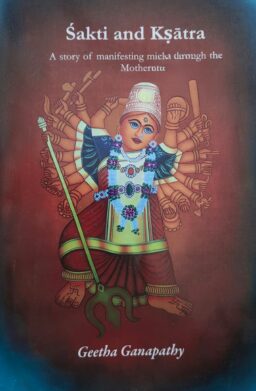
Manifesting Might through the Mother
Some books arrive at the right time. This felt like one of them.
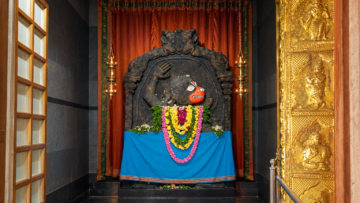
I had returned from a visit to Kamākṣī Amman Temple a few weeks back. The Brahmotsavam was still fresh in my mind. The grandeur of her rathams still lingered within me. So did the sound of the nādasvaram, the chanting and the unspoken joy of people waiting in a queue for darśana. Some experiences stay with us for days. This was one of them.
So, when I opened Śakti and Kṣātra and found Balan standing in that same queue before Kamākṣī on the very first page, the story felt instantly familiar. It captured that deeply personal moment when a person comes to the Divine carrying burdens they may not yet fully understand.
At first glance, Śakti and Kṣātra by Geetha Ganapathy appears to tell a simple story. It follows four friends. Their lives are familiar. Their struggles are the kind many of us carry in silence. One wrestles with uncertainty at work. Another faces pain within his own family. A third is shaken by the fractures he sees in society and by concerns for his daughter’s future. And then there is Rāma, the one friend whose steady presence gathers these scattered anxieties and gives them direction.
As the story unfolds, its deeper layers begin to surface.
Through Rāma, the author brings the reader gently into the world of the Divine Feminine. The Durga Saptashatī, Lalitā Sahasranāma, Saundarya Laharī and the Mahīṣāsuramardinī Stotram become part of the story very naturally. They arise through conversations. Through reflection. Through those moments when life pushes a person to search for something beyond their own understanding. Perhaps this is what gives the book its strength. These are not presented as teachings. They begin to feel inseparable from the lives of the characters, making the story feels so close to our Purāṇic traditions, where wisdom has always travelled through stories, relationships and lived experiences rather than through heavy doses of instruction. Such truths stay with us more easily when they are lived before they are explained.
For readers familiar with the Devī Māhātmyam, the journeys of the characters carry a sense of familiarity. There are echoes of Suratha and Samādhi here. Balan’s fears around livelihood and security recall Suratha’s anguish over all that seemed lost. Sunil’s pain within family relationships brings to mind Samādhi, whose deepest wounds also arose from those closest to him. Murali brings another shade to this journey. His concerns arise from the world around him. Rāma, in many ways, carries the presence of a modern Medha Ṛṣi, who gently turns troubled minds towards the grace of the Divine Mother.
What makes these parallels meaningful is the way Geetha Ganapathy brings them into our own times. The setting is recognisably ours. The questions are contemporary. Yet the inner movement remains unchanged. Human beings still arrive at the feet of the Divine carrying the same fears, confusions and longing for direction.
The title of the novel carries its essence.
Śakti is its heart.
Kṣātra is its force.
And in between is surrender, the kind born of śraddhā.
Surrender made me think of Draupadī in Sabhā Parva, her fingers still clinging to that fragile knot at her waist before she finally let it go. Both hands rose to Kṛṣṇa, and in that moment of āśraya, anugraha unfolded around her in endless folds.
Something of that same truth runs through this story too.
Surrender is never the end of the journey.
It is where another begins.
This is where Kṣātra begins to reveal itself.
Geethaji then leads the reader to the timeless reminder of the Manusmṛti: Dharmo rakṣati rakṣitaḥ. Dharma protects those who protect it. The truth of this feels relevant even today, although the battles of our times rarely resemble those of old. Kṣātra is far more than martial valour, and shatrus are not always found beyond national borders. Adharmis may appear in our institutions. In our systems. In public discourse. And even across the restless spaces of social media. Often, the greatest of these struggles arise within our own minds too. Perhaps this is what Kṣātra dharma asks of each of us: clarity, responsibility and the strength to remain anchored in dharma. Through its characters, Śakti and Kṣātra shows that this strength finds its deepest grounding in surrender to the Divine.
This comes through powerfully in the journeys of the characters.
One journey reflects this with particular force. Faced with painful conflict within his own family, he chooses rightful action though it is the harder path. His decision carries the spirit of the Bhagavad Gītā’s understanding of Kṣātra as courage anchored in dharma. The novel handles this with care, showing that firmness and compassion can stand together.
Another journey is especially moving. He is tested at a moment when his faith could easily have faltered. Yet he remains steady. This becomes one of the most memorable moments in the novel. It reveals how trust in the Divine becomes a source of inner resilience, allowing life to be faced with dignity.
The third journey too carries another kind of beauty. His fears are deeply human. Yet his transformation lies in learning to trust. His turn towards service to society gives this inner shift a meaningful outward expression. It shows how clarity within naturally seeks to flow outward.
The novel also widens its vision through references to Sri Aurobindo and the idea of Bhārata Mātā. Here, Śakti appears in another light. She is deeply personal. She is also civilizational. She belongs to the seeker standing in prayer. She also belongs to a larger collective consciousness.
This gives the story another dimension, connecting personal transformation with cultural memory. It reminds the reader that the journey inward often carries meaning beyond the self.
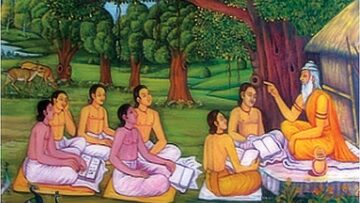
Through all this, the novel remains beautifully accessible. Its language is simple and the flow is natural. The interspersed illustrations too make the reader feel present within the story.
That simplicity is one of Geethaji’s greatest strengths. She knits philosophical ideas through a telling that remains warm, relatable and anchored in everyday life.
There is sincerity in these pages. There is faith. Above all, there is trust. The novel trusts its course. It trusts its reader. It allows meaning to unfold in its own time.
By the final page, Śakti and Kṣātra leaves behind a sense of clarity. It offers gentle assurance. It reminds us that life’s struggles carry within them the possibility of awakening when met with śaraṇāgati, dhairya and trust in Devī’s anugraha.
What begins as the tale of four lives moving through the currents of saṁsāra slowly opens into something deeper. It ends in the gentle light of inner freedom, showing us that through Śakti and Kṣātra, the way beyond can always be found.
Note: Śakti and Kṣātra may be purchased through the following link: Eyeview Publications
Disclaimer: The opinions expressed in this article belong to the author. Indic Today is neither responsible nor liable for the accuracy, completeness, suitability, or validity of any information in the article.