
From Curiosity to Clarity: Unlocking India’s Timeless Knowledge Traditions
Indian Knowledge Systems and Heritage represent one of the world’s most ancient, continuous, and holistic traditions of understanding life, the universe, and human existence. Rooted in the timeless wisdom of the Vedas, enriched by the philosophical insights of the Upanishads, and systematically expressed through the Darshanas, this knowledge tradition is not confined to abstract speculation but extends to every sphere of human activity. It integrates spirituality, science, art, ethics, and practical living into a unified vision, emphasizing harmony between the individual, society, and nature. Unlike fragmented modern disciplines, Indian Knowledge Systems (IKS) adopt a deeply interconnected approach, where knowledge is pursued not merely for material advancement but for inner transformation and the realization of truth.
A distinctive feature of this tradition is its experiential foundation. Knowledge (Jnana) is validated through direct realization (Anubhava), supported by reason (Yukti) and scriptural authority (Shruti). This triadic framework ensured both continuity and adaptability across centuries. Fields such as Ayurveda, Yoga, Jyotisha, and Vastu Shastra demonstrate the application of this wisdom in health, well-being, cosmology, and built environments. Similarly, contributions in mathematics, astronomy, linguistics, metallurgy, and governance reveal a sophisticated and empirical tradition. The works of scholars like Aryabhata and Sushruta stand as testimony to India’s scientific temper long before the modern era.
Equally significant is the ethical and cultural dimension of Indian heritage. Concepts such as Dharma (righteous duty), Karma (action and consequence), and Moksha (liberation) provide a moral and spiritual framework guiding individual and collective life. These ideas are not imposed dogmas but living principles that have shaped literature, art, festivals, social institutions, and everyday practices across millennia. The epics, oral traditions, temple culture, and classical arts serve as carriers of this knowledge, ensuring its transmission across generations.
In contemporary times, IKS are gaining renewed relevance. As the world grapples with ecological crises, mental health challenges, and the limitations of purely materialistic paradigms, the integrative and sustainable worldview of this tradition offers valuable insights. It encourages balance rather than excess, duty over entitlement, and inner fulfilment over external accumulation. Thus, IKS and Heritage are not relics of the past but living, evolving reservoirs of wisdom that continue to inspire, guide, and enrich humanity at large.
A Foundational Journey into India’s Civilizational Wisdom
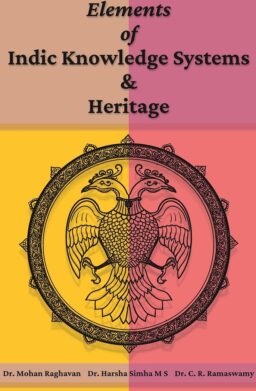
In an era where India is consciously rediscovering and reintegrating its civilizational roots into contemporary discourse, books on IKS are not merely academic contributions—they are cultural necessities. The book, Elements of Indic Knowledge Systems & Heritage by Dr. Mohan Raghavan, Dr. Harsha Simha M. S., and Dr. C. R. Ramaswamy, published by HTSR Institute, Bengaluru, stands out as a remarkable and timely effort in this direction.
My engagement with this book was not just that of a reader, but of a seeker attempting to reconnect with the deeper currents of Bharat’s intellectual and cultural traditions. By the end of this immersive reading experience, I can confidently say that the book has given me a clear conceptual understanding of the basics of IKS and Heritage—something that many contemporary texts struggle to achieve with such clarity and coherence.
A Unique Voyage
This is no ordinary book. It is a thoughtfully crafted intellectual journey spanning 256 pages, structured into 64 concise chapters, enriched with 64 illustrations, and complemented by nearly 70 ‘curiosity boxes,’ and engaging activities. This distinctive format transforms the reading process into a dynamic learning experience.
Rather than overwhelming the reader with dense theoretical exposition, the book adopts a modular and exploratory approach. Each chapter serves as a stepping stone, gently guiding the reader into increasingly deeper layers of Indic thought. The curiosity boxes, in particular, are a masterstroke—they provoke reflection, stimulate inquiry, and invite the reader to actively participate in the learning process.
Understanding Heritage
The Preface sets the tone for the entire work by offering a profound yet accessible reflection on the meaning of heritage. It reminds us that heritage is not merely about monuments or artefacts, but also about the living knowledge traditions embedded in language, literature, philosophy, rituals, and customs.
The authors draw an important distinction between tangible and intangible heritage, while also emphasising their inseparable unity. The references to globally recognised examples—such as temple architecture, Yoga, Vedic chanting, and traditional practices—serve to underline India’s enduring civilizational continuity.
What is particularly striking is the assertion that the true value of Indian heritage goes far beyond institutional recognition or global listings. This perspective anchors the book firmly within an indigenous framework of understanding.
The ‘First Principles’ Approach to IKS
One of the most significant contributions of this work is its adoption of a ‘first principles’ approach to IKS. The book does not merely present fragmented disciplines; instead, it seeks to uncover the core foundational elements from which diverse streams of Indic knowledge emerge.
This method is both refreshing and intellectually rigorous. It allows the reader to perceive Indian knowledge not as a collection of isolated subjects, but as an integrated and coherent system of thought. The analogy with scientific disciplines—where complex phenomena are understood through fundamental principles—makes this approach especially relatable to modern readers. The result is a framework that is at once traditional and contemporary, rooted in classical sources yet highly relevant for present-day inquiry.
The book offers a compelling civilizational narrative by tracing the origins of Indic thought to the fundamental human quest for happiness. It highlights how sensory-motor experiences initially shape our understanding of joy, but the ancient ṛṣis did not stop there. Through profound inner inquiry—what may be described as explorations within the very laboratories of human existence—they uncovered a higher state of fulfilment, one that far exceeds ordinary sensory pleasure. Yet, this discovery brought with it a paradox: the familiar comforts of sensory enjoyment often hinder the pursuit of deeper, more enduring bliss. As the text insightfully suggests, human beings are reluctant to relinquish the ‘bird in hand’ for the promise of a golden treasure hidden within.
The ṛṣis resolve this conundrum not through rejection, but through integration. Drawing upon their understanding of the cyclical laws governing nature (prakṛti), they evolve a pathway that harmonises external enjoyment with inner realisation. This enables a gradual movement towards ātma-sukha—the profound inner happiness—without the need to entirely abandon indriya-sukha, or sensory joy. Upon this foundational insight, they construct, layer by layer, the vast and sophisticated edifice of Indic civilization.
The book beautifully illustrates how this quest for happiness permeates every dimension of Bharatiya life—manifesting in magnificent temples, centres of learning, festivals, cuisine, arts, and ultimately, in the emergence of a civilizational state called Bhārata. Its celebrated achievements—ranging from yoga and āyurveda to mathematics, astronomy, the Vedas, Purāṇas, Itihāsas, Kāvyas, Śāstras, and the fine arts such as citra and śilpa—are presented not as isolated intellectual pursuits, but as organic outcomes of this deeper, unifying search for enduring happiness.
The Śrīraṅga Model and Its Legacy
The intellectual foundation of the book draws inspiration from the teachings of Śrīraṅga Mahāguru (1913-1969) whose life and work are briefly but meaningfully introduced in the opening section. The evolution of what is referred to as the ‘Śrīraṅga Model of Indian Knowledge Systems and Heritage (SaMIKSHA)’ is a central theme. This model represents a systematic attempt to organise and interpret Indic knowledge through an elemental framework.
The book succeeds in presenting this model not as an abstract theory, but as a living tradition shaped by practice, instructional methods, and experiential wisdom. The emphasis on Yoga as not merely a physical discipline but a pathway to higher states of consciousness is particularly noteworthy.
Bridging Tradition and Modern Education
The book also situates itself within the broader effort to systematically present IKS in a contemporary academic framework, effectively bridging the gap between traditional wisdom and modern disciplines. Drawing upon the insights of eminent resource persons associated with Faculty Training Programmes for IKS Master Trainers, the work reflects a rich and diverse intellectual foundation. It consciously moves beyond narrowly framed, Western-centric lenses and foregrounds the holistic, purpose-driven, and practice-oriented character of Indic knowledge traditions.
The thematic spread of the book is both wide-ranging and well-structured. It traverses foundational ideas such as Happiness and Dharma, the Philosophical and Scientific Basis of Knowledge, and traditional methodologies like Tantrayukti, while also engaging with applied domains including Chemistry, Water Management, Ayurveda, Mathematics, Agriculture, and Intellectual Property Rights. Equally significant is its engagement with India’s ethical and narrative traditions through Nītiśāstra and the Pañcatantra.
Taken together, these discussions offer a comprehensive and multidimensional overview of IKS, presenting it not merely as a subject of historical interest, but as a living, dynamic body of knowledge. Each section contributes to a deeper understanding of how Indic traditions integrate theory and practice, and how they continue to hold relevance in addressing contemporary challenges. The book thus succeeds in reframing India’s intellectual heritage as a vital resource for the present and the future, rather than a relic of the past.
Another commendable aspect of the book is its relevance to contemporary educational needs. In the context of the National Education Policy (NEP) and the increasing inclusion of IKS in curricula, the book emerges as an ideal introductory text. It is accessible to undergraduate students and general readers alike, requiring no prior exposure to the subject. At the same time, it offers enough depth to serve as a foundational resource for further exploration.
An Engaging and Transformative Reading Experience
What sets this book apart is its ability to engage the reader at multiple levels—intellectual, cultural, and experiential. The illustrations aid visual understanding, while the activities encourage introspection and application.
The narrative style is clear, concise, and free from unnecessary jargon. Yet, it never compromises on depth. The reader is gradually led to appreciate the holistic vision of life inherent in Indic traditions, where knowledge is not merely informational but transformational.
A Must-Read for Every Seeker of Indic Wisdom
This book is more than an introduction—it is an invitation. An invitation to rediscover the profound knowledge systems that have sustained one of the world’s oldest living civilizations. For students, educators, policy-makers, and anyone interested in India’s intellectual heritage, this work serves as a comprehensive and accessible gateway. It successfully balances scholarship with simplicity, tradition with modernity, and theory with practice.
For me, this 256-page voyage has been deeply enriching—offering clarity, perspective, and a renewed appreciation for the depth and diversity of IKS and Heritage. In a time when reclaiming our civilizational narrative is both a responsibility and a necessity, this book stands as a valuable and timely contribution.
This unique book is a meaningful intellectual and civilizational offering that rekindles our connection with the deeper foundations of Bharatiya thought. It succeeds in presenting complex ideas with clarity, coherence, and relevance, making it an invaluable resource for students, scholars, and seekers alike. I place on record my sincere gratitude to the three distinguished authors—Dr. Mohan Raghavan, Dr. Harsha Simha M. S., and Dr. C. R. Ramaswamy—for their dedicated effort in bringing out such a profound and accessible work. My heartfelt thanks also to the HTSR Institute, Bengaluru, for publishing this remarkable volume and contributing to the larger cause of reviving and disseminating Indian Knowledge Systems. I would also like to express my deep appreciation to Sri Pankaj Saxena, author of the widely acclaimed Svayambodha and Shastrubodha – Hindu View of the Self and the World, whose reference to this book, while I was reading his work, prompted me to seek out and engage with this enriching text.
Book Details: Elements of Indic Knowledge Systems & Heritage, Published by HTSR Institute, Bengaluru. Price Rs.640/ (HB)-Pages: 255.
Disclaimer: The opinions expressed in this article belong to the author. Indic Today is neither responsible nor liable for the accuracy, completeness, suitability, or validity of any information in the article.