
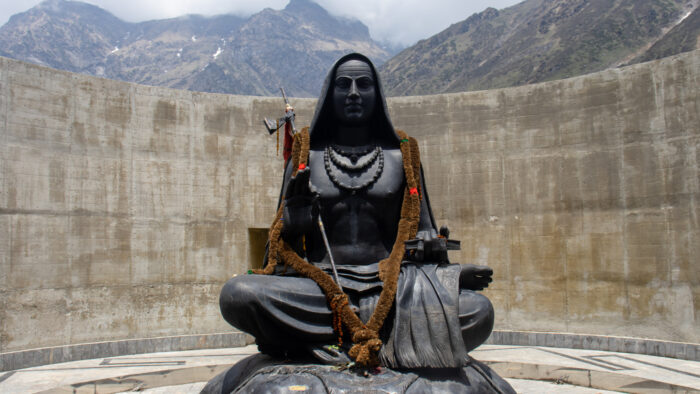
Adi Shankara’s Digvijaya — and Why It Still Refuses to Let Us Rest
There are conquerors who leave behind maps.
There are conquerors who leave behind ruins.
And then, once in a few centuries, there comes a man who leaves behind clarity.
No blood spilled.
No armies raised.
No flags planted.
Only a mind so precise, so luminous, that it rearranges how an entire civilization understands itself.
That man was Adi Shankaracharya.
And his story preserved in the Sankara Digvijaya is not merely the life of a monk.
It is the story of a civilization being pulled back from the edge.
A Civilization Drifting Without Knowing It
We like to imagine ancient Bharat as eternally stable—rooted, serene, self-aware.
The truth is more uncomfortable.
By the time Shankara was born, something had gone off-balance.
The Vedic tradition still existed, yes.
But it had begun to fracture into silos.
Ritual had hardened into habit.
Philosophy had splintered into competing camps.
Logic had become an end in itself.
Schools argued.
Scholars debated.
Systems multiplied.
Clarity did not.
The problem was not lack of knowledge.
It was a loss of center.
The Sankara Digvijaya doesn’t present this as decline in a modern academic sense.
It presents it as something more visceral—
A world that had forgotten how to see clearly.
Kalady: Where the Story Quietly Begins
In a small village in Kerala – Kalady, a child is born.
To Shivaguru and Aryamba.
No empire marks the event.
No chronicler announces it.
But the text insists on something that modern readers often hesitate to accept:
This was not merely a birth.
This was a descent.
Not in the literal sense one argues over in classrooms.
But in the experiential sense that history sometimes bends to allow clarity to re-enter.
A Childhood That Refuses to Behave Like One
The stories are almost unsettling in their compression.
By eight, the boy has absorbed the Vedas.
Not memorized. Absorbed.
There is a difference.
By twelve, he is writing.
Not essays. Commentaries.
By sixteen, he is no longer a student of philosophy.
He is intervening in it.
And yet, what the quietly suggests is not just brilliance.
But urgency.
There is no indulgence in childhood.
No wandering. No experimentation.
Only a kind of forward movement, as if time itself were not something he could afford to spend casually.
The Renunciation That Was Not Escape
Most renunciations are personal.
A turning away.
A quiet decision to step back from the world.
Shankara’s renunciation is… different.
It is strategic.
The famous episode—seeking his mother’s permission, the pull toward sannyasa has often been retold with emotion.
But stripped of sentiment, what remains is something sharper:
He does not leave because the world is unworthy.
He leaves because he intends to engage it fully.
He finds his Guru—Govinda Bhagavatpada.
Receives instruction.
Understands the core.
And then—does something almost unheard of for a monk.
He walks toward the noise.
This Was Not Travel. This Was Campaign.
The word used is Digvijaya.
It is not casual.
It means conquest of the directions.
But here’s where it shifts.
There are no soldiers.
No territories annexed.
No treaties signed.
Instead, there are debates.
Relentless, precise, unforgiving debates.
He walks across Bharat—north, south, east, west – not as a pilgrim alone, but as a challenger.
To Mimamsakas.
To Buddhists.
To Sankhya thinkers.
To logicians.
And what happens in these encounters is often misunderstood.
He does not merely defeat.
He absorbs.
He does not flatten opposing systems.
He locates their place.
He reorganizes them.
He builds a hierarchy – not of dominance, but of resolution.
That is rare.
Most intellectual traditions win by exclusion.
Shankara wins by integration without dilution.
Mandana Mishra: The Debate That Became Legend
Among the many encounters, one stands out – not because of spectacle, but because of what it represents.
Mandana Mishra.
A formidable scholar of ritualism.
The debate is not casual.
It is exhaustive.
Days pass.
Arguments sharpen.
Positions strain.
And then comes the detail that makes the story linger—
The judge is not a neutral arbitrator.
It is Mandana Mishra’s wife, Ubhaya Bharati.
A scholar in her own right.
The implication is clear:
This is not theatre.
This is a civilizational conversation at its highest level.
When Shankara prevails, he does not erase Mandana Mishra.
He transforms him.
Mandana becomes Sureshvara, one of his foremost disciples.
This is not victory.
This is conversion of intellect into alignment.
Writing That Did Not Age
Debates win attention.
Writing wins time.
Shankara understood this.
What he produced in a life that barely crossed three decades is difficult to process even today.
His commentaries on:
- Brahma Sutra Bhashya
- Bhagavad Gita Bhashya
- The principal Upanishads
These were not explanatory texts.
They were re-anchorings.
At a moment when interpretation had fragmented meaning, he restored coherence.
And he did it without simplifying complexity.
His central insight remains disarmingly direct:
Brahman is the only reality.
The world is an appearance.
The self is not separate from that reality.
This is not abstract philosophy.
It is a statement about how to see.
An Architect, Not Just a Thinker
Most philosophers leave behind ideas.
Shankara left behind infrastructure.
He established four mathas – strategically located:
- Sringeri Sharada Peetham
- Dwarka Sharada Peeth
- Govardhan Math Puri
- Jyotir Math
This was not symbolic geography.
It was design.
A distributed network.
A way to ensure that what he had clarified would not dissolve again.
He also structured the Dashanami order.
Disciplined. Mobile. Rooted in a shared understanding.
In modern terms?
He built a civilizational operating system.
The Genius Most People Miss
Here is where Shankara becomes difficult to imitate.
He does not reject ritual.
He reframes it.
He does not dismiss devotion.
He redirects it.
He does not attack logic.
He uses it—and then steps beyond it.
Every layer is retained.
But nothing is allowed to claim finality except realization.
That balance is rare.
And it is why his framework does not collapse under diversity.
It holds it.
The Digvijaya: More Than History
Modern readers often ask:
Did all of this happen exactly as described?
Were the journeys precisely mapped?
Were the debates recorded verbatim?
These are fair questions.
But they miss the point.
The Sankara Digvijaya is not a modern biography.
It is a memory text.
Part history.
Part metaphor.
Part transmission.
It does something that pure history cannot:
It gives a civilization a figure through whom it can remember itself.
That was the brilliance of Madhava Vidyaranya.
He did not just document Shankara.
He made him unforgettable.
Thirty-Two Years. Let That Sit.
No aircraft.
No highways.
No digital networks.
Yet within roughly thirty-two years:
He travels the subcontinent.
Engages the sharpest minds.
Writes foundational texts.
Builds enduring institutions.
Even today, with all our tools, such output feels improbable.
Which forces an uncomfortable question:
Was it efficiency?
Or was it intensity of purpose?
Why This Story Refuses to Stay in the Past
It is tempting to place Shankara safely in history.
To admire. Quote. Move on.
But that does not work.
Because the conditions he responded to feel… familiar.
Fragmentation.
Identity clashes.
Noise mistaken for knowledge.
Information without digestion.
We are not lacking data.
We are lacking clarity.
And that is precisely where Shankara returns – not as nostalgia, but as disruption.
Five Things He Still Does to Us Today
1. He reduces noise.
Not by adding more ideas, but by aligning them.
2. He refuses division.
Not by enforcing sameness, but by showing underlying unity.
3. He dismantles ego.
Advaita is not comforting. It is dissolving.
4. He slows us down.
Not in pace, but in depth.
5. He redirects conquest.
From the world outside, to the ignorance within.
The Line We Don’t Like to Admit
We remember his name.
We invoke his legacy.
But we do not live his clarity.
Because clarity is not decorative.
It is demanding.
It asks you to drop what is unnecessary.
It asks you to see without distortion.
It asks you to stand without identity as a crutch.
That is not easy.
And So the Story Ends Where It Began
No armies.
No empire.
No monument in the conventional sense.
Just a man who walked across a civilization and said—
Look again.
And because he said it with precision, with depth, and with absolute conviction—
Bharat did not just hear him.
It reorganized itself around that seeing.
Final Line
Adi Shankaracharya did not conquer India.
He revealed it to Itself.
And if that feels relevant today,
It is because we are still, quietly, trying to see.
References
- Sankara Digvijaya
By Madhava Vidyaranya
Translated by Swami Tapasyananda
Publisher: Sri Ramakrishna Math, Chennai - The Philosophy of Advaita
By T. M. P. Mahadevan - Shankara and His Thought
By Paul Deussen - A History of Indian Philosophy Vol. 1
By Surendranath Dasgupta
(Author’s note: This article synthesizes traditional hagiographical accounts, primary Advaita Vedanta texts, and modern scholarly interpretations to present a holistic view of Adi Shankaracharya’s life and legacy.)
Feature Image Credit: IStock
Disclaimer: The opinions expressed in this article belong to the author. Indic Today is neither responsible nor liable for the accuracy, completeness, suitability, or validity of any information in the article.