
People usually think that Bali Jatra, the iconic festival of Odisha, celebrated on Kartika Purnima, is a vibrant riverside fair; however, it is far more than that. It is a living memorial to the vast and adventurous maritime legacy of Kalinga’s people, who navigated both the eastern and western seas. While popular memory emphasises their links with Southeast Asia – Bali, Java, Sumatra, and Borneo, voyages celebrated in the Hathigumpha inscription and ancient Buddhist, Jain, and Odia records, their reach extended to the far west, touching Arab lands, Persia, Rome, and even Africa.
Classical sources like the Periplus of the Erythraean Sea and the accounts of Ptolemy and Pliny the Elder describe the magnificent ports of Kalinga and the movement of Kalingan goods and sailors to Mediterranean markets. Archaeological finds, including Roman coins and exotic artefacts at sites like Sisupalgarh and Manikpatna, confirm these exchanges.
Thus, Bali Jatra celebrates not only the revival of Kalinga after its devastation by Magadhan conquest but also the global vision and maritime courage of its people, a civilizational spirit that reached both the islands of the east and the empires of the west, rooted in authentic inscriptions, numismatic and archaeological evidence, and traditional Odia chronicles.
The Kalinga War of 261 BCE is widely known for its brutality. But did Kalinga not take revenge on Magadha? Was the memory of brutality forgotten by the people of Kalinga? Didn’t the pain of the war of Kalinga boil the blood of the mighty emperors who ruled after Kalinga was?
Let’s discuss this in detail in the article. Very few people are aware of the revenge taken by Kalinga nearly two centuries later under the leadership of the great Emperor Kharavela.
The battles of Indian history changed the borders and the societies. One of the major ones among them is the war of Kalinga, which was brutal, traumatic, and led to recovery. The beautiful land of Kalinga was the ruins. However, the war also sowed the seeds of revenge, which were passed down through generations, and ultimately led to Kalinga’s powerful resurgence under King Kharavela almost two hundred years later.
The Major Rock Edicts of Ashoka, including the 13th Edict, are found at sites like Girnar, Kalsi, Shahbazgarhi, and Mansehra, where all 14 edicts are engraved. From Ashoka’s Rock Edict XIII (which mentions the Kalinga War), we learn that the amount of destruction that happened during the battle was enormous. This edict details not only the horrors of the war but also Ashoka’s remorse after his victory.
The widely accepted narrative is that Ashoka experienced deep remorse and regret after witnessing the devastation of the Kalinga War, leading him to renounce violence and embrace Buddhism. This view is based on Ashoka’s inscriptions, especially the 13th Rock Edict, where he explicitly states his sorrow over the suffering caused by his conquest of Kalinga and his subsequent commitment to dhamma (moral governance).
About 1.5 lakh people were forced to leave their homes, 1 lakh were killed, and many more lost their lives as a consequence. The war’s effects were marked by immense grief and trauma; families were torn apart, communities uprooted, and the cultural life of Kalinga came to a standstill.
Interestingly, the 13th Major Rock Edict is not present at the Dhauli and Jaugada sites in Odisha, which lie at the heart of ancient Kalinga. Scholars believe this omission was deliberate. Since the 13th Edict describes the suffering of Kalinga’s people, its absence likely reflects an intention to avoid reopening wounds and to foster reuniting with the newly conquered subjects. Inscribing an edict that graphically recounts the suffering of the local population could have provoked bitterness among the people. However, despite this approach, the trauma of the Kalinga War was imprinted in memory for centuries, suggesting that the scars it left behind could not be easily healed.
Instead of Edicts 11–13, Ashoka placed two “Separate Edicts” at these sites, which are not found elsewhere. These edicts focus on kindness, moral governance, and the well-being of the local population, emphasising Ashoka’s desire to be seen as a compassionate ruler and to reassure the people of Kalinga about his intentions. The separate edicts instruct local officials to act fairly and kindly, treating the people as Ashoka’s children. However, the pain was so deeply ingrained in the subconscious of the people that his efforts to reassure them were unsuccessful; his showy intentions couldn’t mask the historical pain in the people of Kalinga.
The people of Kalinga witnessed immense loss, as cities like Tosali, Kalinganagar and Dantapura that were once thriving centres of culture and trade, were engulfed in flames. Homes were abandoned in haste as Mauryan forces swept through, leaving behind devastation that scarred the land and its people.
Ashoka’s edicts don’t just list numbers; they reveal the suffering of a civilisation whose pain remained for generations. The edict itself mentions that even Brahmins, monks, and ordinary people suffered. This devastation was not easily forgotten. For the people of Kalinga, the war was not just a military defeat; it was a significant loss of identity.
It was a civilisational wound. The memory of humiliation, the stories of loss passed down through generations and the conversion of their once-proud kingdom into a forcefully ruled kingdom under Mauryan rule created a burning desire for justice.
Though there is no direct mention, it would not be wrong to imagine the pain and destruction felt across the land of Kalinga, a mother who lost her sons and husband in the war. A soldier returned to find his village had been raided and his family was missing. A child raised with stories of loss, humiliation, and a deep longing for justice. These imagined yet realistic stories give human depth to the unbiased numbers in
Ashoka’s inscriptions. (Sources: Ashoka’s Rock Edict XIII; History of Odisha: “Kalinga War: Causes and Consequences”)
We learn from the scholarly works of Prof. Manmath Nath Das (a former parliamentarian, noted historian, and former Vice-Chancellor, Professor, and Head of the Department of History at Utkal University, Bhubaneswar, Odisha, India) that Kalinga had long enjoyed autonomy for several centuries. It was not just a physical territory but a civilisational centre with thriving ports, a powerful navy, and extensive maritime trade networks extending across the Kalinga Sagara (now the Bay of Bengal) into Southeast Asia.
It was a culturally pluralistic region. Before the Kalinga War, the area of Kalinga was characterised by a diverse and peaceful coexistence of several religious traditions. These included established Brahmanism (which was later recognised as Hinduism) with its Vedic rituals, the Śramaṇa movement including Buddhism, Jainism, and Ajivika, as well as various indigenous tribal religions.
The conflict devastated its economy, ruined its infrastructure and led to the breakdown of its social and cultural networks. Kalinga, once proud and free, was reduced to a confined province, the fifth administrative division under Mauryan rule, governed as a province with reduced autonomy. Tosali was established as the local capital. Although it is widely believed that Ashoka converted to Buddhism after the Kalinga War and attempted to govern with compassion under the influence of Dhamma, many credible accounts suggest that he had already adopted Buddhism years before the war, as also mentioned by Sanjeev Sanyal Ji. (Sources: History of Odisha; Odisha Review; Textbook)
The notion that Ashoka became a Buddhist only after the Kalinga War is now viewed by many as not entirely accurate. Based on his inscriptions, historical records and scholarly research, it is more likely that Ashoka had already adopted Buddhism two to three years before the war. His transformation was not simply a reaction to violence.
Some historians also question the depth and sincerity of Ashoka’s remorse. They point out that the edicts expressing regret are not found in Odisha (ancient Kalinga) itself, but rather in distant parts of the empire, raising doubts about whether he truly sought to apologise to the people most affected. Even in his “regretful” edicts, Ashoka warns forest tribes of his power to punish, indicating that his approach was not entirely that of a peace-maker.
Almost a century later, as the Mauryan Empire weakened and regional powers emerged, a new leader arose from the land of Kalinga, King Kharavela of the Mahameghavahana dynasty, also known as the Chedi dynasty. He was the third king of his line, and his reign is dated approximately to the late 1st century BCE, based on the Hathigumpha inscription. Born into a land still scarred by the consequences of Ashoka’s invasion, Kharavela was likely raised between the collective memory of destruction and humiliation.
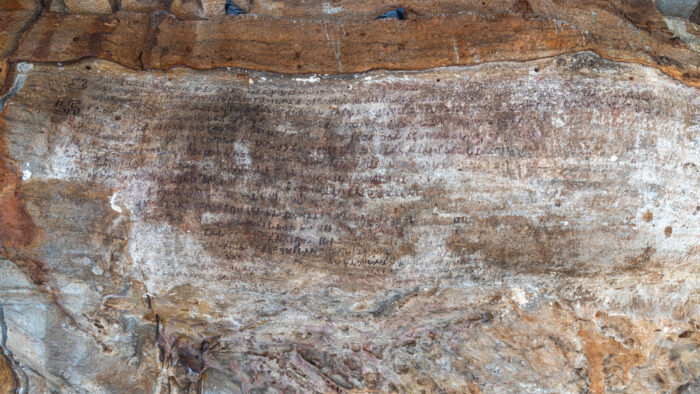
His early life included rigorous training in governance, military strategy, Vedic knowledge, and the arts, preparing him from a young age to restore Kalinga’s dignity. The Hathigumpha inscription, chiselled into the rocks of Udayagiri near Bhubaneswar, provides a rare and chronologically ordered autobiographical record of his thirteen-year rule.
It begins with his early administrative training and then outlines a series of carefully calculated expeditions: first to the south, where he defeated Tamil alliances, likely including the Cheras and early Pandyan polities, which held influence over the southern trade routes important to eastern coastal economies, as well as the western Satavahana powers. Then to the north and northwest, extending influence toward the Vidyadhara region, believed by many scholars to be in the Vindhyan region of central India, possibly including parts of present-day Madhya Pradesh and Chhattisgarh, defeating and forcing into retreat the Yavana (Indo-Greek) king near Mathura, who then withdrew from the region, frightened by the advancing valorous Kalingan forces.
Kharavela deliberately delayed his attack on Magadha until his twelfth regnal year, which most scholars place around 27 BCE. According to the Hathigumpha inscription, his earlier campaigns were part of a strategic vision, first to suppress the dominance in the south and west regions where Tamil allies and Satavahana powers posed significant threats to regional stability and trade routes important to Kalinga’s revival. By humbling these opponents and restoring control over economically and culturally substantial territories, he strengthened Kalinga’s military position and morale. It was only after securing his side and confirming Kalinga’s supremacy in the subcontinent that he turned his attention toward the heart of the former Mauryan seat, Magadha, where he launched his most symbolic campaign of justice and honour.
Kharavela was an exceptional military general. According to the Hathigumpha inscription (lines 12–14), his forces in his eighth regnal year first captured Gorathagiri (modern Barabar Hill, a strategic hill fortress near modern Gaya, Bihar), which guarded the approach to the Magadhan capital, Pataliputra, crippling Magadha’s defences and putting pressure on the Magadhan capital. Kharavela’s army stormed the fort, described as a “venomous attack” that shattered Magadha’s defences. The victory destabilised Magadha, causing panic in Pataliputra.
This action secured Mathura, a key Jain and political centre; disrupted Indo-Greek influence in the Gangetic plains; and demonstrated Kharavela’s ability to project power far beyond Kalinga. By redistributing war spoils to Brahmins in Mathura, Kharavela positioned himself as a protector of Dharma and legitimised his rule in northern India.
In the twelfth year of his reign, Kharavela launched a final campaign against Magadha. Kharavela marched with a massive force of 100,000 soldiers, elephants, and chariots, camping near the Ganges. His army’s presence “terrorised” Magadha, symbolised by elephants drinking from the Ganges.
The inscription records that he compelled the Magadhan ruler, Bahasatimita (interpreted as Bruhaspati Mitra of the Mitra dynasty of Kosambi), to bow at his feet, symbolising a complete reversal of Kalinga’s humiliation under Ashoka. The Mitras emerged as regional powers after the Kanva interregnum (73–28 BCE), filling the power vacuum in Magadha. This victory was both military and psychological, avenging the trauma of the Kalinga War.
The invasions avenged the Mauryan devastation of Kalinga (261 BCE), with Kharavela’s palace inscriptions at Udayagiri deliberately facing Ashoka’s edicts at Dhauli. Kharavela’s inscription at Udayagiri stands as a proud declaration of his military success against Magadha and his restoration of Kalinga’s sovereignty, deliberately placed in front of Ashoka’s earlier inscriptions to assert his triumph and counter Ashoka’s narrative symbolically.
A significant achievement was the recovery of the sacred idol of the Kalinga Jina, which had been taken centuries earlier by Mahapadmananda of the Nanda dynasty. Bringing back this Jain idol restored Kalinga’s spiritual pride and reaffirmed Kharavela’s patronage of Jainism. The inscription notes this act alongside the retrieval of wealth from Anga and Magadha, further highlighting the cultural redemption of the campaign.
This event marked the end of Magadha’s dominance in eastern India, shifting regional power to Kalinga under Kharavela. The humiliation of Brihaspatimitra marked the decline of the Mitra dynasty’s influence. Gorathagiri’s capture showcased Kharavela’s tactical brilliance, while the Pataliputra campaign highlighted his ability to leverage psychological warfare.
Kharavela’s civic efforts also equalled his military ones: he restored canals, tanks, and irrigation networks, revived monastic institutions, and established religious and cultural development. He ruled not as an autocrat but as a dharmic king devoted to both spiritual and worldly strength. (Sources: Hathigumpha Inscription; Odisha Review; Utkal University MA History Syllabus; History of Odisha)
His campaigns were strategic and ambitious. He led a well-organised army composed of infantry, cavalry, and war elephants, as mentioned in the inscription.
The memory of the Kalinga War and Kharavela’s resurgence continues to shape Odisha’s cultural identity. These events are reflected in regional literature, public festivals like Kalinga Mahotsav, and educational curricula. The narrative of suffering, endurance, and cultural renewal is a common theme in Odia historical discourse. Scholars such as Manmatha Nath Das and various Odisha government sources confirm that the war and Kharavela’s reign remain foundational to Odia identity. “Kalinga did not just seek revenge. It sought to rise again.” (Sources: Odisha Review – Kalinga and Kharavela; History of Odisha – Kalinga War; Utkal University MA History Syllabus)
References
- Ashoka’s Rock Edict XIII. Translated by Ven. S. Dhammika. Access to Insight.
- Hathigumpha Inscription. Jatland.
- History of Odisha. “Kalinga War: Causes and Consequences.”
- Odisha Review. “Kalinga, Kalinga and Kalinga.”
- Let Us Discover India. “The Kalinga War and its Aftermath – Kalinga’s Revenge.”
- Testbook. “Kalinga War.”
- Utkal University. “MA History Syllabus.”
- Das, Manmatha Nath. Glimpses of Kalinga History. Internet Archive.
- History of Odisha. “Kharavela.”
- Nagesh Muntha. “The Revenge of Kharavela.”
- Amar Bharatiya. “Kharavela.”
- Self-Study History. “Kharavela.
Feature Image Credit: Wikipedia
Disclaimer: The opinions expressed in this article belong to the author. Indic Today is neither responsible nor liable for the accuracy, completeness, suitability, or validity of any information in the article.