
Bengaluru presents a microcosm of historical and cultural significance. What may seem like an ordinary neighborhood, a bustling junction, or a familiar road often harbors a history predating the contemporary cityscape. The region of Bengaluru and its environs have been traversed by numerous dynasties, including the Cholas, Hoysalas, rulers of Karnataka Samrajya (Vijayanagara empire) and, in subsequent centuries, the Mysuru Wodeyars and the Palegaras. Historical remnants do not always manifest as grand monuments; they often persist quietly in small shrines, ancient stone inscriptions, or temples that many overlook. This historical allure led us to Bannerghatta on this occasion. The mention of “Bannerghatta” typically evokes thoughts of its well-known attractions, such as the excitement of Wonderla or the wildlife experiences at Bannerghatta National Park. However, nestled within this familiar landscape lies a site of distinct historical significance: the Champakadhamaswamy Temple.
Accessing Bannerghatta from central Bengaluru is relatively straightforward. From Majestic, the Metro provides convenient access to the southern part of the city; from Yelachenahalli, an autorickshaw or local transport facilitates the onward journey. However, a lesson every Bengaluru traveler learns is that when the destination is a temple, an early start is advisable. The city awakens gradually, but Bengaluru’s roads do not. Consequently, we commenced our journey early, before the city could accumulate its traffic, and proceeded towards the abode of Sri Varu.
Upon passing through the gateway, a palpable sense of tranquility enveloped us. The environment transformed, resembling a serene village rather than the bustling city of Bengaluru—characterized by greenery, a leisurely pace, and an absence of urban commotion. We exchanged glances of astonishment, questioning whether this was indeed Bengaluru. Before us stood the temple, Kshetranatha, Sri Champakadhamaswamy, as if anticipating our arrival. After navigating the city’s roads, traffic, and noise, standing before the temple offered profound reassurance. It appeared less as though we had discovered the temple and more as if Sri Varu had been awaiting our presence.
History of Champakadhamaswamy Temple
Bannerghatta, located in the Anekal taluk of Bengaluru Urban district, is approximately 10 miles from Bengaluru. Historical references to Bannerghatta can be traced back to ancient inscriptions, where it was recorded as Varadaraja Pattana, Vanniyoor Ghatta, and Bamnooraghatta. Historian Dr. Devarakonda Reddy has identified the name as having a metallurgical or mineral-related origin. The town is renowned for the Champakadhama Swamy Temple. The deity, originally referred to as ‘Damodara of Bamnooraghatta’ and ‘Damodarapperumal’ in ancient inscriptions, was later named ‘Champakadhama’ in an inscription from 1818 CE (EC XIV, Anekal 9). This name is attributed to the surrounding Champaka (Sampige/Magnolia) trees, with which the deity was traditionally worshipped. Additionally, a nearby village is named Sampigehalli. The temple is associated with approximately 18 inscriptions, the earliest of which dates to 1257 CE. There are four donation inscriptions each from the Hoysala and Sangama periods of the Vijayanagara Empire. According to the Mysore Archaeological Report, the temple is believed to have been established by Poorvadiraya, initially a feudatory of the Cholas and later of the Hoysalas. Although distinct Hoysala architectural features are not prominently visible today, the temple is thought to have been constructed in the 13th century. The temple complex developed and expanded over three distinct phases.
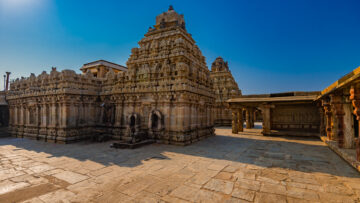
The garbhagriha (sanctum sanctorum) and the antarala (vestibule) constitute the ancient structures of this temple. Notably, the adhisthana (base) section extends beyond the antarala and includes small flanking pillars, indicating that the original construction can be traced to this specific point. The ardhamantapa (half-hall) and navaranga (assembly hall), located directly in front of this area, are attributed to the Vijayanagara period. In contrast, all subsequent outer sections were constructed during the era of the Mysore Wodeyar kings. Similarly, the main temple tower (shikhara) and the shikhara of the Goddess Mahalakshmi shrine also date to the Mysore rulers’ period. Consequently, only the garbhagriha and the antarala can be definitively identified as the original, core temple structure.
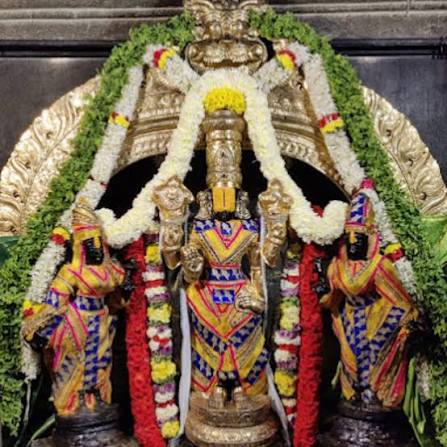
(Figure 1: Champakadhamaswamy flanked by Sri Devi and Bhu Devi on each side)
Upon entering the temple, the initial visual focus is the Champakadhamaswamy, an elegant depiction of Vishnu positioned on a lotus pedestal, wielding the abhaya, conch, discus, and mace in his four hands. Flanking him are Sri Devi and Bhu Devi, whose tranquil expressions impart an uncommon sense of calmness to the sanctum. The elongated proportions, minimal ornamentation, and stylistic elements of the images suggest a 14th–15th century origin. Inscriptions identify the deity as Varadaraja, referred to as the “Varada” of Kali Yuga and “Damodara” of Dvapara Yuga, and the location as Varadarajapattana. The east-facing temple maintains a compelling architectural sequence comprising the sanctum, antarala, ardhamantapa, navaranga, and entrance hall. Noteworthy features include intricately carved pillars, floral motifs, and elephant reliefs, alongside the distinctive pushpabodige brackets characteristic of the Vijayanagara style. Within the navaranga, there is also an image of Vishvaksena and a metal representation of Garuda, serving as subtle reminders that this seemingly modest temple encapsulates centuries of artistic and sacred heritage.
Abode of Mahalakshmi Devi
Standing before Champakadhamaswamy evokes a profound sense of tranquillity that is challenging to articulate. The atmosphere within the garbhagriha exudes a quiet familiarity, reminiscent of the Vasantha Vallabharaya Temple at Vasanthapura. This shared character is perhaps indicative of the ancient temples of Bengaluru, where the city’s noise gradually dissipates upon entry. After descending the steps and turning right at the Garuda-kambha, one encounters another exquisite shrine—the temple of Mahālakṣmi. Although Sri Devi and Bhu Devi accompany the principal deity, the Goddess has acquired a distinct sacred space over time. The Mahālakṣmi shrine, facing south, contrasts with the east-facing Champakadhamaswamy temple. Its exterior features jālendra screens, refined stonework, and a vesara-style shikhara, endowing the shrine with a unique identity while maintaining the architectural coherence of the main temple.
Within the sanctum, Mahālakṣmi is depicted holding lotuses in her upper hands, while her lower hands convey abhaya and varada—symbols of assurance and grace. The ardhamantapa is adorned with intricately carved pillars featuring floral motifs, and a small image of Ganesha is situated in a niche on the inner wall. Beyond this lies a spacious pillared hall, whose design and craftsmanship reflect several elements of the Champakadhamaswamy temple. The surroundings are imbued with historical memories. Local residents recall a kalyāṇa mantapa that once stood adjacent to the shrine. Across the road, a simple ūyyaale mantapa exists, equipped for suspending a swing. During festivals, Sri Varu is placed on this swing. Consequently, this tranquil corner of Bannerghatta is not merely an assemblage of stones and structures; it remains a vibrant space where architecture, devotion, and memory converge.
Bannerghatta Darshana
Following our visit to the Mahalakshmi Devi temple, we observed that Annadanam was being offered at the site, scheduled to commence at 11 a.m. However, our exploration of Bannerghatta was not yet complete. Adjacent to the temple, a staircase ascended towards the hill behind the shrine, prompting us to climb. As we progressed, the urban sounds of Bengaluru gradually faded, revealing a picturesque landscape of verdant hills, trees, and forest expanses. At the summit, we encountered a small Narasimha Swamy shrine. Although the shrine was reportedly ancient, recent renovations imparted a nearly new appearance.
Beyond the temple, we discovered a forest-like area accessible to visitors. We ventured further in this direction, encountering green hills and dense vegetation, accompanied by the distant calls of peacocks. Wildlife photographers, equipped with long camera lenses, were observed attentively observing the forest, suggesting a possible connection to the broader forest ecosystem of Bannerghatta National Park.
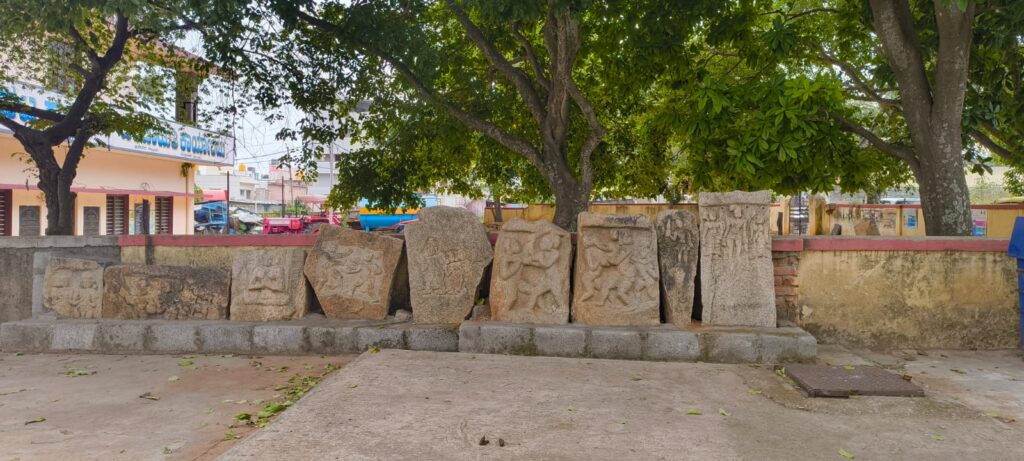
(Figure 2: Stone sculptures at bearing silent witness to the history of this region)
During our return, we noticed an intriguing stone structure beside the path, around which individuals were gathered in prayer. Despite our inquiries, the structure’s significance remained unclear. Local residents mentioned the ‘Seven-Ring Fort’ and other ancient remnants in the area, believed to date back to the 4th–5th century BCE, indicating a history of human habitation in Bannerghatta spanning nearly 2,500 years. Although the structure did not precisely match these descriptions, the conversation prompted reflection on the potential historical depth concealed within these hills. Also we noticed an old stone wall along the way. At first, it appeared to be just another part of the landscape, but as we came closer, we saw that many people had written their names, “I love you” messages and even abusive words across the stones. It was a disappointing sight. In a place surrounded by temples, sacred spaces and so much history, seeing people treat an old stone structure as a place for graffiti felt deeply disrespectful. What saddened us even more was that such writing had been allowed to remain in a temple environment. These stones are not merely walls; they are part of the memory of the place. Preserving such spaces also means teaching visitors to respect them.
Then we paused to observe Bengaluru from an elevated vantage point, noting the city’s seemingly endless expansion. While its growth is remarkable, concerns arise regarding the potential erasure of landscapes and memories that render places like Bannerghatta unique. As we descended, an old Hanuman temple captured our attention briefly before we continued our journey.
The Old Veeranjaneya Temple
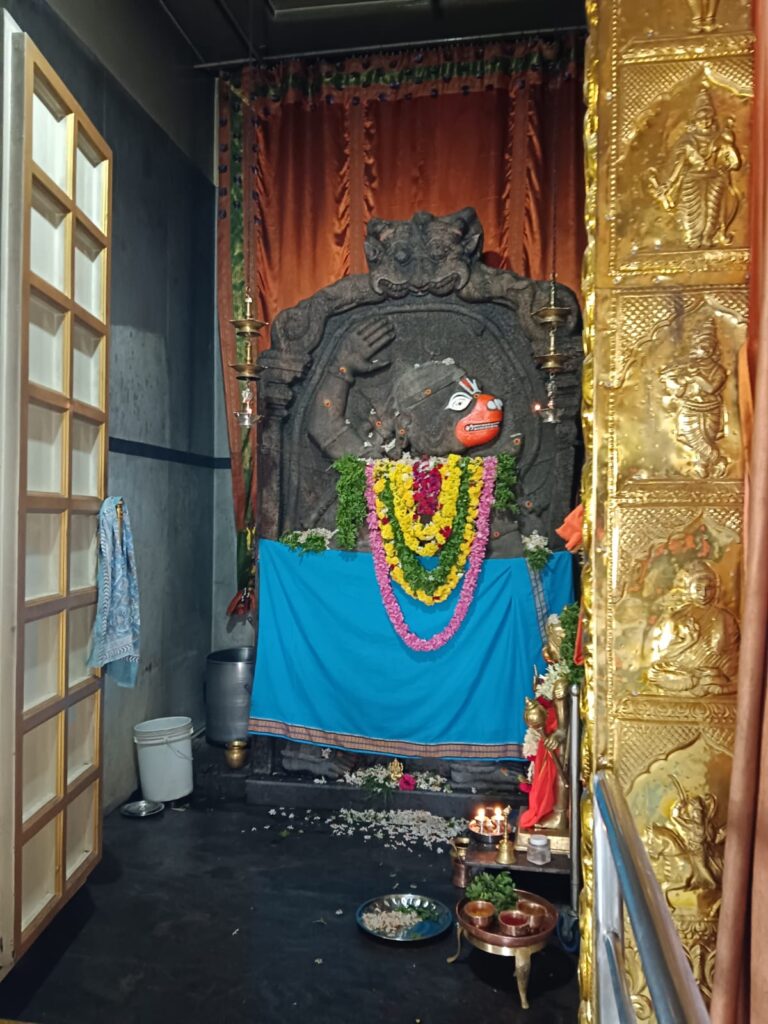
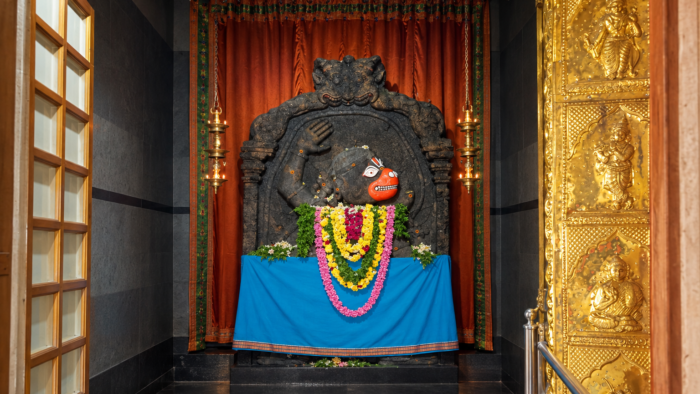
(Figure 3: Veeranjaneya Temple)
During our return from the hill, we encountered an ancient Veeranjaneya Temple, located slightly distant from the ūyyale mantapa. Although the current structure underwent renovation in 2002, the Anjaneya image housed within is estimated to be approximately 400–450 years old. The temple is modest in scale, yet its simplicity exudes a distinct charm. The shikhara is square and intricately detailed with leaf-and-creeper motifs, while small images of Anjaneya in various postures embellish the upper sections. The temple’s interior primarily comprises the garbhagriha and navaranga, featuring the full image of Veeranjaneya standing in the sanctum, adorned with a crown and a bell tied to his tail. A lotus medallion decorates the ceiling of the navaranga, and a deepa-stambha along with an old Ashwattha platform are situated outside. A nearby tall dhvajastambha bears an inscription from the era of Sadasiva Raya, contributing an additional historical dimension to this seemingly tranquil shrine.
Prior to entering the temple, our attention was drawn to several Veeragallu (hero stones) and stone inscriptions situated nearby. These artifacts appeared to serve as silent witnesses to a bygone era. In conversation with the purohita, he expressed great enthusiasm regarding the temple’s antiquity and the historical influence of the Vijayanagara rulers and Tamil kingdoms in the area. His enthusiasm was compelling. Additionally, he referenced Dr. Devara Konda Reddy, who has extensively documented the region’s history and heritage in his book, “Bannerghatta Darshana.” It was intriguing to discover that what initially appeared to be merely an old Hanuman temple was, in fact, enveloped by layers of history awaiting reboocognition.
The Man Who Preserved Bannerghatta’s History
Upon learning about Dr. Devarakonda Reddy’s work, “Bannerghatta Darshana,” our interest was piqued, prompting a desire to meet the author. The purohita kindly directed us to a nearby bakery, indicating that adjacent to it was a shop owned by his father, Naveen Kumar Reddy Ji. As we exited the temple, our attention was drawn to another small shrine, a Gramadevata temple dedicated to Bisilu Maramma Devi. The Devi was adorned with arishina, exuding a serene, earthy grace characteristic of the village-like surroundings of Bannerghatta. We proceeded towards the main road in search of the shop, only to find it closed. However, a telephone number was displayed on the shop. Upon contacting Naveen Kumar Reddy Ji, he initially informed us that the author was unavailable and suggested a later visit. Nevertheless, upon explaining our intent to document and comprehend the history of Bannerghatta, his demeanor shifted. He listened attentively and soon agreed to meet us personally.
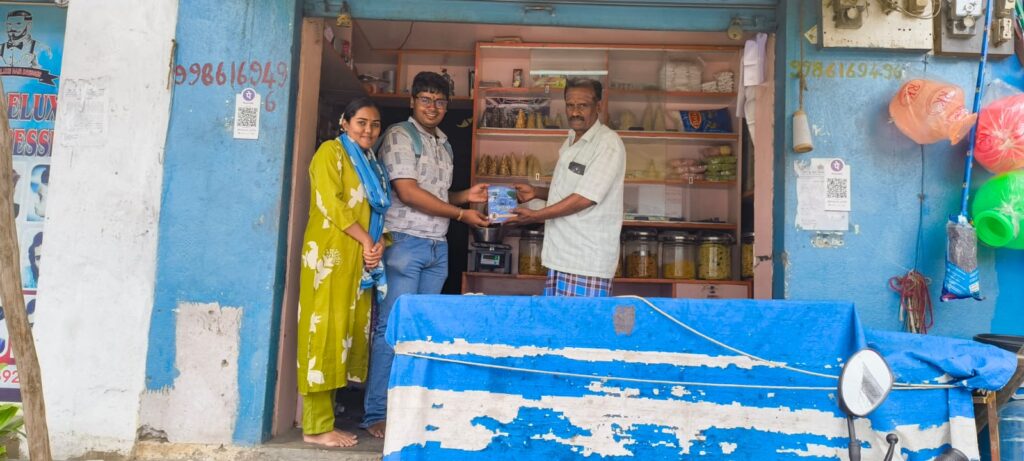
(Figure 4: The authors with “Bannerghatta Darshana”)
The encounter transcended a mere meeting, resembling a blessing. Despite his advanced age, he exhibited remarkable humility, cheerfulness, and warmth. During our conversation, he revealed that only one copy of “Bannerghatta Darshana” remained . Without hesitation, he generously offered us this last copy, accompanied by a smile—a gesture that left a lasting impression. This book, embodying years of memory and research, was entrusted to us due to our genuine interest in understanding the locale.
He elaborated on the multifaceted history of Bannerghatta, highlighting that the landscape encompassed more than the modern city reveals. His extensive knowledge was particularly striking. In urban contexts, there is often an assumption that proficiency in English equates to greater knowledge. However, here was an individual proficient in Kannada, Tamil, Telugu, and Hindi, with the ability to read and write in Tamil and other languages. His knowledge was not derived from ostentation but from an intimate engagement with the history, languages, and people surrounding him.
As we departed, we felt truly fortunate to have met him. Our gratitude extends to Naveen Kumar Reddy Ji for his warmth and generosity, and to his son, Dr. Devarakonda Reddy, for preserving the history of this remarkable place through “Bannerghatta Darshana.” Bannerghatta emerges as a new world with an ancient soul, offering much to be explored, understood, and remembered.
As we walked away with Bannerghatta Darshana in our hands, a thought from D. V. Gundappa’s Mankuthimma Kagga came to our minds:
ಇಹುದೊ ಇಲ್ಲವೊ ತಿಳಿಯಗೊಡದೊಂದು ವಸ್ತು ನಿಜ।
ಮಹಿಮೆಯಿಂ ಜಗವಾಗಿ ಜೀವವೇಷದಲಿ ॥
ವಿಹರಿಪುದದೊಳ್ಳಿತೆಂಬುದು ನಿಸದವಾದೊಡಾ ।
ಗಹನ ತತ್ತ್ವಕೆ ಶರಣೊ – ಮಂಕುತಿಮ್ಮ ॥
There are things whose presence we cannot always know or explain; perhaps the Divine moves through the world, taking different forms of life. Standing there, we felt something similar. At one moment, we had come to Bannerghatta seeking its history; at another, it felt as though the history itself had come looking for us. We had wanted to meet the author, yet it was his father, Naveen Kumar Reddy Ji, who appeared before us and placed the last copy of Bannerghatta Darshana in our hands. Was it merely a coincidence? Perhaps. But there are moments when coincidence itself seems to carry a deeper meaning.
Sometimes, the Divine does not appear in the form we expect. It may be a deity in a garbhagriha, a forgotten inscription beside a temple, a Gramadevata adorned with arishina, or even a smiling elderly man who quietly hands you a book containing the story of his land. That day, we felt that Sri Varu had revealed Himself in yet another form—not through words alone, but through an unexpected meeting and an act of generosity.
And perhaps this is the deeper mystery of travel. We set out thinking that we are going to discover a place; only to realize, somewhere along the way, that the place has discovered something within us. Bannerghatta was no longer merely a destination on the outskirts of Bengaluru. It had become a living world of temples, forests, stones, memories and people, a new world with an old soul, waiting patiently for those willing to look beyond the familiar.
Disclaimer: The opinions expressed in this article belong to the author. Indic Today is neither responsible nor liable for the accuracy, completeness, suitability, or validity of any information in the article.