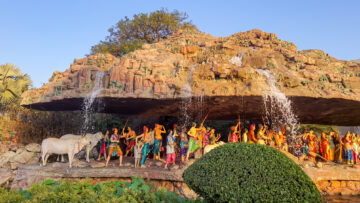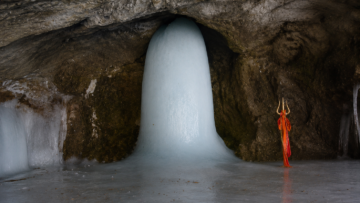

Chikkaballapura is widely recognized for Nandi Hills, yet its significance extends beyond being a mere hiking destination or tourist attraction. The town is home to some of the region’s most ancient temples, embedded within its cultural landscape. These temples trace the historical footprints of the Nolamba dynasty, guiding us through centuries of history—from the early medieval period to the illustrious era of the Karnataka Samrajya (Vijayanagara Empire), and further into the period of the Mysuru Wadiyars, under whose patronage these temples continued to thrive.
We scheduled a day to experience the grandeur of this historic town and to explore the cultural treasures it encompasses. On a Sunday morning, we embarked on our journey to Chikkaballapura. Chikkaballapura is accessible from Bengaluru via both government and private buses. Notably, private buses charge approximately ₹10 less than government buses. We departed Bengaluru at around 6:00 a.m. and arrived in Chikkaballapura at approximately 7:00 a.m.
Our initial destination was the illustrious Bhoganandishwara Temple. Although we intended to take a bus to the temple, the early morning bus service was infrequent. When a bus eventually arrived, it was already crowded, leaving insufficient space for additional passengers. Consequently, we opted for an auto-rickshaw. During this brief auto ride, our journey took an unexpected turn. The auto driver informed us of an alternative route to the hill and suggested that we first ascend to have darśana of Yoga Nandīśvara Swamy, whose shrine is situated atop the hill. He recommended that after descending later in the afternoon or evening, we could visit Bhoganandīśvara at the foothills.
This suggestion appeared to possess a certain poetic symmetry—from Yoga to Bhoga, from the summit to the sacred landscape below. Consequently, we decided to heed his advice and commenced our ascent.
As we set out on our journey, a sense of happiness washed over us when we spotted the faint footsteps leading along a narrow path. The air was fresh, and the surroundings were vibrant with trees and plants. It was a welcome sight, especially since greenery had become a rarity in Bengaluru lately. This was one of the highlights of our adventure, and with renewed spirits, we began to climb. Not even ten minutes into our trek, we encountered a lady and her weary family coming down the path. Her tired face bore the weight of their journey, and she asked us how much longer it would take to get down. We answered confidently that it would take about ten minutes. But then came their response, one that jolted us a bit: they had been descending for over two hours and still hadn’t reached the ground. A wave of apprehension washed over us as we imagined how long our ascent to the top would take. Doubts crept in, but as we continued on, we spoke to other hikers who reassured us, sharing that the summit was not as far as that family had described. Encouraged by their words, we pressed on, ready to embrace whatever awaited us at the top of the hill.
Discovering the History of Gavi Veerabhadra Swamy Temple
After a challenging hike up the picturesque Nandi Hills, we came across the Gavi Veerabhadra Swamy Temple, a hidden gem steeped in history and spirituality. Nestled within a naturally occurring rock formation, the temple stands distinct from the larger structural temples frequently found across Karnataka. The cave-like shrine, dedicated to Veerabhadra Swamy, the fierce manifestation of Shiva, carried an atmosphere of quiet devotion. We paused here, took darshan of Gavi Veerabhadreshwara, and continued our climb towards the summit of the hill.
As we learned more about the shrine, its remarkable history added another dimension to the journey. Dating to around 1397 CE, the temple is attributed to a ruler named Devaraya and belongs to the period of the Vijayanagara Empire. Although some historical details surrounding its foundation remain uncertain, the shrine represents an important addition to the long-standing Shaiva traditions associated with the Nandi Hills region.
Having taken the darshan of Gavi Veerabhadreshwara and then continued our ascent towards the summit, the journey felt like more than a hike through the hills. The sacred landscape, where natural rock formations, ancient shrines, history, and devotion come together, offered a quiet sense of continuity. The name “Gavi Veerabhadra” itself reflects the shrine’s intimate relationship with its natural setting. By the time we reached the top of Nandi Hills, the journey had become a gentle passage through layers of Karnataka’s spiritual and historical heritage. Then we visited Tippu Sultan’s summer palace at Nandi Hills, which was surrounded by a lovely garden. It was a Sunday, so many tourists were there enjoying the fresh air. We continued on and admired the beautiful views of nearby villages. After that, we made our way to the Yoga Nandishwara Swamy temple.
Yoganandishwara Temple
The temple is dedicated to Lord Yoganandishwara, a form of Shiva, and Goddess Muktambika. The very name Yoganandishwara evokes Shiva in his yogic aspect, and the peaceful setting of the temple seemed particularly appropriate for such a form of the deity. The temple displays a distinctly Dravidian architectural character with Chola influences. The entrance to the sanctum is marked by decorative doors and guardian figures, traditionally said to have been gifted by the Vijayanagara ruler Krishnadevaraya.
As we stood before the temple, we noticed the stone pillars and sculptural details around us. The simplicity of the shrine, combined with the grandeur of the hilltop landscape, created a striking atmosphere. We took darshan of Yoganandishwara and Muktambika Devi before spending a few moments observing the surroundings. What caught our attention further was a historical inscription associated with the temple. We noticed a written account referring to Chhatrapati Sambhaji Maharaj, the son of Chhatrapati Shivaji Maharaj, and his association with the struggle over Nandi Hills. The inscription describes the hill and recounts how the Marathas reclaimed it from the Mughals.
Standing there and reading about this episode added another dimension to our visit. The same hill that had drawn us for its natural beauty and sacred atmosphere had also witnessed the movements and struggles of different powers across centuries. The temple thus became more than an ancient shrine to us; it felt like a silent witness to the many layers of history that had unfolded around Nandi Hills. After taking darshan, we continued to explore the summit.
Bhoganandishwara: A Thousand Years in Stone
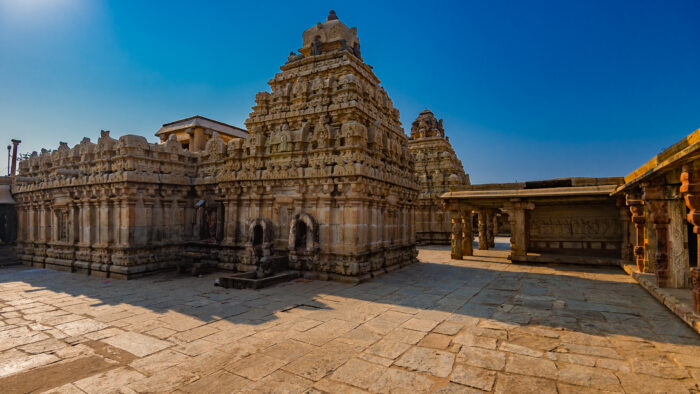
After spending some time at the summit, we stopped for lunch and later began our descent. As we made our way down Nandi Hills, we headed towards the village of Nandi, where another important chapter of our journey awaited us—the Bhoganandishwara Temple. The moment we entered the temple complex, the atmosphere seemed to change. It almost felt as though we had stepped into a different world. The sounds and movement outside gradually disappeared behind the massive stone walls, while the intricate carvings, ancient pillars, courtyards and shrines drew our attention in every direction. What initially appeared to us as an old temple soon revealed itself to be something much larger: a monument shaped by centuries of devotion, craftsmanship and royal patronage.
Bhoganandishwara is not a temple that can be attributed to one ruler or one dynasty alone. The surviving complex represents several layers of South Indian history. The Archaeological Survey of India places its architectural development broadly between the 9th and 15th centuries CE, while the National Culture Fund, in collaboration with the ASI, describes it as an important example of the Dravidian architectural tradition dating approximately from the ninth to the fifteenth century. The earliest architectural phase is generally associated with the Nolambas, who ruled parts of present-day Karnataka during the early medieval period. Early inscriptions in the Nandi region, dating to around the beginning of the ninth century, refer to a temple dedicated to Shiva. Although these inscriptions do not conclusively name the present Bhoganandishwara structure, architectural and iconographic evidence places the origins of the surviving temple complex within the 9th–10th-century Nolamba architectural milieu.
As we walked further inside, it became apparent why this temple is considered such an important example of Karnataka’s temple architecture. The complex consists principally of the Bhoganandishwara and Arunachaleshwara shrines, with the Uma-Maheshwara shrine situated between them. The northern shrine is dedicated to Bhoganandishwara, while the southern shrine is dedicated to Arunachaleshwara. Each major shrine possesses its own sanctum and Nandi pavilion, creating a remarkable architectural composition within the same enclosure.
The central Uma-Maheshwara shrine immediately caught our attention. Its beautifully carved Kalyana Mandapa contains some of the finest sculptural work in the complex. As we moved around the pillars, we encountered representations of divine couples including Shiva and Parvati, Brahma and Saraswati, Vishnu and Lakshmi, and Agni and Swaha. The pillars are further enriched with carvings of birds, creepers, animals and other decorative motifs. The temple’s sculptural world extends far beyond Shaiva imagery. While Shiva remains the central presence, the complex also contains representations associated with Vaishnava and Shakta traditions and Vedic deities. Among the notable sculptures are Vishnu, Narasimha, Durga, Lakshmi, Surya and Agni, revealing a much broader sacred imagination than the name of the temple alone might suggest.
One of the most striking aspects of the temple for us was the way these different forms of divinity were integrated into the architecture. Rather than appearing as isolated images, the deities seemed to inhabit the pillars, walls, doorways and niches. Every few steps revealed another figure or another detail that demanded our attention.
We also came across a particularly interesting sculpture that appeared to depict the dhāraṇa of the iṣṭaliṅga, a practice deeply associated with the personal worship of Shiva through the Ishtalinga. The image immediately reminded us of the distinctive Shaiva traditions of Karnataka. The practice of Ishtalinga worship and liṅga-dhāraṇa carries a particularly important place in the Virashaiva tradition, where the personal linga is worn on the body and becomes the focus of one’s continual relationship with Shiva. What made the experience even more fascinating was that the temple did not appear frozen in a single historical moment. The architecture itself seemed to tell us that different generations had returned to this sacred space, added to it, repaired it and expressed their own artistic vocabulary without erasing what had come before. The Nolambas, Gangas, Cholas, Hoysalas and Vijayanagara rulers all contributed to the architectural and artistic evolution of the complex.
The Chola contribution is visible in the architectural development of the Bhoganandishwara shrine, while the Hoysala period is remembered for the richly carved marriage hall and its extraordinary pillars. Later Vijayanagara additions further transformed the complex, giving it the expansive character that we experience today. Rather than seeing these layers as separate monuments, we found ourselves looking at them as successive chapters of one continuing story.
By the time we stepped out of the temple, we realised that our journey from the Gavi Veerabhadra shrine to Yoganandishwara and finally to Bhoganandishwara had taken us through remarkably different expressions of the same sacred landscape. The hilltop shrine, the temple at the summit and this vast temple complex below it was not merely destinations along a journey. Together, they revealed how deeply the landscape around Nandi Hills has been shaped by the continuing presence of Shiva worship.
An Unexpected Visit to Sadhguru Sannidhi
Later, we returned to Chikkaballapur by bus. When we reached the Chikkaballapur bus stand, we noticed buses heading towards Sadhguru Sannidhi Bengaluru, the Isha Foundation centre near Nandi Hills. It was around 1:25 in the afternoon, and the foundation was just around 10 km and without giving it much thought, we decided not to delay and simply boarded the bus. As we travelled towards the centre, however, something along the route caught our attention. The hills surrounding the road appeared to be heavily affected by quarrying and stone-mining activities. In several places, we could see portions of the hills being cut away, leaving visible scars on the landscape. Looking at this, we began wondering about the ecological consequences of such extensive quarrying in a region blessed with hills and natural vegetation. We wondered what the Isha Foundation would be like when we finally reached it. Would it too be another heavily developed space amidst the hills?
But the moment we entered Sadhguru Sannidhi Bengaluru, our expectations changed. The surroundings were remarkably serene. The greenery, open spaces, hills and peaceful atmosphere immediately created a sense of calm. For a moment, we actually wondered, Are we really in Chikkaballapur? Or have we somehow reached the hills of Uttarakhand? The contrast between the landscape we had witnessed along the way and the serenity within the centre was striking. The centre, officially known as Sadhguru Sannidhi Bengaluru, was established near Nandi Hills and is home to the imposing 112-foot Adiyogi, unveiled on 15 January 2023. It also houses the Yogeshwara Linga and other consecrated spaces associated with Isha’s spiritual tradition. We spent some peaceful time there, enjoyed the food, and noticed the presence of a desi cow goshala within the premises. After a day filled with temples, history and a long journey through the hills, this unexpected visit gave us a completely different experience. For a while, we simply felt happy and peaceful, enjoying the atmosphere without thinking about the journey ahead. There was also a quiet sense of happiness in seeing Sadhguru Ji’s presence and work in Karnataka through this center. What had begun as an unplanned decision at the Chikkaballapur bus stand had unexpectedly become one of the most memorable parts of our journey.
From Narayana to Narasimha: Another Unexpected Discovery
After coming out of Sadhguru Sannidhi, we noticed a small shrine situated just beside the Naga Sannidhi, almost directly opposite it. The shrine stood on a small hill, and its simple stone structure immediately caught our attention. From there, we could also see another temple shrine nestled among the surrounding hills. Curious to know more, we asked a local about it, and he told us that it was an old temple dedicated to Sri Narasimha Swamy. We decided to walk towards it. Once again, the journey led us to a temple that we had not planned to visit. The Narasimha Swamy Temple appeared to have been recently renovated, but the deity within it was believed to be much older. The priest told us that the Narasimha murti is Swayambhu, believed to have manifested by itself, and that the shrine has a history extending back nearly a thousand years. Hearing this from the priest while standing before the ancient deity gave the place a special significance for us.
We spent some time there, took darshan of Sri Narasimha Swamy, and enjoyed the quiet surroundings. As we stepped out of the temple, another beautiful sight caught our attention—a small lake nearby, surrounded by the hills and greenery. The peaceful setting made us pause for a while and take in the landscape. Before leaving, we happened to speak with the same priest again. During our conversation, he mentioned yet another ancient temple near Chikkaballapur—the Moksha Ranganathaswamy Temple at Rangasthala. The name immediately caught our attention. We had already discovered so many unexpected sacred places during the day, and here was another one being introduced to us by someone we had met almost by chance.
Rangasthala: An Unexpected Final Destination
From there, Rangasthala was about 6 km away from Sadhguru Sannidhi. We hurried towards it, not wanting to miss yet another unexpected temple that had come into our journey. As soon as our auto stopped outside the temple, Nisarga suddenly pointed towards the magnificent gopura and shared something that made the moment more special. She told us that whenever she travelled towards her hometown, she would often see this huge gopura from the road. Yet, despite seeing it so many times, she had never had the opportunity to actually visit the temple. This time, she was finally standing before it. The Moksha Ranganathaswamy Temple at Rangasthala is a beautiful Vaishnava shrine dedicated to Lord Ranganatha, who is worshipped here in the reclining posture of Anantaśayana. The temple is associated with the Hoysala period, although the present complex also bears the influence of later architectural developments, including the Vijayanagara period. Its architecture reflects the rich temple-building traditions that flourished in Karnataka over several centuries.
As we entered, the towering gopura gave way to a peaceful temple interior filled with carved pillars and traditional architectural details. The principal deity, Moksha Ranganatha, reclines upon the serpent Adishesha, accompanied by Sridevi and Bhoodevi. The image and the surrounding sculptures bring alive the Vaishnava imagination in stone. After the unexpected visit to Narasimha Swamy and the beautiful landscape around it, arriving at Rangasthala felt like the perfect continuation of our journey. What began as a casual suggestion from a priest had taken us to another ancient sacred space, and for Nisarga, it was particularly meaningful to finally step inside the temple whose gopura she had watched from the road for years.
A Journey Through the Sacred Landscape of Chikkaballapur
As we began our return journey to Chikkaballapur by auto, our driver became an unexpected source of information. During our conversation, he told us that the town and its surrounding areas were dotted with several small and old temples, some believed to be a few hundred years old and some even older. Many of these shrines, he explained, are not prominent destinations. Some are maintained by local families, while others are situated quietly on the outskirts of the town, continuing their traditions away from the attention of the larger world. He mentioned temples dedicated to Lord Shiva, Gopalaswamy and Narasimha, among others. There was even another Narasimha Swamy temple near Rangasthala that he told us about, but by then our time was running short and we could not visit it. Before returning, however, we managed to visit one smaller temple within the town—the Gopalaswamy Temple, which we learned was being maintained by a local family.
That final visit somehow brought the journey to a fitting close. We had begun the day with a climb up Nandi Hills and had encountered Gavi Veerabhadreshwara, Yoganandishwara, Bhoganandishwara, Sadhguru Sannidhi, Narasimha Swamy and finally Ranganatha at Rangasthala. Yet, perhaps the most fascinating discovery was realizing how many sacred spaces remain scattered quietly across the landscape, known intimately to the local communities but often overlooked by visitors.
We returned with a sense of gratitude for the experience—and with the feeling that we had only scratched the surface. Chikkaballapur has many more stories, shrines and sacred traditions waiting to be discovered. Perhaps the best way to truly understand this landscape is to explore it slowly, temple by temple, and discover its sacred heritage for oneself.
Feature Image Credit: Wikicommons
Disclaimer: The opinions expressed in this article belong to the author. Indic Today is neither responsible nor liable for the accuracy, completeness, suitability, or validity of any information in the article.