
प्रथमं शैलपुत्री च द्वितीयं ब्रह्मचारिणी।
तृतीयं चन्द्रघंटेति कूष्माण्डेति चतुर्थकम् ।।
पंचमं स्क्न्दमातेति षष्ठं कात्यायनीति च ।
सप्तमं कालरात्रीति महागौरीति चाष्टमम् ।।
नवमं सिद्धिदात्री च नवदुर्गाः प्रकीर्तिताः ।।
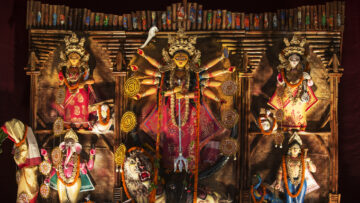
From Śailaputrī to Siddhidātrī, each name heralds a new dawn in the worship of the Divine Mother. As Navarātri arrives, Mā comes home, and with Her comes the fragrance of flowers, the glow of dīpas, the sound of prayers, and the indescribable joy of welcoming Her into our midst.
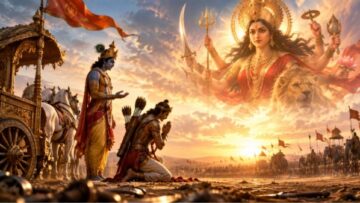
The festival of Navaratri is often described in grand, cosmic terms. We visualize vast battlefields, glowing divine weapons, and the ultimate triumph of a warrior goddess over dark, chaotic force. Yet for millions of us, this sacred story does not begin in the heavens. It begins right at our own doorstep.
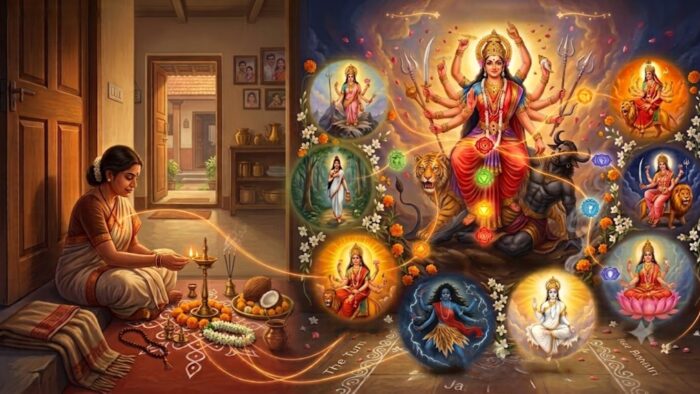
Think back to the busy mornings of your childhood during this season. You can still recall the scent of parched earth meeting the first rains, the natural fragrance of fresh marigolds, and the gentle, tireless rush of your mother moving around the house. Long before the sun was fully up, she was already awake. She would sweep the courtyard, draw the traditional white patterns on the ground, and light the brass lamp at the household altar. In her everyday presence, you did not just see someone managing a home. You witnessed a quiet, enduring grace that held your entire world together.
To truly understand the Navadurga, the nine forms of the Goddess celebrated over these nine nights, we do not need to look far. The journey is not just a distant mythology. It is the story of our own homes. Each of her sacred forms reflects the familiar faces, sacrifices, and quiet strengths of the mothers who raise us, shelter us, and silently guide us every day.
1. Shailaputri: The Solid Foundation
Think of the very early years of your life, or perhaps the early days of a family starting out. Everything of value begins with a quiet, unwavering stability. It is like a mother who stands as an unbreakable wall against the outside world. No matter what worries or financial struggles are happening, she stays deeply grounded. She gives her children the natural confidence that they are safe, that they have a home, and that they can grow because their foundation is secure.
On this first night, the festival begins with Shailaputri, the daughter of the mountains. According to the Shiva Purana, she is the reincarnation of Sati, born to Himavat, the king of the Himalayas. Her name literally means “daughter of the peak.” She does not represent grand, dramatic action, but rather the immense, quiet power of the earth itself. She is depicted riding a bull, holding a trident in one hand and a gentle lotus in the other.
Shailaputri corresponds to the Muladhara Chakra, the very root of our spiritual being. In daily life, she is that first, essential source of security. She reminds us that before we can reach for the stars, we must be deeply rooted. She is the mother who teaches us how to stand firm, face the wind, and keep our balance when the ground beneath us begins to shake.
2. Brahmacharini: The Quiet Patience
Think of the times when your mother had to wait for years to see her family’s hopes come to life. Consider the long, uncomplaining hours she spent teaching you, saving tiny bits of money, or managing the household through endless lean years. There was no instant reward for her daily labor. It was a long, silent discipline, driven by a deep and quiet faith that better days would eventually come.
On the second night, we meet Brahmacharini, the seeker of truth. As the Matsya Purana describes, she is the young goddess who undertook thousands of years of intense, barefoot penance in the forest to win the heart of Lord Shiva. Her name signifies one who moves on the path of sacred discipline. She is depicted barefoot, wearing simple white robes, holding a rosary in her right hand and a water pot in her left.
She corresponds to the Svadhisthana Chakra, the seat of creation and perseverance. Brahmacharini shows us that the most difficult battles are not won with weapons, but with quiet, long-term patience. In our homes, she is the living spirit of dedication. She is the mother who shows us that true strength is the ability to keep moving forward, day after day, with grace and without losing heart.
3. Chandraghanta: The Guardian of Peace
Recall a time when your household was in a state of chaos, perhaps when everyone was arguing, stressed, or when bad news arrived. Then, your mother walked into the room. She did not yell or lose her temper. Instead, with just a few calm words, a gentle touch, or perhaps a firm look, she restored peace. The tension simply faded away. In her gentle presence, you knew everything would be fine, even though you could also sense the fierce protective energy beneath her calm.
The third night belongs to Chandraghanta, the guardian of the household. The Markandeya Purana describes her as the married form of the goddess, who wears a crescent moon shaped like a temple bell on her forehead. When her bell rings, its sound scares away evil and brings peace. She rides a tiger, has ten arms filled with weapons, and sits ready to protect. Yet her face is completely serene, radiating grace and motherly warmth.
Chandraghanta corresponds to the Manipura Chakra, the fire and strength of the navel. In our lives, she is the mother who guards the harmony of the home. She is the gentle keeper of peace who can, in an instant, become a fierce protector if anyone tries to harm her family. She teaches us that true peace is never weak. It is a powerful, active shield that guards our happiness.
4. Kushmanda: The Generous Creator
Think of the incredible warmth of your mother’s kitchen on a festival morning, or even on a regular evening when you came home tired and hungry. You would find her busy in a warm, crowded room, creating nourishing meals out of whatever was available, always ensuring everyone else was fed first. Her creativity was not just about the food. She was the one who filled the entire house with life, hope, and joy, making something beautiful out of almost nothing.
On the fourth night, we worship Kushmanda, the creator of the universe. In the Devi Bhagavata Purana, she is the goddess who created the entire cosmos with just a tiny, gentle smile when the universe was nothing but dark, cold emptiness. Her name is also linked to the pumpkin, which symbolizes fertility and growth. She is depicted with eight arms, riding a lion, and holding a variety of weapons, a rosary, and a pot of nectar. She is as bright as the sun, radiating warmth and life in all directions.
She corresponds to the Anahata Chakra, the heart centre of love and compassion. Kushmanda is the mother as the natural source of life and joy. She reminds us that even when the world feels cold and empty, we have the inner warmth to create light and hope. She is the mother whose silent grace keeps the household thriving, filling our lives with abundance and love.
5. Skandamata: The Protective Teacher
Think of a mother teaching her child to take their very first steps, or sitting beside them late at night before a difficult exam. She holds her child close, offering comfort, but her eyes are also focused on the future. She is preparing them to face the world on their own. She is both a soft, sheltering haven and a fierce, proud guide, ready to push her child forward while ensuring they never fall.
On the fifth night, we see the goddess in her most tender, motherly form as Skandamata, the mother of Skanda (or Kartikeya), the warrior god who led the divine armies. As the Skanda Purana tells us, she sits on a lion, holding her young son in her lap. She has four arms, with two of her hands holding lotus flowers, while another hand is raised in a blessing, and the fourth holds her child secure.
Skandamata corresponds to the Vishuddha Chakra, the center of expression, wisdom, and guidance. In our homes, she is the mother as the first teacher. She is the one who holds us when we are small, protects us, and trains us to go out and face our own battles. She shows us that the ultimate purpose of her love is not to hold us back, but to make us strong and brave enough to stand on our own.
6. Katyayani: The Fierce Defender
Think of a time when your family faced a real crisis, like a sudden illness, a severe financial threat, or a moment of injustice. You might have seen your otherwise quiet, gentle mother transform overnight. The soft woman who served meals was suddenly gone. In her place stood an unstoppable force, dealing with doctors, banks, or difficult relatives, refusing to back down until her family was safe.
The sixth night is dedicated to Katyayani, the warrior daughter born to Sage Katyayana to defeat the buffalo demon Mahishasura, as celebrated in the Devi Mahatmya. She is the goddess of action and justice, riding a fierce lion and holding a sword and shield in her hands, while her other hands offer blessings and peace. She is a natural force of righteous anger, moving swiftly to destroy evil.
She corresponds to the Ajna Chakra, the third eye of wisdom, vision, and inner clarity. In our everyday lives, Katyayani is the mother who defends us. She show us that love is not always soft and quiet. Sometimes, love must be fierce, brave, and ready to fight. She is the strength that rises up within us whenever we have to stand up for what is right.
7. Kalaratri: The Dark Night
Think of the darkest, most painful times your family has ever faced. Perhaps it was a time of deep grief, a sudden tragedy, or the loss of a loved one. During those terrifying nights, when everyone else was weeping and lost, there was always one person who sat in the dark, holding the broken pieces together. She did not hide the pain, but she did not let it destroy the family either. Her quiet, steady presence was the only thing that kept the darkness from taking over.
On the seventh night, the mood shifts as we meet Kalaratri, the destroyer of darkness. In the Markandeya Purana, she is the fiercest form of the goddess, appearing with dark skin, wild hair, and three glowing eyes, riding a donkey and holding a cleaver and a torch. Her name means “the night of death” or “time.” Although her form is terrifying, her name is also Shubhankari, which means “she who does good.” She is the one who destroys fear itself, assuring her devotees that they have nothing to dread.
Kalaratri corresponds to the Sahasrara Chakra at the crown of the head, but also connects to our deepest survival instincts. In the home, she is the mother who helps us survive our darkest hours. She shows us that we do not have to be afraid of the dark, because she is there, absorbs our fear, and guides us through the night until the morning comes.
8. Mahagauri: The Gentle Healing
Think of the quiet, peaceful days that follow a long crisis. After the illness has passed, the debts are paid, or the grief has softened, a natural sense of peace returns to the house. You can remember your mother sitting on the porch in the quiet evening, the strain finally gone from her face, looking tired but completely at peace. The house is clean, the air is calm, and everyone can breathe easily once again.
On the eighth night, Maha-Ashtami, we celebrate Mahagauri, the goddess of peace and purification. The Padma Purana tells us that after her long and painful penance in the forest, her body had become covered in dust and wear. Lord Shiva then bathed her in the sacred waters of the Ganga, and she emerged dazzlingly white, radiant as the snow. She is depicted riding a white bull, wearing white garments, holding a trident and a small drum, with her hands offering blessings and safety.
She corresponds to the Soma Chakra, the seat of peace and healing. Mahagauri is the mother as a healing force. She shows us that no matter how difficult our trials have been, we can always be made whole again. She brings the gentle, soothing grace that cleanses our worries and restores our hope, making our home feel like a sacred space once more.
9. Siddhidatri: The Quiet Fulfillment
Recall a moment when your family gathered together after years of effort and sacrifice. Perhaps it was a quiet evening when everyone was fed, safe, and content. Your mother sat in the corner of the room, looking at her family with a gentle smile, asking for nothing for herself. In her quiet presence, the entire house felt whole. There was no need for more words or grand achievements. Life felt completely fulfilled.
On the ninth night, Maha-Navami, the journey reaches its culmination in Siddhidatri. As described in the Devi Bhagavata Purana, she is the supreme giver of all siddhis, or spiritual fulfillments. Scriptural lore tells us that Lord Shiva worshipped her to attain all cosmic perfections, through which he realized his completeness as Ardhanarishvara. In her distinct iconographic form, she sits upon a fully bloomed lotus, holding a discus, conch, mace, and lotus in her four hands. She corresponds to the full awakening of the Sahasrara Chakra at the crown of the head.
Siddhidatri represents ultimate contentment. In daily life, she shows us that the highest fulfillment is not the acquisition of extraordinary powers or external recognition. It is the quiet realization of our inner completeness. Through her grace, we see that the peace we spent nine nights searching for was always present within us.
Conclusion: The Light of Vijayadashami
When the nine nights draw to a close and the bright morning of Vijayadashami dawns, the clay images are carried to the water for immersion. We celebrate the eternal victory of good over evil, the triumph of light over darkness. Yet in our living tradition, this victory is not fought on distant battlefields alone. It is won every single day at home. It happens whenever patience overcomes anger, whenever quiet sacrifice replaces selfishness, and whenever a mother’s silent love holds a family together through hard times.
As the physical forms dissolve in the river, her spirit returns home to stay permanently inside our hearts. Vijayadashami is the morning we step back into the world with fresh hope. We carry the quiet strength, moral clarity, and grace we learned from the mother who stood by us through every struggle.
To see the Navadurga through the eyes of home is to bow in deep gratitude before the sacred presence in our midst. The divine victory was never distant or unreachable. It was living right beside us all along, cradling us in every quiet, tireless act of a mother’s love.
Disclaimer: The opinions expressed in this article belong to the author. Indic Today is neither responsible nor liable for the accuracy, completeness, suitability, or validity of any information in the article.