
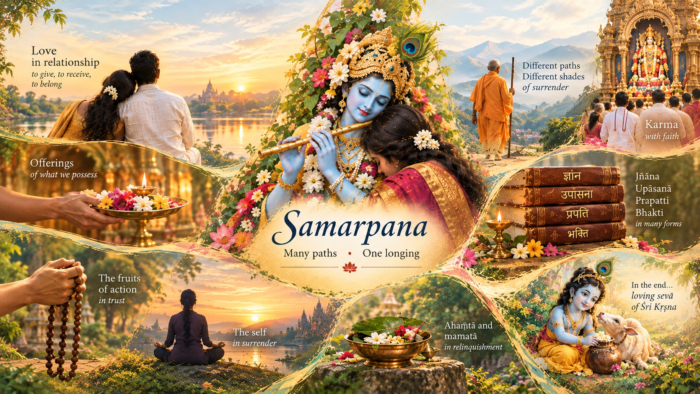
The most important thing for human beings is love. We express it towards various people and things: our beloved, parents, children, pets, and many others. The question arises: why? The Upaniṣads answer this beautifully:
न वा अरे पत्युः कामाय पतिः प्रियो भवत्यात्मनस्तु कामाय पतिः प्रियो भवति… न वा अरे सर्वस्य कामाय सर्वं प्रियं भवत्यात्मनस्तु कामाय सर्वं प्रियं भवति।[1]
“Verily, not for the sake of the husband, is the husband loved, but he is loved for the sake of the Self… Verily, not for the sake of all, my dear, is all loved, but it is loved for the sake of the Self.”
This love for the Self is the driving force behind our longing for love from the outer world. In order to obtain that love from outside, we dedicate ourselves to the respective objects of our affection. This very process of dedication becomes the source of bondage when done towards the outward objects and the source of liberation when done towards the inward object. It is this process that lies at the heart of the concept of Samarpana in Sanatana Dharma.
Samarpana plays a vital role in almost every Sampradaya of Sanatana Dharma. The word Samarpana means सम्यक्प्रकारेणार्पणम्. The Apte Practical Sanskrit-English Dictionary translates it as “giving or handing over to; delivering; consigning,” whereas the Monier-Williams Sanskrit-English Dictionary defines it as “delivering or handing completely over; consigning; presenting; imparting; bestowing.” Taken as a whole, it means giving or handing oneself or something over to another.
This can easily be understood through an ordinary example. If we desire love from our family, we must first offer love to them. We take care of them, and whatever hard work or hectic schedule we go through at the workplace is ultimately for their well-being. This is our Samarpana towards the family. In return, they reciprocate with love.
In the context of Sanatana Dharma, Samarpana generally involves offering food, flowers, fragrances, one’s possessions, or even oneself to the Supreme Lord or one’s Iṣṭadevatā with the aim of attaining mokṣa or bhakti.
Although the act of offering may appear similar in different traditions, its philosophical meaning is far from uniform. Just as water has no color of its own, yet reflects the color of whatever it comes into contact with, Samarpana also has no single shade of its own. However, when placed within the tattva-siddhānta of different paths, it assumes different shades of meaning. This is not a contradiction. Rather, it is like a collage composed of diverse abstract colors that, despite their variety, together create a beautiful and harmonious pattern.
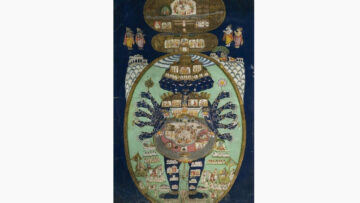
To understand the various shades of Samarpana, the classification of the paths must first be understood. The following classification is based on the philosophical understanding of Shri Vallabhacharyaji.
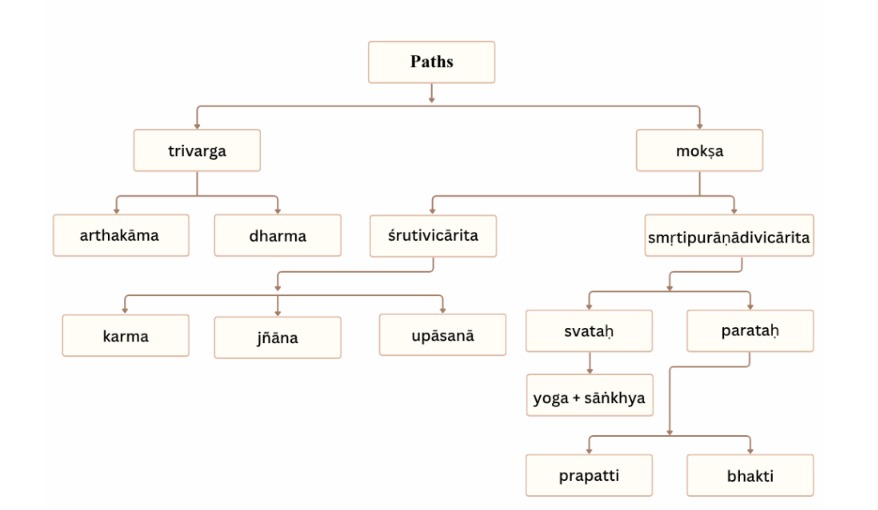
The whole concept of Samarpana has been broken down into several parts in the following in accordance with the above table. By doing so, it becomes easier to understand. The different shades of Samarpana can be assessed through these parameters.
The first parameter is the desired outcome. There is a famous saying in Sanskrit: विना प्रयोजनेन मन्दोऽपि न प्रवर्तते, which means, “Without a purpose, even a fool does not undertake any action.” Therefore, the desired outcome must be understood first.
After that, the offered objects should be identified. They have been classified into four categories. The first is ājya padārtha, which refers to the various items to be offered to the devatās. The second is karmaphala. In certain cases, a person surrenders his/her own karmaphala to devatās or in other cases, the person enjoys its fruits. The third and fourth categories are the senses and the ātman. These have been further divided into two subcategories: merger and dedication. Samarpana can be practiced in both ways. One may either merge the senses and the ātman into the devatā or dedicate them to the devatā.
The next parameter is the deity to whom the offering is made, and the final parameter is the phala, that is, the outcome.
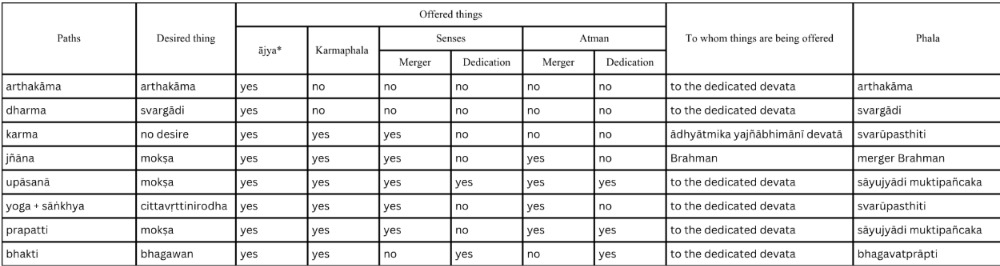
An important thing to be noticed in Sanatana Dharma is that it does not speak only about the spiritual upliftment of a person. Rather, it talks about both the material and spiritual well-being of humankind. To achieve this, it speaks of the four Puruṣārthas: dharma, artha, kāma, and mokṣa. The first three, which are regarded as the Trivarga, are meant for material upliftment, whereas their proper fulfillment leads one to the path of mokṣa. Samarpana is also practiced in both these contexts. That is why both have also been added to the table.
1. Trivarga
1.1. Arthakāma
A person who desires only artha and kāma can be counted under this category. Bhagavān also says in the Bhagavad Gītā:
चतुर्विधा भजन्ते मां जनाः सुकृतिनोऽर्जुन ।
आर्तो जिज्ञासुरर्थार्थी ज्ञानी च भरतर्षभ ॥ ७.१६ ॥
“O Arjuna, four kinds of virtuous people worship Me: the distressed, the seeker of knowledge, the seeker of wealth, and the jñānī, O best of the Bharatas.”
Here, arthārthī refers to the arthakāmapara category.
Likewise the Vedas prescribe such yajñas that are meant to bestow material benefits. For instance, the Āpastamba Śrauta Sūtra says:
पुष्कलेषु नक्षत्रेषूदवसाय कारीर्या वृष्टिकामो यजेत ॥ 19.25.16 ॥
“When the (constellation) Puṣya is in abundance (or under the appropriate asterism), one who desires rain should perform the Kārīrī sacrifice.”
In order to obtain these material benefits, a person performs the yajña as prescribed by the scriptures. During the performance of the yajña or pūjā, the prescribed offerings are dedicated to the respective devatās. This act of offering constitutes Samarpana.
1.2. Dharma
These kinds of people perform the nitya yajñas prescribed by the Vedas with the intention of attaining svarga. Bhagavān says in the Bhagavad Gītā regarding such people:
त्रैविद्या मां सोमपाः पूतपापा यज्ञैरिष्ट्वा स्वर्गतिं प्रार्थयन्ते ।
ते पुण्यमासाद्य सुरेन्द्रलोकम् अश्नन्ति दिव्यान् दिवि देवभोगान् ॥ 9.20 ॥
“Those who are versed in the three Vedas, who drink Soma, and are purified from sin, worship Me through sacrifices and pray for heaven. Having attained the world of Indra as the fruit of their merit, they enjoy the divine pleasures of the gods in heaven.”
At first glance, this category appears to be very similar to the arthakāmapara category discussed above. Indeed, there is no significant difference in the external practice of Samarpana. In both cases, the performer undertakes the Vedic yajñas as prescribed by the scriptures and offers the prescribed materials (ājya-padārthas) to the respective devatās.
The distinction lies in the intended outcome. While the arthakāmapara performer seeks particular worldly benefits, such as rain, wealth, or progeny, the dharmapara performer carries out the nitya yajñas with the aspiration of attaining svarga. Accordingly, although the external form of Samarpana remains the same, its purpose differs.
2. Mokṣa
2.1. Śrutivicārita
2.1.1. Karma
There is a slight difference between the dharmapara and the karmamārgīya categories. Although both perform the Vedic nitya karmas, the intention behind them is different. People falling under this category do not have any material desire, including the desire for svarga. Rather, through the performance of nitya karmas, they aspire to attain mokṣa.
It is said:
अग्निहोत्रं जुहुयात् स्वर्गकामः ।
“One who desires svarga should perform the Agnihotra sacrifice.”
At first sight, this statement appears to contradict the above classification, since the practitioner is said to desire svarga. However, the word svarga is interpreted differently in this context. Bhagavān explains this in the Bhāgavata:
स्वर्गः सत्त्वगुणोदयः ॥ 11.19.42 ॥
“Svarga is the arising (predominance) of the quality of sattva.”
Thus, svarga here refers to svarūpasthiti. When sattva-guṇa arises through the performance of nitya karma, one attains svarūpasthiti, that is, the realization of the self.
The same principle is further clarified in the Bhagavad Gītā. Bhagavān says:
तस्मादसक्तः सततं कार्यं कर्म समाचर ।
असक्तो ह्याचरन्कर्म परमाप्नोति पूरुषः ॥ 3.19 ॥
“Therefore, always perform the action that ought to be done without attachment; for by performing action without attachment, a person attains the Supreme.”
To reinforce this teaching, Bhagavān gives the example of King Janaka:
कर्मणैव हि संसिद्धिमास्थिता जनकादयः ।
लोकसंग्रहमेवापि सम्पश्यन्कर्तुमर्हसि ॥ 3.20 ॥
“Indeed, it was through action alone that Janaka and others attained perfection. Therefore, you should also perform action, keeping in view the welfare and maintenance of the world.”
Having established the objective of this path, the next question is: what form does Samarpana take here? Their Samarpana differs slightly from the cases discussed earlier. Most importantly, from this stage onwards, every practitioner performs niṣkāma karma. Describing this process of Samarpana, Bhagavān says in the Bhagavad Gītā:
यज्ञार्थात्कर्मणोऽन्यत्र लोकोऽयं कर्मबन्धनः ।
तदर्थं कर्म कौन्तेय मुक्तसङ्गः समाचर ॥ 3.9 ॥
“Actions performed for any purpose other than yajña cause bondage in this world. Therefore, O Kaunteya, perform your prescribed duties for the sake of yajña, free from attachment.”
Thus, the nitya karmas are to be performed for the sake of yajña, that is, for the pleasure of Viṣṇu, since Viṣṇu Himself is Yajña. Since the practitioner seeks mokṣa rather than worldly rewards, the fruits of all actions are surrendered to Bhagavān. Upon attaining mokṣa, the senses merge into the ādhyātmika indriyābhimānī devatās presiding over those respective senses.
2.1.2. Jñāna
Having discussed the Karma Mārga, we now turn to the Jñāna Mārga. The Bṛhadāraṇyaka Upaniṣad describes the sādhanā paddhati of the jñānī:
आत्मा वा अरे द्रष्टव्यः श्रोतव्यो मन्तव्यो निदिध्यासितव्यः ॥ 2.4.5 ॥
“Verily, the Self, O dear one, is to be realized. It should be heard about, reflected upon, and deeply contemplated.”
This is the sādhanā paddhati of the jñānī. First, one hears the teachings concerning the Ātman (Brahman) from the guru. Thereafter, those teachings are reflected upon through reasoning and contemplation. Finally, through deep meditation, the Ātman is directly realized.
Unlike the Karma Mārga, where liberation is attained through the performance of niṣkāma karma, the Jñāna Mārga seeks liberation through the realization of Brahman. Desiring mokṣa, the practitioner seeks complete identity with Brahman. The Māṇḍūkya Upaniṣad also states:
आत्मैव संविशत्यात्मना । 12 ।
“The self enters into the Self alone.”
Accordingly, the nature of Samarpana also undergoes a significant change. In the previous category, the karmaphala was surrendered to Bhagavān while the practitioner continued to perform the prescribed actions. Here, however, the ultimate Samarpana is not merely of the fruits of action but of the individual self itself. The practitioner relinquishes the sense of individuality and seeks complete identity with Brahman. Thus, the ātman is merged into Brahman, and all actions together with their fruits are surrendered as a natural consequence of that realization.
2.1.3. Upāsanā
Having discussed the Jñāna Mārga, we now come to the Upāsanā Mārga. In this path, the mantra is of primary importance. Many such mantras are found in the Vedas. The Praśna Upaniṣad describes the upāsanā of Praṇava (Om). It says:
यः पुनरेतं त्रिमात्रेणोमित्येतेनैवाक्षरेण परमपुरुषमभिध्यायीत स तेजसि सूर्ये सम्पन्नः । यथा पादोदरस्त्वचा विनिर्मुच्यत एवं ह वै स पाप्मना विनिर्मुक्त: स सामभिरुन्नीयते ब्रह्मलोकं स एतस्माज्जीवघनात्परात्परं पुरिशयं पुरुषमीक्षते तदेतौ श्लोकौ भवतः ॥5.5॥
“But he who meditates upon the Supreme Person, taking the three-mātrā Praṇava (Om) as the support of meditation, becomes united with the brilliance of the sun. Just as a snake casts off its worn-out skin, so too is he freed from all sin. He is then led by the Sāma hymns to Brahmaloka, the abode of the Supreme Brahman. There he beholds the Supreme Person, who transcends the aggregate of individual souls (jīvaghana), who is beyond the perishable (kṣara) and even beyond the imperishable (akṣara), and who dwells in the cavity of every heart as the Inner Controller (Antaryāmin).”
Apart from this, the Vedas also prescribe mantras for the upāsanā of various devatās. By performing japa of these mantras, a person attains mokṣa associated with the respective devatā. Accordingly, the form of Samarpana in this path is also distinct. Here, the practitioner dedicates oneself through continuous meditation and japa to the chosen devatā. At the end, the practitioner merges into respective devatā.
2.2. Smṛtipurāṇādivicārita
Having discussed the paths described in the Śruti, we now turn to those described in the Smṛtis, Purāṇas, and other allied scriptures. These may be broadly divided into two categories: svataḥ and parataḥ. Here, svataḥ refers to attaining mokṣa through the spiritual discipline prescribed in the scriptures by the person himself, whereas parataḥ refers to attaining mokṣa through the grace of another.
2.2.1. Svataḥ
2.2.1.1. Yoga and Sāṅkhya
There is a slight difference between the sādhanā of Sāṅkhya and Yoga, but the nature of Samarpana in both paths is more or less the same. Their Samarpana is also similar to that of the Karma Mārga. They perform their prescribed disciplines without attachment to the fruits of action. For them, the role of Īśvara is primarily that of an object of concentration and meditation.
2.2.2. Parataḥ
2.2.2.1. Prapatti
We now come to Prapatti, where Samarpana reaches a much deeper form. A very famous and often quoted verse spoken by Bhagavān in the Bhagavad Gītā describes Prapatti:
सर्वधर्मान्परित्यज्य मामेकं शरणं व्रज ।
अहं त्वां सर्वपापेभ्यो मोक्षयिष्यामि मा शुचः ॥ 18.66 ॥
“Abandoning all forms of dharma, take refuge in Me alone. I shall liberate you from all sins; do not grieve.”
Here, Bhagavān asks Arjuna to take refuge in Him and assures him of liberation through His grace. In Prapatti, a person performs the Samarpana of everything to Bhagavān and becomes free from all worldly bondage. Unlike the previous paths, where liberation is attained primarily through one’s own spiritual discipline, here liberation depends upon the grace of Bhagavān. The practitioner of Prapatti ultimately merges in Bhagavān and attains mokṣa.
2.2.2.2. Bhakti
Having discussed prapatti, we now come to bhakti. Although both belong to the parataḥ category and depend upon the grace of Bhagavān, the nature of Samarpana in bhakti is much more comprehensive. In order to understand Bhakti, we have to understand its nature.
Mahāprabhu Śrī Vallabhacharyaji quotes the Nārada Pañcarātra to define bhakti in his Tattvārthadīpanibandha:
माहात्म्यज्ञानपूर्वस्तु सुदृढः सर्वतोऽधिकः ।
स्नेहो भक्तिरिति प्रोक्तस्तया मुक्तिर्न चान्यथा ॥ 1.42 ॥
“Bhakti is said to be firm and unsurpassed love for the Lord, preceded by the knowledge of His greatness (māhātmya-jñāna). Liberation is attained through that alone and not otherwise.”
This definition of bhakti revolves around two key expressions: māhātmya-jñāna and sudṛḍhaḥ sarvato’dhikaḥ snehaḥ. Both are explained by Mahāprabhu in the immediately preceding verse of the Tattvārthadīpanibandha:
यथाकथञ्चिद् माहात्म्यं तस्य सर्वत्र वर्ण्यते।
भजनस्यैव सिद्ध्यर्थं तत्त्वमस्यादिकं तथा ॥ 1.41 ॥
“The greatness (māhātmya) of Him is described everywhere in one way or another. Likewise, the statements such as tat tvam asi are taught solely for the accomplishment of bhajana (devotion).”
Māhātmya-jñāna refers to the knowledge of Bhagavān’s greatness as revealed throughout the scriptures. Whether the scriptures describe Him as the creator, sustainer, or supreme ruler of the universe, their purpose is to direct the devotee towards Bhagavān alone, thereby ensuring that bhakti remains free from worldly motivations.
The second expression, sudṛḍhaḥ sarvato’dhikaḥ snehaḥ, denotes an unwavering and unsurpassed love for Bhagavān. Mahāprabhu relates this to the Upaniṣadic mahāvākyas, such as tat tvam asi. According to the Vallabha tradition, these statements establish a tādātmya-sambandha between Bhagavān and the jīva. Consequently, the devotee develops complete identification with Bhagavān while retaining individuality in order to relish loving communion with Him. It is upon this philosophical foundation that Samarpana rests.
Having understood the nature of bhakti, the next question is how Samarpana functions in the actual lifestyle of a devotee. In the sādhanā of the Vallabha Sampradāya, Samarpana of one’s ahaṃtā (I-ness) and mamatā (my-ness) is made to Bhagavān. Through this process, the devotee becomes purified. This Samarpana takes place through the sevā of Bhagavān.
To explain this, Mahāprabhu says in the Siddhāntamuktāvalī:
कृष्णसेवा सदा कार्या मानसी सा परा मता ।।१।।
चेतस्तत्प्रवणं सेवा तत्सिद्ध्यै तनुवित्तजा ।
Thus, in order to attain mānasī sevā (dedication of the mind), one must first undergo the process of dedicating oneself through tanuvittajā sevā (dedication of one’s body and possessions). To understand this process more clearly, a passage from the Bhāgavata Purāṇa is helpful:
इष्टं दत्तं तपो जप्तं वृत्तं यच्चात्मनः प्रियम् ।
दारान् सुतान् गृहान् प्राणान् यत्परस्मै निवेदनम् ॥ 11.3.28 ॥
“Whatever sacrifices have been performed, gifts given, austerities practiced, mantras recited, and whatever is dear to oneself, including one’s spouse, children, home, and even one’s life, should be offered to the Supreme.”
At this point, an important question naturally arises. Non-living objects can be dedicated without their consent, but how is such Samarpana possible in the case of living persons? The answer is that, whether living or non-living, the Samarpana is not of the object or the person itself, but of the devotee’s mamatā (sense of ownership) connected with them. Thus, living persons continue to remain independent in their own personal capacity. What is surrendered is one’s sense of “mine” towards them, and that mamatā is offered to Bhagavān. In fact, Samarpana in the Vallabha Sampradāya is not confined to ritual worship. The entire life of a devotee becomes an expression of sevā. Every action, every possession, every relationship, and every thought are dedicated to Bhagavān. Thus, Samarpana becomes a continuous mode of living. Similar ideas are also expressed in the Brahmasambandha Mantra of the Vallabha Sampradāya.
The origin of this understanding is closely connected with the revelation of the Brahmasambandha Mantra. Once, Mahāprabhu Śrī Vallabhacharyaji was contemplating the fact that Bhagavān is completely free from all doṣas, whereas the jīva is full of doṣas. At that time Bhagavān appeared before him and revealed the Brahmasambandha Mantra, which is the foundational mantra of the Puṣṭimārga. Mahāprabhu records this incident in the Siddhāntarahasyam. While commenting on this text, Śrī Gokulanāthaji beautifully explains the meaning of the mantra:
तस्मादादौ स्वोपभोगात्पूर्वमेव सर्ववस्तुपदेन भार्यापुत्रादीनामपि समर्पणं कर्तव्यम्। विवाहानन्तरं स्वोपयोगात्पूर्वमेव स्वोपयोगार्थमेव तन्निवेदनं कर्तव्यम्। एवमपि पुत्रोत्पत्त्यनन्तरमपि पुत्रादीनां समर्पणं कर्तव्यम्। सर्वकार्ये सर्वकार्यनिमित्तं तत्तत्कार्योपयोगिवस्तुसमर्पणं कार्यम्। समर्पणं कृत्वा पश्चात्तानि तानि कार्याणि कर्तव्यानि इति अर्थः ॥ 6 ॥
This passage has often been quoted out of context in an attempt to portray the Sampradāya as promoting immoral practices. It has been claimed that wives or maidens are to be offered to the Mahārāja (guru). Such interpretations arise from quoting isolated Sanskrit passages without properly understanding either the language or the context. The text nowhere states that the Samarpana is to be made to the guru. On the contrary, it clearly indicates that the offering is to be made to Bhagavān alone.
This understanding was also accepted by the court in the Maharaj Libel Case:
“The text upon which the libel was founded is a commentary by Gokulnathjee Maharaj upon a work composed by his grandfather Vallabhachary, the founder of the sect. In the Sanskrit original, the name of the person to whom an offering is to be made is not mentioned, and upon the evidence there can be no reasonable doubt that the offering was to be made to ‘Purushottam’, which is a name of the Supreme Being.” (Maharaj Libel Case, C.P., pp. 410–411.)[2]
Thus, Samarpana is made exclusively to Śrī Kṛṣṇa and to no one else. For a more detailed discussion of this subject, readers may refer to the book, “Doctrines of Puṣṭibhaktimārga: Allegations, Conspiracy and Facts (In the Context of the Maharaj Libel Case)”
The Samarpana of the bhakta therefore differs fundamentally from that of the other paths discussed earlier. In the previous paths, the object of surrender was either ritual offerings, the fruits of actions, or ultimately the individual self. In bhakti, however, the devotee surrenders not merely possessions or actions but one’s entire sense of ahaṃtā and mamatā. Yet, unlike the path of jñāna, this surrender does not culminate in the dissolution of individuality. The devotee retains individuality in order to participate eternally in the loving sevā of Bhagavān. To glorify this particular process Bhagawat says,
अक्षण्वतां फलमिदं न परं विदाम: ॥ 10.21.7 ॥
“This alone is the true fulfillment of those endowed with the senses; even mokṣa is not their highest fulfillment.”
In the commentary of this shloka Mahaprabhu in Shree Subodhini says that,
इदमेवेन्द्रियवतां फलं मोक्षोपिनान्यथा ॥ 10 ॥
यथान्धकारे नियता स्थितिर्नाक्ष्णोः फलं भवेत्।
एवं मोक्षोपीन्द्रियादियुक्तानां सर्वथा न हि ॥ 11 ॥
“This alone is the true fulfillment of those endowed with the senses; even mokṣa is not their highest fulfillment. Just as the mere existence of the eyes in darkness cannot be regarded as the fulfillment of their purpose, similarly, even mokṣa cannot be considered the true fulfillment of those who possess the senses.”
Mahāprabhu’s intention is to demonstrate that the senses are not obstacles to liberation. Rather, their true fulfilment lies in being dedicated to the sevā of Bhagavān. Consequently, the highest form of Samarpana is not the destruction or negation of the senses but their complete consecration in loving service to Śrī Kṛṣṇa. In this way, bhakti represents the fullest and most comprehensive expression of Samarpana within Sanātana Dharma.
Having examined the concept of Samarpana in the Vallabha Sampradāya, it is worthwhile to briefly compare it with the other major Vaiṣṇava traditions, such as those of Rāmānuja and Madhva. Broadly speaking, the principle of dedicating every action of one’s life to Bhagavān remains common to all these traditions. The primary difference lies not in the practice of Samarpana itself but in the philosophical framework through which it is understood.
In the Śrī Vaiṣṇava tradition, Śrī Vedānta Deśika describes the daily conduct of a devotee in the third chapter of the Pāñcarātrarakṣā, drawing upon the Gītārthasaṅgraha of Śrī Yamunācārya. Likewise, in the Madhva Sampradāya, Śrī Rāghavendra Tīrtha explains the dedication of one’s actions to Bhagavān in his Sarvasamarpanagadya. Śrī Madhvācārya himself, in his Sadācārasmṛti, quotes a passage from the Śrīmad Bhāgavata to describe the spirit of complete Samarpana:
वैश्वदेवं बलिं चैव कुर्यान्नित्यं तदर्पणम् ।
इष्टं दत्तं हुतं जप्तं पूर्तं यच्चात्मनः प्रियम् ॥ १४ ॥
दारान् सुतान् प्रियान् प्राणान् परस्मै सन्निवेदयेत् ।
भुक्तशेषं भगवतो भृत्यातिथिपुरस्सरः ॥ १५ ॥
भुञ्जीत हृद्गतं विष्णुं स्मरंस्तद्गतमानसः ॥
These passages demonstrate that the dedication of one’s actions, possessions, and even one’s entire life to Bhagavān is a shared feature of the major Vaiṣṇava Sampradāyas. Nevertheless, the philosophical understanding of that dedication differs according to the respective tattva-siddhānta. Consequently, while the external practice of Samarpana remains largely similar, its ontological nature (svarūpa), theological significance, and ultimate purpose assume distinct shades in each tradition.
Conclusion
This study began with a simple yet fundamental question: Why do we hand ourselves over to someone or something? The answer lies in the innate love that every individual has for oneself. It is this self-love that motivates us to seek happiness through various objects, relationships, and pursuits. Consequently, we dedicate ourselves to those persons or things from whom we expect fulfillment. This very process of dedication is what Sanātana Dharma understands as Samarpana. Depending upon the object of surrender and the philosophical framework within which it is understood, Samarpana becomes either the cause of bondage or the means to liberation.
The preceding discussion has demonstrated that Samarpana occupies a central place in almost every Sampradāya of Sanātana Dharma. However, its nature is not uniform. The various Sampradāyas differ not in accepting Samarpana, but in explaining its object, purpose, process, and ultimate result. In some paths, Samarpana consists of offering ritual substances to the respective devatās for the attainment of worldly prosperity or heavenly enjoyment. In others, it takes the form of surrendering the fruits of one’s actions, the individual self, or one’s entire being for the attainment of mokṣa. In the major Vaiṣṇava Sampradāyas, the dedication of one’s entire life to Bhagavān remains a common ideal, although its philosophical interpretation varies according to the respective tattva-siddhānta.
Among these traditions, the Vallabha Sampradāya presents a distinctive understanding of Samarpana. Unlike the path of jñāna, this surrender does not culminate in the dissolution of individuality. Rather, individuality is retained so that the devotee may eternally relish the tādātmya (bliss of loving communion) with Bhagavān. Thus, the senses and the self attain their highest fulfilment not through negation but through complete dedication in the service of Śrī Kṛṣṇa.
The Śrīmad Bhāgavata further reveals the deepest reason behind our love for ourselves. Bhagavān says:
अहमात्मात्मनां धातः प्रेष्ठः सन् प्रेयसामपि ।
अतो मयि रतिं कुर्याद्देहादिर्यत्कृते प्रियः ॥ ३.९.४२ ॥
“O Brahmā, I am the Self of all selves and the dearest among all that is dear. Therefore, one should direct one’s love towards Me, for it is because of Me that the body and everything associated with it become dear.”
Thus, our love for ourselves is ultimately rooted in Bhagavān, who resides within every being as the innermost Self. Whatever we regard as dear derives its dearness from Him alone.
The Taittirīya Upaniṣad expresses the same truth in another way:
को ह्येवान्यात् कः प्राण्यात् यदेष आकाश आनन्दो न स्यात् । एष ह्येवानन्दयाति ॥ 2.7 ॥
“Indeed, who could live or even breathe if this Bliss were not present? It is He alone who bestows bliss.”
Because Bhagavān is of the very nature of bliss (ānanda), every being naturally seeks happiness and love. Every act of Samarpana is therefore, knowingly or unknowingly, an attempt to return to that supreme source of bliss. The various Sampradāyas of Sanātana Dharma differ only in the philosophical understanding and practical expression of this return. Ultimately, all authentic forms of Samarpana culminate in Bhagavān, who is both the supreme object of love and the eternal source of all bliss.
सर्वं समर्पितं भक्त्या कृतार्थोऽसि सुखी भव ॥
।। श्रीकृष्णार्पणमस्तु ।।
Notes and References
- [1] बृहदारण्यकोपनिषद् 2.4.5
- [2] Doctrines of Puṣṭibhaktimārga: Allegations, Conspiracy and Facts (In the Context of the Maharaj Libel Case), Shree Vallabhacharya Trust, Mandvi-Kutch, VS. 2078, 89-90
- अन्तःकरणप्रबोधः
- आपस्तम्बश्रौतसूत्रम्
- तत्त्वार्थदीपनिबन्धः
- तत्त्वार्थदीपनिबन्धः आवरणभङ्गः
- प्रश्नोपनिषद्
- पाञ्चरात्ररक्षा
- भक्तिरसत्ववादः
- भक्तिरसत्ववादः रसप्रकाशिका टीका
- बृहदारण्यकोपनिषद्
- माण्डूक्योपनिषद्
- शब्दकल्पद्रुमः
- श्रीमदणुभाष्य अध्याय ३ भूमिका (श्रीश्याममनोहरजी)
- श्रीमद्भगवद्गीता
- श्रीमद्भागवत
- श्रीमद्भागवत तामस प्रमेय प्रकरण सुबोधिनी
- श्रीमद्भागवत राजस प्रमाण प्रकरण सुबोधिनी
- सदाचारस्मृतिः
- सर्वसमर्पणगद्यम्
- सिद्धान्तमुक्तावली
- सिद्धान्तरहस्यम्
- सिद्धान्तरहस्यविवृति (श्रीगोकुलनाथजी)
- Apte Practical Sanskrit-English Dictionary
- Doctrines of Puṣṭibhaktimārga: Allegations, Conspiracy and Facts (In the Context of the Maharaj Libel Case)
- Monier-Williams Sanskrit-English Dictionary
Disclaimer: The opinions expressed in this article belong to the author. Indic Today is neither responsible nor liable for the accuracy, completeness, suitability, or validity of any information in the article.