

Understanding Viruddha Ahara
Thailam (Sesame oil). Ghritam (Ghee). Madhu (Honey). In Ayurveda, these aren’t just kitchen staples — they are śamana, balancing medicines for Vata, Pitta, and Kapha respectively. They’re potent enough to carry healing deep into the body. Yet the same texts that praise them also warn: get the combination, timing or preparation wrong, and these “ambrosias” turn into slow poison.
This is the paradox at the heart of Ayurvedic nutrition, and it has a name: viruddha ahara or food incompatibility.
The Question Isn’t “Healthy or Not”
Modern nutrition tends to sort foods into simple categories: good for you, bad for you. Ayurveda takes a more nuanced view. Even cobra venom — one of nature’s deadliest substances — is used in Ayurvedic medicine to treat liver cirrhosis, cataracts, and chronic blockages. Meanwhile, something as benign as curd (yogurt) can become toxic if boiled or eaten at night.
The real question Ayurveda asks isn’t whether a substance is inherently healthy. It’s: do we understand its intrinsic nature well enough to know when it heals and when it harms?
What Exactly Is Viruddha?
The word viruddha traces back to the Sanskrit root rudhir avarani, combined with the prefix vi — together meaning something that obstructs, opposes, or resists. In the context of diet, viruddha ahara refers to food or food combinations that go against the body’s natural physiology. Charaka defines:
देहधातुप्रत्यनीकभूतानि द्रव्याणि देहधातुभिर्विरोधमापद्यन्ते| परस्परगुणविरुद्धानि कानिचित्, कानिचित् संयोगात्, संस्कारादपराणि, देशकालमात्रादिभिश्चापराणि, तथा स्वभावादपराणि|| ८१||
dehadhātupratyanīkabhūtāni dravyāṇi dehadhātubhir virodham āpadyante | parasparaguṇaviruddhāni kānicit, kānicit saṁyogāt, saṁskārād aparāṇi, deśakālamātrādibhiś cāparāṇi, tathā svabhāvād aparāṇi || 81 ||
“Substances that are antagonistic to the bodily tissues (deha-dhātus) come into conflict with them. Some are mutually contradictory by their inherent qualities (guṇa), some by their combination (samyoga), others by processing (saṁskāra), some by region (deśa), time (kāla), and dose (mātrā), and still others by their very nature (svabhāva)”.
Charaka describes precisely: any substance that provokes the body’s doshas without helping to eliminate them is considered viruddha. Here, take a look:
यत् किञ्चिद्दोषमास्राव्य न निर्हरति कायतः| आहारजातं तत् सर्वमहितायोपपद्यते|| ८५||
yat kiñciddoṣamāsrāvya na nirharati kāyataḥ, āhārajātaṁ tat sarvamahitāyopapadyate
“Whatever food mass provokes or dislodges the doshas within the body but fails to expel them out of the system, all of that unwholesome diet leads to disease and harm”.
It doesn’t necessarily poison you outright — it disturbs your internal balance in ways that accumulate and eventually manifest as disease.
The Many Faces of Viruddha
Ayurveda doesn’t treat Viruddha as one single rule. It breaks the concept down into several distinct types (eighteen by Charaka), each governing a different dimension of how we eat – a few below:
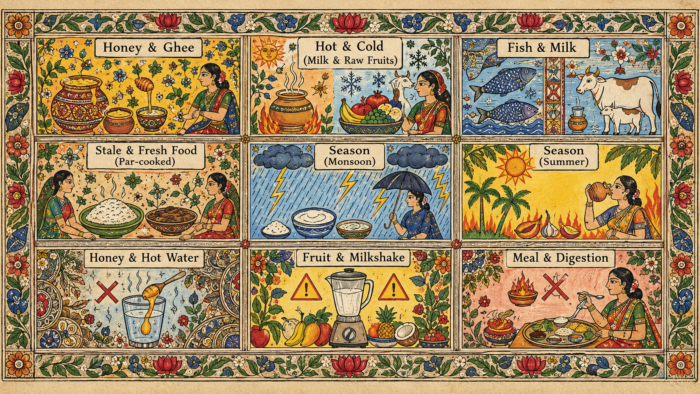
Dose incompatibility (mātrā viruddha) — Honey and ghee, both individually beneficial, become harmful if consumed in equal quantities. The rule of thumb: one should always be double the other.
मधुसर्पिः समधृतं मात्रया तद्विरुध्यते||९०||
madhusarpiḥ samadhṛtaṁ mātrayā tadvirudhyate
“Honey and ghee taken together in equal quantity is incompatible by dose.”
Processing incompatibility (saṁskāra viruddha) — Honey should never be heated, added to hot drinks, or consumed by someone who has just come in from the heat. Cooking changes its molecular character in ways that turn into toxins.
Order incompatibility (krama viruddha) — Even the sequence matters. Drinking hot water right after eating honey is considered a violation of proper order. And so, ice cold water after a meal.
Time incompatibility (kāla viruddha) — Raw salads during monsoon season, spicy food in peak summer, or cold foods in winter all work against what the season and body require.
Combination incompatibility (samyoga viruddha) — Some pairings are simply discordant, regardless of dose or timing: milk with horse gram or fish, citrus fruit salad with milk, jackfruit with fish.
Potency incompatibility (veerya viruddha) — This covers combinations where the fundamental energetic properties of two foods clash, like horse gram paired with water melon.
Contraindication incompatibility (parihar viruddha) — Drinking cold water immediately after a hot beverage falls into this category.
Everyday Habits That Slip Into Viruddha Territory
Ancient examples sound exotic — peacock meat roasted on a castor spit, specific birds fried in mustard oil. But modern eating has its own version of the same mistakes, and a few patterns show up again and again.
Around ghee, curd and honey specifically:
- Ghee in excess — thought to encourage arterial blockages when consumed without liquifying, or followed by cold water.
- Daily or nighttime curd consumption — particularly boiled curd, considered outright toxic. If you do eat curd, pairing it with black pepper, moong dal soup, or gooseberry pickle is recommended to offset its effects.
- Overconsuming honey — linked to constipation.
- Drinking too much water — strains the kidneys and can flush out essential nutrients.
Around combinations we reach for daily, often without noticing:
- Smoothies, milkshakes and fruit bowls. Milk combined with acidic fruit is a samyoga viruddha. The acid curdles the milk almost immediately, and what results is heavy, kapha-provoking, and hard on digestion. Some animal studies on the milk-and-banana combination specifically have found measurable shifts in liver enzyme levels with repeated exposure — worth taking seriously, though it’s one study, not a settled result.
- Milk and eggs together — a breakfast staple in the form of bread, cake and muffins — pairs two dense proteins that strain digestion when combined.
- Tea with milk. Tea’s flavonoids are good for the heart, but milk’s casein binds to them and blunts the benefit. Separately, tea’s mild anticoagulant properties combined with garlic’s anti-clotting effect can meaningfully raise bleeding risk.
- Warm honey water, marketed everywhere as a morning detox ritual, is exactly what the texts warn against. Honey is a mix of nectars from many different plants, each with its own taste, potency and post-digestive effect — heating it disrupts that composition rather than “activating” it.
None of these foods are “bad.” They’re simply powerful enough that misuse carries consequences.
The Cost of Getting It Wrong
Classical Ayurvedic texts don’t treat viruddha ahara as a minor digestive inconvenience. The Charaka Samhita links prolonged intake of incompatible food combinations to a strikingly long list of conditions — everything from skin diseases, anemia, and acid reflux to insanity, fistulas, edema, and even infertility. Some effects are described as immediate; others behave like a slow-acting toxin (gara visha), surfacing only after repeated exposure over time.
Why This Still Matters Today
Many of the specific incompatibilities described in classical Ayurvedic texts have faded from everyday practice — most people today have never heard of mātrā viruddha or krama viruddha. But the underlying principle is arguably more relevant than ever, in an age of smoothies that mix a dozen “superfoods” without a second thought.
Where the convergence gets interesting: the gut microbiome
2026 · IBS modeling study
Incompatible food combinations were associated with delayed gastric emptying, fermentation, and dysbiosis of the gut microbiota. Biochemical changes — including advanced glycation end-products and HMF formation — were linked to increased intestinal permeability, low-grade inflammation, and altered motility.
This suggests some viruddha ahara effects aren’t “poisoning” in a classical toxicology sense, but slow, cumulative gut-barrier and inflammation effects — closer to how modern medicine now understands many chronic digestive and metabolic diseases.
The sharper mechanism: generated toxicity, not blocked absorption
Everything above still frames viruddha ahara loosely, as if it worked like an antinutrient — one food’s chemistry blocking absorption of a nutrient from another. But the classical texts describe something more specific: incompatible combinations produce ama, undigested metabolic residue, and in severe cases ama viṣa or gara viṣa — a slow-acting poison generated when digestion fails to process a mixture cleanly.
Not “nutrient X gets blocked.” Rather: “the body can’t metabolize this combination, so it manufactures something toxic as a byproduct.” A meaningfully different claim — and the one place modern biochemistry offers the most direct confirmation.
mechanism · inflammation
Viruddha ahara triggers the eicosanoid pathway, raising prostaglandin-2 and thromboxane — a concrete inflammatory mechanism, offered as the biochemical basis for weakened digestive fire (agnimandya) and ama formation.
mechanism · reheated oil (HNE)
Reheating polyunsaturated oils — soybean, corn, sunflower — generates 4-hydroxy-trans-2-nonenal (HNE), a compound that barely exists in the original oil but forms through oxidation of linoleic acid under heat. HNE reacts with DNA, RNA, and proteins, and is linked to cardiovascular disease, stroke, liver disorders, and cancer. The oil in the bottle is fine; the oil reheated for frying is a different chemical entity. This is the clearest modern parallel to saṁskāra viruddha in the literature — processing itself creating the harm.
mechanism · combination-generated carcinogens
Areca nut, slaked lime, and catechu combined and chewed as gutkha – the mixture contains thousands of chemical constituents, of which roughly 40 are carcinogenic, and betel-quid combinations are formally classified as carcinogenic to humans. No single ingredient comes close to that risk alone — the combination itself generates the danger. An extreme case, but it validates the underlying viruddha logic in its purest form.
What Next?
Researchers reviewing this field keep landing on the same practical point: Ayurveda’s system for thinking about food — combination, processing, timing, dose, and individual constitution, considered together — is arguably more sophisticated than the single-nutrient thinking that still dominates popular nutrition advice. Modern science is good at isolating variables; it’s historically weaker at modeling how combinations, sequences, and context interact in a real meal, in a real body, over years. That’s precisely the gap viruddha ahara describes — and ama viṣa specifically turns out to be one of its more testable ideas: toxicity generated by process and combination, not present in any single ingredient.
Disclaimer: The opinions expressed in this article belong to the author. Indic Today is neither responsible nor liable for the accuracy, completeness, suitability, or validity of any information in the article.