
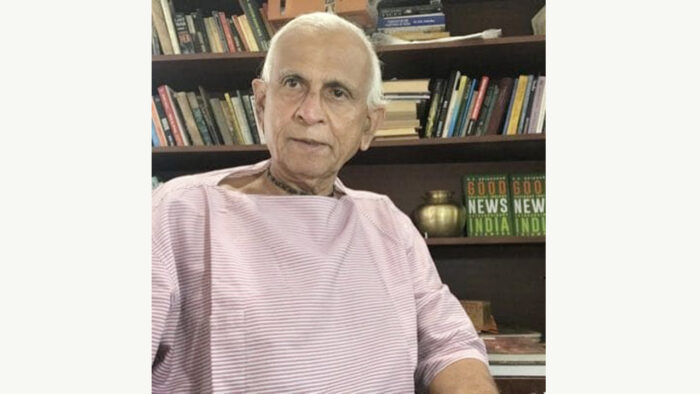
(A Tribute in Loving Memory of Shri D. V. Sridharan (1938–2025))
Today, on the sacred and deeply auspicious day of Gītā Jayanti, when Bhagavān Śrī Kṛṣṇa revealed the eternal message of Dharma to the world, Shri D. V. Sridharan left his mortal body in Chennai and journeyed onward. It feels profoundly symbolic that a man who lived with sincerity, introspection and devotion to Dharma should depart on a day so spiritually radiant. Perhaps the universe, in its quiet wisdom, chose this moment for a soul whose lifelong quest was for meaning, truth and inner stillness.
As I write this, not merely as the Chief Editor of IndicA Today, but as someone who loved, respected and was deeply influenced by him, my heart is heavy with grief, yet full of immense gratitude. It is rare to encounter a human being whose presence is gentle yet powerful, whose words soften the hardest of spaces and whose silence carries meaning. Shri Sridharan was one such rare soul.
DVS was a contributor to IndicA Today, an author, an environmentalist, a philanthropist, a listener, a friend, professionally a mariner, a storyteller and so many things to different people.
He began his career as a Marine Engineer in 1963, working at sea. It was a profession defined by solitude, endurance, discipline and long periods of silence with only one’s thoughts as company. Those long nights on the ocean, where horizons dissolve and one must confront oneself with courage, guided his inner world. Long before he became a writer, the sea taught him to listen – deeply, honestly, without escape.
His writing later emerged from that intimacy with silence and suffering, not from technique or polish. His words were carved from experiences that broke him and rebuilt him.
When we met the first time, he regaled me with his time in Mumbai as he studied to be a mariner at the Indian Maritime Institute. Even at age 74 when we met, his vivid description and memory was enthralling. But I quickly understood that this way with words was not a gift of effortless ease. It came from a life lived intensely.
A Voice Forged by Life, Not by Literary Craft
If today people marvel at the beauty, honesty and emotional power of Shri D. V. Sridharan’s writing, it is because his eloquence was not born from literary training or academic pursuit but in the crucible of life itself. His words were forged in loneliness, sharpened by suffering, softened by love and polished by the discipline of silence. He never wrote for applause. He wrote from places most people fear to enter, i.e., grief, vulnerability and honesty.
His writings were not imagined; they were lived. Not theories, but truth that stayed. Not ornament, but a light that never fades.
When he lost his mother at the age of five and later his beloved wife early into their married life, he faced emotions of grief, loneliness, despair and disorientation that could have drowned anyone. But he chose to walk through them instead of running away from them.
A Childhood Shaped by Heartbreak

To understand the depth of his words, one must begin with his first wound. He lost his mother when he was just five years old, a loss that altered the landscape of his life. In his quiet and heartbreaking recollection, he once wrote:
“About a week later, my Tamizh Sangam Road life ended. My Grandfather was taking me and my sister away to Madras, to give Father time to rebuild his life.I was said to have cried having to leave my Father, and Grandfather had calmed me saying we’d be riding the same train that carried away my Mother.”
From that moment onward, his life was sculpted by absence and longing, and yet he grew not hardened, but gentle. Not bitter, but compassionate. Not silent, but articulate in the language of emotional truth.
A Love Story Beyond Death

(A 45-year search for a village in a painting and the love that never left him.)
He lost his beloved wife Shaku early in their married life. It was a grief that left a wound time never erased. His tribute “Rendezvous at Marly-le-Roi” remains one of the most profoundly moving pieces of writing I have ever read – a love story written across decades, stitched with memory, art and longing.
In that piece, he narrates the 45-year search to identify her favourite Alfred Sisley village painting, ending with the triumphant exclamation:
“I pumped a fist in the air and like a fool yelled, ‘I got you, Shaku!’
When the time comes, I will rendezvous in minutes.”
Today, on Gītā-Jayanti, I believe he kept that promise.
A Born-Again Hindu, A Tireless Seeker of Dharma
Calling himself a “born-again Hindu,” he devoted his later life to learning Sanātana Dharma in its fullness, from Āgama Śāstra and temple architecture to cultural festivals, history, heritage, ecology, and living traditions. He supported Indic scholarship extensively and quietly, including:
- Smt. Jayalakshmi Narasimhan Endowment for Women Scholars
- Publication Grant for “Gems of Sankara”
- Many smaller grants to various organisations and projects of IndicA
His curiosity was unbounded; his sincerity, unwavering.
A Writer Who Carried the World in His Chest
His essays, including the deeply intimate “Dukh, Depression and Journeys of Life” and the reflective “Time Travel in Kerala” touched thousands.
He healed without prescribing. He guided without lecturing. He consoled without comforting words. Simply by showing that he had walked that path himself.
Good News India – His Testament of Hope
His landmark book Good News India: Ordinary Indians, Extraordinary Triumphs emerged from his refusal to accept despair as the only narrative about India. Reviewers have called it “a masterpiece of hope”, “a restoration of faith in humanity”, and “a reminder that India’s civilizational strength lives through its ordinary heroes.”
The book has been widely praised for its sincerity, warmth, accessible storytelling, and powerful humanism. Critics note that it does not glorify India sentimentally. It simply chronicles real people who build, restore, revive and serve. It is Gandhian in spirit, journalistic in discipline and profoundly dhārmic in philosophy.
Many readers have said that the book changed their understanding of India, teaching them that the extraordinary is often quiet, unseen and humble.
A Sacred Departure
That he left on the day when Kṛṣṇa spoke of eternal life feels beyond coincidence. As the Bhagavad Gītā (2.20) consoles us:
न जायते म्रियते वा कदाचित् |
नायं भूत्वा भविता वा न भूयः ||
अजो नित्यः शाश्वतोऽयं पुराणो |
न हन्यते हन्यमाने शरीरे ||
(The Self is never born, nor does it die. Eternal and ancient, It is not slain when the body is slain.)
A Personal Farewell

(Fortunate to have shared this moment with him)
To me personally, he was a wellspring of encouragement, affection and trust. During difficult phases, his messages would arrive like quiet blessings. He made us believe that the work of IndicA mattered, not just to the present moment, but to the civilizational future.

(At Kalady in 2018: A shared moment of warmth)
Today, IndicA has lost a guardian voice.
I have lost an elder.
But the light he kindled will not go out.
ॐ शान्तिः शान्तिः शान्तिः।।
धर्ममार्गे नित्यमेव दीपः प्रदीप्यताम्।
(May his ātmā travel in peace.
May his words continue to heal.
May his life continue to inspire.)
On behalf of the entire IndicA and IndicA Today family,
With love, reverence and tears.
Om Tat Sat.
Disclaimer: The opinions expressed in this article belong to the author. Indic Today is neither responsible nor liable for the accuracy, completeness, suitability, or validity of any information in the article.