
The Architectonics of Devotion: Re-reading the Tirumurai
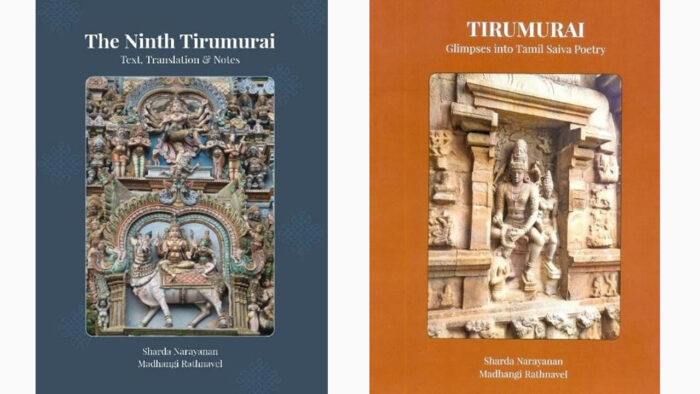
Most scholarly engagements with the Tirumurai dwell on its emotional fervour, celebrating it primarily as a literary and devotional outpouring of the Tamil bhakti movement. Dr. Sharda Narayanan and Madhangi Rathnavel, however, offer something far more consequential for the contemporary reader: a structural and analytical bridge that repositions the Tirumurai as an instrument of intellectual, social, and civilizational renewal.
Together, these two volumes amount to an analytical reconstruction of how the Shaiva tradition reclaimed its intellectual and cultural sovereignty through poetry, music, ritual, and lived experience.
Bhakti as Intellectual Insurgency
For centuries, Tamilagam was at a civilizational crossroads. By the mid-first millennium, the Vedic-Agamic traditions of the south were reeling under the influence of powerful monastic orders. Jainism and Buddhism, backed by royal patronage, had established an intellectual hegemony that favoured extreme asceticism and a move away from the life-affirming, householder-centric traditions of the soil. The story of how the Nayanmars (the 63 Shaiva saints) won back the Tamil heart is a tale of religious fervour; as well as a masterclass in “Conscious Management” and cultural strategy.
One of the most compelling contributions of “Glimpses into Tamil Saiva Poetry” lies in its sociological analysis, particularly in Chapters 3 and 4, where the authors examine the historical moment when Jain and Buddhist traditions dominated the terrain of logic, monastic discipline, and royal patronage.
Against this backdrop, the Nayanmars, especially Tirujnanasambandhar and Tirunavukkarasar (Appar), emerge as strategists. Appar’s return from Jainism to Shaivism is treated as a symbolic reclamation of the Tamil civilizational core.
The authors demonstrate how they shifted the battleground from scholastic abstraction to aesthetic and experiential realization, using: Pannisai (the raga-based musical system), Public debates, Temple-centred performance and collective participation.
Mapping a Sacred Geography
A particularly illuminating methodological move is the authors’ consistent linkage of hymns to their respective Sthala Puranams (temple histories). This reveals how the Nayanmars effectively mapped a sacred geography of Tamilagam, embedding theology into place and pilgrimage.
This temple-centric sacralisation functioned as a counterweight to the more decentralized monastic networks of the period, rooting Shaiva devotion firmly in public space, memory, and locality.
The Shastra in the Song
Perhaps the most significant scholarly intervention across the two volumes is the demonstration that the Tirumurai is not merely devotional poetry, but the primary source-text for later Shaiva Siddhanta Shastra.
Key highlights: Nataraja Tattvam (Chapter 1): A lucid unpacking of metaphysics encoded in iconography and hymn. Tirumantiram (Chapter 8): Shown as a philosophical bridge between poetic intuition and formal doctrine. The authors convincingly argue that complex Agamic concepts—Anava (ego), Karma, and Maya—were deliberately encoded in accessible Tamil lyricism, making philosophy participatory rather than elitist.
The Ninth Tirumurai and the Chola Synthesis
The second volume, The Ninth Tirumurai: Text, Translation & Notes, shifts the lens to the Chola period, a time of political consolidation and cultural confidence.
In Chapter 1, the authors trace what they call the “Chola Splendour,” marked by a measured infusion of Sanskrit vocabulary into Tamil devotional expression. Far from dilution, this linguistic synthesis enabled the Tamil Shaiva tradition to engage pan Indian intellectual currents while retaining its distinctive identity. The meticulous philological notes and transliteration further position this volume as both a scholarly reference and a pedagogical tool.
Technical Study of Pannisai
Moving beyond textual analysis, the authors explore the performative and musicological dimensions of the Tirumurai. Chapter 2 (Pannisai Tradition) offers a technical history of Tamil musical modes, highlighting that the Tirumurai was conceived as a multi-sensory experience engaging mind, body, and emotion. The inclusion of an online audio album is a notable innovation, allowing readers to experience the raga structures directly and reconnect text with vibration. In doing so, the books restore the Tirumurai to its original status as a living tradition.
The value of this two-volume work lies in its Notes, Glossary, and Appendices, which function as a much-needed decoder for a conceptual vocabulary long marginalized in mainstream Indian education. The authors reveal that the Tirumurai was never intended as a static scripture. It was a dynamic, melodic instrument, almost a civilizational technology, designed to preserve, transmit, and renew a way of life. As Jataayu (Sri Sankaranarayanan) rightly notes: “The Shiva temple corridors still reverberate with the music of Tirumurai—a timeless legacy and priceless heritage.”
The publication details for readers interested in accessing the books are as follows:
1. Tirumurai: Glimpses into Tamil Saiva Poetry
by Sharda Narayanan & Madhangi Rathnavel
published by Ambika Aksharavali, Chennai (2021) ISBN 978-81-930812-6-6
Pages: 384; Hardbound; Price: Rs 1400
2. The Ninth Tirumurai: Text, Translation & Notes
by Sharda Narayanan & Madhangi Rathnavel
published by Ambika Aksharavali, Chennai (2025)
ISBN 978-81-930812-3-5
Pages: 325; Hardbound; Price: Rs 1200
Disclaimer: The opinions expressed in this article belong to the author. Indic Today is neither responsible nor liable for the accuracy, completeness, suitability, or validity of any information in the article.