

The Self seeing the Self
“When the mind grows quiet, the one who knows becomes the only light left to see.”
Bhagavad Gītā Verse 6.20
यत्रोपरमते चित्तं निरुद्धं योगसेवया ।
यत्र चैवात्मनात्मानं पश्यन्नात्मनि तुष्यति ॥
yatrōparamatē cittaṁ niruddhaṁ yōgasēvayā |
yatra caivātmanātmānaṁ paśyannātmani tuṣyati ||
(When the mind becomes quiet and steady through the practice of meditation, one sees the Ātman (the eternal witnessing Self) by the Ātman (the eternal witnessing Self), and then rests in contentment in the Ātman (the eternal witnessing Self) alone.)
Prologue
Before we speak about meditation, let us stay with something simple. You are aware right now. You know you are reading these words. You can also notice that you know. This is a small shift. It feels quiet. It does not need effort. It is already here, like a gentle light in the background.
On most days, we use awareness like a tool. We use it to plan the day. We use it to decide what to do next. We use it to worry. We use it to compare. We use it to fix problems. We also use it to carry our roles. We keep checking what is missing. Yet awareness itself does not get damaged by these movements. Thoughts change. Feelings change. Awareness remains present through all of it.
That is why (BG 6.20) can feel close to the heart. It does not speak in heavy language. It points to a quiet return. It asks us to notice what is already near. It asks us to notice the one who is noticing. If we begin from here, the reflection becomes about recognition. It becomes about noticing what was always present.
So before we enter the first section, keep one simple curiosity alive. What is it that knows your experience right now. Experiences keep changing. Still something knows them. Let that question stay with you as we step into the verse.
Introduction: When the Light Turns Toward Itself
Imagine a lamp in a quiet room. It lights the floor, the walls, the faces, and the small details you forgot were there. You can see everything because of it. Now sit with a simple question. Can the lamp see its own light. Not as a reflection in a mirror. Not as a picture. Just the light knowing its own shining.
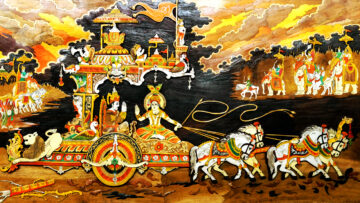
In a gentle way, Bhagavad Gītā verse (BG 6.20) points to something like this. Śhrī Kṛiṣhṇa describes a moment in Dhyān Yog (the Yog of meditation) where citta (mind) becomes restrained through yog-sevā (steady practice of meditation). Then something remarkable is said. One sees the Ātman (the eternal witnessing Self) by the Ātman (the eternal witnessing Self), and then rests in contentment within the Ātman itself. It is a short line. Still it carries depth.
Most of our seeing moves outward. Even when we say we are “looking within,” we often look at thoughts, feelings, and images as if they are objects on an inner screen. That can bring real clarity. Yet the verse hints at a deeper intimacy. It points to the one who knows the inner screen. It points to awareness itself.
So the central inquiry of this reflection is simple to say. When awareness turns back upon itself, what happens to the seer and the seen. In daily life, the seer feels like “me,” and the seen feels like “that.” In meditation, that habit can soften. The verse seems to describe a moment where the usual split does not hold the same way.
I want to explore this verse as a lived inner movement. I do not want to treat it as a puzzle for the intellect. The Gītā is speaking to Arjun as a living seeker in the middle of real inner struggle. Chapter 6 is offering a path of steadiness through practice. This verse is one description of where that steadiness can lead.
As we move forward, we will first place verse (BG 6.20) in its chapter flow. Then we will stay close to the language of the verse itself. That will help the question ripen in a grounded way, without strain.
Context from the Gītā: The Flow of Dhyān Yog Into Stillness
In Chapter 6, Śhrī Kṛiṣhṇa is guiding Arjun toward Dhyān Yog (the Yog of meditation). He is not starting with a sudden mystical idea. He is building a way of life that supports a steady mind. The chapter speaks about practice, self-discipline, and a mind that learns to settle. You can feel a slow movement through these verses. The teaching keeps returning to one point. The mind can become calm. It can become steady. It can learn to stay.
By the time we reach (BG 6.20), the chapter has already been pointing toward this inner stillness. Earlier, Śhrī Kṛiṣhṇa speaks about steadiness in practice, settling the mind little by little through buddhi (intellect), and bringing attention back again and again (BG 6.19, BG 6.25 & BG 6.26). He also speaks about the yogī (one who strives in discipline) who becomes free from disturbance and rests in inner peace (BG 6.15). So verse (BG 6.20) is not an isolated line. It is describing what can happen when the practice becomes mature.
The verse shows a clear inner sequence. First, citta (mind) becomes restrained through yog-sevā (steady practice of meditation). Then comes something deeper. One sees the Ātman (the eternal witnessing Self) by the Ātman (the eternal witnessing Self). Then comes the result. One rests in contentment within that Ātman (the eternal witnessing Self). This is a movement from settling, to seeing, to resting.
Now we should ask what “restrained” means here. It does not mean forcing the mind into silence. It does not mean crushing thoughts. It means the mind is no longer running in every direction. It is gathered. It can stay with one point. It can hold attention without slipping away again and again. When the mind is gathered, it becomes less noisy. It becomes more transparent. It becomes capable of a quieter kind of knowing.
This is also why the verse uses such a tender language. It does not describe effort at that stage. It describes recognition and rest. When the mind is prepared through steady practice, something can be noticed that was always present. That “noticing” is what the verse hints at as seeing the Self by the Self.
Teaching move in one line: Chapter 6 prepares the mind through steady practice, and verse (BG 6.20) describes the moment when that steadiness ripens into direct inner recognition and quiet contentment.
In the next section, we will slow down and stay close to the exact phrasing of the verse. That is where the key meaning begins to open in a simple way.
What the Verse Actually Says: Seeing Ātman (the eternal witnessing Self) by Ātman (the eternal witnessing Self)
Let us take verse (BG 6.20) slowly, as if we are holding it in the palm of the hand. The verse speaks of a person whose citta (mind) has become restrained through yog-sevā (steady practice of meditation). Then it says something that sounds unusual. One sees the Ātman (the eternal witnessing Self) by the Ātman (the eternal witnessing Self). Then one rests in joy in that Ātman (the eternal witnessing Self) itself.
This line can feel confusing at first, because our everyday way of knowing is based on objects. We see a cup because our eyes take its shape. We know a thought because it appears in the mind. We know a feeling because it rises in the heart. In all these cases, there is a clear “thing” that is known. So when we hear “see the Self,” we may imagine the Self is another inner object, like a hidden picture inside us. Many seekers carry this expectation without noticing it.
Yet the Ātman (the eternal witnessing Self) is not presented as an object in the Gītā. It is the knower. It is the one that is present while thoughts come and go. It is present while feelings rise and fall. It is present while the body changes. It is present in waking, dream, and deep sleep. In simple words, it is the fact that you are aware. It is the “knowing presence” in which all experience appears.
So how can it be “seen”? Traditional commentaries read ātmanā ātmānam paśyan as the Self revealing the Self, and not the mind turning the Self into an object. This simply means awareness is self-evident. This is where the verse becomes very precise. It does not say, “the mind sees the Self.” It says, “the Self sees the Self”. The seeing here is not like looking at a thing. It is not like the intellect forming an idea. It is not like the mind creating a picture. It is a quieter kind of knowing. It is awareness recognizing awareness.
You may have tasted a small hint of this in daily life. Sometimes you pause and notice, “I am aware.” In that moment, you are not looking at an object. You are noticing the fact of knowing itself. It is subtle. It feels simple. It does not require a story. That is closer to what this verse is pointing to.
Now the language sounds circular. “Seeing the Self by the Self” can sound like a loop. Yet this loop matters. It protects us from a common misunderstanding. It tells us not to search for the Self as a special object inside the mind. It tells us the Self is already the light by which everything is known. So the “seeing” is really a recognition. It is like a light noticing its own shining.
When the mind becomes quiet and gathered, it stops pulling attention outward all the time. It also stops turning every inner event into a problem to solve. In that settled space, awareness is not hidden by constant movement. It becomes easier to notice what has always been present. That noticing is not a new object. It is a clear recognition of the one who knows.
That is why the verse ends with contentment. When awareness recognizes itself, the inner chase softens. The sense of needing to become whole loosens. One rests in the Ātman (the eternal witnessing Self) as one rests in a natural home.
In the next section, we will look at the everyday split we live from, the sense of seer and seen. This will help the verse feel even more real in ordinary life.
Seer and Seen in Ordinary Life: The Hidden Split We Live From
In daily life, we live with a simple structure in the background. There is “me,” the one who sees. Then there is “that,” the thing seen. It feels so normal that we rarely notice it. You look at a person and you think, “I see them.” You look at a task and you think, “I have to handle that.” You look at a problem and you think, “I must solve it.” The seer feels like the one inside, and the world feels like what stands in front.
This split does not stop when we turn inward. It often continues in a quieter way. A thought comes and we say, “I am thinking.” A worry comes and we say, “I am worried.” An old memory rises and we say, “I remember.” Even when we practice observing the mind, the structure can remain. We say, “I am watching this thought.” We say, “I am noticing this feeling.” This is useful. It creates space. It reduces blind reaction. It helps us become less lost in the mind.
Still, there is a subtle distance in it. The watcher feels separate from what is watched. The watcher feels like a person sitting inside the head, looking at the inner screen. And the watched feels like a stream of changing things, thoughts, feelings, images, body sensations.
You can see this pattern in simple moments. You are in a meeting and a sharp comment is made. A wave of heat rises in the body. The mind quickly produces a reply. Inside, there is a strong feeling, “I am the one who was attacked.” Here, the “I” is the seer, and the comment is the seen. In another moment, you open your phone and see a message. The mind creates a story in two seconds. “They ignored me.” “They are unhappy.” Again, there is “me” as the one who knows, and “that” as the thing known. Or think of a moment when you are praised. Someone says you did well. A warm lift happens inside. The mind starts replaying it. It starts building a picture of “me who is valued.” Here too, the seer feels like “me,” and the seen becomes the praise, the image, and the story that follows.
Even during meditation, the same structure can show up. You sit, you observe the breath, and then you observe thoughts. You may feel proud when the mind becomes quiet. You may feel disappointed when it wanders. Both reactions assume an “I” who is managing a mind, almost like a person holding a leash. This is how the inner split quietly stays alive.
Now verse (BG 6.20) is pointing to a deeper step. It is pointing beyond observing thoughts and feelings. It is pointing toward noticing the seer itself. That is a different kind of turn. It is not “I watch the mind.” It is more like, “What is this I that claims to watch.”
So a gentle question begins to form. If thoughts and feelings are seen, then who is the one that sees them. And if we try to notice that seer, what exactly changes in this whole structure of seer and seen.
In the next section, we will look at how this turn can happen in meditation in a very quiet, ordinary way.
Awareness Turning Back Upon Itself: The Quiet Shift in Meditation
Let us speak about this shift in a simple way. It does not need to feel dramatic. It can happen in a small and ordinary sitting. You sit down. You close your eyes. You begin with the breath. You notice air moving in and out. The mind wanders. You bring it back. You do this again and again. This is already part of yog-sevā (steady practice of meditation). Over time, the mind becomes less jumpy. It becomes a little more willing to stay.
At first, meditation often feels like watching objects inside. You watch the breath. You watch thoughts. You watch feelings. You may even watch silence. This is useful. It builds steadiness. It builds patience. It builds a kind of inner honesty. You begin to see how much the mind moves without your permission. You begin to see how stories form quickly. You begin to see how the body holds tension.
Then something subtle can happen. A thought appears, and you notice it without chasing it. You do not push it away. You simply know it is there. The same happens with a feeling. It rises, stays for a moment, and fades. And you are present through all of that. You are not absent when the thought comes. You are not absent when it goes. This simple presence is easy to miss, because it feels too plain.
Now comes the gentle turn. Instead of staying only with the thought, you also notice the knowing of the thought. Not the words of the thought, but the fact that it is known. You may notice the breath, and then notice that the breath is known. You may notice a sound outside, and then notice that the sound is known. In that moment, attention shifts from the object to the knowing itself.
This is where the Self is often misunderstood. This is not blankness. This is not trance. This is not a special vision. It is a simple noticing of the fact that knowing is already present. Many people expect the Ātman (the eternal witnessing Self) to appear as a special inner thing. They may expect a bright light, a vision, a powerful emotion, or a deep trance. Those experiences can happen to some people. Yet the verse is not telling you to hunt for a special object. The Ātman (the eternal witnessing Self) is the one that knows experiences. It is the knowing presence itself. So it cannot be found as one more thing inside the mind. It is not a thought. It is not a feeling. It is not an image. It is not a mood.
So how is it known. In the spirit of verse (BG 6.20), it is known by being itself. Knowing is present, and then knowing notices itself as knowing. It is like noticing the fact of awareness without needing a picture of it. It can feel like a quiet shift from “I am watching the mind” to “I am aware.” Then even the sentence “I am aware” may soften, and only awareness remains.
This can last for a few seconds. Then the mind comes back with a comment. “This is good.” “This is not it.” “I am doing it right.” “I lost it.” This gentle return from commentary to the practice is exactly what Śhrī Kṛiṣhṇa describes, again and again, as the way the mind is brought back under control. That is normal. The point is not to hold the moment. The point is to recognize what the moment reveals. Awareness was present before the comment. Awareness was present during the comment. Awareness remains after the comment.
This is the quiet shift. It does not demand force. It asks for gentle attention. It asks you to notice the knower, not only the known. And slowly, the split between seer and seen begins to feel less tight.
In the next section, we will speak about why the verse says contentment arises here. We will stay with tuṣyati (rests in contentment) and make it feel real in human terms.
Why Joy Arises: Tuṣyati (rests in contentment) as a Natural Ease
In (BG 6.20), the verse ends with a simple word that matters. Tuṣyati (rests in contentment). It does not say the person becomes excited. It does not say the person gets a high. It points to a steady ease. It points to a quiet satisfaction that does not need noise. Tuṣyati (rests in contentment) is felt as no inner pushing for a moment.
This helps us understand the kind of joy being described. In daily life, a lot of our happiness comes from getting something. A message comes and we feel seen. A plan works and we feel safe. A problem gets solved and we feel relief. These joys are real. Still they rise and fall. They depend on events, people, and outcomes. The mind keeps looking for the next thing that will make it feel complete.
The verse points to another kind of ease. When awareness recognizes itself, the inner chase softens. For a moment, you do not feel pushed to improve the moment. You do not feel pushed to hold a pleasant feeling. You do not feel pushed to escape an unpleasant feeling. There is a quiet sense that nothing is missing right now. That is why the verse uses tuṣyati (rests in contentment).
You may have felt small hints of this in ordinary life. You finish a long day and sit quietly without any screen. For a few seconds, you feel no demand inside. Or you watch the sky at dusk and the mind stops asking for more. Or you breathe out after a tense call and feel a simple settling. These moments are not dramatic. Still they carry a taste of wholeness.
In meditation, a similar ease can arise in a deeper way. The Gītā later describes this joy as an inner happiness that is known beyond the senses and held with steadiness, in the verses that follow (BG 6.21–6.23). When you are no longer chasing thoughts, and you are no longer chasing special experiences, there can be a quiet resting in presence itself. The verse calls this resting in the Ātman (the eternal witnessing Self). It is not resting in a mood. It is not resting in a vision. It is resting in the fact of awareness, the simple knowing that is already there.
This is why the joy feels steady. It is not built from sense contact. It is not borrowed from an outer situation. It comes from a pause in the inner need to become complete. In that pause, contentment feels natural.
In the next section, we will bring this into a practical approach. We will speak about yog-sevā (steady practice of meditation) and how patient returning can support this quiet recognition in real life.
Practice Approach: Yog-sevā (steady practice of meditation) as Patient Returning
Many readers hear verse (BG 6.20) and feel it is beyond them. “Seeing the Ātman (the eternal witnessing Self) by the Ātman (the eternal witnessing Self)” can sound like something meant for saints. Yet the verse begins with something simple and human. Yog-sevā (steady practice of meditation). It is not about one perfect sitting. It is about returning again and again with sincerity.
Keep it consistent. Sit at the same time, in the same place, for a short duration, so the mind learns the rhythm without strain.
Let us keep the practice very simple. Choose a time that you can keep most days. Ten minutes is enough to begin. Sit in a way that feels stable. Keep the spine natural. Let the shoulders drop. Let the face soften. Then choose one gentle anchor. Breath is the easiest. Feel the breath at the nostrils or the chest. Do not force it. Just feel it.
For the first two minutes, stay only with the breath. The mind will wander. That is normal. Each time you notice it has wandered, return to the breath. Do not make this return heavy. Let it be simple. This is already the heart of yog-sevā (steady practice of meditation). It is patient returning.
For the next five minutes, you keep the breath as home base. Thoughts will still come. Feelings will still come. You are not fighting them. You are learning to see them as passing events. Then you add one gentle step. You begin to notice not only what appears, but that it is known. This is the beginning of the “turning back” that verse (BG 6.20) points to.
Here are three small doorway moments you can watch for. They may last only a few seconds. That is enough. Do not try to hold them. Notice them and let them pass.
- You notice a thought, and you also notice the knowing of it. A thought appears. Maybe it is a plan. Maybe it is a memory. First, you simply acknowledge, “a thought is here.” Then ask softly, “this thought is known, by what.” Do not answer with words. Just rest for a second in the fact that the thought is known. This shifts attention from the content to the knowing.
- You let an emotion pass, and you sense the awareness that held it. A feeling rises, maybe irritation, sadness, or restlessness. Instead of naming it too much, feel it in the body. Where is it. In the throat. In the chest. In the belly. Let it be there. Keep breathing. Then notice something quiet. The emotion is moving, but something is aware of the movement. That aware presence does not need to fix the emotion. It simply holds it. Stay with that for a second.
- You rest with the breath until technique softens and presence remains for a few seconds. Some days, the breath becomes smooth and attention becomes soft. For a moment, you may feel that you are not “doing” meditation. You are simply here. The breath continues on its own. Knowing is present without effort. When this happens, do not grab it. Do not comment. Let it be simple. This is a small taste of resting in presence, which the verse describes as resting in Ātman (the eternal witnessing Self).
After ten minutes, end in a quiet way. Open the eyes slowly. Before you stand up, notice one thing. Awareness is still here. It was here at the start. It is here now. This helps the practice move into daily life.
One common mistake to avoid is expecting a special experience. The mind may look for a bright sign that “something spiritual happened.” That expectation creates pressure. It also pulls attention back into chasing. In this practice, the sign is simpler. You returned. You noticed. You rested for a few seconds in knowing itself. That is enough for today.
In the next section, we will take a short look through the lens of brain research. It will help explain why attention steadiness and self-story quieting can make this kind of recognition feel more accessible.
Brain Research Perspective: Attention, Self-Model, and Quiet Recognition
When you practice steady attention, your brain starts supporting that steadiness in a practical way. The prefrontal cortex (the brain’s manager for planning, focus, and self-control) plays a role in keeping attention on one chosen anchor, like the breath (Tang et al., 2015). This matters because a wandering mind often pulls you into small stories. You start planning. You start replaying. You start worrying. Practice trains the ability to notice wandering sooner and return with less drama.
Many researchers speak about the default mode network (the brain’s self-story and daydream network). This network becomes active when the mind is busy with “me and my life.” It can be helpful for reflection, and it can also keep self-talk running all day. During meditation practice, this self-story activity can reduce for many people (Brewer et al., 2011). When this quiets, inner space can feel more open and simple.
A key hub in that self-story system is the posterior cingulate cortex, or PCC (the back hub that monitors the self-story and mind wandering). When the PCC stays active, attention can slide into inner narrative without you noticing it. In some meditation studies, changes in PCC activity have been linked with shifts in self-referential thinking (Brewer et al., 2011). This is one reason a person may feel less “stuck inside” their commentary during practice.
Another helpful player is the insula (the brain’s body-awareness and early tension meter). When you keep attention connected to the body, you get earlier signals of stress, tightening, and restlessness (Tang et al., 2015). This makes it easier to return to the breath before thought-streams grow loud.
Research suggests association, not a guarantee for every person. Here is the simple insight that matches the feel of (BG 6.20). As self-story quiets, awareness can feel more like simple knowing than a personal narrator. This can make “turning back” feel natural, even for a beginner. From here, we can bring the same gentle recognition into ordinary moments during the day.
Source:
- Brewer, J. A., Worhunsky, P. D., Gray, J. R., Tang, Y.-Y., Weber, J., & Kober, H. (2011). Meditation experience is associated with differences in default mode network activity and connectivity. Proceedings of the National Academy of Sciences, 108(50), 20254–20259.
- Tang, Y.-Y., Hölzel, B. K., & Posner, M. I. (2015). The neuroscience of mindfulness meditation. Nature Reviews Neuroscience, 16(4), 213–225.
Application in Life’s Context: Bringing “Seeing the Seer” Into Ordinary Moments
Meditation is not meant to stay on the cushion. It is meant to touch life in small ways. Not as a rule. Not as a performance. It touches life as a softer way of meeting what is already here. Verse (BG 6.20) describes a mind that becomes steady through yog-sevā (steady practice of meditation), and then a quiet recognition arises. In daily life, we may not sit long enough for deep stillness. Still we can learn to bring a small part of that recognition into ordinary moments. Some days you will remember the pause only after the reaction, and that is still part of learning. This is where the teaching becomes friendly. It becomes practical.
Start with work life, because work brings speed and pressure. Picture a moment when a message arrives that feels sharp. You can feel urgency rise in the body. The mind wants to reply fast. Before typing, take one slow breath. Feel the feet on the floor. Then notice something simple. Urgency is known. That knowing is present even as the urgency moves. You do not have to fight urgency. You only have to notice that it is seen. In that pause, the reply often becomes cleaner. The tone becomes less reactive. You may still say what must be said. The difference is that you are not carried by the inner rush.
Now take relationships. A loved one says something, and a surge rises. It could be hurt. It could be anger. It could be fear of being misunderstood. Most people speak from the surge. Words come fast. Later there is regret. Here, try a small shift. Feel the surge for one second without speaking. Notice where it sits in the body. Then notice the awareness that holds it. The surge is changing. The holding awareness is steady. This does not remove emotion. It gives emotion a safe space. From that space, you can choose words with more care. You can also listen better. Listening becomes easier when you are not fully fused with the inner wave.
Now look at money and decisions. Money often brings a push to act quickly. A sale appears. A fear appears. A comparison appears. The mind says, “Buy now.” Or it says, “Save now.” Or it says, “Prove yourself.” In such moments, pause for a breath. Notice the push. Notice the story attached to it. Then notice that the push is known. That knowing can wait. It can hold the moment without rushing. This small waiting does not make you passive. It makes you clear. Decisions made after a short pause usually have less regret.
Now include your spiritual practice itself. Many people treat practice like a project. They want a result fast. They compare their sitting with someone else’s. They judge themselves when the mind wanders. Yet verse (BG 6.20) begins with yog-sevā (steady practice of meditation). Steady means simple repetition. It means showing up again. It means allowing the mind to learn slowly. If one day is restless, that day is also part of practice. The sincerity is what matters.
You can carry one simple line through the day. “This is known.” A thought is known. A feeling is known. A push is known. Then ask, very softly, “By what is it known.” Do not force an answer. Let it be a gentle turning. Over time, this makes the seer feel less like a tense manager and more like a quiet presence.
This prepares the ground for integration. When you live this way, even for a few moments each day, the split between seer and seen loosens a little. In the next section, we will gather the whole arc of the article and hold verse (BG 6.20) as a doorway you can return to again and again.
Integration: When the Split Softens, Presence Remains
Let us gather the whole movement of this reflection in a simple way. Chapter 6 asks for steady practice. It speaks about returning again and again, and letting the mind learn calmness through repetition. This is the base of yog-sevā (steady practice of meditation). When practice continues, the mind becomes more gathered. It stops running after every thought. It stops treating every feeling as a command. It begins to stay.
From that gathered mind, verse (BG 6.20) points to a quiet step. Awareness recognizes itself. The verse says one sees the Ātman (the eternal witnessing Self) by the Ātman (the eternal witnessing Self). This is not the mind catching a new object. It is the knower noticing itself as the knower. It is a simple recognition. It can arrive for a few seconds. It can arrive without warning. It can also arrive in very ordinary moments, when the mind becomes quiet and stops chasing.
Then the verse speaks of the result. Tuṣyati (rests in contentment). Contentment here is not excitement. It is an ease that appears when the inner chase softens. When awareness rests in itself, the feeling of lack loosens for a moment. That is why the verse ends in rest.
Still, it is important to keep the key inquiry alive. This is not something we “finish” by reading a page. The verse gives a question that ripens with time. When awareness turns back upon itself, what happens to the seer and the seen. When this question stays alive, it keeps the mind honest. It keeps the heart open. It keeps practice simple.
Awareness stays present in every moment. It is present when the mind is calm. It is present when the mind is busy. This is what makes verse (BG 6.20) a doorway. It points to what is already here, not to something you have to manufacture.
So keep one simple image now. Awareness is like the quiet background knowing. It does not need to prove itself. It does not need to become an experience. It is the steady fact that every experience is known. When you remember this in small daily moments, the split between seer and seen softens on its own, and presence feels more natural.
In the final section, we will close with two questions and leave them with you as a quiet background curiosity you can return to.
Conclusion: Resting Where the Search Ends
Verse (BG 6.20) speaks in a quiet voice. It speaks about yog-sevā (steady practice of meditation), and a mind that learns to settle. It speaks about a simple recognition, where the Ātman (the eternal witnessing Self) is seen by the Ātman (the eternal witnessing Self). It speaks about tuṣyati (rests in contentment). This is not a promise of quick results. It is a gentle invitation to sincerity, patience, and steady returning.
Let this reflection stay simple for you. Do not turn it into a goal. Let the question ripen slowly through small moments of honesty. You sit, you notice, you return. The verse then becomes a doorway you carry in daily life, not a peak you chase.
Before you close this page, pause for a few seconds and ask yourself two real questions.
- When you say, “I am aware,” what is this “I” right now.
- Can awareness be known as an object, or does it reveal itself by being itself.
Do not rush these questions. Let them stay with you in a simple way, and let the answer grow in quiet background knowing.
Key Terms
Here are the key terms glossary in alphabetical order
- Ātman (the eternal witnessing Self): The inner presence that knows all thoughts, feelings, and perceptions. It is the steady knower that verse (BG 6.20) points to.
- Attention: The mind’s ability to stay with one chosen focus, like breath or sound. In practice, attention becomes steadier through repetition and gentle returning.
- Awareness: Simple knowing that is present before any thought labels experience. In this article, it points to the direct knowing that notices even the sense of “I.”
- Breath anchor: Using the felt sense of breathing as a steady reference point. It helps settle citta (mind) and supports calm returning during meditation.
- Citta (mind): The inner field where thoughts, memories, emotions, and impressions rise and fall. In verse (BG 6.20), it becomes restrained through yog-sevā (steady practice of meditation).
- Contentment (tuṣyati): A steady ease that does not depend on events going a certain way. In verse (BG 6.20), it is the resting that follows inner recognition.
- Default mode network (the brain’s self-story and daydream network): A brain system linked with self-focused thinking, replaying, and inner narration. Meditation practice can reduce its pull for some people, creating more inner space.
- Dhyān Yog (the Yog of meditation): The discipline of meditation taught in Chapter 6. It emphasizes steadiness, self-mastery, and a mind that can rest in stillness.
- Insula (the brain’s body-awareness and early tension meter): A region linked with sensing the body’s inner signals, like tightness or calm. Body awareness supports steadier attention and earlier noticing of stress.
- Mind wandering: The natural drift of attention into thoughts, memories, and planning. The practice is to notice wandering and return, without frustration.
- Posterior cingulate cortex, or PCC (the back hub that monitors the self-story and mind wandering): A brain region linked with drifting into inner narrative. Changes in its activity are often discussed in meditation research.
- Prefrontal cortex (the brain’s manager for planning, focus, and self-control): A region linked with keeping attention steady and supporting self-control. It helps with returning to the chosen anchor when the mind slips away.
- Self-model: The mind’s built-in sense of “me,” shaped by memory, roles, and inner narration. In this article, it is the felt “seer” that can be noticed and softened.
- Seer and seen: The everyday structure of experience where “I” feels like the knower and everything else feels like the known. The article explores what shifts when the seer itself is noticed.
- Yog-sevā (steady practice of meditation): Patient, repeated practice that trains the mind to settle. In verse (BG 6.20), it is the foundation for restraint of citta (mind) and inner recognition.
Further Reading
For deeper insight into the themes explored in “When Awareness Becomes Its Own Seeing: Reflection on (BG 6.20)”
- Swami Dayananda Saraswati. (2007). Bhagavad Gita Home Study Course (Volumes on Chapter 6). Arsha Vidya Gurukulam. Clear verse-by-verse teaching that helps a reader stay steady with what the Gītā is pointing to in Dhyān Yog (the Yog of meditation), especially the inner meaning of stillness and self-knowledge.
- Swami Chinmayananda. (1996). The Holy Geeta. Chinmaya Mission Trust. A practical commentary that keeps the chapter flow alive and helps readers understand meditation as a lived discipline, not as an abstract idea.
- Swami Sivananda. (1995). Bhagavad Gita. The Divine Life Society. A direct, devotional, and practice-friendly explanation, useful for first-time readers who want simple steps for meditation and mind training from Chapter 6.
- Tang, Y.-Y., Hölzel, B. K., & Posner, M. I. (2015). The neuroscience of mindfulness meditation. Nature Reviews Neuroscience, 16(4), 213–225. A short and readable research review on how meditation practice relates to attention, self-regulation, and brain networks, which aligns with the article’s “quiet recognition” theme.
- Brewer, J. A. (2017). The Craving Mind: From Cigarettes to Smartphones to Love, Why We Get Hooked and How We Can Break Bad Habits. Yale University Press. A clear explanation of how self-story loops and habit loops run in the mind, and how simple awareness practices can reduce automatic pull, which supports the idea of pausing and noticing the knower in daily life.
(Note on Sources: This article draws primarily on the Bhagavad Gītā, with special focus on Chapter 6, where Śhrī Kṛiṣhṇa teaches Dhyān Yog (the Yog of meditation). Key references include (BG 6.10–6.15) on preparing a steady practice, (BG 6.19) on the steadiness of a settled mind, (BG 6.20) on seeing Ātman (the eternal witnessing Self) by Ātman (the eternal witnessing Self) and resting in contentment, and (BG 6.26) on gently bringing attention back when it wanders. Together, these verses frame the article’s theme of practice ripening into quiet recognition and inner ease.
The scriptural reflections are placed within a Vedānta (end of the Vedas) study spirit that values direct listening, careful reflection, and steady contemplation. The traditional steps of śravaṇa (listening), manana (reflection), and nididhyāsana (steady contemplation) form a background approach for reading (BG 6.20) as lived guidance. Standard English translations were consulted for clarity and consistency of meaning across key Sanskrit terms used in this reflection.
The brain research perspective integrates peer-reviewed studies that explore attention training, self-referential thinking, and meditation-related changes in brain networks. These studies help explain, in everyday language, how steady practice can reduce mind wandering and soften the grip of inner narration, which supports the article’s practical emphasis on “seeing the seer” in ordinary moments.
These sources support the article’s aim of keeping the teaching both faithful to the verse and friendly to a first-time reader, while offering a light scientific lens for how attention and self-story can soften through steady practice.)
Disclaimer: The opinions expressed in this article belong to the author. Indic Today is neither responsible nor liable for the accuracy, completeness, suitability, or validity of any information in the article.