
The Śāstras are often viewed simply as religious texts, but their scope extends far beyond rituals and worship. They offer a wider body of knowledge that touches upon life, society, human conduct and more. The stories in our texts do not just convey morals but also record a huge part of our itihāsas. In earlier times, formal histories were not recorded on paper, which came into use much later. Other writing materials, such as palm leaves (tāla-patra), birch bark (bhojapatra), and copper plates, were available, but they did not always offer the durability or convenience needed for preserving extensive bodies of knowledge. Yet the human desire to remember and transmit the past has always existed. In the Indian tradition, this was sustained through guru-paramparā: the Guru recited verses from memory, while disciples listened, memorised them word for word, and learned their meaning. In this way, knowledge and accounts of the past were preserved and passed from one generation to the next.
This is one of the primary reasons why Dharmic timelines and European timelines don’t match. But just because of a lack of current proof and unmatched timelines with European standards, it does not mean that we can completely discard these Shastras. We should rather be thankful to them for preserving such a huge part of our history and culture. As it is famously said, “Absence of evidence should not be considered evidence of absence.” Now, let us take a closer look at the story mentioned in Vālmiki Rāmayan, Bāla Kāṇḍa Sarga 51-56.
The scene was such, Lord Rāma with his brother Lakshman and Viśvāmitra had arrived at Mithilā where they were greeted by Janaka. As they sat near the sacred fire place Shatānandā, the chief priest of Janaka starts narrating a story about Viśvāmitra to Lord Rama, which revealed much about his past.
Viśvāmitra was a mighty ruler, unparalleled in both might and wealth. Once he went on an expedition with his grand ‘Akṣauhiṇī Sena’ (The army unit called akṣauhiṇī consists of 21,870 elephants, as many chariots, 65,610 cavalry and 1,09,350 foot soldiers). While travelling, he stumbled upon the ashrama of Rishi Vasiṣṭha. Vasiṣṭha with all due honorifics welcomed Vishvāmitra into his ashrama which was full of ascetic sages who had renounced material life and possessions.
Vālmīki explains it as ‘second Brahma Loka’ in its essence. Viśvāmitra enters and, from his conduct, appears to hold Vasiṣṭha in high regard, or at least that is how it seems. They sit and talk. Vasiṣṭha asks him if he has defeated all his foes and was his populace happy under his rule, to which Viśvāmitra replies with ‘yes’ each time. Desiring to extend his hospitality, Vasiṣṭha offered to feed him and his entire army before they left. Viśvāmitra wondered,“How could such an ordinary sage, whose āśrama members live on roots and fruits, possibly feed my entire army of lakhs?” Viśvāmitra tried to avoid such inconvenience by stating that Vasiṣṭha’s presence alone had fulfilled all obligations, but Vasiṣṭha insisted on his demand.
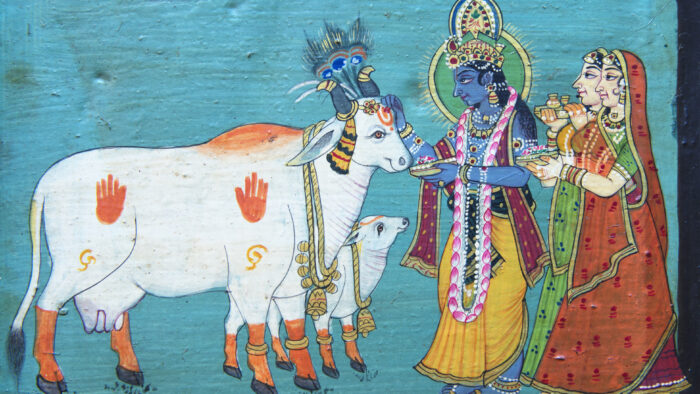
He then brought forward “Kāmadhenu” also called “Śabala”. Texts treat it as a divine cow that could make things appear out of thin air and fulfill wishes. But is it right for us to consider Śabala as just a divine wish-fulfilling cow? Let’s say that Śabala in this case is a valuable economic resource that Vasiṣṭha possesses and Viśvāmitra does not.
Vasiṣṭha then pleads Śabala, “Oh, Kāmadhenu, the Divine Cow, the Milker of All-Desires, for my sake shower whatsoever foodstuff is savoured by whosoever according to one’s own piquancy from each of the six savour, that too plentifully”. Viśvāmitra saw with sheer admiration how Śabala fed the Akṣauhiṇī Sena. For the first time, Viśvāmitra felt as if he lacked something.
And he did what anyone would suspect. He requested Vasiṣṭha to sell Śabala to him. In return, he made many grand offers, such as:
“Oh, godly sage, this Śabala may be given to me for a barter of a hundred thousand cows. Indeed this do-all cow is a treasure, and the kings are the gatherers of treasures. Therefore bestow this cow to me. As a rule, this cow also belongs to me.’ Thus Viśvāmitra said to Vasiṣṭha.” [1-53-9, 10a]
Vasiṣṭha at this point realized how grave of a mistake he had committed. He tried to decline the offer as respectfully as possible without offending the king. He explained how the cow was required for his Yajnas, how it is the only property he possessed. But nothing worked and Viśvāmitra remains persistent. He made several offers, each of which was difficult to refuse.
“I bestow upon you fourteen thousand elephants adorned with golden girdles, golden necklets and golden goads.” [1-53-17b, 18a]
“I will grant you eight hundred golden chariots whichever can be yoked on with four whitely-white horses trimmed up with the sets of tintinnabulating bells.” [1-53-18b, 19a]
“I award ten million diversely coloured and differently divisionalized cows, whichever of them will have come of age as milker, thereby, let this do-all cow Śabala be given to me.” [1-53-20]
“Oh, eminent Brahman, if you yearn either for gems or gold, I give that much of everything as much as you can yearn, let Śabala be given to me.” Thus Viśvāmitra earnestly pleaded again. [1-53-21]
Despite this persistence, Vasiṣṭha remains firm. He denies them all. But the offended Viśvāmitra tries to take Śabala by force. However, Śabala escapes and goes to Vasiṣṭha weeping. Vasiṣṭha orders the divine cow to summon an army which could fight off Viśvāmitra’s army. In response, she summons Pahlvas (Indo-Parthians), Shakas (Indo- Scythians), Yavanas (Indo-Greeks) Haritas (Indo-Tibetans) and Kiratas (Sino-Tibetans). Their description is stated vividly as well.
The Kāmadhenu first summons Pahalva Kings. The Pahlava army starts taking a toll on Viśvāmitra’s forces. Viśvāmitra then uses his various astrās. The Pahalva army was reduced to dust by Śabala’s wrath.
The Cow then called upon Shakas and Yavanas alongside Kambhojas. They annihilated Viśvāmitra’s army once again. He again unleashes his astrās on them, making them scatter out of fear.
The cow now commanded a humongous force comprising Kāmbojas, Śakas, Yavanas, Pālhavas, Haritas, and Kirātas, emerging from various parts of her body.
“From the ‘hums’ of her mooing, Kāmbojas, radiant like sunshine, are born; from her udder, Pālhavas wielding weapons are born; from her lower region, Yavanas; likewise, from her posterior, Śakas; and from the roots of her hair, Mlecchas, Hāritas, along with Kirātas, emerge.” [1-55-2, 3]
These forces soon overwhelmed Viśvāmitra’s army and destroyed it, killing all his sons. Viśvāmitra was thus forced to surrender.
Now let’s pause for a moment and think of this from a logical standpoint. A lot of things in our Shastras aren’t written to be taken literally such as Śabala summoning all these foreign warriors. So what actually happened?
We can safely assume that due to Viśvāmitra’s influence, other indigenous kings denied to help Vasiṣṭha and in desperation he turned to his only hope, ‘Mlecchas’ (Foreigners). With Kāmadhenu, a massive economic resource, he hired these warriors as mercenaries to fight his battle.
The mention of all these foreign forces springing forth from the cow’s various parts can be easily assumed as ‘Atishayokti’ which was used commonly back then to make it easier to memorize thousands of verses all at once.
One may ask “How can we say that they are outsiders? They could be other names for indigenous people too”? Well, because the text itself calls them ‘outlandish’ and ‘Mlechha’.
“Then the earth was pervaded with the Shaka-s associated with Yavana-s, who have effectuation and bravery in overcoming their enemy forces, and who are golden in bodily colour similar to the golden pistils of flowers which complexion is outlandish.” [1-54- 21b, 22a]
Some scholars, including Robert Goldman in his work on the Princeton Critical Edition, have interpreted this episode differently, suggesting that these passages may represent later additions or interpolations, possibly dating to the Mauryan period or thereafter, when the Śakas had entered the Indian subcontinent.
What, then, may have been the reason for such an interpolation? One possibility is that the names were adapted over time to make the account more familiar and meaningful to later audiences. Whoever the earlier Mlecchas referred to may have become less familiar by that period, and the names of groups known to the people of the time could have been introduced in their place.
Another view is that our current understanding of the history of Shakas and these groups may be incomplete, as suggested by thinkers such as H.C. Raychaudhuri, B.C. Law and Satya Shrava. It is also possible that these terms signified communities that existed before the groups we associate them with today. Some sources suggest that terms like Yavana may have existed much earlier than anticipated and referred to a group of people from a particular direction, with the term later becoming associated with the Indo-Greeks. Whatever may be the case, this only goes to show that our ancestors were well aware of their neighbors. And whoever these outsiders were, they appear to have been distinct from the people of the land, though some of these groups may have been integrated later. And whatever these astrās were, they were a form of advanced weaponry capable of changing the tide of war and clearing hordes of enemies with ease, a sight that left these Mlecchas utterly terrified.
Could this episode also offer an early glimpse into how encounters with groups from beyond the subcontinent were remembered and transmitted?
What happened to these groups after the battle? Did they return to their homeland, carrying tales of what they had witnessed beyond the Hindu Kush? Would they have spoken of the prosperity of the land, its advancements, and the power of its warriors and kings? After all, swords may have limits, but words and tales do not. They cross ethnic and civilizational boundaries.
It is possible that such accounts travelled far beyond those who had witnessed them. What followed is a subject for another day. The story of Vasiṣṭha, Viśvāmitra and Śabalā opens a much larger window into how our ancestors understood power, knowledge, resources and the world beyond them.
Sources and Citations
- Verses taken from: https://sanskritdocuments.org/sites/valmikiramayan/vr_index.htm
- Goldman, Robert P. The Rāmāyaṇa of Vālmīki: An Epic of Ancient India, Volume I: Bālakāṇḍa. Princeton: Princeton University Press, 1984:
https://press.princeton.edu/books/paperback/9780691206868/the-ramayana-of-valmiki
- Raychaudhuri, Hem Chandra. Political History of Ancient India: From the Accession of Parikshit to the Extinction of the Gupta Dynasty. Calcutta: University of Calcutta, 1923
- Law, Bimala Churn. Tribes in Ancient India. Poona: Bhandarkar Oriental Research Institute, 1943.
Disclaimer: The opinions expressed in this article belong to the author. Indic Today is neither responsible nor liable for the accuracy, completeness, suitability, or validity of any information in the article.