
The objective of this article is to provide a framework that productively explains an aspect of the caste dynamic in India in the context of the Modern Indian State. Two specific focus areas are caste conflict and the competitive representation politics that has become prominent in Bharat in the 20th century. The latter has spread itself to every single modern sphere – legislature, jobs and education. While conflict is more pronounced in the post-independence era but has its roots in the pre-independence era. In particular, they are rooted in the transformations brought about in the colonial era by the colonial powers through the colonial administration. The era, powers and administration called out as colonial separately is to emphasise the time period, intention and instruments, each of which evolved in mutual stimulation and dependence.
The critical enterprise of the article is to arrive at a framework/model of Indian society that has the ability to characterise the following with the minimum ambition of explaining caste conflict and competitive representation politics
- The pre-British era configuration of the Indian society
- The British era transformations of 250 years
- The post British era and contemporary conflict
The next three articles will apply this framework to explain the following as a consequence of the colonial dynamic
- The journey of Jatis that experienced elevation in the colonial period
- The journey of Jatis that experienced suppression in the colonial period
- The combined journey of Jatis in the post colonial/post independence period
The framework is crafted as a higher level of abstraction seeking to represent the Indian social dynamic independent of time. However, the abstraction has the minimal purpose of representing the flow of time starting from the colonial to contemporary times, with an ambition to be timeless, as an additional one. The immediate need to explain the 20th century might bring its own limitations, as social realities of the past are not a focus for explanation. Nevertheless, this first article is a preparatory note and does not provide detailed explanatory accounts of the 20th century yet, that will be part of subsequent articles. For each specific context and period, separate articles will be crafted subsequently. Nevertheless, the final section of this article will make some key observations across time periods and about specific time periods just in order to establish the veracity of this note and give a glimpse of what might come in subsequent articles.
So far such explanatory models have been built with a western lens. This is now common knowledge and this article makes no analysis of such explanatory models. It is arguable whether they productively explain all the realities of all phases. Nevertheless, they are mainstreamed and have held sway harvesting several problematic situations. This essay does not claim to present a comprehensive, complete model on our terms but makes an attempt to build one that potentially explains chosen realities such as caste relationship/dynamics and representational politics (Eg., reservation) – the chief concerns of this essay.
The Structure of this Article
The article opens by setting out its central aim: to construct a framework capable of explaining caste dynamic/conflict and competitive representation politics in modern India by situating them within a long civilizational trajectory spanning the pre-colonial, colonial, and post-colonial periods. It proposes a high-level, time-transcending model rooted in Indian Knowledge Systems.
The core of the framework is introduced as a “5-Set Network” model of Indian society, where each Jati is conceptualized as a node defined by Performances, Consumption, Aesthetics, Rituals, and Sacred Energy. The article posits that every Jati possesses a unique and shared subsets (with other Jatis) of this 5-Set. Consequently, Jatis form a complex, interdependent network. This structure enables the article to posit and account for enabled autonomy, stable livelihoods, cultural distinctiveness, and a balanced social order in the society over millennia until the colonial era.
Using this framework, the article outlines the socio-cultural implications of the model: communities possessed exclusive professions, secure identities, intergenerational excellence, and a strong sense of self-worth. These conditions collectively ensured psychological security for individuals, further reinforced by a Rajya (State) that remained equidistant from all communities, guided by Rajadharma and Dandaniti, and refrained from interfering in internal community dynamics.
The discussion then transitions to the foundations of psychological security – anchored in stable livelihood (Artha), identity and legacy (Kama), fairness in state relations (Dharma), and access to sacred life (Moksha). This equilibrium, the article argues, was fundamentally disrupted during the British colonial period.
A detailed account of this Yuga-Pallata (epochal transition) during the colonial period follows. The article identifies five major colonial drifts – exploitation, social reconfiguration, industrial change, knowledge paradigm shift, and modernity – which led to disintegration of communities, loss of livelihood and identity, and erosion of the 5-Set alignment.
The article further highlights the disproportionate impact of knowledge systems, historiography, and industrialization in reshaping social hierarchies and opportunities. Finally, it argues that these disruptions altered the traditional equidistance from the State, giving rise to competitive representation politics—manifested in struggles over education, jobs, and political power – as communities seek to restore lost security through proximity to the modern State. In this exposition, the article marks eleven conjectures as key milestones and makes a case for their further exploration.
I. A High Level Model of the Indian Society
Communities are the most striking feature of Indian society. They are referred to as caste today and kula/jati etc., in the past. While to a non-discerning eye (especially trained in the modern/western perspective), India appears to be a hotch-potch of Jatis ordered into a complex hierarchy by Varna, Indian scholars have long contested such a position. At the very least, at a visible level, Jati-s engage with each other in multiple ways and there are complex, longstanding relationships between them that cannot be reduced to a simplistic hierarchy. This lends the overall society to be viewed as an intricate Network whose nodes need to be characterized through Jatis.
Here is a model of Indian society constructed to present an explanation of phenomena chosen for exploration in this essay.
- Indian society is a Network where each node can be deemed as a Jati. Jatis consist of several small sub-units that could be called Kulas or Clans or a collective of families that are tightly bound with some pursuit which this essay characterizes later. This too is simplistic. Kulas to Jati relationship is not this planar but for the purpose of this essay – we can make this reduction and move further. On the one hand, the non-planar nature of this relationship is irrelevant to the concerns of this article. On the other, its nature is complex and any explanation here would be distracting and out of context. Kulas could be deemed as significantly more autonomous and Kulas within a Jati having a strong interdependence.
- Jatis consist of five foundational characteristics from which its other features are constructed. Let us call this the 5-Set of a community.
-
- Performances (Pursuits and Excellences)
- Consumption (Needs)
- Aesthetics (Elevation from Basal Instincts)
- Rituals (Divine and Social Connections)
- Sacred Energy (Devata ensemble and Sacred Source of Energy)
The nature of Aesthetics and Rituals is to elevate Performances & Consumption and anchor them in the Sacred Energy for sustenance and balance.
(These five foundational elements of a community are drawn from Panchakosha/Purushartha perspective, very briefly explained at the end of this document)
[Refer to this Article for further elaboration: Srishti-Sthiti-Laya: The Position Of Soundarya In The Bharateeya Jeevana Drishti – Indica Today]
- The 5-Set of Every Jati has two subsets. One of them represents the Node in this Network and another an Edge.
- A unique subset that distinguishes this Jati from any other Jati
- A shared subset through which it relates itself with other Jatis in their adjacent vicinity.
The shared-subset results in a network of Jatis. The shared subset represents EDGEs between two nodes ie., Jati ie., An Edge in this Network is nothing but a 5-Set that is shared between two Jatis. In other words, an Edge is an ‘intersection’ of the 5-Sets of two Jatis. Thus all edges of this network are shared subsets of the 5-set between two nodes (Jatis) in the network. This makes the 5-Set of a Jati node a union of its ‘unique subset’ and all ‘shared subsets’ with all other Jatis with which it has a relationship.
- Performances and Consumption shaped the ‘professions’, ‘skills’ and ‘material culture’ of a Jati. ‘Aesthetics’ and ‘Rituals’ represented their ‘culture’. ‘Sacred Energy’ determined the nature of their divine pursuit. Each shaped the other with a near 5*5 relationship between them. Every Jati had the autonomy to shape/compose their aesthetics, rituals around their performances/consumption, binding it to the sacred energy. The composition here refers to a natural alignment between performances/consumption with aesthetics/ritual with sacred energy. The quality of this composition is measured by the synergy between the 5-Set of the Node. This is explained in detail in Appendix-2. Thus, an autonomous life emerged around the main profession. The quality of this composition determined the health of a Jati. The autonomy was put to its best creative use in designing the 5-Set composition.
- This design was capable enough to absorb all kinds of shocks – internal/external – and keep its movement towards the balance/dynamic.
-
- Natural dynamics within a Jati node resulted in sub-groups of a node moving to a different node or forming another node as a consequence of performances morphing, new performances emerging, relationships with another node becoming stronger and so on.
- Famine/natural calamities in their extreme pushed people to migrate. Groups that migrated got absorbed into the Jati network of the new ecosystem, either retaining their Jati configuration, or altering it partially or sometimes completely expressed through their 5-Set.
- Internal invasions from within the Indosphere hardly made any difference to the ground society.
- Pagan invasions from outside merely altered Jatis but Abrahamic invasion significantly altered the 5-Set configuration often resulting in greater disturbance and setting a longer course of the restoration of the network into a new configuration. This article characterizes the nature of the disturbance brought about by British invasion and colonization. The framework is capable of describing other disturbances, but that would be the concern of other downstream articles not part of the plan as of now.
Conjecture-1: A community represented by its 5-Set elements are sufficient to explain every other dimension of the society such as professional pursuit, skillset, social organization, external engagement, political endeavour, cultural organization and so on. All these are a unique combination of chosen elements of the 5-Set of a community – Performances, Consumption, Aesthetics, Ritual-Complex and Sacred. A complete model of how the 5-Set determines different socio-political-cultural features of a community would be the scope of another article. This article recognizes this as a conjecture to use this productively within this article.
Thus, the society is represented by two concepts – unique-subset and shared-subsets together resulting in the 5-Set. These are drawn from the first principles of Indian Knowledge Systems (IKS) as described in the Appendix. As a consequence, all associated conflicts explained in this article earn their explanatory power from IKS.
II. The socio-cultural implications of the 5-Set Network
A critical feature of Indian communities, represented by the 5-Set Network, is that it ensured that each Jati had an exclusive pursuit as a function of its exclusive ‘Performances’ and ‘Consumption’. More specifically, this meant the following for each Jati.
- A dominant profession/function that determined the main livelihood pursuit of the Jati. It is referred to as the dominant profession as it always contained within and coexisted along with multiple related professions around the main pursuit. Thus within weaving as a profession, bards who retained the Jati Purana of the weaving community coexisted – rather ensured that sustenance and survival of sufficient bards to ensure the seamless flow of a cultural legacy.
- A unique culture as a result of the autonomy to shape the 5-set, aesthetics in particular, around the main profession. While the 5-set consists of performances, consumption, aesthetics, ritual-complex and sacred energy – they are not static elements. There is a continuous change with time. Any change in one element, requires a potential realignment of the other four. A micro-change in an element may not need/result in any change in the other four. When an element drastically changes, it may force a chance in one or more of the remaining four. For instance, if performances change drastically, rituals and aesthetics may need to change drastically to keep the source of sacred energy unaltered. Nevertheless, there is a unique engagement between these elements that shapes a unique culture for a community which is also continuously evolving. While aesthetics makes the most visible, tangible, apparent part of the culture – all 5 elements contribute substantially to the actual unique culture of a community.
- Guaranteed livelihood – The dominant main profession of a community has largely remained without competition within a region of strong economic engagement. Consequently, communities have lived and evolved with a sense of absolute ownership of the main profession and with a sense of security of guaranteed livelihood resulting from this ownership.
- Self-contained life (largely) within the community – The autonomy of shaping performances, consumption, aesthetics, ritual-complex, sacred energy largely by their own volition, while not being insulated from the world, meant that a large part of an individual’s life was spent within the virtual boundary of a community. In the parlance of Indian Knowledge Systems, the Satva-Rajas-Tamas and IchchaShakti-GnanaShakti-KriyaShakti of human beings found sufficient expression within the community resulting in minimal interaction outside the community (represented by the Shared 5-Set). This reduced the complexity of inter-community conflict, if any, and a minimum number of institutions outside the community was sufficient to oversee and keep inter-community interaction healthy. It would be the subject of another article to explain this dimension wholesome.
- Secure Identity/An Exclusive position in the society as a consequence of the unique 5-Set. While the ritual-complex and sacred energy anchored identity at the spiritual end, the performances/consumption/aesthetics anchored at the material end. In particular, performances as the biggest expression of Rajas, shaped and anchored identities. There are two ways in which this shaped a unique and secure identity. On the one hand, a community was guaranteed with unique 5-set – performances in particular. On the other hand, the collective of shared-sets of a node also crafted another unique dimension of a community in terms of its relationship with other communities, in particular in what way it ‘served’ others. Thus, exclusivity resulted in identity which is a natural cause for a community to feel ‘secure’ within the larger society. It could be conjectured that a sense of self-worth is the consequence of an exclusive identity/position/contribution that brings its own security to individuals in a community [Conjecture-2].
- A sense of excellence and a legacy of excellence owned within the community – The consequence of owning a main professional pursuit and associated pursuits is the opportunity to exclusively excel in a pursuit. This exclusive excellence means a generational flow of excellence, the creation and owning of a legacy of excellence. This in turn shapes a shared sense of responsibility towards that legacy and deeper purpose for life.
- Exclusive value in the society as a consequence of the Shared 5-Set. All the above mentioned factors results in an exclusive value for a community in the society. This in turn resulted in a strong sense of belongingness and association with the larger society beyond the community. While the community network represents the general belongingness of the society – it is specifically reflected on the three dimensions Desha, Rashtra, Rajya. Desha is a region consisting of many Kshetras (living places), Rashtra was the collective of society in a kingdom and Rajya the royal organization that ran the kingdom. The history of India shows that Desha was more permanent. Rashtra and Rajya experienced a larger dynamic of change in Kaala and Vartamaana scale. In these three dimensions a community experienced different value based on the exclusive value it brought to the table through its Shared 5-Set.
- Lastly, it is conjectured that a definite self-worth was a consequence of all of the above points explained. That root of this self-worth was the 5-set. The material outcome of the 5-set resulting in dominant profession, unique culture, guaranteed livelihood, self-contained life, secure identity, ownership and legacy of excellence, and exclusive value brought self-worth of significant weight to every community [Conjecture-3].
Such an arrangement ensured that the Jati developed a natural Varna-Fractal within.
- The main profession/function shaped a certain Varna of the community
- Diverse pursuits around the main profession ensured individuals with a different Varna orientation, according to their Svabhava, were accordingly engaged.
These characteristics brought in significant security and harmony to the society network. Of course, the objective is not to say that the network was always harmonious overall or within each Jati, and without any conflict. But an aspiration and instrumentation for harmony was carved and configured respectively into the very design of the community network itself. This ensured natural restoration within the society when each time there was a fall [Conjecture-4]. This is another conjecture of this article which would be elaborated further in a subsequent article.
III. Rajya, Dandaniti and Jati
This section elaborates the relationship of a community/Jati with the Rajya/the State. From the standpoint of a comparison with modern society, a critical question is where do we place the Rajya – the equivalent of the modern State. Is the State within (or outside) this community network?
At this point, it is necessary to understand the distinction between Desha, Kshetra and Rajya – realities beyond the community. The Desha (region) and Kshetra (living place) were certainly realities in between. The Desha is largely a cultural entity with different natural commonalities. Kshetra is a place where parts of a community had to live together in order to sustain a holistic livelihood. Desha and Kshetra are way more organic and were a composite of elements it constituted. However, the Rajya/State comes with a lot more man-made distinctions for governance. Its distinction is represented by two elements a) The nature of authority and governance b) The nature of relationship between community and society. In regard to this, India distinguished itself in two ways. Its authority was drawn from the philosophy of Dandaniti – the expositions of which can be found in Mahabharata and Arthashastra. Secondly, the Rajya placed itself firmly within the Society – the community network ie., the constitution of the society itself contained the Rajya itself. Thus, if community/Jati was the one crucial element of the society, Rajya was naturally another.
This section is an elaboration of this perspective of the distinction of Rajya in the 5-Set Network.
- A distinguishing feature of Indian Society in the context of the State (Rajya) was that one of the Jatis within the integrated 5-Set network was also responsible for the Rajya. Such a Rajya-Node in the 5-Set network became responsible for a subset of the overall civilizational 5-Set Network. Collectively, many Rajyas managed the complete 5-Set network with each having a consequential influence over many nodes. Often, nodes experienced influence from multiple Rajya-Nodes but chose one over the other. Conflicts were a function of the extent of difference in influence from multiple Rajya-Nodes.
- Every Rajya-Node had a unique relationship with every other Node (Jati) within its Rajya. The distinguishing feature of the relationship with a Rajya-Node is that, at least theoretically, all other Nodes in the Rajya were (functionally), equidistant from the Rajya-Node ie., the State, within the Network [Conjecture-5]. This is an important conjecture with which this article proceeds.
- The Rajya-Node did not seek to play a role in the function of the society ie., it did not seek any role in the internal function of any Jati. Its core role was focused on a) Security, b) Criminal Justice, c) Upholding social order represented by the Network itself and d) Welfare needs beyond that run by communities.
- The Rajya-Node did not let any one Jati play a higher role in the administration than any other Jati. Carefully chosen individuals from each community played specific roles as aristocrats (for want of another word in English) in the administration as described by Mahabharata. Their powers were drawn from the concerns of security, justice, order and overflowing welfare and did not stretch to either drawing state power in favour of their communities and to alter the nature of any community.
Such neutrality of the Rajya-Node was not serendipity or accidental. It was driven by Rajadharma – sought by the society, formally articulated by thinkers and embodied by the rajas. Once a node in the network acquired a Rajya status a different code of conduct kicked in driven by Rajadharma. By definition, as Rajadharma Parva of Mahabharata puts it, the Raja was responsible for the Purushartha of all. The Purushartha of individuals required independence and non-intervention with respect to a community. Purushartha of an individual was drawn from the nature of a community and its function – especially its 5-Set – hence, kings did not seek to alter their course by any which way. This ensured that other nodes did not feel insecure about the possibility of other nodes in the network to have an excessive proximity with the new Rajya Node. Individuals from a community could have higher proximity with the state but nodes ie., communities were equidistant. Rajadharma achieved this not by an explicit dictate but by defining responsibilities for the Rajya – maintenance of the existing community order was the responsibility of the Rajya. Thus, the distinction of a Raja was defined by how far away the state was in deciding the internals of a community.
More specifically, this dimension of Rajadharma is reflected by what Bheeshma says about the Dandaniti’s purpose, once again in the Rajadharma Parva of Mahabharata (69th Chapter). The right application of Dandaneeti by a King results in all Varnas
- Following their Swadharma
- Avoidance of Adharma
- Being in their Swakarma
- Living fearlessly
- Living skillfully (Kushalapoorvaka is the Hindi translation given by Gita Press, Kushal requires Kaushalya)
- Perceiving security and protection of health
- Being within the boundary of their Maryada
It is important to note that society living skillfully is listed as an outcome of successful Dandaniti of a Raja. It is the consequence of Yogakshema being an objective of Dandaniti which in turn requires communities/individuals to live skillfully.
This emphasis on Swadharma of individuals was crucial in Kings not intervening/favouring/disfavouring communities or communities seeking a similar proximity with the State. Any intervention would alter the Swadharma of the community which flowed onto individuals. The last point is crucial as well. The boundary meant that Raja was within his/her boundary not entering into the realm of community affairs. The community was within the boundary not seeking to affect internal affairs of other communities and the Rajya-Node itself. As a consequence no community got to play a role in Rajyakarma any more than the other. Not that such attempts weren’t there but the society was configured to avoid, protest, push that back through a formal code of conduct represented by Rajadharma teaching [Conjecture-6].
IV. The Psychological Security of an individual/Jati/community
With this as the background, let us explore a few questions that are playing out intensely in our times. Let us begin by asking the question what brings psychological security to a human being in life. Given that Bharat has always anchored its life on a community organization of the society that may be a good starting point for this question. Does a good community life nurture a psychology for security in individual lives? This essay answers in the affirmative [Conjecture-7]. The essay both conjectures the same and presents an explanation.
The following elements of a community appear to be nurturing psychological security of an individual. This draws from the expositions in previous sections, especially the purpose of Dandaniti in Rajadharmaparva.
- The Security of Artha: a core profession that supports livelihoods being fully owned by the community with the following properties
- Strong and Dynamic enough to support a host of other pursuits that cover a wide spectrum of Varna orientation within the community
- Creating Dynamic Equilibrium within familiar circles through balancing opposites: Independence through interdependence, co-operation alongside competition and livelihood security with legacy excellence
- An assured Present and Future through owned profession
- A sustainable access to any resource that is needed for the above life
- The Security of Kama
- A strong Identity in the larger society that is also Exclusive
- A unique sense of the past with legacy whose narrative is shaped from within the society. This sense of the past is represented by both Poorva-Sooris (Heros) and important milestones/achievements/contributions, In ancient times, this was underscored in many ways – Jati Puranas in particular.
- A unique presence/position in the present in terms of operation and contribution
- A unique 5-Set that shapes a correspondingly owned sense of ‘Excellence’
- Autonomy to shape most parts of life within the community – providing a sense of freedom, contribution and participation
- The Security of Dharma
- An Equal Access to the State as a community – no other community has any more access than one’s own
- An Equal Distance from the state as a ‘community’ – no other community has any lesser distance and hence a greater opportunity to shape the State’s behaviour
(Equal Access and Equal Distance could also be the same)
- The Security of Moksha (Sacred Pursuits): A Productive Ritual Life that ensured an independent access to Sacred Experiences
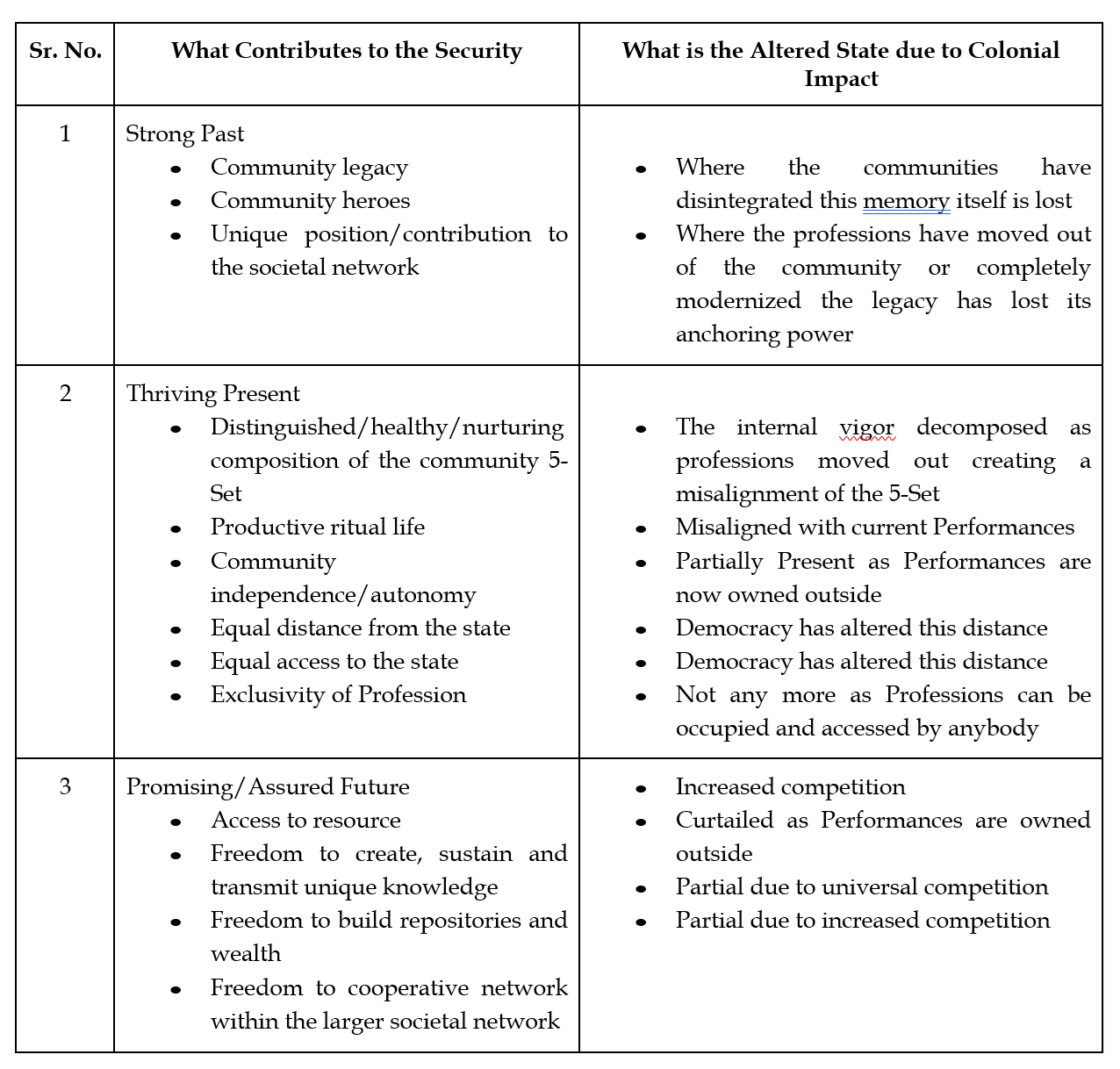
In all strife and change, across times, society has always strived to restore itself to the above configuration aided by the State. This could be represented across time too given in the table below.
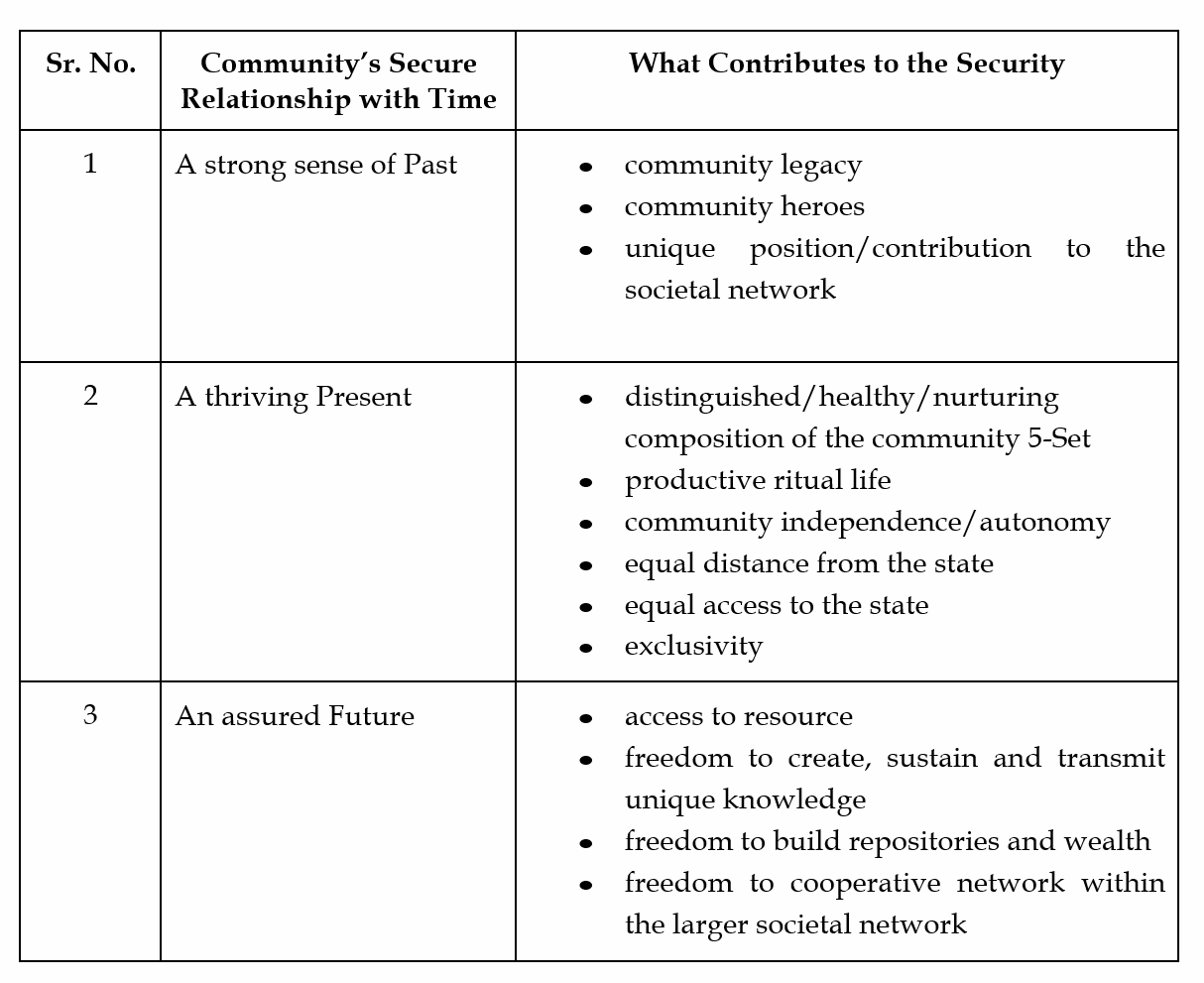
In summary, a sense of strong/deep past, thriving and exclusivity of today, and a promise of a secure future is what brings self worth and security to life. The long Indian past appears to have delivered this to itself till the arrival of the British even through the strife of the Islamic colonisation.
Something altered the course of things in British time in a fundamental way – probably, in ways that never did anytime in the past. In some regions, it may have ended earlier as well. They have altered not just the course and direction but the very configuration of the society in ways that are not easy to recognize and attribute to the British measures that caused them. The British era could truly be described as Yuga-pallata – the epochal remake. The remaining sections attempt to capture, characterise and assess the implications of this massive change.
V. Yuga-Pallata in the British Colonial Period
This section seeks to build an account of the changes brought about by the British colonial period to the extent of being able to explain today’s caste relations and related dynamics. It seeks to build an account on our terms ie., using conceptual categories drawn from our fundamentals. To be more specific, the changes are explained in terms of the Purushartha/Panchakosha based community model explained in the previous sections.
At a high level, the British Colonial period can be characterized as given in the table below.
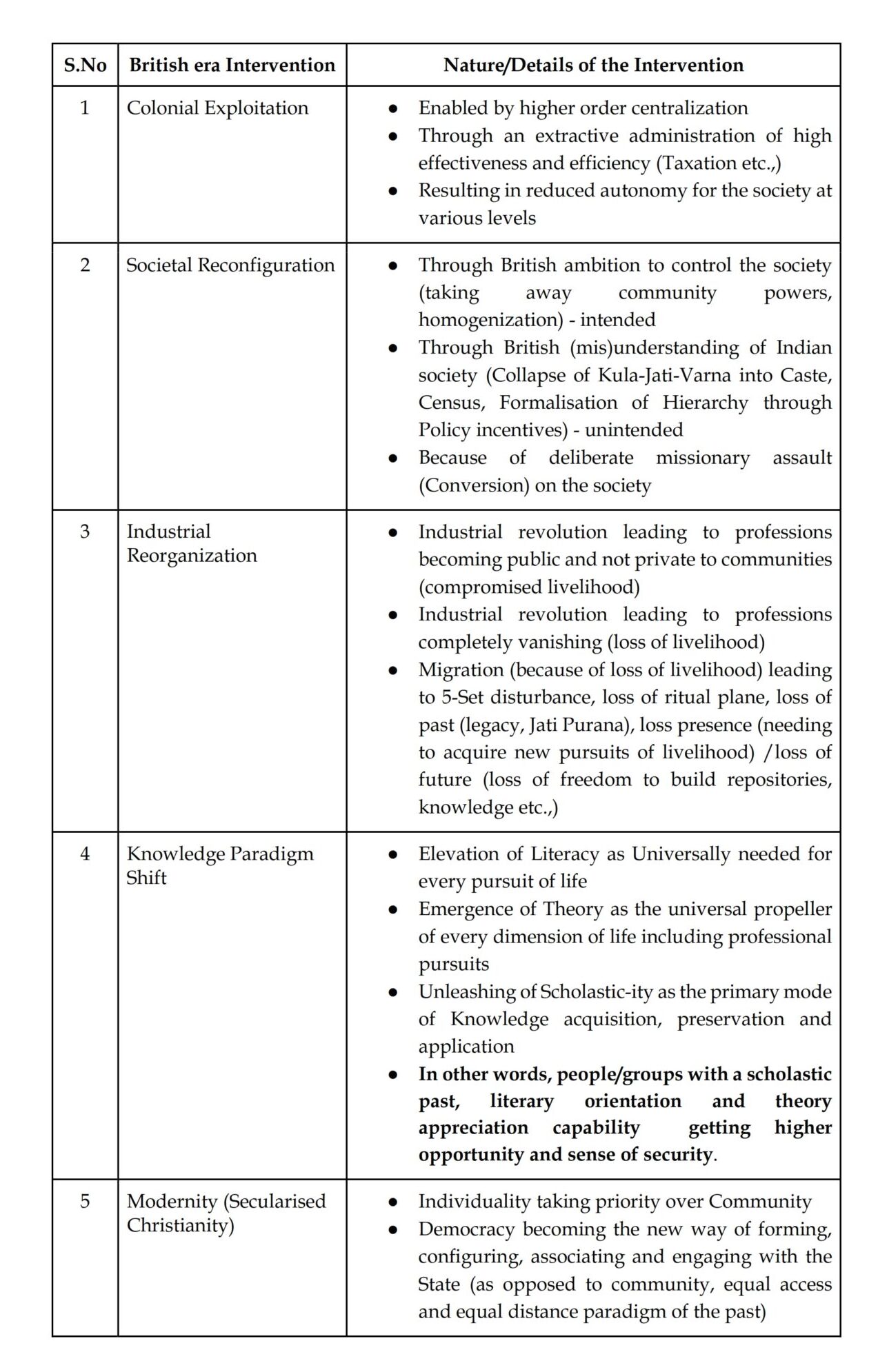
The above has turned the Indian society topsy turvy resulting in a configuration where insecurity thrives unresolving of which leads to increased conflict [Conjecture-8] – another important conjecture of this article. The objective of this article is to not as much explain the above in greater detail as that is already done sufficiently in publicly available literature. The objective is to characterise and explain the implications of these changes in and place the psychology and state of the current caste dynamic as a consequence/function of these changes. The essay seeks to minimally explain any of these as is required to develop an account of the contemporary dynamic/conflict situation.
VI. The impact of British colonial period on Indian communities
This article conjectures, along with an exposition, that the psyche of Indian communities and thereby individuals has significantly altered during and post British colonial period with respect to what relationship they sought with the Rajya – the State [Conjecture-9]. This change is largely due to shifts that occurred as a result of the 5 important Colonial Drifts in the British colonial period described in the previous section (Section V) – colonial exploitation, social reconfiguration, industrial reorganization, knowledge paradigm shift and modernity. This Section articulates the impact of the colonial drifts through specific elements that summarily lead to the conjecture stated.
The collective impact of the Colonial Drifts is articulated through the following important changes in Indian communities.
- Disintegration: Several communities have completely disintegrated. Others have loosened or weakened. Only a few survive and have managed to reinvent themselves for modern times. Individuals are without the cover of their community or with reduced cover leading to higher order stress and burden leading to strife and insecurity.
- Loss of 5-Set Alignment: Most communities lost the alignment of their 5-Set (performances, consumption, aesthetics, ritual-complex and sacred) – the most foundational characteristic of a healthy community and healthy life of an individual in the Indian context. This has severely diminished life experience – leading to even richer communities to move to a state of insecurity and conflict. This is natural in the case of communities that disintegrated. Those who survived or reinvented themselves too do not retain the past well-composed-ness of their 5-Set.
- Livelihood insecurity: Professions have largely & essentially vanished out of communities leading to immense livelihood insecurity. Those who retain their professions too suffer severe competition from people and communities beyond the originally participating with whom they may not have any relationship. The west and modernity have championed individuality, the western industry has felt this an essential necessity to retain elite differentiation and flexibility to redraw industrial pursuits. Consequently, there is no community livelihood and for an individual livelihood is not guaranteed.
- Loss of exclusivity: Communities don’t have any exclusivity or recognition as a functional entity. They do not have any definite space/standing in the society or in front of the State which anybody outside cannot occupy. Their Jati Puranas have lost relevance for more than one reason. Communities themselves have withered away – naturally there is nobody to learn, embody and perpetuate Jati Puranas. Its devastating loss has gone unnoticed. This means they have lost their heroes, milestones, contribution to the culture/civilization – entire legacies – which anchored their sense of self worth and security. Worse, if their new profession is now deemed lowly in the modern world, then communities live with a sense of humiliation even if there was no associated exploitation either today or in the past.
- Loss of Status: The above losses also resulted in the consequential loss of status. Communities that lost their professions for industrial and other reasons lost their respectful positions in the society, at times their Varna itself changing as a result. Loss of profession also altered their Ritual-complex as much of it was configured for good alignment with livelihood pursuit which again resulted in loss of social and ritual status. In particular, the transition from a community creating material/product/value for the society to a community dependent to be hired for labour/work drastically altered the psyche of communities. This impacted communities of all Varnas. For instance, several priestly communities moved out to become cooks after the temple ecosystems weakened due to British policies. Their fractal-varna and ritual plane moved down within the communities.
This can be restated mirroring how we represented community security in terms of past, present and future in Section IV. The table describes the altered state of Indian communities wrt exactly those elements that contributed to a sense of security in the society.
VII. The exceptional role of knowledge, history and industrial dynamic
The previous section articulated the impact of British colonialism in terms of its impact on Indian communities. However, there are some elements deserving an explicit calling and elaboration for the exclusive power it brought to British colonialism in reorienting Indian civilization in such enormity. Most importantly, it is not clear whether the British themselves realized its consequences on India for they were their core/natural strengths as a civilization at that point in time and they kept reacting to emerging opportunities these three elements created for them over and beyond their exploitative purposes. These elements stand out in terms of the way they handed out advantages and disadvantages to different communities and played a role in transformation/hardening of Indian society into a hierarchy.
The three standing out elements are:
- Knowledge: As mentioned earlier, modern knowledge championed by British colonialism was highly scholastic, theoretical and textual. Communities of India had a varying degree of indulgence in scholasticity. While Dharampal has conclusively proved that education and literacy were equally available to all communities, the nature of community pursuits/professions were such that some communities had minimal indulgence and others in excess. Consequently, some communities with a higher order exposure to scholastic, theoretical and textual knowledge could move into knowledge and industrial pursuits created by Modernity and Industrial Revolution championed by the British. In other words, they did not have it as bad as other communities in the colonial era. They had a higher order upward movement possible for them as the scholastic plane thrust by modernity was accessible by them the best. Several other communities did not have the possibility of such an upward mobility – not at least in the scale that the scholastically oriented communities had. The subsequent articles of this study will present their journey. The State itself was organized and run through this new form of knowledge, apart from modern industrial pursuits, which delivered a higher order advantage to some communities. The British, of course, used this to their advantage, incentivizing such movement and using them in state administration and other institutional positions to rule over and implement the exploitative/extractive system and purpose they had in mind.
- History: While communities were losing their legacies due to disintegration and disarray, the emerging discipline of Modern History played an extraordinarily villainous role further. On the one hand, it delivered a death blow to Puranas as a form of cultural/essential legacy of the civilization – affecting Jati Puranas of communities in particular. On the other hand, the paradigm of History envisioned by the western civilization made the (Modern) History of India unwittingly that of scholastically oriented and royalty pursuing communities. This is the consequence of Modern History according importance, authenticity, and legitimacy to such performances and sources such performances that resulted in the construction of a history that made it largely the histories of scholastic/royalty communities. Oral Histories got completely banished from the official stamp – a damage we realized only too late. Even today we are struggling to elevate oral history without an academic tool-set/instrumentation to bring them back to the new mainstream on an equal plane. Every acknowledgement is either a margin or a lipservice or a charity.
The devastating impact of this on other communities, with their legacy/heroes finding no expression and position in modern history, has created a cultural crisis of sorts. This has forced every such community to either desperately search for legacies/heroes that can find a place in the historical paradigm or recraft/renarrativise something/someone available as the best possible candidate to a higher hall of fame. This trauma is under acknowledged and under-studied. Its sociological impact and consequent flow into other realms is completely unknown. A cursory look at the society tells us that those who found a natural expression in Modern History saw an uplift in their psyche unwittingly bringing down that of others who found less or none.
- Industrial Dynamic: In the pre-British era, any new livelihood pursuit that emerged was owned by some families which went onto form a clan – eventually a Jati around the same. The new livelihood pursuit could be the result of the emergence of a new technology or methodology or material or value. It could either organically emerge from an existing Jati’s pursuits or from the State’s external necessities. The natural progression of any one of the elements of 5-Set of a Jati could spawn off a new livelihood pursuit. The natural consequence of this emergence would be some families from within an existing community owning this new livelihood pursuit, serving the larger society and gradually emerging as a new Jati.
The modern industrial dynamic, brought about by modern science and technology, fundamentally altered this course. More particularly, it made any pursuit based on modern science and technology impossible to become a community owned professional pursuit for the two reasons. Firstly – the chief innovator, the west, was outside the paradigm of Jati. Thus, Indian Jatis had to compete with the western industry that sought to aggregate a new mass of people around a technology without having to break any Jati – it was always an amorphous to amorphous paradigm. Jatis found it difficult to match this dynamic in its speed and required scale. Secondly, the nature of technology itself was such that its speed of change was against the kind of stable pace that any community could contain, nurture and adapt. Before a community settled into a technology a new variant would emerge. Colonial era control over India made this even worse, whatever opportunity existed to contain modern pursuits within Indian communities also could not be fully realized. By the time we had any sense of freedom over it we had a 200 years gap between ourselves and the west.
Thus, our Jatis could not rebuild themselves around new technology and industry. Consequently, Modern Industry has created a new ecosystem of ownership of pursuits, professions and material whose social and institutional configuration has not completely been established or stabilized yet. At the very least, the erstwhile Jati ecosystem could not contain this within any minimally to not suffer an existential crisis.
Thus, these three elements – Knowledge, History and Industrial Dynamic – have contributed enormously to the loss of vitality that our communities enjoyed over centuries. These are least understood, articulated and accounted for. Their impact on Indian communities is very deep and multidimensional. In particular, this has contributed to the psyche of representational politics – a national concern shared by a wide spectrum of the society. In subsequent articles the representational politics will be explored based on the framework created by this article with specificities.
VIII. Emergence of a new Public Space
The transformation of social relations in colonial India cannot be understood without recognizing the emergence of a new category of space – the public space. Prior to this shift, most communities operated within clearly demarcated, often exclusive, social and spatial boundaries. In such a setting, the idea of my community space versus your community space did not necessarily generate large-scale conflict. As long as each group had access to its own alternatives, exclusion did not translate into a systemic crisis. Social life was organized in relatively self-contained units, and inequalities, though present, were mediated within these bounded worlds.
However, the onset of colonial modernity fundamentally altered this arrangement.
- Driven by industrial revolution and modernity, the British era introduced new administrative practices, urban planning, legal frameworks, and, crucially, the very notion of a shared public. This was not merely a physical transformation but also a conceptual one. Spaces such as roads, schools, institutions, and civic utilities increasingly came to be seen as common spaces – accessible, at least in principle, to all.
- With communities loosening, breaking, and disintegrating, the entity called community space itself began to be less viable, unsustainable and incapable of anchoring the life of its members.
This marked a decisive shift: what was once a landscape of parallel, exclusive domains began to transform into an interconnected social field – meshed up and hashed into one as amorphous, dissolving distinction and forcing common/universal access.
It is within this newly emergent public space that older forms of segregation acquired a different meaning. Practices rooted in ritual hierarchy, which may have functioned within localized and bounded contexts, now extended into arenas that were implicitly or explicitly shared. The problem was no longer just about maintaining exclusive community spaces; it may have drifted into one of unequal access within spaces that began to be perceived as common. When certain groups found themselves excluded from these emerging public domains, with or without viable alternatives, the issue deepened into one of social conflict.
Moreover, the colonial state’s classificatory exercises, most notably the census, appears to have played a role in bringing ritual hierarchies into socio-political hierarchies. It may have wittingly/unwittingly contributed to expansion, hardening and systematizing ritual hierarchies, giving them a more visible and normative character which hitherto did not exist. As these hierarchies intersected with the expanding public sphere, they seem to have generated new tensions. There are two possibilities: a) ritual segregation translating into social segregation in public spaces b) emerging social dynamics feeding back into reinforcing ritual distinctions.
Importantly, this transformation is not reversible in any simple sense. Modernity has already reshaped the spatial and social fabric, embedding the idea of public space as an enduring reality. As long as the modern industrial dynamic exists, the new public space exists. On the one hand, modernity no longer requires ideological advocacy – it exists as a lived and structural condition. On the other, the emerging public space requires a significant restating of everything that is Hindu. Therefore, the challenge is not about debating their legitimacy but about negotiating their implications.
Ultimately, the issue is not one of achieving equal outcomes across all domains, but of addressing access expectations to everything that is modern – for it represents power that is essential to psychological security. That includes most basic material facilities representing Annamaya Kosha and opportunities within these newly formed public spaces that span from Annamaya to Manomaya. Thus, what was once a manageable, if not harmonious, coexistence of separate worlds has, through the emergence of a shared public realm, has become a site of intensified interaction – and consequently, of conflict [Conjecture-10]. This conjecture is, in many ways, a part of Conjecture-8 and Conjecture-9, but the enormity and complexity of it requires its explicit call out as a separate one.
VIII. Altered Distance from the State and the Representational Politics
This section seeks to provide a brief exposition that supports the synthesis and crafting a new hypothesis – how all of the above have altered the relationship of the society with the State and has spun-off a Competitive State Representation leading to the conflict of representational politics. Reservation is nothing but one expression of the same. While all the above issues converge into a confluence at the altar of the new State, the State itself has gone through a transformation which has made each of these dynamics much worse.
As explained earlier, the traditional design of the 5-set community network was that all communities are effectively equidistant from the State ie., the Rajya Node. The basis of this was explained based on the 56th and 69th chapter of Shanti Parva in Mahabharata. Two things have altered the course of this in the last 200 years. The Colonial State deliberately chose to favour some and rule over others through the favoured.
In the post independence era, Democracy is the chief change agent in this drift away from the traditional equidistance. The numerically strong can occupy the State in a certain way through Democracy. Knowledge paradigm shift is another change agent. The State requires people who have a higher order scholasticity, textuality and theoretical formalism. Any individual or community more aligned with this can dominate the State and they have, including communities with small numbers. Thus, the formation, configuration and sustenance of the State itself has made anybody from any community participate completely taking away the security of equidistant and enabling numerically strong or well organized or knowledge ready communities to have a higher share of the State [Conjecture-11]. Thus, all societies are no more equidistant from the State. With democracy as the mediator – Knowledge, Money and People strength define new ways of acquiring proximity to the State and its internal working. In addition, Democracy is now the only way of engaging with the State. Consequently, Representation in the State and Public Life has become a sought after pursuit of every community.
There is an added complexity to this. The rupturing of the 5-Set Community Network in the colonial era means that there was already a dynamic of restoration and resolution within the society. Traditionally, this dynamic would have been the formation of a new 5-Set Community Network consisting of new Jatis, new relationships, new compositions. The State or the Rajya-Node being neutral was a critical necessity for this organic reset. The Colonial State hampered this process by force. The Industrial Dynamic never let this process acquire a sustained pace through its continuous tear. Democracy completely inverted this dynamic of resolution of the colonial damage to communities by adding an additional dynamic that did not exist previously. That of an Active State than a Neutral State. The State being formed, configured and sustained through an active participation from the society effectively meant that communities in the altered form now had the opportunity to take part in the State. However, the disturbed psyche of communities transformed the process of their restoration into a ‘competition’ for Representation in the State.
Now this Representation Politics expresses itself in three ways –
- State Representation – Legislature/Parliament
- Modern Education – Higher Education
- Modern Institution Representation – Jobs for Livelihood
Thus, the fight for State–Representation is nothing but a desperation for the restoration of old ‘security’, ‘exclusivity’ and ‘distance’ from the State. Insecurity and Democracy has transformed communities that celebrated distance from the State into ones that actively seek proximity with the State. The absence of any other alternative civilizational imagination has pushed the average Indian community to resort to a soft civil war for State-Representation.
The unevenness of State-Representation is the consequence of the complexity of acquiring knowledge in the new paradigm. Every dimension of pursuit and livelihood now requires a higher order scholarly orientation than was necessary in the past. Consequently, scholastic communities, who were otherwise limited to some professions in the past, managed to occupy and dominate every modern profession, including the State, – a movement that began 150 years ago. Few Jatis developed this largely upward movement in the material universe while other communities which did not have scholastic-ity in their past struggled to catch up. This disadvantage is perceived by communities and has affected their psyche in ways that they cannot articulate but reflect it with a fight for State-Representation. Few Jatis have been able to overcome this disadvantage both at material level and at the level of the psyche.
This, in summary, is the reason for
- Deep rooted discontent, bordering on hatred, against some communities
- Reservation being pressed as legitimate Instrument – An aggressive seeking of State-Representation – in the three dimensions of Modern Life
APPENDIX
Appendix-1: Panchakosha and the 5-Set of a Community
- Annamaya Kosha of an individual along with Desha-Kaala-Vartamaana determines the Consumption
- Pranamaya and Manomaya determine the unique Performances set
- Manomaya Kosha determines the Aesthetic pursuit
- Vijnanamaya shapes the Ritual-Complex to make Consumption, Performance and Aesthetics healthy and sustainable
- The journey towards Anandamaya Kosha is largely determined by the Sacred Source
The Ritual here is not just an isolated ritual performance but a layer that helps a community to develop abilities beyond the mind and strive for thought that enables the Dharmicisation of all their Performances and Consumption.
Appendix-2: Experience Design and the 5-Set of a Community
- Consumption and Performances shape our Artha-Kama pursuits
- Aesthetics tempers Consumption and Performances for higher taste
- Ritual-Complex stabilizes Consumption/Performance (Artha-Kama) towards sustainability, order and hence Dharma
- The Sacred Source influences the other 4 and determines the journey towards Moksha
Refer to this Article for further elaboration: Srishti-Sthiti-Laya: The Position Of Soundarya In The Bharateeya Jeevana Drishti – Indica Today
Disclaimer: The opinions expressed in this article belong to the author. Indic Today is neither responsible nor liable for the accuracy, completeness, suitability, or validity of any information in the article.