Swami Sadashiva Tirtha is one of those rare contemporary spiritual teachers who refuses to see science and spirituality as rival camps. For more than four decades, he has worked patiently at the intersection of ancient wisdom and modern urgency, adapting meditation, yoga, Ayurveda, and subtle healing sciences to a world that is moving faster than ever before.
Recognised internationally for his depth as well as his accessibility, Swamiji has addressed forums as diverse as the White House Commission on Complementary & Alternative Medicine, Johns Hopkins University, and medical colleges across the world. A pioneer of Ayurveda in the United States, he founded some of the earliest certification schools, herbal companies, and Ayurveda centres, helping legitimise and globalise an Indian knowledge system long before it became fashionable. His Ayurveda Encyclopedia, a No.1 Amazon bestseller with over 30,000 copies in print, remains a standard reference even today.
Yet Swamiji is no mere scholar or institutional reformer. A natural-born psychic medium, shaman, and healer—later formally trained and certified in advanced mediumship—he has continually expanded his inner disciplines, studying with leading mediums in the US and UK, and even being recognised by Amazonian shamans in Ecuador as one of their own. From these diverse streams has emerged his signature focus on “instant healing” and heart-based meditation—methods designed for profound inner shifts in seconds rather than hours, without diluting depth.
At the request of students searching for relevance rather than ritual, Swamiji authored Bhagavad Gita for Modern Times, a lucid, lived commentary that translates Krishna’s timeless wisdom into everyday dilemmas of work, stress, relationships, and purpose. His concern for mental well-being in academic spaces led to The Stress-Free College Student, a book so impactful that Bryant University listed it among “50 Books that Changed the World.” His more recent work, 21 Days of Joy, speaks to what he calls the present “Celebration Era,” challenging deeply ingrained cultural habits of anxiety and self-denial, and inviting readers to relearn the radical discipline of joy.
In this wide-ranging online conversation, Swami Sadashiva Tirtha reflects on his spiritual journey, his teachers and trials, the meeting points of Ayurveda, astrology, healing and mediumship, and—above all—his continuing effort to make inner freedom practical, immediate, and humane for our times.
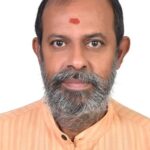
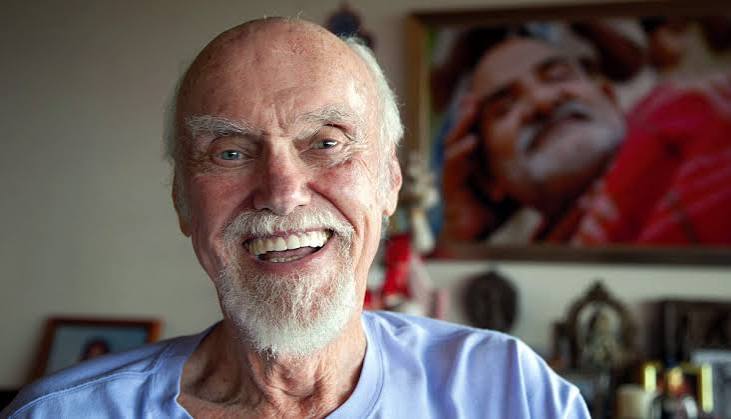
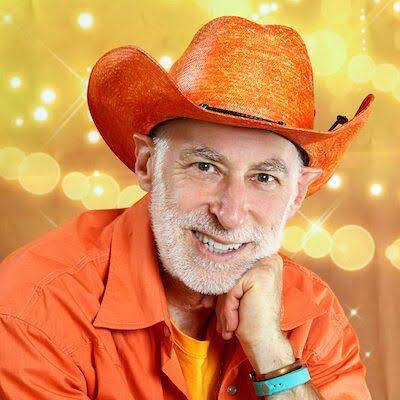 (Figure 1: Swami Sadasiva Tirtha aka Swami Orange Joy)
Swamiji, kindly tell us about your place of birth, parents, and childhood.
I was born in Long Island, New York—a fish-shaped stretch of land east of New York City and Queens. My father was an engineer, and my mother, a teacher. From an early age, I had intuitive or psychic gifts, though I didn’t understand them at the time. I would have dreams or premonitions—about future events in my life, unexpected guests, or even snow arriving during spring. My mother found these abilities unsettling.
Once, when I was about 14, we were playing the game Password, based on a TV show. My mother said “fruit,” and immediately I saw a plum in my mind and answered confidently: “Plum!” She became upset, accusing me of cheating. Unlike some children whose parents nurture their spiritual gifts, mine were not encouraged—though later I learned to use them for helping others.
I was a quiet child, keeping mostly to myself or with one or two close friends. Academically, I was content with a B average—working harder if I got a C and relaxing if I got an A. I graduated high school a semester early and started college, majoring in Radio, TV, and Film. But my spiritual journey soon took over—and childhood ended.
How did you come to the spiritual path, and what was the turning point in your life?
My earliest spiritual memories go back to a time before I was eight years old, when I was subtly guided towards experiencing energy. However, my real spiritual journey began around the age of ten, when I started having recurring dreams in which my parents would leave me, and I would find myself with different sets of parents. As I grew older, the dreams changed in form, but their underlying message remained the same: my parents would disappear without telling me where they had gone.
About a decade later, when I was around seventeen, I experienced what I can only describe as a vision while travelling with my family. We stopped at a red light in front of a funeral home, and suddenly my vision swirled into blackness. Overcome by an inexplicable fear, I cried out, “I don’t want you to die!” My parents were stunned by my reaction. Within a year, they died in a car accident.
This happened in 1972, a time when mystical experiences were rarely discussed openly. The Beatles’ journey to India was perhaps the only spiritual reference I encountered in the mainstream media. There was no one to guide me or offer support in understanding the extraordinary experiences I was going through.
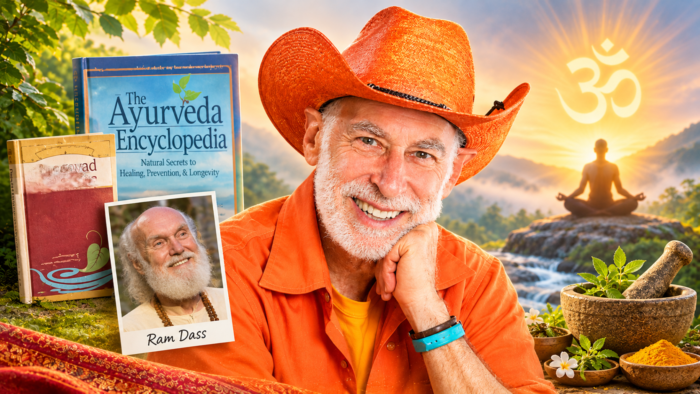
A friend introduced me to Be Here Now by Ram Dass and the trilogy of books by Carlos Castaneda. These works opened new doors for me. Soon afterwards, I attended a lecture on meditation and learned how to meditate. From that point onwards, spirituality became the sole focus of my interest. I transferred to a college that emphasised meditation and spent the next five years immersed in intensive spiritual courses.
(Figure 2: Ram Dass: Author of Be Here Now)
Eventually, the inner guidance that I recognised as the Voice of God instructed me to return to the outer world. I followed that guidance and worked in television for five years. During this period, I discovered Ayurveda and Jyotish, both of which transformed my life profoundly.
Feeling an unmistakable inner calling to India, I travelled to Varanasi, where I met my Guru, His Holiness 1008 Sri Swami Narayan Tirthaji Maharaj. This meeting marked another significant milestone in my spiritual journey. After spending some time with my Guru, I returned to the United States. There, I taught yoga, practised Ayurveda and Jyotish, and published Yoga Vani, a work by my Param Guru, Swami Shankar Purushottam Tirtha.
In due course, I established an Ayurveda and Jyotish centre and published Guru Bani: 100 Ways to Know Truth. Between 1990 and 2001, I travelled to India every year to visit my Guru. During this period, I also wrote The Ayurveda Encyclopedia, which went on to become a number-one bestseller.
In 2001, Rahu entered Ardra and Ketu entered Moola. Four months later, the September 11 attacks took place. The resulting atmosphere of fear and uncertainty left people deeply stressed, and many stopped visiting my centre. It was during this period that I was writing Bhagavad Gita for Modern Times.
While working on the book, I experienced a vision of a house beside a lake. I recognised the place as being in Upstate New York and decided to move there. The peaceful surroundings provided the ideal setting for me to deepen my psychic abilities, with what I experienced as divine guidance.
On another occasion, while fully awake, I had a vision in which everything once again swirled into blackness. Then I received a clear inner message: “You can now go deeper into your mediumship.” I understood this experience as the beginning of an entirely new chapter in my spiritual life.
Years later, when Rahu returned to Ardra in 2019 and Ketu returned to Moola in 2020, the COVID-19 pandemic began. I interpreted this period as another sign that it was time to embark on a new spiritual path. I believe that we are entering a new era—a mini Satya Yuga, characterised by joy, unity, and divine celebration.
Although the world is passing through a period of considerable turmoil, I believe that the Divine continues to show us the way forward. Krishna told Arjuna, “In the darkest of times, I give you the easiest way to reach me: chant my name.” These words hold a profound message for our times. Each of us now has a clearer opportunity to choose whether to live in darkness or in light.
How did you meet your Guru, Sri Narayan Tirtha, and what are some of your most memorable experiences with him?
In December 1988, I left for India with no contacts. Ananda Ashram in Monroe, NY, gave me a letter of introduction to their guru-bhai, Swami Narayan Tirtha. I arrived in Varanasi and visited Siddhayogashram. After Arti, I met him and was invited to join morning meditation (4–7 AM). A few days later, he gave me diksha.
He allowed me to continue my sadhana in his room, even as other disciples came and went. One day, during practice, I started spinning from the Shakti and gently lay down. Guruji laughed, saying, “That is the power of Siddhayoga Shakti.”
Each year, I visited him, especially in his serene Uttarkashi ashram by the Ganga. On my first visit, I surprised him and couldn’t speak from excitement—so I just recorded him. He gestured to try the camera and filmed me instead! He had such playful simplicity.
Back then, there were no phones or emails. Letters took a month each way. Still, whenever I asked him questions, answers would arise in my heart even before his reply came. I stopped waiting and began trusting inner guidance.
We would wake at 3 AM and visit every temple in Uttarkashi with prayers and offerings. Leaving the ashram was always hard; I felt a loss of sunlight—the subtle yet powerful effect of his darshan. His love was so gentle, you only realized it after leaving. He remains the most sacred presence in my life—my Baba.
What inspired you to study Ayurveda, and could you tell us about your book, The Ayurveda Encyclopaedia?
This too was a transformative experience. Living in New York City, I caught the flu every winter despite trying all remedies from health food stores. One day, I found a book on Ayurveda and discovered a vaidya in the city. He gave me Sitopaladi powder. Upon taking it, I felt my body realign, and the flu disappeared instantly. I realized: the flu wasn’t an outside germ, but an internal water imbalance.
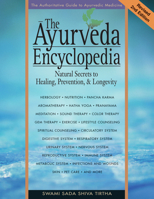
(Figure 3: The Ayurveda Encyclopaedia)
Determined to learn more, I enrolled in a distance certification course in Ayurveda and Jyotish. My first client was a local guru—an auspicious beginning! I later opened one of the first Ayurveda centers in the U.S.
Students requested formal training, so I developed a certification program. An MD student encouraged me to write a book. I spent six years compiling ancient and modern texts into a nearly 700-page volume: The Ayurveda Encyclopedia. When Ayurveda was introduced on the Oprah show, the book became a #1 bestseller.
Ayurveda works because it’s personal, gentle, and holistic. For instance, a heart patient was taking garlic post-surgery. Though it’s “good for the heart,” it aggravated his fiery (Pitta) constitution. I advised cooling Arjuna instead. He soon felt truly healthy.
Ayurveda addresses root causes through dosha balance. It teaches that most illnesses begin in digestion and even anticipated today’s “gut health” trend decades ago. It also offers psychological insight—recognizing Air (Vata), Fire (Pitta), and Water (Kapha) minds—and how to interact with each.
Ancient texts include specialties like women’s health, child development, mental health, and even socio-political wisdom. Charaka Samhita says epidemics arise from corrupt leadership. Ayurveda has insights far beyond physical health.
What are your views on Vedic astrology? To what extent do the stars influence or determine our lives, and how much free will do we have in shaping our own destiny?
Jyotish—or “inner light”—reveals the soul’s path. While Western astrology focuses on the outer self, Jyotish guides the inner self. It is both precise and poetic. Patterns observed over millennia show planetary influences “rhyme” over time.
Jyotish doesn’t show fixed fate. It shows probabilities and offers remedies: gems, mantras, foods, colors, seva. For example, a client once told their Jyotishi they could never end up in jail. The astrologer advised community service in a jail as a preventive measure. The client did it—and the troubling karma passed harmlessly.
The nodes Rahu and Ketu entering Ardra and Moola have historically triggered global events: AIDS in the early 1980s, JFK’s assassination in 1963–64, and 9/11 in 2001. Astrology gives us tools to prepare and align with nature’s rhythms. Jyotish, Ayurveda, and Vastu Shastra are powerful systems that harmonize individuals and societies with divine order.
What does spiritual living mean to you, and how can we incorporate it into our daily lives to promote peace, joy, and the well-being of others?
To me, “spiritual” means whatever brings peace and joy to the heart, mind, and soul. Laughter and playfulness are divine medicine. Eating foods aligned with your constitution, choosing careers aligned with your soul, and letting your inner light overflow to bless others—this is spiritual living. Smile at strangers. Send silent prayers to people you pass. Life becomes lighter. Yes, there are challenges—but life is for learning, growing, and serving.
What is unique about your book Bhagavad Gita for Modern Times?
Many students asked me to write a Gita commentary. I resisted—there are hundreds! One student replied, “Yes, but none show how to apply it in daily life. I drive a car, not a chariot.” That made sense. So, I wrote a clear translation suited for modern readers. A Sanskrit scholar in Uttarkashi reviewed and approved it. I also included original illustrations summarizing each chapter’s theme, for visual learners. That’s what makes Bhagavad Gita for Modern Times unique.

(Figure 4: Bhagavad Gita for modern times)
Could you please tell us about the book Guru Bani: 100 Ways to Know Peace?
This book, by my Param Guru Swami Shankar Purushottam Tirtha, was translated by a disciple and published by me. It offers 100 short reflections—guiding seekers to live spiritually in everyday life. His earlier book Yoga Vani describes the inner path of sadhana and kundalini rising. Together, they offer both wisdom and practical inspiration.
How did you come to be known as the “Orange Cowboy,” and what inspired you to adopt this name for your website?
Upstate New York is full of farms and sunshine. I started wearing a cowboy hat for shade. At Lily Dale, while studying mediumship, people began calling me “Orange Cowboy” because of my outfit. It made people smile, so I embraced it. After all, Krishna was also a cowherd.
Please tell us about your latest book The Magic of the Blessed Mother’s Miracles.
Over 20 years of energy healing, I repeatedly saw a nurturing feminine presence—later revealed to be the Blessed Mother. She comforted and healed others through me, even though my prayers were usually to Lakshmi or Durga.
During a mediumship reading, the Blessed Mother appeared strongly. My client—who had lost two children—recognized her immediately. We became friends, and she invited me to co-author this book. It features true stories of miraculous encounters and healing.
Like Ramakrishna, who realized the truth in multiple faiths, I now see the universality of divine love. The Blessed Mother is a light for all, and her presence reminds us we are never alone. Miracles and joy are always near when hearts are open.
Disclaimer: The opinions expressed in this article belong to the author. Indic Today is neither responsible nor liable for the accuracy, completeness, suitability, or validity of any information in the article.