Ancient Practices. Sacred Meanings. Lessons That Travel Beyond the Temple
I have bowed before God a thousand times. I am still learning to bow before the person I have hurt.
I learned the rituals before I learned their meanings.
As a child, I followed my grandfather into the Shiva temple where he served as a trustee. He showed me how to approach the deity, how to bow and how to walk the parikrama. I watched him and did the same. At that age, trusting him was enough.
Years later, I return to those familiar gestures with different questions. What does it mean to bow if I still struggle to admit I am wrong? What have I understood about prasad if I forget to share? What stands at the centre of my own life?
The actions I learned as a child have begun to ask something of the adult I have become.
Hindu temple worship carries traditions far older and deeper than any personal interpretation I can offer. Its rituals belong to living streams of devotion shaped by sampradayas, regions, families and generations of practice, and their sacred meanings deserve to remain intact. The Bhagavad Gita is not a ritual manual, so each verse below is offered as a companion teaching that sits beside the ritual.
Alongside those meanings, I have found something personal: each ritual leaves a small lesson for ordinary life. So let us walk through the temple the way many of us first met it, not as a list, but as a journey. The order, and even the presence of some practices, varies from temple to temple, so this is one possible journey, not a rulebook.
1. Leaving Footwear Outside
In most temples, footwear is left outside, since it carries the dust of the outside world, and devotees enter the sacred space barefoot as a mark of cleanliness and reverence.
The tradition is one of cleanliness and reverence. The lesson I take home is simpler: leave my difficult day at the door.
रागद्वेषवियुक्तैस्तु विषयानिन्द्रियैश्चरन् ।
आत्मवश्यैर्विधेयात्मा प्रसादमधिगच्छति ॥ BG 2.64
Rāga-dveṣa-viyuktais tu viṣayān indriyaiś caran, ātma-vaśyair vidheyātmā prasādam adhigacchati.
(One who moves among worldly objects with senses under control, free from attraction and aversion, attains inner serenity.)
My shoes are easy to leave outside. My irritation is harder. So is yesterday’s argument. The verse is not about shoes, but it teaches what to carry and what to set down. Not everything I carried to the temple needs to be carried inside, and before I walk back through my own front door, I can remember that whoever waits there did not cause what went wrong outside. Do not make loved ones carry the weight of a difficult day. A heart that has set down its burdens is far readier to bow.
2. Touching the Temple Steps (Bhumi Pranama)
In many temples and traditions, devotees respectfully touch or acknowledge the step or threshold before entering, sometimes bringing the hand to the forehead. The custom is not followed everywhere.
Alongside its traditional reverence for sacred space, it reminds me to thank the people whose support quietly helped me reach where I am today.
तद्विद्धि प्रणिपातेन परिप्रश्नेन सेवया ।
उपदेक्ष्यन्ति ते ज्ञानं ज्ञानिनस्तत्त्वदर्शिनः ॥ BG 4.34
Tad viddhi praṇipātena paripraśnena sevayā, upadekṣyanti te jñānaṁ jñāninas tattva-darśinaḥ.
(Learn that truth by humbly approaching a teacher, by sincere inquiry and by service. Those who have realised the truth will impart knowledge to you.)
The ground holding this place up deserves respect too, not just the shrine at its centre. We admire the visible achievement and forget the quiet support beneath it: a parent, an early teacher, a struggle nobody saw. The verse speaks of learning through humility and service, and few of us learned anything alone. Before admiring how high we have reached, remember what helped us stand. Honouring them, in a word or a visit, keeps us from mistaking the height we have reached for something we built alone.
3. Ringing the Bell
In many temples, devotees ring a bell on entering. Its sound is meant to wake the senses and bring attention to the sacred space.
The sound belongs to worship. For ordinary life, it leaves me with a simple discipline: return to the present moment.
यतो यतो निश्चरति मनश्चञ्चलमस्थिरम् ।
ततस्ततो नियम्यैतदात्मन्येव वशं नयेत् ॥ BG 6.26
Yato yato niścarati manaś cañcalam asthiram, tatas tato niyamyaitad ātmany eva vaśaṁ nayet.
(Whenever the restless and unsteady mind wanders away, one should bring it back under control and direct it toward the Self.)
We often arrive with the body ahead of the mind: feet inside, thoughts still in an argument. The bell is less an instruction than an interruption: stop, you are here now. Outside the temple the interruption is quieter. Someone speaks while I look at my phone, and I have to bring myself back. The point is not to never wander, only to notice. Return your attention to the person before you. Attention is a form of care.
4. Darshan
We stand before the deity to see, to pray and to be seen, with eyes open and heart quiet.
Darshan is sacred seeing. Its additional lesson for me is not to confuse looking with truly seeing, especially when another person is standing in front of me.
यो मां पश्यति सर्वत्र सर्वं च मयि पश्यति ।
तस्याहं न प्रणश्यामि स च मे न प्रणश्यति ॥ BG 6.30
Yo māṁ paśyati sarvatra sarvaṁ ca mayi paśyati, tasyāhaṁ na praṇaśyāmi sa ca me na praṇaśyati.
(For one who sees Me everywhere and sees everything in Me, I am never lost, nor is that person ever lost to Me.)
Darshan is far more than looking at an image. It is the sacred act of beholding the Divine and standing in that presence. How much of life do we look at without truly seeing? We see the waiter but not the person. We see our parents every day until one day we notice how much older they have become. If I can stand before God with such attention, can I see the people in front of me with a little more attention too? Sometimes the greatest gift we can offer someone is our undivided gaze.
5. Applying Tilak
Tilak is a sacred mark of blessing, remembrance and devotional identity. Its form is not uniform: sandalwood, kumkum, vibhuti, gopi-candana and distinctive sectarian markings each carry meanings shaped by deity, lineage and sampradaya. A Shaiva vibhuti and a Vaishnava urdhva-pundra should never be flattened into a single explanation.
The mark is a reminder of devotion and blessing. As a personal lesson, it asks me to let remembrance guide my actions.
उद्धरेदात्मनात्मानं नात्मानमवसादयेत् ।
आत्मैव ह्यात्मनो बन्धुरात्मैव रिपुरात्मनः ॥ BG 6.5
Uddhared ātmanātmānaṁ nātmānam avasādayet, ātmaiva hyātmano bandhur ātmaiva ripur ātmanaḥ.
(One should elevate oneself by one’s own mind and not degrade oneself. The mind alone can be one’s friend, and the mind alone can be one’s enemy.)
The mark is seen by others, but whether I keep my word, listen fairly or lose patience is noticed over time. The sacred mark travels with me. My conduct should not leave devotion behind. What I remember in the morning should still be visible in how I treat people by evening.
6. Folding Our Hands (Namaste)
We fold our hands when we pray or stand before God, as an expression of gratitude.
As an additional life lesson, namaskar asks me to carry that respect into the way I speak.
अद्वेष्टा सर्वभूतानां मैत्रः करुण एव च ।
निर्ममो निरहङ्कारः समदुःखसुखः क्षमी ॥ BG 12.13
Adveṣṭā sarva-bhūtānāṁ maitraḥ karuṇa eva ca, nirmamo nirahaṅkāraḥ sama-duḥkha-sukhaḥ kṣamī.
(One who hates no being, who is friendly and compassionate, free from possessiveness and ego, balanced in pain and pleasure, and forgiving.)
Folding my hands before God has never been difficult. The harder lesson begins when I lower them. Can I stay respectful in a disagreement? Can I show a waiter, a driver or a junior colleague the dignity I show someone powerful? The verse describes someone who hates no being and stays friendly and forgiving. That is a standard for how we speak, not only how we pray. Namaste lasts a few seconds. Respect has to survive after the hands separate. Keep respect in your voice when you disagree. We can be firm without being unkind.
7. Offering Flowers
In many temples, devotees offer flowers, fresh and fragrant, as a small gift of love and devotion.
The flower belongs first to devotion. The smaller lesson I take home concerns how I give.
पत्रं पुष्पं फलं तोयं यो मे भक्त्या प्रयच्छति ।
तदहं भक्त्युपहृतमश्नामि प्रयतात्मनः ॥ BG 9.26
Patraṁ puṣpaṁ phalaṁ toyaṁ yo me bhaktyā prayacchati, tad ahaṁ bhakty-upahṛtam aśnāmi prayatātmanaḥ.
(Whoever offers Me with devotion a leaf, a flower, a fruit or water, I accept that offering from the pure-hearted devotee.)
The verse places the emphasis on devotion, not expense. A flower wilts within a day, so it cannot be given for display alone. We delay giving because what we have feels too small: the call, the apology, the affection. Something does not have to be grand to be sincere. Give with care, without counting what comes back. Love offered simply is never wasted.
8. Jal Abhishek (Offering Water)
In some forms of worship, water is poured slowly and steadily over the deity. Practices differ across temples and traditions.
In the forms where it is practised, the steady pour reminds me that continued effort matters more than a burst of enthusiasm.
मय्यावेश्य मनो ये मां नित्ययुक्ता उपासते ।
श्रद्धया परयोपेतास्ते मे युक्ततमा मताः ॥ BG 12.2
Mayy āveśya mano ye māṁ nitya-yuktā upāsate, śraddhayā parayopetās te me yukta-tamā matāḥ.
(Those who fix their minds on Me and always worship with steadfast faith, I consider them most perfect in yoga.)
Water falls slowly. The devotee stays. We begin with enthusiasm and abandon things when it fades, yet relationships, discipline and trust never survive on occasional grand gestures. What matters deeply asks for the willingness to keep coming back. If we lose the thread for a day, we simply pick it up again. What a steady stream asks is not perfection, only that we keep caring, with patience and a quiet heart.
9. Breaking the Coconut
In many temples, a coconut is broken and offered, though its meaning and manner of offering vary by tradition and region.
One symbolic reading I find meaningful is that ego is like the hard shell: difficult to crack, but what lies beneath is far better. This is my reflection, not the single established explanation of the ritual.
प्रकृतेः क्रियमाणानि गुणैः कर्माणि सर्वशः ।
अहङ्कारविमूढात्मा कर्ताहमिति मन्यते ॥ BG 3.27
Prakṛteḥ kriyamāṇāni guṇaiḥ karmāṇi sarvaśaḥ, ahaṅkāra-vimūḍhātmā kartāham iti manyate.
(All actions are performed by the modes of nature, but the person bewildered by false ego thinks, “I am the doer.”)
Where a flower is placed with care, the coconut is struck until it gives way, and that difference is the point. Ego rarely announces itself. It is the need for the last word, the certainty that only my version is right, the defensiveness when someone corrects me. Breaking a coconut is easy compared with cracking the need to always be right. What lies beneath the shell is sweet, and it reaches the offering only once the shell is broken. The same is true of us: once the need to be right gives way, there is room to accept correction, to listen and to grow.
10. Lighting a Diya
Many devotees light a small lamp, adding oil and a flame, as an act of hope and intention.
The diya remains first a sacred lamp offered in worship. For me, its steady flame also becomes a quiet reminder to tend character after inspiration fades.
यथा दीपो निवातस्थो नेङ्गते सोपमा स्मृता ।
योगिनो यतचित्तस्य युञ्जतो योगमात्मनः ॥ BG 6.19
Yathā dīpo nivāta-stho neṅgate sopamā smṛtā, yogino yata-cittasya yuñjato yogam ātmanaḥ.
(As a lamp in a windless place does not flicker, so is the disciplined mind of a yogi practising meditation on the Self.)
Life is rarely windless. Grief, failure and unfairness will tilt the lamp, and yet the flame still points upward. The verse describes a lamp that does not flicker, and that steadiness is never found by accident. It is tended. A lamp needs oil and a careful hand, and so do faith and relationships. We complain the light has weakened after forgetting to tend the flame. It is about tending, every single day, the qualities we hope will endure.
11. Aarti (The Flame Ceremony)
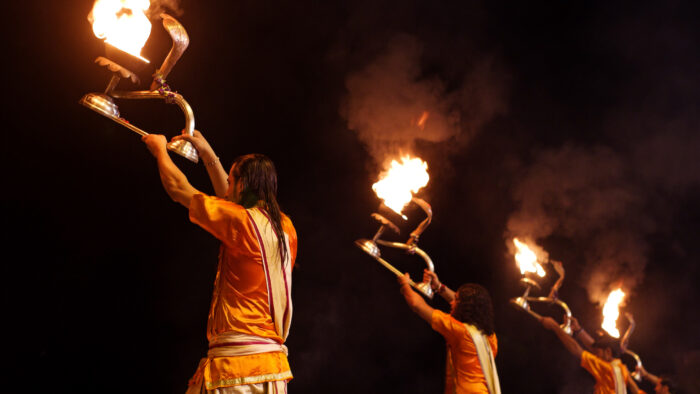
Aarti is the offering of light to the deity, usually a lit lamp waved in circles before the image while hymns are sung. Customs and songs differ from temple to temple.
The light of aarti belongs first to worship. As an additional reflection, it turns my attention to clarity: even when I cannot choose the outcome, I can examine my own part honestly and take the next right step.
तेषामेवानुकम्पार्थमहमज्ञानजं तमः ।
नाशयाम्यात्मभावस्थो ज्ञानदीपेन भास्वता ॥ BG 10.11
Teṣām evānukampārtham aham ajñānajaṁ tamaḥ, nāśayāmy ātmabhāvastho jñānadīpena bhāsvatā.
(Out of compassion for them, dwelling in their hearts, I destroy the darkness born of ignorance with the shining lamp of knowledge.)
Voices rise as a flame moves before the deity, and strangers carrying different griefs and hopes look towards the same light. We ask the Divine to remove darkness from our path, and we also need the courage to see the darkness within: anger, fear, envy, an old grudge. Hope is sometimes simply the courage to take an honest next step. Light becomes easier to find when we remember that someone, somewhere, is also looking for it.
12. Mantra Japa
Many devotees repeat a mantra or God’s name quietly, often counting on a mala, to steady the mind.
Japa has its own sacred discipline of remembrance. Alongside it comes a personal question: what am I repeatedly allowing my mind to return to?
महर्षीणां भृगुरहं गिरामस्म्येकमक्षरम् ।
यज्ञानां जपयज्ञोऽस्मि स्थावराणां हिमालयः ॥ BG 10.25
Maharṣīṇāṁ bhṛgur ahaṁ girām asmy ekam akṣaram, yajñānāṁ japa-yajño’smi sthāvarāṇāṁ himālayaḥ.
(Among the great sages I am Bhrigu; among words, the single syllable Om. among sacrifices I am the sacrifice of japa (repetition of a sacred formula), and of immovable things the Himalayas.)
Japa looks like almost nothing from outside, yet the Gita gives it an honoured place. If I keep returning to an insult, resentment grows. If I return to prayer or gratitude, those grow instead. What we repeat, we tend to become. So I ask myself: what am I repeating when no mantra is on my lips? I can notice it kindly, and choose again.
13. Tying the Kalava (Sacred Thread)
Kalava or mauli is tied in different ritual settings as a sacred thread associated, according to the tradition and occasion, with blessing, protection, worship or sankalpa. Its precise significance is understood within the rite in which it is given.
Only after respecting that ritual meaning do I take a personal lesson from the thread: worthy commitments need remembrance after the ceremony is over.
अनन्याश्चिन्तयन्तो मां ये जनाः पर्युपासते ।
तेषां नित्याभियुक्तानां योगक्षेमं वहाम्यहम् ॥ BG 9.22
Ananyāś cintayanto māṁ ye janāḥ paryupāsate, teṣāṁ nityābhiyuktānāṁ yoga-kṣemaṁ vahāmy aham.
(Those who worship Me with single-minded devotion, constantly thinking of Me, for them, ever steadfast, I carry what they lack and preserve what they have.)
We make promises in a moment of clarity and forget them once life gets busy. The thread is a stubborn little nudge back to what we meant when we tied it. The verse promises protection to those who stay constantly devoted, This reminds me, in a different way, of the care our own commitments require. We protect what we promise by staying with it. Make the call. Keep the promise. Show up. A commitment grows trustworthy through small, repeated follow-through, including putting things right on the days we fall short. The thread simply asks me to remember who I decided to be.
14. Bowing the Head
We lower our head before God as a sign of respect and surrender.
Bowing is an act of reverence and surrender before the Divine. Its additional human lesson is harder: humility must sometimes become the words, “I was wrong.”
तस्मात्प्रणम्य प्रणिधाय कायं प्रसादये त्वामहमीशमीड्यम् ।
पितेव पुत्रस्य सखेव सख्युः प्रियः प्रियायार्हसि देव सोढुम् ॥ BG 11.44
Tasmāt praṇamya praṇidhāya kāyaṁ prasādaye tvām aham īśam īḍyam, piteva putrasya sakheva sakhyuḥ priyaḥ priyāyārhasi deva soḍhum.
(Therefore, bowing down and prostrating my body, I seek Your grace, O adorable Lord. As a father bears with a son, a friend with a friend, a beloved with the beloved, so please bear with me, O God.)
My grandfather taught me the gesture. Life taught me the harder versions: “I was wrong.” “I don’t know.” “I am sorry.” In this verse, even Arjuna bows low and asks to be forgiven. If I can bow before God without becoming smaller, admitting a mistake before another person does not make me smaller either. Humility makes room for others. It also gives another person the chance to be right without turning truth into a contest.
15. Offering at the Hundi
In many temples, devotees make an offering at the hundi as an act of dana, a gift in support of the temple. It is distinct from the dakshina traditionally given to a priest.
It reminds us that generosity does not need recognition.
दातव्यमिति यद्दानं दीयतेऽनुपकारिणे ।
देशे काले च पात्रे च तद्दानं सात्त्विकं स्मृतम् ॥ BG 17.20
Dātavyam iti yad dānaṁ dīyate’nupakāriṇe, deśe kāle ca pātre ca tad dānaṁ sāttvikaṁ smṛtam.
(A gift given out of duty, at the proper time and place, to a worthy person, without expectation of return, is charity in the mode of goodness.)
Most of us expect something back for what we give: recognition, thanks, a future favour. The hundi quietly removes that expectation. Can I be generous without needing anyone to notice? Someone else’s need should never become an occasion to advertise my own goodness. Help without needing your name to be mentioned. Quiet giving asks nothing of the receiver.
16. Receiving Charanamrit / Tirtham
In many temples, a few drops of sacred water, called charanamrit or tirtham, are given to devotees. The practice and its name vary by tradition.
Receiving sacred water is an act of reverence. As an additional reflection, it reminds me how much of life asks us to receive rather than to give.
न हि ज्ञानेन सदृशं पवित्रमिह विद्यते ।
तत्स्वयं योगसंसिद्धः कालेनात्मनि विन्दति ॥ BG 4.38
Na hi jñānena sadṛśaṁ pavitram iha vidyate, tat svayaṁ yoga-saṁsiddhaḥ kālenātmani vindati.
(In this world, there is nothing so purifying as knowledge. One perfected in yoga finds it within oneself in due course of time.)
Until now we have offered. Now our palm opens to receive. Giving requires generosity. Receiving requires humility. Sometimes someone offers guidance, kindness or forgiveness, and an open hand is a spiritual posture too. Make room for understanding before judgement. Sometimes the wisest sentence is simply: “I don’t know enough to judge.”
17. Receiving Prasad
In many temples and homes, food is first offered to God, and once it becomes prasad, it is shared with others.
Prasad is received as grace. That sacred act also leaves me with an everyday rhythm worth remembering: receive with gratitude, and do not let what you have received stop with you.
यज्ञशिष्टाशिनः सन्तो मुच्यन्ते सर्वकिल्बिषैः ।
भुञ्जते ते त्वघं पापा ये पचन्त्यात्मकारणात् ॥ BG 3.13
Yajña-śiṣṭāśinaḥ santo mucyante sarva-kilbiṣaiḥ, bhuñjate te tv aghaṁ pāpā ye pacanty ātma-kāraṇāt.
(The good who eat what remains after the offering are freed from all sin; but those who cook only for themselves eat sin.)
First we offered, now we receive, and then we share. Offer. Receive. Be grateful. Share. Not only food. Someone was patient with us when we were learning, and someone gave us another chance. What have we received that can now travel through us to somebody else? Notice who has not yet received a share. Gratitude becomes complete when blessing does not stop with the person who receives it.
18. Sitting Quietly on the Temple Steps
Where this custom is followed, devotees sit quietly for a few moments before completing the visit, rather than rushing back outside.
It teaches us to pause and let an experience settle, instead of always rushing on to the next thing.
शनैः शनैरुपरमेद्बुद्ध्या धृतिगृहीतया ।
आत्मसंस्थं मनः कृत्वा न किञ्चिदपि चिन्तयेत् ॥ BG 6.25
Śanaiḥ śanair uparamed buddhyā dhṛti-gṛhītayā, ātma-saṁsthaṁ manaḥ kṛtvā na kiñcid api cintayet.
(Little by little, let one gain stillness, holding the intellect with steadiness, and, having fixed the mind on the Self, think of nothing else.)
We move from a meeting straight into a call, from waking straight into the news, leaving no room for anything to settle. The verse says little by little, and that is honest. Stillness is not switched on. It is practised in small amounts. Pause long enough to notice what you feel. Name the worry you could not set down, or remember something you are thankful for. Sometimes stillness simply lets understanding catch up.
19. Walking Around the Temple (Parikrama)
In many temples, devotees walk around the sanctum, keeping the sacred at the centre and themselves in motion. Where it falls in the visit, before or after darshan, sitting or prasad, differs from temple to temple.
The sacred centre stays fixed while the devotee moves. Beyond that devotional meaning, I ask what my own daily choices reveal about the centre of my life.
मन्मना भव मद्भक्तो मद्याजी मां नमस्कुरु ।
मामेवैष्यसि युक्त्वैवमात्मानं मत्परायणः ॥ BG 9.34
Man-manā bhava mad-bhakto mad-yājī māṁ namaskuru, mām evaiṣyasi yuktvaivam ātmānaṁ mat-parāyaṇaḥ.
(Fix your mind on Me, become My devotee, worship Me and bow to Me. Thus, with your mind devoted to Me, you will come to Me.)
The deity stays at the centre, and we are the ones who move. What actually sits at the centre of my life? I may say family, but give it only the time that is left. I may say honesty, until honesty becomes inconvenient. Our priorities are easy to name and harder to live. Give time to what you say matters most. The circle reminds me that I am always moving around something, and that my daily choices reveal what I have truly placed at the centre.
20. Leaving the Temple
The final step is the most ordinary one: we walk outside, put our footwear back on and return to everyday life.
The temple visit ends, but the opportunity to live with attention, humility, gratitude and responsibility begins again.
कर्मण्येवाधिकारस्ते मा फलेषु कदाचन ।
मा कर्मफलहेतुर्भूर्मा ते सङ्गोऽस्त्वकर्मणि ॥ BG 2.47
Karmaṇy evādhikāras te mā phaleṣu kadācana, mā karma-phala-hetur bhūr mā te saṅgo’stv akarmaṇi.
(You have a right to action alone, never to its fruits. Do not make the fruits of action your motive, and do not become attached to inaction.)
The traffic is still there. The work remains. The difficult conversation has not disappeared. This verse is not about leaving a temple, but it is a fitting companion as worship gives way to responsibility. Do the next right thing sincerely, without allowing anxiety about results to become an excuse for inaction. The ritual ends. The learning continues.
What We Carry Out With Us
Years ago, I followed my grandfather into a Shiva temple and learned where to stand, when to bow and how to walk the parikrama. I thought I was learning the rituals. I was, but I did not yet know how long their meanings could take to unfold.
The temple visit eventually ends. We receive what is given, sit for a moment where that is our custom, complete the parikrama with the sacred centre where it belongs, and step outside. The bell grows quieter behind us. The road, the telephone, the unfinished work and the unresolved conversation are still waiting. Nothing outside has necessarily changed.
But perhaps I can return to it a little differently. Tomorrow, attention may mean putting the phone aside when someone speaks. Humility may mean saying, “I was wrong.” Prasad may return to me as the instinct to share. Parikrama may return as a question when my calendar becomes crowded: am I actually giving time to what I say stands at the centre of my life? I learned how to bow before the Divine as a child. I am still learning how to carry that bow into the way I speak, give, listen, apologise and act.
The ritual belongs to worship. Its sacred meaning remains complete. But when we leave the temple, perhaps its teaching need not remain behind.
Scriptural References
Each verse is offered as a companion teaching to its ritual. It is not presented as the origin of that ritual. Verses are numbered in chapter-verse form.
- Leaving Footwear Outside Bhagavad Gita 2.64
- Touching the Temple Steps Bhagavad Gita 4.34
- Ringing the Bell Bhagavad Gita 6.26
- Darshan Bhagavad Gita 6.30
- Applying Tilak Bhagavad Gita 6.5
- Folding Our Hands Bhagavad Gita 12.13
- Offering Flowers Bhagavad Gita 9.26
- Jal Abhishek Bhagavad Gita 12.2
- Breaking the Coconut Bhagavad Gita 3.27
- Lighting a Diya Bhagavad Gita 6.19
- Aarti Bhagavad Gita 10.11
- Mantra Japa Bhagavad Gita 10.25
- Tying the Kalava Bhagavad Gita 9.22
- Bowing the Head Bhagavad Gita 11.44
- Offering at the Hundi Bhagavad Gita 17.20
- Receiving Charanamrit / Tirtham Bhagavad Gita 4.38
- Receiving Prasad Bhagavad Gita 3.13
- Sitting Quietly Bhagavad Gita 6.25
- Parikrama Bhagavad Gita 9.34
- Leaving the Temple Bhagavad Gita 2.47
(Source note. Verses are identified by chapter and verse. English explanations are concise interpretive renderings for this essay, not authoritative translations. For comparison and traditional commentary, see the Bhagavad Gita text and commentaries at IIT Kanpur’s Gita Supersite (gitasupersite.iitk.ac.in), including verses 9.22 and 10.25. Readers are encouraged to consult an edition and commentary from their own tradition.)
(A note from the author: Hindu temple practices are diverse, and their forms, sequence and interpretations may vary across sampradayas, regions, temples and families. The Bhagavad Gita verses here are offered as companion teachings where they resonate with a ritual or reflection, not as the procedural origin of every practice. The everyday lessons are my personal reflections, offered alongside, and never in place of, the sacred meanings preserved by tradition. I write with respect, as a student who is still learning.)
Feature Image Credit: IStock
Disclaimer: The opinions expressed in this article belong to the author. Indic Today is neither responsible nor liable for the accuracy, completeness, suitability, or validity of any information in the article.