
For some time now, I have been fascinated by the subject of the 108 Divya Desams, sacred temples dedicated to Bhagavan Shri Maha Vishnu as celebrated by the Alwars[1] in the Divya Prabandham and have felt an ardent yearning to visit them. Over the past 5 years, through Bhagavan’s blessings, I was fortunate enough to visit about 20 of them – often alongside other temple and punya sthala[2] visits. I had also made special note of Thiru Vada Mathura, literally meaning “The divine Northern Mathura” and Thiru Ayarpadi, both of which encompass several divine spots and temples within the modern city of Mathura and the surrounding towns of Vrindhavan and Gokul. These towns, which are sanctified by Shri Krishna’s (revered as the eighth Avatar of Shri Maha Vishnu) footsteps, are remembered as living sanctuaries of His childhood — each blessed to hold a chapter of His earthly play. The original temples in which the Alwars performed their Mangalasasanam[3] on Shri Maha Vishnu, the Govardhanesa Perumal temple (Thiruvadamathura) and the Navamohana Krishna temple (Thiruvaipadi), are no longer in existence in Mathura and Gokul respectively, as they were lost to Mohammedan invasions over the years.
In the modern day, devotees complete their pilgrimage to Thiru Vada Mathura by visiting several religious sites and temples like Akrur Ghat, Krishnajanmabhoomi temple complex, Keshavji Mandir, Potra Kund, Rangabhoomi, Vishram Ghat, Adi Varaha Perumal temple and Dwarkadish temple. A pilgrimage to Thiru Ayarpadi involves visiting and worshipping sacred spots in the towns of Gokul, Govardhan and Vrindavan-towns which were blessed by Shri Krishna’s early childhood leelais[4]. Each of these spots holds a special significance in Shri Krishna’s childhood- for eg. The Krishnajanmabhoomi temple hosts the prison cell in which He was born.
Recently, by His grace and through a divine calling, I was blessed to set foot upon these Divya Desams. I had just quit my corporate job, wanting to take a different direction in life and I needed His blessing and reassurance more than anything at this juncture. When faced with difficult questions and decisions in life, it is usual for me to seek divine guidance. I do this by visiting Bhagavan Shri Maha Vishnu at a nearby temple and leaving the matter at His lotus feet. I entrust the problem and any decision to be taken completely to Him, believing that He will show me the right way eventually. In keeping with this practice, prior to making the decision to quit, I had visited the temple to seek His blessings. I now wanted to seek His reassurance on the path I had taken by visiting Him in his very homeland and leaving the days to come at his feet once again. And so, with this expectation at heart, I set forth on this journey, along with my family.
We arrived in Mathura, one Saturday morning all set to start our little pilgrimage. After a satisfying and emotional visit to the Krishna Janmabhoomi temple in the morning, we set off to Govardhan Hill in the afternoon. The hill is located at a distance of about 20 km from the main city. Upon reaching the spot, we learned that worshipping here meant circumnavigating (performing parikrama of) the sacred mountain. Before delving into the specifics of the Govardhan Parikrama, I would like to take a step back and touch upon the spiritual significance of a Parikrama and the Legend of the Govardhan Hill.
Significance of Parikrama
The word Parikrama is derived from Pari (around) and krama (step or progression). It is an ancient Sanatana practice that acknowledges that Bhagavan is the center of our existence and all life revolves around Him. By performing a Parikrama, devotees indulge in an act of submission, acknowledging His Supremacy in all of existence. Each round taken by a devotee mirrors the eternal cycle of creation (birth), preservation (sustenance) and dissolution (return to the divine). The start of each parikrama or round represents creation, the continuation of one represents sustenance and the end of one represents dissolution or return to the divine.
Legend of the Govardhan Hill
Govardhan Hill is considered the very embodiment of Bhagavan. Legend has it that young Shri Krishna, as the son of the village chief Nanda Maharaj, urged his fellow villagers to worship and honor the Govardhan hill in an annual festival as it nurtured and sustained them in their daily life. Prior to His suggestion, the festival involved performing elaborate sacrifices to Shri Indhra, the God of Thunder and Rain. Shri Krishna, embodying his characteristic charisma and pragmatic wisdom, convinced the villagers to worship and honor the Mount with its luxuriant grass, beautiful flora and fauna and clear streams of water instead.
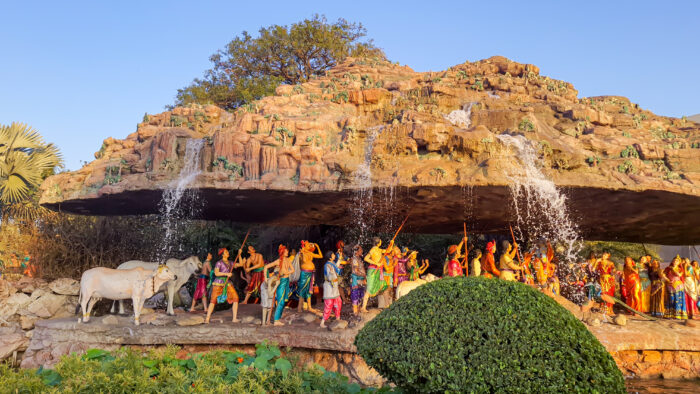
Thus, in a huge departure from tradition, the Mount, its trees and cattle were worshipped in a festival of joy and devotion. This made Shri Indra very angry and, in his fury, he unleashed upon the villagers a tempest of lightning, thunder, and torrential rain. Legend has it that Shri Krishna then miraculously balanced the Govardhan hill on his little finger and held it up like a huge umbrella to shield his fellow villagers from the rain. Some scholarly accounts speak of the miracle of the mountain itself, as it is said to have risen above the ground, enabling Shri Krishna to perform this wondrous feat.
Other scholars highlight Shri Krishna’s extraordinary leadership and steadfast courage, as he guided the Gopas and Gopis [5] into protective caverns within the Mount, shielding them from the storm. With tender care, he attended especially to the weak and vulnerable until the rains subsided. From that blessed moment onward, Govardhan has been revered as a divine embodiment, worshipped each year in the sacred tradition established by Bhagavan Himself.
Parikrama of the Govardhan Hill
The parikrama of the Govardhan Hill is of special spiritual significance, since, as outlined above, the hill named Giriraj Parvat, is a divine embodiment of Bhagavan himself. In an effort to honor the Divine Govardhan leelai, several hundreds of devotees go around the sacred hill, in a humble gesture of divine supplication to Him. This particular Parikrama is considered especially powerful in that it is believed to cleanse sins, fulfill desires and grant moksha [6] to devotees.
There are three types of Govardhan Parikrama available for devotees to undertake-
- Full Govardhan Parikrama – This is the traditional route of the parikrama, which is 21 km in length, covering all the sacred spots.
- Badi Parikrama – the 12 km route which covers the outer or remote places of worship.
- Chhoti Parikrama – an 8-9 km inner route centred around Radha Kund [7]and local shrines.
In general, the route along all three Parikramas include Kunds, Sarovars [8], places of divine significance and temples. The Parikrama can be undertaken on foot or by e-rickshaws. There are also different modes undertaken by devotees, depending upon the extent of their commitment and physical ability – walking, Dandavat[9] and Sankirtan Parikrama[10].
As suggested by our guide, and with Bhagavan’s blessings, we undertake the Badi Parikrama in an e- rickshaw. The route, beginning from the Dhaan Ghati temple at Govardhan village, covers a stretch of about 12 km covering the holy villages of Anyur, Puchhari and Jatipura before returning to the starting point.
A few kilometers into the parikrama and we reach Anyur village. On the outskirts of this village is the Sankarshan Kund, which is our first stop.
Sankarshan Kund
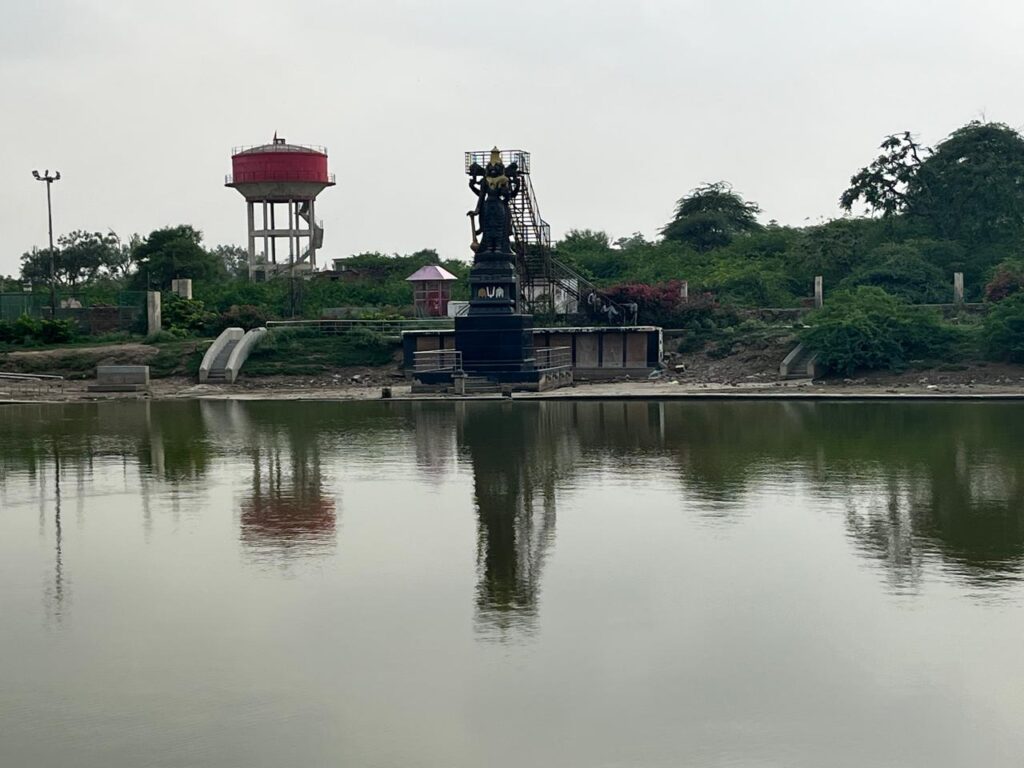
(Figure 1: Sankarshan Kund)
This is a pond dedicated to Balram Ji – Shri Krishna’s older brother. The pond is huge, spanning a few acres and on the opposite bank, there is a statue of Lord Sankarshan or Balaram. Legend has it that at the time when Shri Krishna lifted the Govardhan mountain, a lot of water collected under it due to the raging storm. Balram Ji collected this water and transferred it to this Kund to protect the people taking shelter from the storm. Our guide tells us that Shri Krishna’s great grandson Shri Vajranabh Ji established a temple dedicated to Balram Ji near the pond about 5000 years ago. Bathing in this Kund is also believed to free us from all the sins committed in the material world.
Right opposite the Sankarshan Kund, “Gouri Kund” is located. Radha Rani along with her Gopika friends worshipped the goddess Gauri here. Tradition also holds that this serene spot became a cherished meeting place for Radha Rani and Shri Krishna, where their divine love blossomed amidst the quiet waters and gentle surroundings.
Govind Kund
Shri Vajranabh Ji also installed a temple on the banks of the Govind Kund, dedicated to Shri Krishna. Post the lifting of the Govardhan Mountain by Shri Krishna, Shri Indra came down to worship Him, after realizing His true nature. Indra prostrated before Him and also performed an Abhishekam. The water from this Abhishekam[11] is said to make up the Govind Kund.
As we travel, we catch glimpses of many small temples dedicated to Shri Krishna, and many other deities. We are told of the “Apsara Kund”, which is said to have formed when Apsaras[12] along with Shri Indra had descended to perform Abhishekam to Shri Krishna. We also glimpse devotees on the walking Parikramas throughout the route.
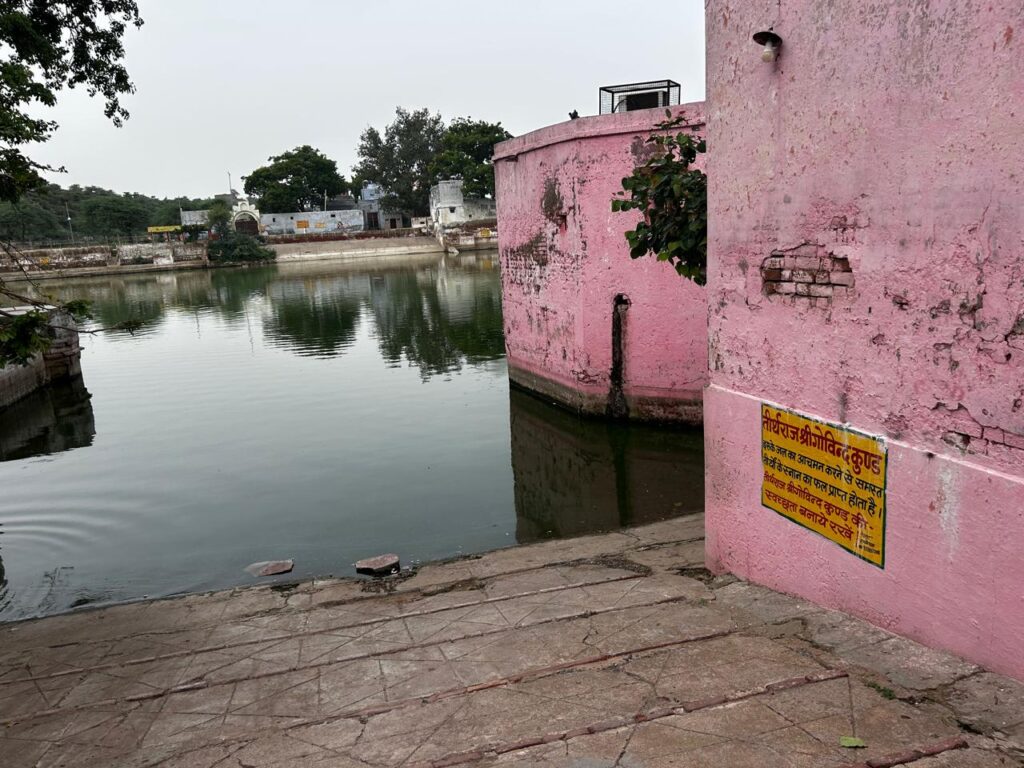
(Figure 2: A smaller Kund along the route)
Further on, we take a detour and walk to a small temple which houses rocks from the Govardhan mountain. The temple houses a few “Swayambhu”[13] rock formations and also shows a painting of Shri Krishna lifting the Govardhan Hill. Our guide and the priest tell us that throughout the village of Govardhan, such small temples housing sacred rocks and Swayambhus from the Govardhan Hill can be found. Govardhan Hill itself is said to be an embodiment of Shri Krishna after all.
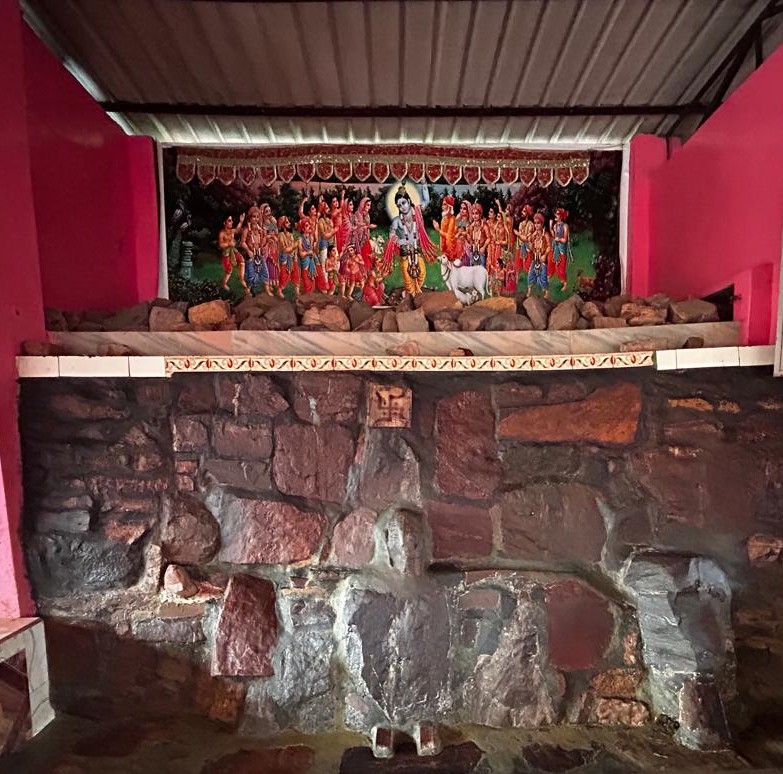
(Figure 3: A Small temple housing a Swayambhu rock)
After about 2 km of travel, we reached the Rajasthan border. We are told that the parikrama route goes via Rajasthan, where the next prominent temple stop is located. In and around the border areas, there are multiple vendors selling bananas – we are told that devotees purchase them to offer them to the resident monkeys.
Puchari ka Lautha Mandir
This temple is dedicated to Shri Krishna’s beloved friend. When Akrura, sent by Kamsa, arrived from Mathura to take the Lord away, Madhumangal Ji — also known as Lauta Ji — asked Krishna when He would return. Shri Krishna assured him that He would come back, and then departed. Yet, Shri Krishna did not return, and in unwavering devotion, Lauta Ji is believed to still wait at this very spot. His vigil is said to continue in tapasya[14], without food or water, sustained only by his love and faith, yearning endlessly for Bhagavan’s return.
The parikrama path then routes back to Uttar Pradesh and goes via the Jatipura village. In this village lies the famous Mukharavind temple. This temple houses the very rock Bhagavan stood on to hoist the Govardhan hill on his little finger. This rock or shila is worshipped as the main deity in the temple. To visit the temple, one would have to take a slight detour from the parikrama route.
Dhaan Ghati Mandir
We formally end the Parikrama with a darshan at the Dhaan Ghati temple. As directed by our guide, we made an offering of butter to Shri Krishna. This temple enshrines the divine image of Shri Krishna lifting Govardhan and sheltering His beloved Gopis and Gopas from Indra’s storm. Legend has it that it was at this spot that young Shri Krishna playfully stopped the Gopis, Radha Rani among them, on their way to Mathura and extracted a “tax” of butter from them. Even today, the offering of butter here is seen as a continuation of that eternal exchange of devotion and happiness.
As I stand in front of Bhagavan, I think of myself as one of the many people He is sheltering with the help of the Mountain. I pray to Him to grant me enough equanimity to weather the uncertainties in the days to come and for the first time in days, I feel a sense of calm and peace.
After this darshan, we decide to leave Govardhan and proceed to Vishram Ghat to witness the Yamuna Ghat Arti. Devotees, however, can continue on the Chhoti Parikrama route which covers a distance of about 9 km. This route houses many important sites like Manasi Ganga, Kusum Sarovar, Radha Kund, Shyam Kund and Udhav Kund.
As we leave the village, I give my thanks once again to Him, to have been able to set foot upon parts of the two Divya Desams on the same day. I am now awaiting another call from Him for a longer visit to these Divya Desams.
Hare Krishna.
Notes and References
- 102 Thiruvadamadurai (Mathura) – 108 divyadesam Introduction [Video] By Shri Velukkudi. YouTube. https://youtu.be/PTA1zRtmjBE?si=a8guMYdtBpKqSjN9
- 103 Thiruvaipadi (Gokulam) – 108 divyadesam Introduction [Video] By Shri Velukkudi. YouTube. https://youtu.be/ZgfquORLAo8?si=ML3ooaGBOEdVSlV4
- Shri K.M. Munshi, Krishnavatara 1 – The Magic Flute (1972), Chapter- The Lifting of The Govardhan, Publisher – Bharatiya Vidya Bhavan, Bombay
- Govind Kund | Gauri Kund | Govardhan Parikrama | Ep3 [Video] by Gupt Vrindavan Dham. YouTube. https://youtu.be/L-I9jDJrX1Y?si=vuM14DZwu1iFw3qd
- Puchari ka Lautha | Surbhi Kund | Govardhan Parikrama | Ep5 by Gupt Vrindavan Dham. YouTube. https://youtu.be/Y_ZcLo8_YBE?si=p4b3lFnfgDJccI4e
- Daan Ghati | Haridev Mandir | Govardhan Parikrama | Ep2 by Gupt Vrindavan Dham. YouTube. https://youtu.be/DlnA3BhWHkU?si=fK5829kOYCmSrAGp
[1] The Ālwārs were Tamil poet-saints (6th–9th century CE) devoted to Lord Vishnu. Their verses, compiled as the Divya Prabandham, are considered sacred in Vaishnavism and are recited in temples across South India.
[2] Punya Sthala (literally “sacred place of merit”) refers to a holy site where acts of worship, pilgrimage, or offerings are believed to bestow spiritual merit (punya) upon the devotee.
[3] Mangalāsāsanam refers to the act of the Ālwārs (Vaishnavite poet-saints) offering auspicious benedictions to Lord Vishnu at the Divya Desams. Unlike typical devotees who seek blessings from the Lord, the Ālwārs expressed their devotion by blessing Him, wishing His eternal glory and presence in the sacred temples.
[4] Leelais (divine pastimes) of Shri Krishna are the sacred acts through which the He reveals his boundless love, playfulness, and compassion.Shri Krishna’s leelais are not mere stories but eternal expressions of the Divine, inviting devotees to experience joy, surrender, and union with the Lord.
[5] “Gopas” refers to the cowherd boys and “Gopis” to the cowherd girls of
Vrindavan. They are remembered with deep reverence as the companions of Shri Krishna during his
childhood leelas — sharing in his play, devotion, and divine love.
[6] Moksha, in Sanātana Dharma, refers to liberation from the cycle of birth and death (saṃsāra). It is the ultimate spiritual goal — the soul’s union with the Supreme, free from worldly bondage and suffering.
[7] Sacred ponds or tanks.
[8] Large ponds, lakes or reservoirs.
[9] Dandavat Parikrama is a rare and intense form of circumambulation performed around Govardhan Hill or a sacred shrine. In this practice, the devotee offers full prostrations (dandavat) — lying flat on the ground with arms outstretched — and then rises only to mark the next step, repeating the act throughout the entire route.
[10] Sankīrtan Parikrama is a form of circumambulation accompanied by the collective chanting of the Lord’s holy names.
[11] Abhishekam is the sacred ritual of bathing the deity with sanctified substances such as water, milk, honey, ghee, curd, sandalwood paste, and fragrant oils. It symbolizes purification, reverence, and the devotee’s offering of the finest gifts of nature to Bhagavan.
[12] In Hindu tradition, Apsaras are celestial maidens renowned for their beauty, grace, and artistry. They dwell in the heavenly realms, often serving in the courts of Shri Indra, and are celebrated as dancers and musicians who embody divine charm.
[13] Swayambhu (literally “self-manifested” or “that which arises of its own accord”) refers to a sacred form or deity believed to have appeared naturally, without human crafting or consecration. In Sanātana tradition, a Swayambhu is revered as a direct manifestation of the divine will, embodying the Lord’s presence in its purest and most spontaneous form.
[14] Tapasya, in the Sanātana tradition, refers to disciplined austerity or penance undertaken with deep devotion and self-control. It often involves practices such as fasting, meditation, or renunciation, performed to purify the mind and body, strengthen spiritual resolve, and draw closer to the Divine.
Feature Image Credit: IStock
Disclaimer: The opinions expressed in this article belong to the author. Indic Today is neither responsible nor liable for the accuracy, completeness, suitability, or validity of any information in the article.