
The Question of Preservation
The Veda has been preserved across millennia through one of humanity’s most sophisticated knowledge-preservation architectures: an oral architecture sustained through the coordinated operation of the Vedāṅgas. Within this architecture, each Vedāṅga safeguards a distinct dimension of transmission. Śikṣā preserves the accurate transmission of Vedic sound. Chandas preserves the measured arrangement through which Vedic śabda is transmitted. Nirukta preserves access to meaning.
This raises an important question. Is the preservation of sound and meaning alone sufficient to ensure the continuity of transmission?
The Vedic tradition recognizes that faithful transmission depends upon preserving multiple dimensions simultaneously. As discussed in the broader framework of the Oral Architecture of the Vedāṅgas, sound, measure, structure, meaning, action, and time-reckoning each contribute to the continuity of transmission. Among these dimensions, the preservation of śabda requires a distinct layer of protection. The form, derivation, and structure of śabda must remain intact across generations if transmission is to remain faithful.
The preservation of śabda-pramāṇa requires multiple layers of protection. Sound must remain intact. Meaning must remain accessible. The integrity of śabda itself must also endure.
This requirement gives rise to a profound question: How does a tradition preserve the integrity of śabda across centuries when neither sound nor meaning alone is sufficient?
The Meaning of Vyākaraṇa
The term Vyākaraṇa itself offers an important insight into the nature of the discipline. Traditional scholars derive it as: वि + आङ् + √कृ + ल्युट् → व्याकरणम् (vi + āṅ + √kṛ + lyuṭ → vyākaraṇam). Here, the prefix वि (vi) conveys the sense of analysis, आङ् (āṅ) the sense of explicit manifestation, and the verbal root √कृ (√kṛ) the sense of bringing about. Together, they yield the sense of a discipline through which the constitution of śabda is analysed and brought into explicit understanding.
This understanding is captured in the traditional nirvacana:
व्याक्रियन्ते व्युत्पाद्यन्ते विशोध्यन्ते साधुशब्दाः अनेनेति व्याकरणम्।
vyākriyante vyutpādyante viśodhyante sādhuśabdāḥ aneneti vyākaraṇam.
(That by which valid śabdas are analysed, derived, and validated is Vyākaraṇa.)
The nirvacana is particularly significant because it speaks not merely of śabdas, but of sādhuśabdas—valid śabdas. Vyākaraṇa concerns itself with establishing the derivation, validity, and internal order of śabda. Embedded within the very name of the discipline is the idea of rendering that order explicit and available for systematic inquiry.
This emphasis on manifestation and explicit understanding appears elsewhere in the tradition as well. A celebrated Brāhmaṇa passage describes speech as originally avyākṛta—undifferentiated and unarticulated:
वाग्वै पराची अव्याकृतावदत् ।
ते देवा इन्द्रमब्रुवन्निमां नो वाचं व्याकुर्विति ।
तामिन्द्रो मध्यतोऽवक्रम्य व्याकरोत् ।
तस्मादियं वागुद्यते ॥
vāgvai parācī avyākṛtāvadat |
te devā indram abruvann imāṃ no vācaṃ vyākurv iti |
tām indro madhyato’vakramya vyākarot |
tasmād iyaṃ vāg udyate ||
(Speech is initially presented as avyākṛta-vāk. The devās request Indra to vyākuru—to render that speech differentiated and explicit. Indra enters into the speech and makes its internal order manifest. As a result, what was previously avyākṛta becomes vyākṛta—articulated, distinguishable, and available for understanding.)
The passage illustrates the process by which the order already present within speech becomes manifest through differentiation and analysis. The same insight is reflected in another traditional statement:
वाग्नो विवृणुयादात्मानम् इत्यध्येयं व्याकरणम्।
vāg no vivṛṇuyād ātmānam ity adhyeyaṃ vyākaraṇam.
(Vyākaraṇa is to be studied because it enables speech to unfold its own nature.)
Taken together, these traditional explanations reveal a consistent conception of Vyākaraṇa. It is the śāstra through which śabda is analysed, differentiated, and made explicit. Its purpose is to render the order inherent in śabda available for systematic inquiry, understanding, and transmission across generations.
The very name Vyākaraṇa thus points toward the central activity of the discipline: the systematic unfolding of śabda.
Why the Veda-Puruṣa Needs a Mukham
The Pāṇinīya Śikṣā identifies Vyākaraṇa as the mukham of the Veda-Puruṣa:
मुखं व्याकरणं स्मृतम्
mukham vyākaraṇaṃ smṛtam
(Vyākaraṇa is remembered as the mukha of the Veda-Puruṣa.)
The Sanskrit word mukha carries a broader meaning than the English word “mouth.” It may denote the face, the front, the point of manifestation, or that through which something becomes available for apprehension. Within the imagery of the Veda-Puruṣa, the designation points to the role of Vyākaraṇa as the discipline through which the constitution of śabda becomes manifest and intelligible.
This understanding follows naturally from the traditional conception of Vyākaraṇa itself. Just as the previous section described the movement from avyākṛta to vyākṛta, Vyākaraṇa renders explicit what would otherwise remain undifferentiated. It brings the order inherent in śabda into a form that can be examined, understood, and transmitted.
The designation of Vyākaraṇa as the mukham of the Veda-Puruṣa reflects its role within the larger architecture of Vedic knowledge. It is the discipline through which the order underlying śabda becomes manifest and available for systematic understanding.
The World Before Pāṇini
By the time Pāṇini composed the Aṣṭādhyāyī, the analysis of śabda was already established within a rich and living tradition. The sophistication of the Aṣṭādhyāyī itself, its reliance upon foundational components such as the Māheśvara Sūtras, the Dhātupāṭha, and the Gaṇapāṭha, and its integration within the wider network of the Vedāṅgas point to the existence of an extensive body of knowledge and reflection that preceded its composition.
The roots of this tradition are visible within the Vedic corpus itself. Vedic texts preserve numerous explanations of śabdas through their association with underlying dhātus, while Brāhmaṇa literature records technical terms such as dhātu, nāma, ākhyāta, vibhakti, pratyaya, and vyākaraṇa. These references indicate that inquiry into śabda and its constitution was already an established concern long before the composition of the Aṣṭādhyāyī.
The Vyākaraṇa tradition preserves the memory of earlier authorities such as Āpiśali, Kāśakṛtsna, Śākaṭāyana, Gārgya, and others. Their presence within the tradition indicates that inquiry into śabda, its derivation, and its ordered constitution was already well developed before Pāṇini. Although their independent works are no longer available, their influence remains visible through references preserved within the grammatical tradition.
Pāṇini inherited this intellectual legacy and organised it into an extraordinarily coherent śāstric system. The enduring significance of the Aṣṭādhyāyī lies in the precision, economy, and architectural unity with which it brought together generations of reflection on śabda.
The Aṣṭādhyāyī stands simultaneously as a culmination and a foundation—a culmination of earlier inquiry and a foundation for the vast Vyākaraṇa tradition that followed. Pāṇini is best understood as the great systematizer who brought an already mature tradition into an unparalleled śāstric form.
To study Pāṇini is thus to enter a tradition whose roots extend well beyond the Aṣṭādhyāyī itself.
The Engineering of the Aṣṭādhyāyī
The extraordinary brevity of the Aṣṭādhyāyī often conceals the sophistication of its design. At first glance, it appears to be a collection of nearly four thousand concise sūtras. In reality, it forms the visible core of a much larger and carefully integrated intellectual system.
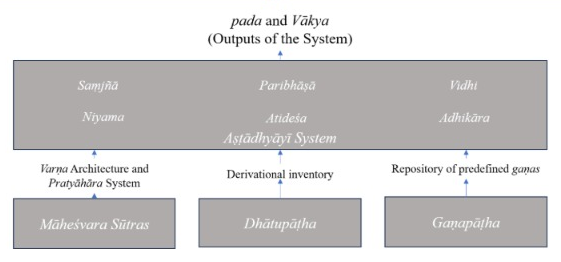
(Figure 1: The Aṣṭādhyāyī as an Integrated Śāstric Architecture)
Note: The figure illustrates the architectural organization of the Pāṇinian system. The Māheśvara Sūtras, Dhātupāṭha, and Gaṇapāṭha constitute the foundational components upon which the Aṣṭādhyāyī operates. The operational architecture of the system is structured through the categories of Saṃjñā, Paribhāṣā, Vidhi, Niyama, Atideśa, and Adhikāra. Through the coordinated interaction of these foundations and operational mechanisms, the Aṣṭādhyāyī provides a unified framework for preserving the structural integrity of śabda and its ordered manifestation as pada and vākya.
The Māheśvara Sūtra
The Aṣṭādhyāyī rests upon several foundational components. Among these, the Māheśvara Sūtras occupy a position of central importance. They provide the varṇa-architecture from which Pāṇini constructs the pratyāhāras—the compact designations that make the remarkable economy of the system possible. Much of the technical language of the Aṣṭādhyāyī rests upon this arrangement.
The Māheśvara Sūtras consist of fourteen sūtras that arrange the varṇas in a carefully structured sequence. Each sūtra concludes with a marker known as an it-varṇa (anubandha). These markers are not treated as members of the varṇa-groups themselves; rather, they serve as boundary indicators that enable the formation of pratyāhāras.
A pratyāhāra is a compact designation for a set of varṇas. It is formed by taking the varṇa with which the desired range begins and combining it with the it-varṇa that marks where the range ends. The resulting expression denotes all varṇas from the starting point up to, but not including, the marker itself. Through this mechanism, precisely defined varṇa-groups can be represented by remarkably concise expressions.
For example, the first two Māheśvara Sūtras are a i u ṇ (अ इ उ ण्) and ṛ ḷ k (ऋ ऌ क्). Here, ṇ (ण्) and k (क्) function as it-varṇas. The pratyāhāra aṇ (अण्) begins with a (अ) and extends up to the marker ṇ (ण्), thereby denoting a, i, u (अ, इ, उ). Similarly, the pratyāhāra ik (इक्) begins with i (इ) and extends up to the marker k (क्), thereby denoting i, u, ṛ, ḷ (इ, उ, ऋ, ऌ). The marker varṇas themselves are not included in the resulting set.
The same principle operates throughout all fourteen Māheśvara Sūtras. By selecting different starting varṇas and different ending markers, numerous pratyāhāras can be generated from a single arrangement of varṇas. Throughout the Aṣṭādhyāyī, Pāṇini employs these pratyāhāras as technical instruments, allowing rules to refer to precisely defined varṇa-groups without repeatedly enumerating their individual members. Without pratyāhāras, the repeated specification of varṇa-groups would greatly increase the length of the Aṣṭādhyāyī. The Māheśvara arrangement functions not merely as an ordering of varṇas, but as a compression mechanism that enables concise reference to repeatedly used varṇa-sets.
This ingenious arrangement contributes significantly to the remarkable brevity and precision of the Aṣṭādhyāyī. The Māheśvara Sūtras function not merely as a list of varṇas but as a carefully designed indexing framework from which Pāṇini derives the pratyāhāra system used throughout the śāstra.
The fourteen Māheśvara Sūtras are presented below. The final varṇa in each sūtra functions as an it-varṇa and serves as the boundary marker for the formation of pratyāhāras (see Table 1).
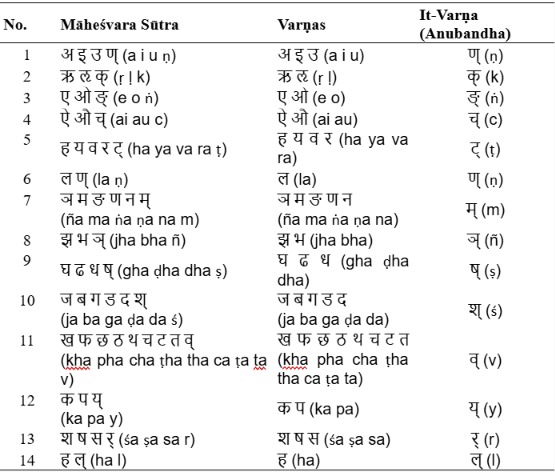
(Table 1. The Fourteen Māheśvara Sūtras and Their It-Varṇas)
Note: The final varṇa in each Māheśvara Sūtra functions as an it-varṇa (anubandha). These marker varṇas are not included in the varṇa-group denoted by the sūtra itself. Their primary purpose is to serve as boundary markers for the formation of pratyāhāras, the compact designations employed throughout the Aṣṭādhyāyī.
The Dhātupāṭha: The Derivational Inventory of the System
The Aṣṭādhyāyī further presupposes the Dhātupāṭha, the traditional collection of dhātus employed throughout the derivational system. The Dhātupāṭha serves as the foundational inventory upon which much of the Aṣṭādhyāyī operates. Rather than repeatedly enumerating dhātus within individual sūtras, Pāṇini refers to a pre-existing repository whose contents are assumed to be known.
The importance of the Dhātupāṭha lies in the role of the dhātu itself. A dhātu is not merely a verbal root in the modern grammatical sense. It serves as a foundational derivational element from which numerous śabdas may arise. A single dhātu can participate in the derivation of verbal forms as well as a wide range of nominal expressions.
For example, from the dhātu भू (bhū) arise forms such as भवति (bhavati), भावः (bhāvaḥ), भूतम् (bhūtam), and many others. The Dhātupāṭha functions as a repository of the derivational elements from which large families of related śabdas may be generated.
The Dhātupāṭha organises its dhātus into ten traditional gaṇas. These gaṇas classify dhātus according to the patterns of operation they undergo within the derivational system. The classification enables the Aṣṭādhyāyī to apply a single rule to an entire class of dhātus rather than repeating the same operation individually for each member.
The ten traditional dhātu-gaṇas are listed below in Table 2.
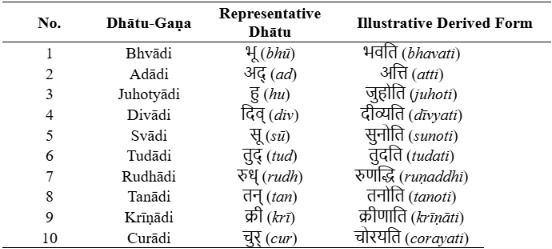
(Table 2: The Ten Dhātu-Gaṇas)
Note: The Dhātupāṭha contains a large collection of dhātus organised into ten traditional gaṇas. The purpose of this classification is to enable the Aṣṭādhyāyī to apply derivational operations efficiently across groups of dhātus that exhibit common patterns of behaviour.
The Gaṇapāṭha: The Repository of Gaṇas
The Aṣṭādhyāyī also presupposes the Gaṇapāṭha, a traditional collection of predefined gaṇas referenced throughout the śāstra. While the Dhātupāṭha provides the repository of dhātus, the Gaṇapāṭha provides repositories of predefined sets of śabdas that are invoked collectively within the Aṣṭādhyāyī.
The importance of the Gaṇapāṭha lies in the remarkable economy it affords the system. Many sūtras concern not merely a single śabda but an established collection of śabdas. Rather than repeatedly enumerating every member of such a collection, Pāṇini refers to the gaṇa through a single designation. A brief reference within a sūtra can invoke an entire predefined set of śabdas.
For example, the Sarvādi-gaṇa contains śabdas such as sarva, viśva, ubha, and ubhaya. Instead of repeatedly listing every member wherever a particular provision of the śāstra applies, the Aṣṭādhyāyī may invoke the gaṇa itself, allowing a single designation to represent the entire collection.
The Gaṇapāṭha thus serves a role analogous to that of the pratyāhāra system. Just as a pratyāhāra provides a compact designation for a set of varṇas, a gaṇa provides a compact designation for a set of śabdas. In both cases, a single designation enables the Aṣṭādhyāyī to invoke an entire predefined collection without repeatedly enumerating its members.
The Gaṇapāṭha contains numerous such collections referenced throughout the śāstra. Some consist of dhātus, while others consist of collections of śabdas brought together for the purposes of the system. The following examples illustrate the nature of these traditional gaṇas.
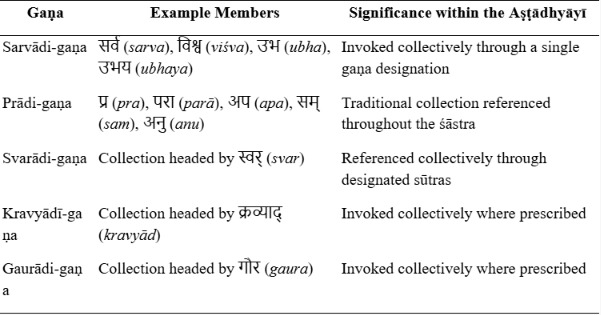
(Table 3. Illustrative Examples from the Gaṇapāṭha)
Note: The Gaṇapāṭha functions as a repository of predefined collections that allow the Aṣṭādhyāyī to invoke large sets of śabdas through concise designations. This mechanism contributes substantially to the brevity, precision, and architectural elegance of the system.
The true sophistication of the Aṣṭādhyāyī, however, lies in its internal architecture. Through saṃjñās, technical meanings are established. Through anuvṛtti, conditions and restrictions are carried across successive sūtras with remarkable economy. These mechanisms enable the operation of a highly compressed yet internally coherent system.
Traditional scholars have long recognized several structural categories through which the system operates. Saṃjñās establish technical definitions. Paribhāṣās provide interpretive guidance. Vidhis initiate operations. Niyamas introduce restriction. Atideśas extend properties across contexts. Adhikāras establish domains of applicability. Together they form the internal architecture through which the Aṣṭādhyāyī achieves both precision and economy.
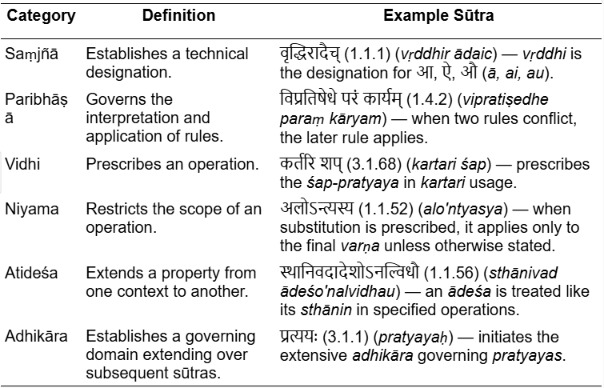
(Table 4: The Six Architectural Categories of the Aṣṭādhyāyī)
Note: The six categories presented here constitute a traditional framework for understanding the architecture of the Aṣṭādhyāyī. Particular sūtras may perform more than one function, and their classification is sometimes interpreted differently across commentarial traditions. The examples cited are intended as representative illustrations of the dominant function associated with each category.
Vyākaraṇa as a System Rather Than a Text
The Aṣṭādhyāyī is often approached as a collection of nearly four thousand sūtras. Such a description captures its form but not its nature. The significance of the Aṣṭādhyāyī lies not in individual sūtras viewed separately, but in the manner in which they interact within a highly ordered system.
A single sūtra rarely functions in isolation. Its operation frequently depends upon definitions established elsewhere, conditions carried forward through anuvṛtti, restrictions introduced by subsequent rules, properties extended through atideśa, and interpretive principles supplied by paribhāṣās. The meaning and operation of any individual sūtra emerge only within the larger framework to which it belongs.
This interconnectedness gives the system its remarkable economy. A condition stated once may influence a long sequence of subsequent sūtras. A technical designation may govern the operation of numerous rules distributed across the text. A restriction introduced in one location may determine the applicability of rules elsewhere. Brevity is achieved not through simplification but through the careful coordination of multiple interacting components.
The same architecture also enables the system to accommodate complexity without sacrificing coherence. General principles, specific conditions, restrictions, and exceptions are integrated into a single ordered framework. The resulting system combines economy with precision and permits a vast range of śabdas to be analysed and understood through a relatively compact body of sūtras.
The Aṣṭādhyāyī is best understood as a functioning śāstric system rather than merely a text. Its enduring achievement lies in the successful integration of definitions, procedures, restrictions, extensions, and interpretive principles into a unified architecture. The power of the system resides not in individual sūtras alone, but in the network of relationships through which they operate together.
This helps explain why the Aṣṭādhyāyī has remained the foundation of the Vyākaraṇa tradition for centuries. It is an intellectual architecture through which the order underlying śabda can be systematically analysed, understood, and transmitted across generations.
Vyākaraṇa Within the Oral Architecture of the Vedāṅgas
The significance of Vyākaraṇa becomes fully visible when it is viewed within the larger architecture of the Vedāṅgas. The preservation of the Veda was never entrusted to a single discipline. Instead, the tradition developed a coordinated system in which each Vedāṅga safeguards a distinct dimension of transmission.
Śikṣā preserves the accurate transmission of sound. Chandas preserves the measured arrangement through which Vedic śabda is transmitted. Vyākaraṇa preserves the structural integrity of śabda. Nirukta preserves access to meaning. Each discipline addresses a distinct transmission challenge and contributes a corresponding layer of protection.
The Vedāṅgas are therefore distinguishable, but not separable. They are distinguishable because each safeguards a different dimension of transmission. They are not separable because the preservation of the Veda as śabda-pramāṇa depends upon their coordinated operation.
Sound may remain intact while structure is lost. Structure may remain intact while meaning becomes inaccessible. Meaning may remain accessible while deviations in measured arrangement enter transmission. The preservation architecture succeeds because each Vedāṅga safeguards a distinct dimension of transmission that the others cannot fully replace.
Viewed in this way, the Vedāṅgas function not as isolated subjects of study but as cooperating components within a unified knowledge-preservation system. Together they preserve the continuity of śruti across generations by safeguarding sound, measured arrangement, structure, and meaning as interconnected dimensions of a single transmission architecture.
Within this larger framework, Vyākaraṇa occupies a vital position. It preserves the structural integrity of śabda and thereby contributes an indispensable layer to the preservation of the Veda as śabda-pramāṇa.
Conclusion: The Preservation of Śabda
We may now return to the question with which this discussion began.
If Śikṣā preserves the sound of the Veda and Nirukta preserves access to its meaning, what preserves the integrity of the śabda through which that meaning is conveyed?
The answer is Vyākaraṇa.
The significance of Vyākaraṇa lies in its preservation of the structural order underlying śabda. It safeguards the principles by which valid śabdas are constituted, derived, distinguished, regulated, and transmitted across generations. In doing so, it preserves a dimension of transmission that neither sound alone nor meaning alone can fully secure.
Viewed within the larger architecture of the Vedāṅgas, Vyākaraṇa occupies a vital position. The preservation of the Veda as śabda-pramāṇa depends upon the coordinated operation of multiple layers of protection, each safeguarding a distinct dimension of transmission. Within this architecture, Vyākaraṇa preserves the integrity of śabda itself.
This is why the tradition remembers Vyākaraṇa as the mukham of the Veda-Puruṣa. The designation reflects a profound recognition: the continuity of Vedic transmission depends not only upon preserving sound and meaning, but also upon preserving the structural order through which meaningful śabda remains intelligible across generations.
The enduring achievement of Vyākaraṇa lies in precisely this contribution. It preserves the conditions that enable śabda to remain available for understanding, transmission, and inquiry, thereby safeguarding an essential pillar of the Vedic knowledge-preservation architecture.
Acknowledgements
I sincerely thank Prof. G. Narahari Sastry, Dean, IIT Hyderabad, for his constant guidance and for helping me balance traditional Indian thought with contemporary perspectives. His support has been invaluable in shaping the direction and depth of this essay.
I am deeply grateful to Mrs. G. Songeeta for her insightful discussions, which significantly enhanced the clarity and philosophical precision of this work.
My daughter, Ms. Akanksha Garikapati (Masters in Performing Arts), offered a thoughtful and meticulous editorial review of the article.
References
- Garikapati Pavan Kumar. Indian Knowledge Systems as Epistemic Architectures: Transmission, Validation, and Ontology. Zenodo, 2025. https://doi.org/10.5281/zenodo.17970871
- Garikapati, Pavan Kumar. The Oral Architecture of the Vedāṅgas: Preserving the Eternal Veda. Indica Today, November 27, 2025. https://www.indica.today/long-reads/the-oral-architecture-of-the-veda%E1%B9%85gas-preserving-the-eternal-veda/
- Telugu Akademi. Pāṇinīya Aṣṭādhyāyī: Kāśikāvṛtti Sahitam (Prathama, Dvitīya Bhāgamulu). Translated into Telugu by Prof. Ravva Sri Hari. Vols. I–II. Hyderabad: Telugu Akademi, Reprint 2017.
Feature Image Credit: iStock
Disclaimer: The opinions expressed in this article belong to the author. Indic Today is neither responsible nor liable for the accuracy, completeness, suitability, or validity of any information in the article.