
Passing the Flame to Gen-H
“Dharma, when destroyed, destroys. Dharma, when protected, protects.”
— Mahābhārata[1]
We like to travel. When there’s an antiquity or a cultural museum in the city, we make it a point to visit it. And almost always, we walk away marvelling at the artefacts that carry the memory of the human spirit and creativity. The ancient vases and statues are beautiful, well-conserved and meticulously labelled. But they are utterly silent — because the culture that prayed to those deities, that debated in those schools, practised medicines with herbs, is gone. The philosophical traditions of Greece, the mystery traditions of Egypt — extinguished by edict, by conquest, by the slow erasure of neglect. A civilisation turned into an exhibit.[2]
Hindu tradition, by contrast, still breathes. It sings, argues, dances, and reinvents itself. Temples in Kumbakonam and Sydney chant the Gayathri Mantra the same way it was done thousands of years ago. Ashrams in Udupi and Kauai provide as serene a space for meditation as the first yogis on Mount Kailash. Debates on Hindu philosophy in Kashi and Oxford carry the same intellectual spirit of the ancient royal halls of Mithila and the universities of Takshashila. Ayurveda, Kalari and Yoga Asanas are practised in the same holistic tradition as they were for millennia. The Veena emanates notes in the Madras Music Academy for the common man with the same beauty as it did in the Brihadeesvara Temple for Raja Raja Chola a thousand years ago. That this tradition has survived — against very much ongoing pressures — is, when you stop to really think about it, nothing short of extraordinary. It survived because ordinary families, generation after generation, made a quiet choice: to keep the flame of Hindu Dharma alive.
We face the same choice. And the same question every Hindu parent eventually asks: how do we pass this to our children in a way that is genuine, not forced? How do we hand them a living tradition — not a museum piece, but not a superficial costume either? How do we pass on the eternal flame of Dharma that has helped us survive, even thrive, for millennia? This is the challenge of raising the next generation of Hindus — what we call Gen-H.
The Questions Haven’t Changed
“Learning is wealth that nothing can destroy.”
— Thirukkural, 400.[3]
Here’s what strikes us about the questions Gen-H is asking: they’re not new. They are, in fact, the oldest ones. What is my purpose? How do I choose right when everything seems relative? How do I stay grounded — and even joyful — through the inevitable ups and downs of life? How do I balance ambition, relationships, and inner growth without sacrificing one for another?
Hindu tradition does not sidestep these questions. It answers them with a precision and practicality that still surprises people encountering it for the first time. The Purusharthas — Dharma, Artha, Kama, Moksha — aren’t abstract philosophy. They’re a working framework for a complete human life. The Ramayana and Mahabharata aren’t bedtime stories; they’re pressure tests — situations designed to be uncomfortable, full of impossible dilemmas, where every character must live with the consequences of their choices. That’s the teaching. Sushruta’s Ayurveda and Patanjali’s Yoga Sutras mapped the mind-body-Universe connection long before modern wellness culture and peer-reviewed papers are only beginning to confirm.
And then there’s the question of happiness — the one Western philosophy keeps circling without quite landing. Jefferson declared it a pursuit, but offered no compass for the inevitable moments when desire goes unmet and pursuit itself becomes exhausting. Maslow placed Self-Actualisation at the peak of human aspiration, but could not say what it felt like to arrive there, how to sustain it, or whether the peak was the destination at all. Both frameworks, for all their insight, stop at the threshold. Vedanta and Yoga do not stop there. They identify Ananda — not as an emotion to be chased, but as the very nature of the Self, always present beneath the turbulence of circumstance. Patanjali’s Yoga Sutras offer a precise method: still the fluctuations of the mind, and what remains is not achievement but recognition, pure bliss. This is not a promise of happiness. Vedanta and Yoga offer something rarer: a map to its source — practical, tested across millennia, and open to anyone willing to walk the path.
The Problem Isn’t the Tradition. It’s the Transmission.
“The finest gift a father gives his child is to see him stand foremost among the learned.”
— Thirukkural 67.[4]
So why does something so profound and wholesome so often fail to reach the next generation intact?
Part of it is structural. The school run, the group chats, the focus on GPA and career moves, the sheer relentless busyness of modern family life — these compress the space where deeper conversations could happen. And when those conversations do happen, something often gets lost between a parent’s intention and a teenager’s ears.
But there’s a subtler problem too. Hindu tradition has sometimes been presented to young people as a set of rules to follow or customs to preserve — rather than as a living intellectual and spiritual heritage that belongs to them. The difference matters enormously. Rules invite rebellion. Rituals without knowing their underlying significance are viewed as superstitious. The real tradition, the flame, lives in our hearts and minds — one that invites exploration of its holistic width and depth.
Despite the age of short social media reels, Gen-H is not averse to depth. If anything, they’re hungry for it. In a world of surface and noise, genuine depth is rare. What they resist is condescension: the suggestion that their world is a degraded version of something purer that existed before they arrived. Meet them where they are, take their questions seriously and answer with the full resources of the tradition.
But are we as parents and teachers fully equipped to answer or explore these questions together? The answer, honestly, is that many of us are not — and that is where the real work begins.
Paramparā: One After Another
“Thus received in succession, the royal sages knew this.”
— Bhagavad Gītā 4.2.[5]
The word paramparā — literally “one after another” — tells us exactly how tradition is meant to travel. Not recorded in archives. Not preserved in institutions alone. Passed through persons, across time, carried in the way people actually live.
What we want for Gen-H, therefore, is not a superficial familiarity with Sanskrit terms and festival customs. We want depth — enough that when life presses hard, as it will, there is something real to draw on.
Thiruvalluvar captures it perfectly in the Thirukkural (396): dig a well in sandy ground, and the water rises in proportion to how deep you go. So it is with learning. Wisdom doesn’t arrive in sudden revelation. It comes through sustained, patient engagement.[6]
The Mahabharata is equally practical about how knowledge actually accumulates: “One fourth from the teacher, one fourth from one’s own intelligence, one fourth from classmates, and one fourth only with time.” Read that again. It’s not a hierarchy — it’s a recipe. The teacher (which includes parents and gurus), your own inquiry, your satsang peers and yoga community, and lived experience. All four, working together, over time.[7]
The good news is that the infrastructure exists to pass on this Parampara as suggested by the Gita: Mathas and Ashrams, Gurukuls, Yoga Schools, outreach programs such as Bala Vihar, Art of Living, Inner Engineering, focus groups such as Indica Today, and publications like Vedanta Kesari, have served for decades as lifelines for Hindu thought across the nation and beyond. And most importantly, because no institution replaces this: the countless conversations and daily disciplines within Hindu families, as we ourselves have been fortunate to receive them from our ancestors. Parents who are themselves living the tradition, not merely passing on instructions about it.
The Letter That Became a Book
“The learning gained in one birth protects a person across seven.”
— Thirukkural 398.[8]
When our daughter Uma was preparing to leave home for university, the question came sharply into focus: had we managed to give her enough of this foundation? We’d saved enough for her tuition. But she needed a compass — the inner kind. Had the conversations we’d had over the years accumulated into something she could actually carry?
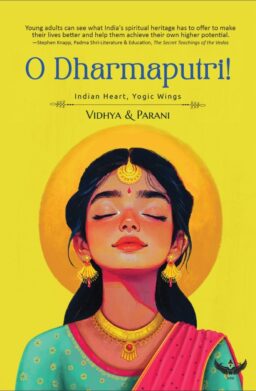
We decided to write it down: the frameworks, the stories, the principles we’d tried to live by, and our own honest wrestling with the tradition’s harder questions. That letter became the book
O Dharmaputri! Indian Heart, Yogic Wings — dedicated to Uma and, through her, to Gen-H. We hope it becomes the spade with which she can dig a well deep enough to gain real wisdom. The book speaks from a Hindu and Indian perspective, but the questions it addresses are universal. Anyone asking what it means to live well will find something of value here.
Uma is home for the holidays now, with her own yoga practice and sharper questions than she left with. She knows some of our traditional yogic and ayurvedic methods to take care of herself when she has a cold or stomach upset, or just exam stress. We can sense the deepening; she is beginning to see the beauty. We’re under no illusion that this is entirely our doing — the tradition itself is compelling, once you get close enough to it.
The Flame Is Ours to Pass
“O Agni, lead us along the good path.”
— Ṛg Veda.[9]
We owe it to our ancestors, our rishis, and our gurus — and to Gen-H themselves — that this tradition reaches them as ideas that lend clarity of purpose to life, principles with which to handle life’s dilemmas, and as practical tools with which to improve well-being, relationships, wealth, and spiritual growth. The gift of this cultural heritage equips them to live with consciousness, intention, resilience, compassion, and genuine inner freedom. A more conscious Gen-H is a better Gen-H for the world: for their communities, for the planet, for the families they will one day build.
The tradition that outlasted the edicts of Justinian and the silence of the Serapaeum and Machu Picchu is not going to be extinguished on our watch, as long as we keep passing the flame. Whatever form the passing of the flame takes in your family and community — through story, through practice, through ritual, through a quiet conversation after dinner — keep going.
May this light illuminate our future.
Note: ‘O Dharmaputri! Indian Heart, Yogic Wings’ (Garuda Prakashan) is available at garudalife.in and Amazon.
References
[1]. “Dharma eva hato hanti, dharmo rakṣati rakṣitaḥ.” Mahābhārata, Vana Parva 313.128; also, Manusmr̥ti 8.15. — Spoken by Yudhishṭhira to a Yakṣa during the forest exile. The full verse: “Dharma, when destroyed, destroys; dharma, when protected, protects. Therefore, I do not abandon dharma, lest the dharma I have forsaken destroy us.” The same verse appears three times in the Mahābhārata.
[2]. The edict of Theodosius in 391 CE destroyed temples such as the Serapeum in Alexandra. The Justinian edict in 529 CE ended the millennia-old Hellenic tradition of law, worship, and philosophy. Tomorad, M. (2015), “The end of Ancient Egyptian religion: The prohibition of paganism in Egypt from the middle of the 4th to the middle of the 6th century AD,” The Journal of Egyptological Studies IV: 147–164. Robert G. Hoyland — In God’s Path: The Arab Conquests and the Creation of an Islamic Empire (Oxford University Press, 2015).
[3]. “Kēṭil viḽucc elvam kalvi.” Thirukkural 400. From the ‘Kalvi’ (Learning) chapter of the Thirukkural, composed by Thiruvalluvar, estimated 1st–4th century BCE/CE. The Thirukkural’s 1,330 couplets cover ethics, governance, and love and remain one of the most translated works in Tamil literature.
[4]. “Tantai makaṛkāṛṛum nanṛi — avaiyattu munti iruppaṉ ceyal.” Thirukkural 67, from the ‘Makaṭpēṛu’ (The Wealth of Children) chapter. One of the ten couplets Thiruvalluvar dedicates to the parent–child relationship. Where the surrounding verses celebrate the joy children bring, this one turns the gaze back on the parent: the real gift is not affection, but the deliberate investment of knowledge.
[5]. “Evaṃ paraparāprāptam imaṃ rājarṣayo viduḥ.” Bhagavad Gītā 4.2.
[6]. “Thottanaith Thoorum Manarkeni Maandharkkuk Katranaith Thoorum Arivu.” Thirukkural 396. From the ‘Kalvi’ chapter. The original couplet: “As the water in a well rises in proportion to the depth dug in sandy soil, so does wisdom flow in proportion to one’s learning.”
[7]. “Ācāryāt pādamādatte, pādaṃ śiṣyaḥ svamedhayā, Pādaṃ sabrahmacāribhyaḥ, pādaṃ kālakrameṇa ca.” Mahābhārata, Udyoga Parva 5.44.16.
[8]“Orumaikkaṇ tāṉkaṛṛa kalvi oruvaṛku eḻumaiyum ēmāp puṭaittu.” Thirukkural 398. The Tamil concept of ‘ezhumai’ (seven births) reflects the tradition’s view of knowledge as cumulative across lifetimes.
[9]. “Agne naya supathā rāye asmān.” Ṛg Veda 1.189.1. — A prayer to Agni, the sacred fire, as guide and illuminator. Agni in the Vedic tradition is not only the ritual flame but the inner fire of consciousness.
Disclaimer: The opinions expressed in this article belong to the author. Indic Today is neither responsible nor liable for the accuracy, completeness, suitability, or validity of any information in the article.