
In an era marked by hyper-commercialised media environments and increasingly polarized news narratives, the search for authenticity in storytelling has become more challenging than ever. Against this backdrop, Karolina Goswami, an independent European researcher and digital commentator, embarked on a journey that would not only transform her own life but also positively influence how millions around the world perceive India.
Leaving behind a promising professional career, Goswami chose to establish a social media platform driven not by rebellion, but by a sense of responsibility. At a time when she felt that global media often presented fragmented or selective portrayals of India, she set out to offer a research-based perspective highlighting what was ignored or overlooked by many.
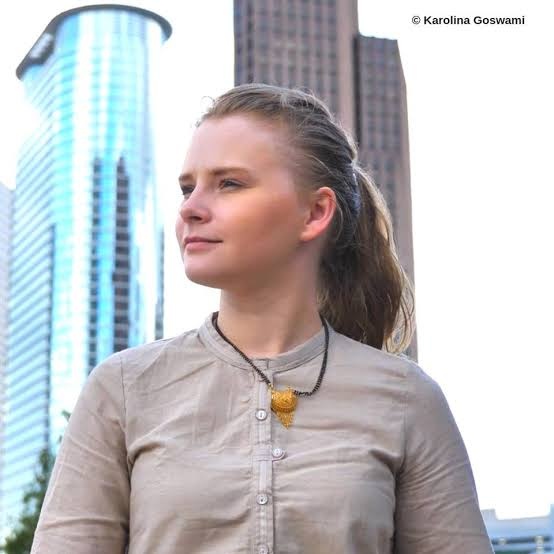
Karolina Goswami is an author and independent digital analyst known for her decade-long engagement with Bharat and its civilizational heritage. Recognized as a EuropeIndia40 – Top 40 Under 40 Europe India Leader (EICBI, 2020) and honoured as one of the “most impactful women creators” by Times Entertainment (in March 2026), Karolina Goswami has built a substantial global audience through carefully researched content across multiple digital platforms.
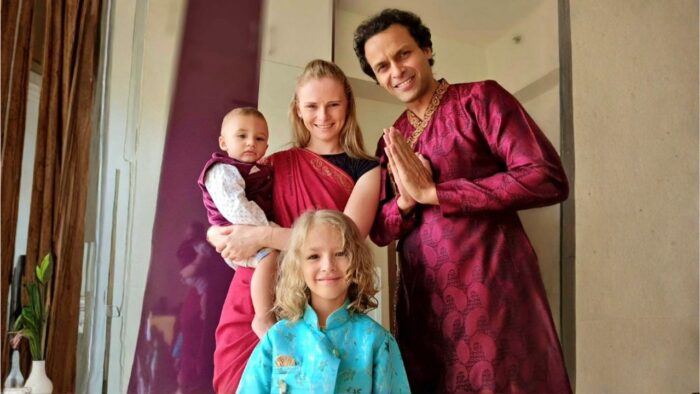
Born in Poland, Karolina is married to Anurag Goswami, an Indian from a traditional Hindu family. The couple lives in India, where she produces analytical and research-oriented content on her YouTube channel, India In Details. Alongside this, glimpses of her family life and reflections on Indian culture are shared through short-form videos on her Instagram platform, @indiaindetails.
“My research and investigations require travel, financial investment, and personal sacrifices. What drives me is both an emotional connection and a commitment to logical inquiry,” she explains.
What began as an effort to present data-driven discussions on India has gradually evolved into a digital platform encouraging audiences to reassess prevailing assumptions—not only about India, but also about the West, about the Hindu civilization, cultural identity, modernity, and the evolving role of the world’s largest democracy.
Her work has found resonance among viewers seeking credible and reliable alternatives to agenda-driven narratives. Now, she continues her effort to introduce global audiences to dimensions of the country that, in her view, remain insufficiently understood. Her journey, however, began long before she emerged as a prominent digital voice. What follows are excerpts from an exclusive online interview with Karolina Goswami.
How did you become attracted to India and Hinduism? What was the turning point in your life?
It has been more than ten years since I first came to India. On my very first visit, I went on a long and intense road trip from the North to the South, which gave me many opportunities to learn, observe, and transform.
Fortunately, such road trips and my continuous journey of learning about India have not stopped.
On a personal level, my husband has faced and continues to face instances of racism in Poland. Our wedding ceremony in Poland was not attended by some relatives because Anurag is Hindu. Some of my relatives and so-called well-wishers asked “strange” questions such as, “Why are you marrying a Hindu?” “Do you know that in India you might get raped?” “Do you know Hindus have many wives?” and so on.
Not only that, there was societal pressure in Poland to convert my husband to Christianity. We were denied permission to hold our wedding rituals in the local Catholic church, even though I am Catholic.
We were informed that the only way forward would be to either get my husband converted to Christianity or provide a written commitment stating that we would raise our “future children” exclusively as Catholic Christians.
We did not like the idea of declaring the religion of children who were not even born yet, so we refused. The local priest then denied us permission. My parents’ dream and my own childhood dream of having a church wedding came crashing down simply because I did not want to declare that our future children would be raised only as Christian.
Our wedding ceremony in Poland was eventually held outside the church.
On the other hand, our wedding ceremony in India had no such issues. Anurag is Hindu, and his parents are very dharmic and traditional Hindus.
But in Anurag’s family and among his relatives, nobody was bothered that I am Christian. There was no question of me converting to any religion. We had a ceremony in a popular Hindu temple in India, and nobody objected.
Nobody in that Hindu temple asked what religion our future children would belong to. There was no question of racism whatsoever, only genuine smiles, sincere curiosity, and accommodating behavior.
Besides that, in Europe, I noticed that the mainstream media is not doing enough to show all sides of India. This realization motivated me to highlight the aspects of India that are lesser-known or not fully understood in the West.
At one point, I told myself, “Enough is enough. Something has to change.” That’s how the idea of our YouTube channel – India in Details was born – and it became the turning point of my life.
As a production engineer who studied in Polish language, switching to English and embracing a completely new professional path could certainly have seemed like a challenge.
However, I was driven by good intentions and a genuine desire to bring to light the lesser-understood aspects of Bharat for the world.
Anurag, my husband, and I want to challenge what can be seen as a “twisted” Eurocentric and Western-centric narrative. We want to question colonial-era power structures and address what can be seen as misleading “anti-India” and “anti-Hindu propaganda” that have influenced global perceptions. In our view, such “twisted” narratives have contributed, at least in part, to the racism and hostility that many Indians face, both online and offline.
We want to contribute, in a meaningful way, to helping our world “decolonize” and to minimizing conflicts and reducing cultural tensions.
I want to broaden people’s understanding of Bharat and help them, if I could, become better informed about India and the West. I learned gradually, and I am still learning, about India and the world. My English has improved gradually, and it continues to be a work in progress.
I am not here to impose my views on anyone. I am here to learn, share, and grow together.
By bringing forward the facts I have uncovered and by seeking the truths I have explored, I have simply aimed to encourage critical reflection in the Western world. I ask my fellow Europeans: Is there any harm in learning positive things from India or other nations? Don’t we, Europeans, at times, need to be more self-critical?
Every day, I continue to learn, and I remain fully open to correcting my mistakes whenever I become aware of them.
What, according to you, is good about Hinduism/Sanatana Dharma?
Hinduism, rooted in Sanatana Dharma, encourages questioning, and I really admire that. Sanatana Dharma’s naturally accommodating and inclusive approach, in a way, offers a framework that can help address many of the tensions we see in today’s world.
On the other hand, there are monopolistic, monotheistic religious forces that often demand exclusivity, whereas Hinduism, in so many ways, celebrates inclusivity.
I have said this before: those exclusivity-demanding, monopolistic, monotheistic religious forces that delegitimize all other paths or seek to replace all other paths cannot fully promote inclusivity in the true sense.
If we truly want a peaceful world, we should remember this: any monotheistic religion that strictly demands exclusivity while delegitimizing or invalidating all other paths, in a way, can promote tension and supremacy while undermining inclusivity.
Now one may ask: do multiple denominations in Christianity and Islam strictly demand exclusivity while delegitimizing all other paths? If they do, how dangerous can that be to societal inclusivity?
Please explain, “India has changed me and exposed me to a world completely out of the ordinary.”
To me, in India where I live, most people do not seem superficial. Here, many seem to have genuine smiles. Perhaps, a smile becomes genuine when one is transparent. An atmosphere positively charged with such transparency allows a person to evolve in a positive way.
It is not only about being honest with others, but also about being honest with yourself. This is one of the many things I consider extraordinary.
What are your views on the Indian economy? In your video, you stated that “India is not just developing — India is reclaiming.” Could you please elaborate on this?
It is true that Bharat was prosperous for centuries; it was a global economic and ‘spiritual’ powerhouse.
Overall prosperity, not merely growth in numbers, is what is needed now, and it appears that India is on its way to reclaiming that. India has its share of imperfections and challenges, but that makes the journey even more meaningful.
Wealth worth trillions of dollars was looted or extracted from India by European colonial criminals.
Imagine how much faster India could grow today if it got back all the wealth that was looted. But it seems clear that the Western colonial criminal states don’t want to, or cannot, return it.
Despite this, Indians are rebuilding their country and demonstrating their resilience.
I understand that you have traveled extensively across India. What are your impressions?
It is a world within a world. Diversity exists everywhere, in what are often described as “skin tones,” “facial features,” culture, cuisine, landscapes, climate, and much more.
But alongside that diversity, there is also something deeply unifying: Bharat’s civilizational heritage. Despite the visible differences, there is an underlying civilizational continuity that binds it all together.
On a personal level, I have experienced a great deal of kindness. Most Indians I have encountered have been remarkably hospitable.
How do you view Bharat, a unique country with diverse religions, castes, creeds, communities, and lifestyles? What is the future of India/Bharat?
Well, the future of Bharat is likely to be very bright if it can keep its Sanatana civilizational heritage alive, a pluralistic and polytheistic heritage that is naturally inclusive. As long as that remains the foundation of this country, it is likely to excel.
At the same time, exclusivity-demanding, foreign, monopolistic, monotheistic religious forces that seek to alter that foundation and challenge Bharat’s naturally and inherently inclusive soul must be approached carefully and thoughtfully.
In your question, you mentioned “castes.” As far as the so-called “Hindu caste system” is concerned, there seems to be a great deal of confusion surrounding the term itself, both within India and elsewhere.
I have addressed this subject in detail in my videos:
VIDEO LINK: https://youtu.be/j8121SyIC4M
VIDEO LINK: https://youtu.be/ngHbZ__QzLg
Besides that, I must mention that I have made several videos explaining what can be seen as Western caste systems.
After all, how many of us are aware of European history regarding “Christian caste systems” and forms of “Christian untouchability”?
Well, the ‘Cagots’ in France, the ‘Unehrliche Leute’ in Germany, and the ‘gong farmers’ of so-called “civilized” Europe… The list goes on… There is a lot that I have explained or brought to light.
VIDEO LINK: https://youtu.be/nAF3wTOdJ6I
While Indian philosophy, culture, and lifestyle are gaining increasing acceptance in the West, we Indians seem to be busy copying the West — your comments?
There is no harm in learning ‘good’ things from one another. There is a lot that the West can learn from India, and there are a lot of ‘good’ things that India can learn from the West.
What seems unfortunate is that when many Indians fail to critically analyze certain Western behaviors or foreign practices and blindly copy them, they lose their self-respect, cultural diversity, and identity in the process.
Many in the West see and treat India primarily as a market. When you treat an ancient civilization or a civilizational nation merely as a market, you are unlikely to give it the respect it truly deserves.
Not only that, but the Western commercial monoculture, which not only homogenizes but also exploits, should be critically analyzed.
Gaining commercial advantage through cultural domination is a time-tested strategy, and India has, at times, been on the receiving end.
Many Indians also struggle with a post-colonial identity crisis and, actually, they need support for their emotional and religious decolonization.
It clearly seems that those emotionally colonized or religiously colonized Indians are, in a way, very vulnerable. To make matters worse, many of them seem completely unaware that they may need guidance or reeducation to decolonize themselves.
Some of them even seem proud of their “borrowed” or “externally imposed” identities and mock or look down upon their own indigenous and pre-Christian, pre-Islamic cultures and ancestors.
On numerous occasions, I have noticed Indians blindly adopting failed or twisted Western and foreign experiments.
It is important to remember that globalization or ‘modernization’ does not justify blind Westernization or homogenization.
It is important to remember that one must not surrender to Western-centric worldviews.
It is important to remember that one should critically analyze Eurocentric worldviews.
What are your views on proselytization?
To start with, conversion to a monopolistic religious path should be discouraged, as it can harm the world’s naturally occurring diversity, which should not be erased.
But yes, a genuine and agenda-free decision to choose a non-monopolistic foreign spiritual or religious path of one’s choice can be acceptable, provided the decision is made with full awareness, genuine devotion, and proper knowledge of the new path.
In addition, the decision must be grounded in informed understanding; free from any direct or indirect pressure or coercion; and undertaken in a mutually respectful free environment without power imbalances favoring any side.
I have made multiple videos on proselytization and conversion to Christianity.
The task of the “total evangelization of the world,” as described by the Lausanne Movement, doesn’t just seem radical but it may also hurt or dilute our indigenous and pre-Christian global civilizational heritage.
VIDEO LINK: https://youtu.be/BRAe6ZLuBFw
VIDEO LINK: https://youtu.be/3SO2oEiBD-c
VIDEO LINK: https://youtu.be/GLlH6OgIBjc
Some Western colonial Christian criminal states destroyed parts of global civilizational heritage across the world. At the very least, we can remain vigilant and prevent similar patterns from continuing today, whether directly or indirectly.
Nowadays, spiritual leaders, particularly Hindu saints, make it a point to tell that all religions are the same. However, Christian and Muslim religious leaders/ scholars assert that ‘salvation’ is possible only through their chosen path. What are your comments?
I cannot generalize or confirm that this is a universal position among spiritual leaders, as my experiences may be limited.
However, I would say that it may be inappropriate and unwise to compare “Dharma” to a “religion,” as they may not be completely identical when it comes to their core foundations.
Exclusivity that is strictly demanded by any monotheistic, monopolistic religious force is, of course, against inclusivity.
Not only that, such religious forces appear supremacist and, in extreme cases, ‘genocidal’ in nature.
History has repeatedly shown this.
Of course, in some cases, even a foreign (non-monopolistic) religious ideology may contribute to India’s diversity – but only if it does not, directly or indirectly, attempt to erase, oppose, invalidate, delegitimize, or weaken the pluralistic, inclusive, polytheistic, and diverse Dharmic paths that already exist in Bharat.
Shouldn’t Indians have the right to reject monotheistic, monopolistic religious colonialism and to revive or return to their pre-Christian and pre-Islamic cultural and indigenous roots? After all, this is a matter of their sovereignty and their ‘right’ to pre-Islamic and pre-Christian cultural self-determination. Protecting and preserving indigenous heritage is a principle that should ideally be supported by those who present themselves as ‘liberal.’
Your message to the readers?
Mainly, we produce two types of content:
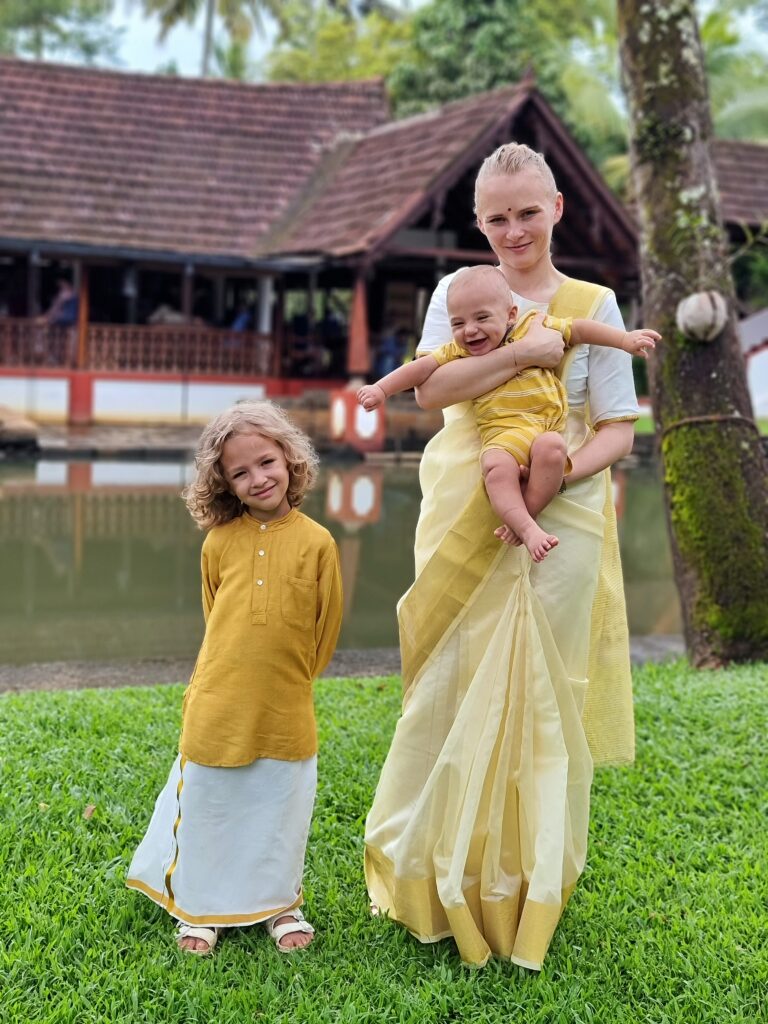
The first type is family vlogs on YouTube (Karolina Vlogs with Anurag) and our family reels on Instagram (@indiaindetails), through which we share a glimpse of our lives with our well-wishers and viewers. I am not very regular on these platforms due to time constraints, but through these vlogs and reels, the Dharmic elements of our daily lives, whether Bharat’s traditional clothing or India’s beautiful traditions, are naturally reflected. We live them sincerely and present them without any mask. We simply show our life as it is, rooted in tradition, culture, and values.
The second type of content is, actually, our main focus. This is the type of content through which we began our journey on social media, our YouTube channel, India in Details. Here, I cover a range of serious subjects related to geopolitics, respond to what is seen as ‘anti-India’ and ‘anti-Hindu’ propaganda, and examine aspects of the West that are often overlooked, deliberately underrepresented, among other topics. It is here that we critically explore the aspects of the West that are often left unspoken.
To produce this well-researched content, my husband and I have dedicated more than ten years of our lives. We have invested our own resources, money, assets, hundreds of sleepless nights dedicated to research, and even sacrificed our original career paths, along with much more.
At times, we struggled financially simply because we chose to do this for Bharat and her people. Even today, we continue to operate while facing a financial deficit.
We sold our ancestral gold and even our first apartment to fund this seva for Bharat.
The journey hasn’t been easy.
We have received multiple death threats.
This happened after I fact-checked Dhruv Rathee’s content. I demonstrated that his video contained fake or fabricated content.
VIDEO LINK: https://youtu.be/k5-FlvC6utA
VIDEO LINK: https://youtu.be/nrgRoer2aTs
We faced attacks and abuse both online and offline. We were targeted in Europe. Our car was damaged. Many disturbing things were done to us, things I do not wish to recall.
VIDEO LINK: https://youtu.be/1C76n8OYb8o
Yes, there are people who value and understand the importance of our work. However, overall, the country and the Dharmic community have not financially supported our efforts to the extent that was required.
We live in India and are raising our children here. Our children have Indian citizenship. They automatically became Polish citizens at birth, but we later applied to give up their Polish citizenship. We chose to give up the European Union and decided to live in India.
Our carefully researched work has been regarded as valuable to India and the Dharmic community worldwide.
Some of our content contains exclusive work, and research one may not easily come across anywhere else.
In addition, these three playlists contain some of the most deeply and painstakingly researched work that Anurag and I have published:
PLAYLIST 1 – Can Indians Question You?
https://www.youtube.com/watch?v=CrIMjG07FpQ&list=PLl_eHKzVOHeusZDqRN9wJP8X8YajI5GHl
PLAYLIST 2 – How India has ‘civilized’ the West:
https://www.youtube.com/watch?v=dANFYQEJuw8&list=PLl_eHKzVOHeu9mI_nR4YMnR6H5iCzVv1v
PLAYLIST 3 – Should India Follow the West Blindly?
https://www.youtube.com/watch?v=JHMnUCKIL2k&list=PLl_eHKzVOHevfK91jRdFFAxL9fPrlq3-h
Bharat has produced, and continues to produce, outstanding thinkers, scholars, and innovators across many fields.
Bharat also has a long tradition of academic and intellectual achievement.
No doubt about that! However, today, many in the Hindu community are still not asking the questions that need to be asked.
Anurag and I have undertaken work that many within the Hindu and Indian ecosystem had not addressed before us. I have multiple examples, but I will mention just two here.
Example one: In Belgium, after visiting the European Parliament, I presented an “International List Of Shame.”
The BBC, DW, Dhruv Rathee, and ‘Joshua Project’ were exposed in a way not seen before.
VIDEO LINK: https://youtu.be/uc_aCmh9Q6M
VIDEO LINK: https://youtu.be/7xmOnhoPpVk
Example two: I have not come across anyone in the entire Hindu ecosystem or in India who spoke about what can be referred to as “Christian cannibalism” before I did, or in the way that I did.
Yes, this deeply unsettling aspect of European history has not been given the attention it deserves, either in the media or in academia.
The practice of “cannibalism” that occurred in parts of Christianized Europe can be regarded as one of the greatest historical whitewashes in world history.
Practices such as “corpse medicine,” including the consumption of Egyptian mummies and other human remains, were present in so-called Christianized Europe. A lot of this occurred during periods when European colonial powers claimed they were “civilizing” the rest of the world.
Please watch this video:
VIDEO LINK: https://youtu.be/FXLxPK_rxxU
To those viewers who find our content thought-provoking and see it as a “game-changer”, Anurag and I can assure you of this: so far, we have only scratched the surface. There is much more waiting to be published.
Yes, we have more well-researched work sitting in our private library, waiting to be published.
Even when we are not publishing videos, Anurag and I are constantly collecting information and researching. As a result, our personal library now contains a vast collection of paradigm-shifting research that could make a transformative contribution to India and the Dharmic community. Unfortunately, a lot of it remains unpublished.
Our limited funds slow us down, and because of that, we cannot publish as quickly as we would like.
If our well-researched content in our private library remains unpublished and fails to reach the public due to limited funds, it could be a significant loss for India, for the Hindu community, and for genuine supporters of decolonization around the world.
But we will never give up.
We will do whatever it takes, within our capacity, to continue this work, whether anyone chooses to support us financially or not.
We will never stop.
Also, I respectfully request that my works, whether written, translated, summarized, or adapted in any form, are not copied, reproduced, or plagiarized. This includes any derivative works, translations, modifications, or summaries.
(Note from the author: The opinions expressed in this article belong to the interviewee, Smt. Karolina Goswami. If you wish to support or contact Karolina Goswami, you can write to this email address: indiaindetails@gmail.com)
Disclaimer: The opinions expressed in this article belong to the author. Indic Today is neither responsible nor liable for the accuracy, completeness, suitability, or validity of any information in the article.