
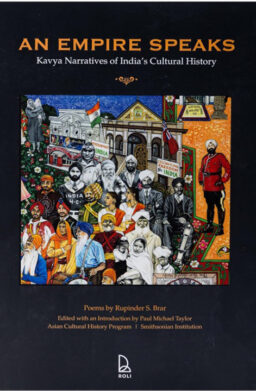
In a time when public discourse often frames Sikh identity as a reaction, either as a reformist extension of Sanatan Dharma or a rupture from it, ‘An Empire Speaks’ offers a more rooted, sovereign response. Dr. Rupinder S. Brar’s poetic work revives the ancient literary form of kāvya to articulate a civilizational continuity that includes the Sikh tradition not at the margins of Indic heritage, but at its moral core.
The result is not just a book of poems. It is a literary reclamation. An Empire Speaks belongs not only to the aesthetic realm, but also to the domain of civilizational memory. Through verse that is historically grounded, spiritually luminous, and philosophically resonant, Dr. Brar reclaims a poetic form that once transmitted dharma, sovereignty, and truth.
Kavya as Civilizational Medium
Rooted in the classical tradition of Sanskrit kāvya, but composed in English, the youngest South Asian language, this work builds a literary bridge between epochs, languages, and identities. The kavya tradition has long been the carrier of cultural DNA in India, from the Raghuvamsha to the Ramcharitmanas. In An Empire Speaks, Brar places Sikh figures, Bhakti saints, and historical rebels within this grand tradition—asserting, implicitly but powerfully, that the Sikh poetic voice is not anomalous but anchored.
The structure of the book reflects the architecture of a mahākāvya, composed in five movements: The Ancients, The Nanakians, Acacia Around the Orchard, Imperium Imperfect, and Diasporic Reflections. Each section builds upon the previous, not just as narrative, but as moral recursion. This is poetry not of performance, but of praxis – a call to remember, realign, and reclaim.
Re-Inhabiting the Indic
The opening poems set the tone for Brar’s vision of continuity. He opens not with Punjab or the colonial rupture, but with Sita, Ganga, Eklavya, and Adi Shankara – figures whose moral dilemmas and civilizational weight still haunt the Indian consciousness. These verses are not mere allusions. They are reinterpretations. Ganga is not just a river, but a civilizational mother; Eklavya is not just a victim, but a seer of injustice; Shankara is not just philosopher, but mapmaker of non-duality.
Brar writes:
“Founder, redeemer, cleanser is she,
a throbbing heart of a mother; not a river,
telling in fluid motion the story of Aryavarta.”
Such lines reintroduce readers, particularly those in the diaspora or post-colonial settings, to a poetic tradition where geography is ethics, and rivers remember.
The Sikh Voice Re-Centered
Where the book becomes transformative is in its unapologetic centering of Sikh civilizational memory. Figures such as Guru Nanak, Guru Arjan, Guru Gobind Singh, and Banda Singh Bahadur are not presented as sectarian icons, but as kāvya subjects—moral agents in the Indic arc.
Guru Arjan’s martyrdom is presented not through lament, but through luminous restraint. Banda Singh Bahadur is remembered not as a rebel, but as a civilizational steward. Guru Gobind Singh’s transformation of society through the Khalsa is framed as an ethical constitution—not merely a religious act.
Brar writes:
“You may have come here as peasants
yet will go back no less than kings…
Now go my warriors, scholars, and saints,
be redeemers of our ancient land.”
This is kavya at its highest register, where poetry encodes sovereignty, and the sword is metaphor not just for defense, but for the piercing clarity of truth.
Bhai Gurdas and the Orchard Metaphor
One of the most striking metaphors in the book is adapted from Bhai Gurdas: the orchard and the acacia. The orchard is a dharmic civilization, vulnerable and rich. The Khalsa are the acacia fence, thorny, unyielding, essential.
This metaphor is not defensive. It is preservational. Brar’s poetry reminds us that Sikhism was never an offshoot nor an outsider faith, it was, and remains, a civilizational conscience, arising when others faltered.
In this framing, the Khalsa becomes not a militia, but a mandala. Guru Gobind Singh’s project becomes not a rupture from India, but its ethical repair.
Diaspora Without Deracination
The final movement of the book shifts tone, turning inward toward migration, memory, and belonging. Here, Brar does not romanticize exile nor glorify victimhood. Instead, he marks the diaspora’s emotional landscapes with humility and hukam.
In the poem Three Homelands I Claim, he writes:
“Scatter my ashes among all three,
to repay that which is owed to each.
But then let the spirit go free…”
The poem became a key curatorial voice in the exhibition I Will Meet You Yet Again at the Fowler Museum at UCLA, which I co-curated. Its resonance lies in its refusal to choose one homeland over another, and in its quiet claim that belonging can be plural, but memory must be whole.
A Book You Don’t Just Read, But Walk Through
The book includes artwork by The Singh Twins, whose layered, postmodern, miniature style mirrors the poetic method: civilizational in reference, modern in technique. Their visuals offer a parallel text, a visual kavya that expands Brar’s themes of syncretism, sovereignty, and continuity. Together, the images and verses form a multi-sensory narrative of South Asia’s poetic memory.
The Final Thread
Historian R.P. Bahuguna writes that by the 18th century, the Bhakti movement had softened across India. Temples were re-ritualized, saints absorbed, heterodoxy quieted. Yet, in the northwest, in the lands beyond Thanesar, one flag remained high.
“Where the flag of Nanak flew high.”
Brar’s book is not only a kavya of memory. It is that flag, flying again, reminding readers that Sikh thought was never meant to be marginalized. It was meant to be central, clear, and civilizational.
An Empire Speaks does not demand to be heard. It simply reclaims the poetic voice that was always there—quietly watching, waiting, and now, singing again.
(Note: Readers can get their copy through the link below:
https://www.amazon.in/Empire-Speaks-Narratives-Cultural-History/dp/B0F62N825V
An Empire Speaks: Kavya Narratives of South Asia’s Cultural History
By Rupinder Singh Brar
Publisher: Roli Books, 2025
ISBN-13: 9788196738717)
Disclaimer: The opinions expressed in this article belong to the author. Indic Today is neither responsible nor liable for the accuracy, completeness, suitability, or validity of any information in the article.