
In the modern twenty-first century, our moral compass is guided largely by the “Ethics of Rights.” We believe, fiercely and correctly for our times, in individual happiness, personal liberty, and the absolute protection of women against judgment. Through this lens, the latter half of the Ramayana is painful to read. We see Lord Rama, the very embodiment of virtue, demanding an Agni Pariksha (fire test) from his faithful wife, and later, exiling her while she carries his heirs. It feels jarring, almost forcing us to ask: Is this truly the Maryada Purushottama (The Ideal Man)?
However, to judge Rama by the standards of the Kali Yuga is to look at a solar eclipse through a microscope, we miss the cosmic scale of the event. To understand the heartbreak of the King, we must transport ourselves back to an era where the atmosphere itself vibrated with a heavier, more terrifying gravity of duty, supported by the highest theological wisdoms.
The Inexorable Slope of Time
To understand the heart of Lord Rama, we must first abandon the modern linear view of history, where we assume civilization is constantly evolving from “barbaric” to “enlightened.” The ancient seers saw time differently. They perceived a descending slope of cosmic purity, known as the cycle of yugas. As time progresses from the Golden Age to the Iron Age, the capacity for righteousness diminishes, and the rules of the universe shift from absolute rigidity to desperate flexibility.
We currently reside in the Kali Yuga, an era defined by spiritual frailty. Today, the laws of nature and society are loose. We prioritize “intention” over “ritual accuracy.” We value individual rights, forgiveness and the freedom to make mistakes. In our age, a sin committed in the mind is considered harmless; we are punished only when we physically harm another.
But Rama stood in the Treta Yuga, an age of titanic moral expectations that are terrifying to the modern mind.
To understand the strictness of Rama’s era, we must look at what came just before it: the Satya Yuga (The Age of Truth). In this primordial epoch, the atmosphere was so spiritually charged that a mere thought held the seismic weight of a physical action. The purity of the mind was the only currency and the universe practiced a “zero tolerance” policy that spared no one, neither women nor children.
Consider the chilling account of Sage Jamadagni and his wife, Renuka. Renuka was a woman of such chastity that she could carry water in a pot made of unbaked clay, held together solely by the force of her mental purity. One day, seeing a celestial gandharva flying above, her mind wavered for a split second, a fleeting moment of appreciation for his beauty. That singular mental ripple broke her power; the pot dissolved. Her husband, Jamadagni, did not see a “human mistake.” In the ruthless physics of Satya Yuga, he saw a collapse of cosmic law. He ordered their son, Parashurama, to behead her immediately.
It is crucial to understand that this terror of perfection did not target women alone. In the same era, the demon-king Hiranyakashipu attempted to execute his own young son, Prahlada. The boy’s “crime” was not a physical rebellion, but a difference in conviction. He chose to worship Vishnu. In the unforgiving logic of that time, a father’s love was secondary to ideological conformity. Whether one was a wife like Renuka or a son like Prahlada, the era offered no shield. Deviation from the established order, even in thought or belief, met with instant, lethal consequences.
As the cosmic wheel turned to Treta Yuga, the Age of Rama, this crushing severity relaxed, but only slightly. The center of gravity moved from the “mind” to the “word and action.” While a citizen in Rama’s time might survive a wayward thought, the spoken word and social standing became the bedrock of reality. This was the era of Eka Vachana (One Word). A promise was heavier than a mountain.
In this specific “time-spirit,” the king was not merely an administrator; he was the moral axiom of the known universe. The King’s personal life was the blueprint for the civilization’s soul. There was no concept of a “private life” for the monarch.
If the King lied, the rains would fail.
If the King harbored unrighteousness, disease would plague the children.
Therefore, for a Treta Yuga king to ignore public opinion was not an act of “bold independence,” it was a collapse of the immune system of the state. He was the custodian of the law, and the law demanded that the throne be raised so high that even the dust of suspicion could not touch it. Rama did not operate in a democracy where he could debate the public; he operated in a theo-monarchy where the integrity of the crown was the only thing standing between order and chaos.
The Suffering of the Self (Lokasangraha)
The most tragic misunderstanding of the Ramayana is the assumption that Rama chose his kingdom over Sita. The reality is that Rama chose the Kingdom over not Sita but Himself.
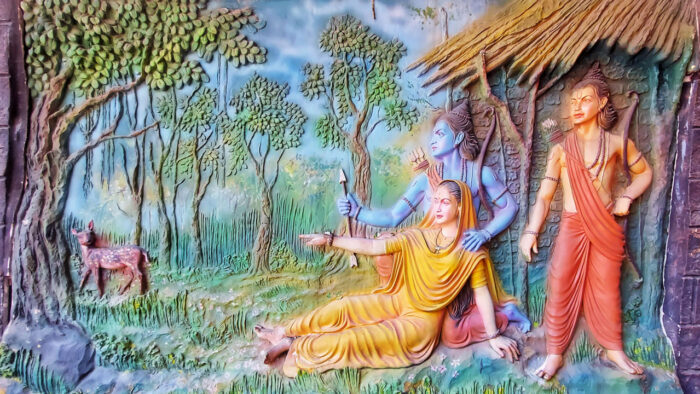
When the scouts reported the slander questioning the queen’s chastity, Rama did not agree with the mob. In his heart, he knew Sita was purity personified. When the spy reported the gossip, Rama did not find any support in the streets. But inside the palace, his brothers, Lakshmana and Bharata, were reportedly incensed. They were the ones who wanted to silence the gossipers, to use the might of the state to crush the slander. But Rama stopped them. He understood a chilling truth: Force cannot kill doubt. If he silenced the critics with violence, he would become a tyrant, and Sita would remain “guilty” in the eyes of history. The only way to preserve the dignity of the Lineage of Raghu, and to ensure that his unborn children would never fall under the shadow of public doubt, was to distance himself from the very source of his joy.
It was an act of self-amputation. By sending Sita to Valmiki’s ashram, he did not reject her; he placed her in the one sanctuary higher than the palace, the realm of the sages.
He had to set this ultimate precedent: The Leader must be held to a higher standard than the subject. The Bhagavad Gita articulates this burden clearly. Rama could not act as a husband; he had to act as the standard-bearer for all civilization.
यद्यदाचरति श्रेष्ठस्तत्तदेवेतरो जनः ।
स यत्प्रमाणं कुरुते लोकस्तदनुवर्तते ॥ Bhagavad Gita (3.21)
Yad yad ācarati śreṣṭhas tat tad evetaro janaḥ |
Sa yat pramāṇaṃ kurute lokas tad anuvartate ॥
(Whatever action a great man performs, common men follow. Whatever standard he sets by exemplary acts, all the world pursues.)
If Rama had kept Sita while doubts festered, future kings would cite him as an excuse to keep corrupt advisors or illicit lovers, claiming, “Even Lord Rama ignored public opinion for his personal love.” To prevent the corruption of future governance, Rama performed the “great sacrifice” of his own happiness.
The Divine Play: A Window through Dvaita
If we shift our gaze from the sociological to the theological, using the lens of Sri Madhvacharya’s Dvaita Vedanta, the narrative reveals a hidden layer. The pain we witness is not the suffering of helplessness; it is a dramatic enactment called Vidambana (divine imitation).
The Mahabharata Tatparya Nirnaya (MBTN) reveals that Rama and Sita are not made of blood and bone, but of pure spirit (Jnana-Ananda). They do not experience sorrow. The entire episode of the abduction, the Agni Pariksha (fire test), and the separation is a “play” designed to fool the wicked (Asura Mohana) and instruct the faithful (Lokasangraha).
Sri Madhvacharya clarifies that the body of the Lord is unlike ours; it is devoid of material defect and incapable of suffering.
अविद्यमान इवेशः कुहकं तद्विदुः सुराः ।
प्रादुर्भावा हरेः सर्वे नैव प्राकृतदेहिनः ॥ Mahabharata Tatparya Nirnaya (2.84)
निर्दोषा गुणसम्पूर्णा दर्शयत्यन्यथैव तु ।
दुष्टानां मोहनार्थाय सतामपि तु कुत्रचित् ॥ Mahabharata Tatparya Nirnaya (2.85)
avidyamāna ivēśaḥ kuhakaṁ tadviduḥ surāḥ |
prādurbhāvā harēḥ sarvē naiva prākṛtadēhinaḥ ॥
nirdōṣā guṇasampūrṇā darśayatyanyathaiva tu |
duṣṭānāṁ mōhanārthāya satāmapi tu kutracit ॥
(The Lord acts as if experiencing things that do not exist (like ignorance or sorrow); the wise (Suras) know this to be His dramatic illusion (Kuhakam). Indeed, none of the incarnations of Hari possess material bodies.
Although He is faultless and full of all auspicious attributes, He displays Himself otherwise (as suffering) to delude the wicked, and sometimes even to test the good.)
So, why this drama? If they cannot suffer, why did they enact the abduction and the tests? Dvaita citations from the MBTN, illuminated within the Madhva tradition, provide the specific mechanics behind these events.
The Mystery of Maya Sita:
It is revealed that the Sita abducted by Ravana was Maya Sita (an illusory form). The real Mother Lakshmi, unable to endure the touch of a demon, had entrusted herself to the Fire God before the abduction. When Rama ordered the Agni Pariksha after the war, it was not the suspicion of a husband. It was a cosmic retrieval operation. The “test” was the mechanism to swap the Maya Sita back for Moola Sita. The world saw a trial; the Gods saw a reunion.
The “Cruelty” as Grace:
Similarly, the banishment of Sita must be viewed through this esoteric lens. Why exile the pregnant queen? The theology explains that this was necessary to purify the “washermen,” the demonic souls lingering in society disguised as common citizens. By casting aspersions on the Divine Mother, these souls severed their final connection to God. Rama’s external act of exile was a way to uphold the law, but metaphysically, it was a way to cleanse the demographic of Ayodhya of these hidden asuras.
Simultaneously, it was an act of profound love for Sage Valmiki. The Great Sage had performed penance to serve the Divine Mother. By sending Sita to his ashram, Rama granted him the rare privilege of becoming the teacher and guardian of the divine children, Luv and Kush. What appeared to human eyes as a family tragedy was, in truth, a divine distribution of grace.
The Ultimate Secret: Samsara and The Golden Deer
Beyond the history and the theology lies the deepest layer of all: The metaphysical message. Why did the Lord enact such a tragedy? Why did the perfect couple have to endure the perfect pain?
The Ramayana is one of the greatest treatises on Vairagya (detachment) to have been written. Through his life, Rama shatters the most dangerous illusion of human existence: The belief that if we are good, the world will be good to us.
Rama had everything. Yet, in one night, coronation turned to exile. This demonstrates that even Shri Hari, when wearing a human form, is not safe from the cruelty of time. By enacting this divine play, Lord Vishnu is shouting a silent warning: Do not build your house on this bridge (earth); just cross over it. The material world cannot be trusted to provide permanent happiness.
मामुपेत्य पुनर्जन्म दुःखालयमशाश्वतम् ।
नाप्नुवन्ति महात्मानः संसिद्धिं परमां गताः ॥ Bhagavad Gita (8.15)
Mām upetya punar janma duḥkhālayam aśāśvatam |
Nāpnuvanti mahātmānaḥ saṁsiddhiṁ paramāṁ gatāḥ ॥
(After attaining Me, the great souls do not return to this temporary world, which is full of miseries (Duḥkhālayam), for they have attained the highest perfection.)
The moment Sita desired the golden deer, the symbol of Maya, she was separated from Rama. The message is stark: As long as the soul chases the glittering objects of the world, it is imprisoned in “Lanka” (misery). The solution is not to find happiness in the world, but to do one’s duty strictly, like Rama, and seek Moksha, the state beyond the river Sarayu.
The Sound of Silence and The Tears of the King
This journey through time, theology, and metaphysics brings us to the final, haunting image of Lord Rama, an image that should evoke not anger, but a profound, heartbroken devotion.
After Sita left, Rama did not remarry. In an era where Kings had hundreds of wives, where polygamy was a political tool, Rama remained Eka-patni-vrata (vowed to one wife). When he performed the great Ashwamedha Yagna, which requires a wife to be present, the priests advised him to marry again. Rama refused.
Instead, he commissioned a golden statue of Sita.
For the rest of his reign, thousands of years in the reckoning of Treta Yuga, the emperor of the world sat alone on the throne, with only the silent, golden image of his beloved beside him.
He bore the crushing weight of the crown, the loneliness of the empty palace, and the whispers of a world he saved, all to uphold the harsh standard of Dharma. He sacrificed his happiness so that humanity would know that a ruler must value the law above his own heart. And in his solitude, he taught us the final truth: that all unions on Earth are temporary, and the only true meeting place is beyond the river Sarayu, in the eternal abode.
That is why he is Maryada Purushottama. He did not live for himself. He bled his own happiness, drop by drop, to nourish the roots of righteousness. In the end, we do not pity Sita, for she returned to the earth in triumph. We weep for Rama, who remained behind, the God who allowed his own heart to break so that the foundation of civilized society would remain unbroken.
॥ श्री दिग्विजय रामो विजयते ॥
Feature Image Credit: istockphoto.com
Disclaimer: The opinions expressed in this article belong to the author. Indic Today is neither responsible nor liable for the accuracy, completeness, suitability, or validity of any information in the article.