
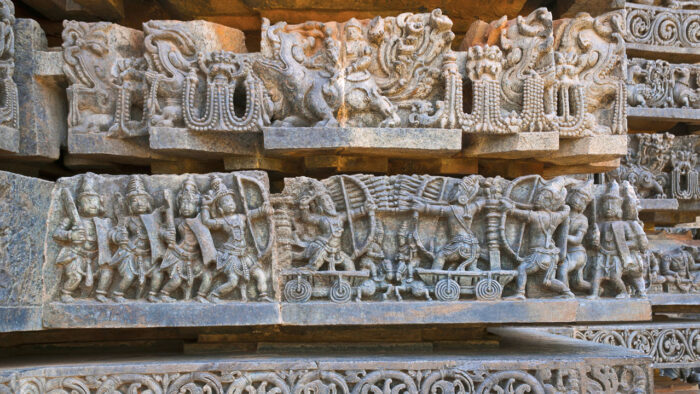
The war had ended.
But silence had not yet returned to Kurukshetra.
Broken chariots lay scattered across the field. Wheels half buried in dust. Banners torn. The smell of iron and earth still hung in the air. Thousands had fallen. Those who survived carried a heavier burden — victory.
At the center of that silence lay a man who had once commanded armies.
Bhishma.
He did not lie on a bed.
He lay suspended on consequence — a thousand arrows holding his body between sky and soil. Even the earth seemed hesitant to claim him.
Around him gathered kings, sages, warriors, and also Sri Krishna.
And among them stood the new emperor of Bhārata – Yudhishthira.
He had won the war.
But victory had stripped him of certainty.
So he asked the only question that mattered.
“What is Dharma?”
Bhishma did not answer with definitions.
He answered with stories.
The Undercurrent Few Notice
Across the teachings Bhishma gives in the Mahabharata – stories of Shibi, Harishchandra, Janaka, Tuladhara, the butcher, the crane, Vishwamitra, Raj Dharma – a quiet pattern runs beneath them all.
It is easy to miss.
The stories look different on the surface.
A king here.
A butcher there.
A merchant somewhere else.
But the spine of every narrative is the same.
Not kingship.
Not sacrifice.
Not devotion.
Something far more unsettling.
The individual is secondary. Dharma is primary.
Everything bends before it.
A King Who Weighed Flesh Against Dharma
Bhishma begins with a king.
A trembling dove falls into the king’s lap, chased by a hawk.
Both make claims.
The dove asks for protection.
The hawk asks for survival.
Two truths collide.
The king does not debate philosophy.
He takes a knife.
And begins cutting flesh from his own body — placing it on a scale to equal the weight of the dove.
No proclamation.
No drama.
Just recognition.
Dharma had made its demand.
And the king answered.
A Truth That Cost a Kingdom
Another story.
Harishchandra.
A king who refuses to lie.
He loses his kingdom.
His wealth.
His family.
Reduced to working at a cremation ground.
Still he does not bend.
Because truth was not his virtue.
It was his obligation.
That distinction is important.
Virtue can be admired.
Dharma must be obeyed.
The Butcher Who Taught a Brahmin
Then Bhishma tells a story that quietly destroys hierarchy.
A wandering Brahmin meets a butcher.
Not a sage.
Not a priest.
A butcher.
The Brahmin expects spiritual instruction to come from ascetics.
Instead the butcher speaks with clarity about duty.
He explains something simple.
One must perform one’s role without resentment, without escape, without pretending to be something else.
Truth emerges from an unlikely mouth.
The Brahmin listens.
Because Dharma does not care who speaks it.
The Merchant Who Owned Nothing
Another story.
King Janaka rules an empire.
But he holds it lightly.
When news arrives that his city is burning, he remains calm.
“My city burns,” he says quietly.
“Nothing of mine is burning.”
He is not indifferent.
He is unattached.
The kingdom belongs to Dharma.
He merely administers it.
The Pattern Becomes Clear
Across Bhishma’s teachings, the same pattern repeats.
Again and again.
• A king sacrifices his body to protect life.
• A ruler loses everything but refuses to lie.
• A butcher attains wisdom without abandoning his work.
• A merchant governs without attachment.
• A king must punish even those he loves if justice demands it.
The message is unmistakable.
Personal comfort bends before Dharma.
Identity bends before Dharma.
Power bends before Dharma.
Emotion bends before Dharma.
Not convenience.
Not popularity.
Dharma.
Why This Idea Is So Rare
Most civilizations organize themselves around the individual.
Power above principle.
Victory above virtue.
Identity above justice.
Tribe above truth.
In such systems, heroes are rarely questioned.
But the Mahabharata does something extraordinary.
It interrogates even its greatest hero.
Bhishma himself lies on a bed of arrows because he upheld a vow mechanically without examining its moral consequences.
That is civilizational self-critique at its highest level.
How many cultures allow their most revered figure to be morally questioned?
Very few.
Dharma Is Not a Rulebook
Another subtle truth runs through Bhishma’s teachings.
He never gives Yudhishthira a simple answer.
Instead, he tells stories.
Contradictory stories.
Layered stories.
Because Dharma is not a rigid commandment.
It is not blind obedience.
It is contextual wisdom.
It must be discovered.
Which is why Yudhishthira keeps asking:
“What is Dharma?”
And Bhishma keeps answering with situations rather than rules.
Because Dharma requires something deeper than obedience.
It requires discernment.
In Sanskrit – Viveka.
The Illusion Bhishma Quietly Destroys
Across these stories Bhishma dismantles several assumptions humans live by.
First comes the illusion of ownership.
We say:
My body.
My family.
My achievements.
But Bhishma speaks while his own body is already returning to earth.
Ownership, he suggests, is temporary custody.
What you cannot keep forever was never truly yours.
The Illusion of Control
Bhishma was the greatest warrior of his age.
Yet he lay immobilized on arrows waiting for the moment Time would permit him to die.
In the Mahabharata, Time is the ultimate sovereign.
Kings rule kingdoms.
Time rules kings.
Kala does not negotiate.
Kala concludes.
The Illusion of Identity
Humans cling to identity.
Powerful.
Successful.
Respected.
Bhishma dismantles that illusion as well.
A butcher may be wiser than a priest.
A merchant may be more enlightened than a king.
Titles do not impress Dharma.
Alignment does.
The Illusion of Permanence
Dynasties collapse.
Relationships dissolve.
Bodies decay.
Memory fades.
Nothing escapes Time.
Except one thing.
Dharma.
Because Dharma does not belong to Time.
Time itself functions within Dharma.
The Most Dangerous Idea
And here Bhishma arrives at the most unsettling idea of all.
You do not exist for yourself.
You exist as an instrument of Dharma.
Not for comfort.
Not for ambition.
Not even for survival.
For Dharma.
This idea is dangerous because it removes the ego from the center of existence.
Most civilizations placed man at the center.
Bhārata placed Dharma at the center.
And man as its temporary custodian.
Why This Land Is Called Devabhumi
Bhārata is not called Devabhumi because gods were born here.
It is called Devabhumi because here moral inquiry was sacred.
Here the question was not:
“How do I win?”
But:
“What is right?”
Even if it costs me everything.
Temples came later.
The real sanctity of this civilization lay in its willingness to ask that question seriously.
And repeatedly.
The Final Paradox
Bhishma’s life itself proves the subtlety of Dharma.
He upheld vows.
He protected the throne.
He remained loyal.
Yet he suffered.
Why?
Because Dharma is subtle.
Mechanical righteousness is not enough.
One must align with the spirit of Dharma, not merely its letter.
The Undercurrent in One Line
Across Bhishma’s teachings runs one uncompromising principle:
Human greatness is measured by how much of oneself one is willing to subordinate to Dharma.
That is the spine of the Mahabharata.
That is the philosophical audacity of Bhārata.
And that is why those stories, spoken on a battlefield thousands of years ago, still disturb
something inside us today.
Because they leave us with a question that refuses to disappear.
If Dharma, not you, is the center of existence,
Are you living as its instrument?
Or merely as its beneficiary?
Feature Image Credit: istockphoto.com
Disclaimer: The opinions expressed in this article belong to the author. Indic Today is neither responsible nor liable for the accuracy, completeness, suitability, or validity of any information in the article.