

Dharma, Viveka and Human Agency in the Age of Artificial Intelligence
From the rishis’ distinction between kinds of knowledge to the modern encounter with science and machinery, Hindu thought repeatedly returns to a question that generative AI has made urgent: what should govern power when capability becomes easier to acquire than discernment?
A new abundance
A person sitting at home with an advanced large language model can now ask for an explanation of a difficult philosophical text, compare competing legal arguments, receive a first-pass medical literature summary, generate software, translate languages, design a business plan, or interrogate centuries of recorded thought in seconds. The answer may be incomplete or wrong; the system may hallucinate; expert verification may still be necessary. Yet the change in human access is real. Capabilities that once required years of apprenticeship, a library, a network of specialists, or considerable wealth are increasingly available through a conversational interface.
This has led naturally to comparisons with older Indic descriptions of extraordinary knowledge: divya-drishti, pratibha, siddhis, revelation, or the possibility that disciplined consciousness can perceive what ordinary cognition cannot. Such comparisons can be illuminating, but only if we resist the temptation to turn analogy into historical claim. The popular phrase ‘Akashic Records’, for example, is not a standard classical Hindu doctrine. The specific idea of a universal cosmic archive under that name took shape in modern Theosophical literature, drawing upon the older Sanskrit word akasha while giving it a new esoteric meaning.[1]
We therefore do not need to claim that the rishis described the internet, that Sanjaya possessed a television, or that an LLM is a technological version of a siddhi. Those claims make Hindu thought smaller, not larger. The more serious continuity lies elsewhere. Across the Upanishads, the epics, Yoga, the Gita and modern Hindu reflection, one encounters a recurring concern: expanded knowledge or power does not by itself produce right judgment. Capability must be governed by qualification, self-mastery, discernment and Dharma.
Artificial intelligence may represent a new mechanism, but it intensifies an old human problem: capability can grow faster than wisdom.
The rishis did not treat all knowledge as the same
The Mundaka Upanishad begins with a question of astonishing relevance to an age of information abundance. Shaunaka approaches Angiras and asks what must be known so that, in effect, everything becomes known. The response does not offer a larger catalogue. It first distinguishes two orders of vidya: para and apara. The text places the Vedas and Vedangas within apara vidya and identifies para vidya as that by which the imperishable is realized.[2]
This distinction should not be flattened into a modern opposition between ‘useful information’ and ‘spirituality’. The presence of the Vedas themselves within the lower category shows that apara is not a dismissal of sacred learning. Rather, the passage establishes a hierarchy: enormous textual, linguistic, ritual and intellectual mastery is still not identical with transformative knowledge of ultimate reality.
That hierarchy is a useful lens for AI. A language model can make previously difficult forms of apara-like knowledge astonishingly accessible: words, summaries, correlations, arguments, translations, procedures, patterns and accumulated records. It can help a student encounter a text and help a scholar search connections. But access to representations of knowledge is not identical with realization, character, judgment or wisdom. The Upanishadic distinction warns us against mistaking the abundance of available answers for the completion of the human search.
When information becomes cheap, the scarce faculty may no longer be retrieval. It may be viveka – the capacity to discriminate.
Power is incomplete without the knowledge of withdrawal
The Valmiki Ramayana offers another instructive pattern. After Vishvamitra imparts powerful astras to Rama, Rama does not stop at acquiring the capacity to deploy them. He asks to learn their withdrawal – the samhara knowledge by which weapons once invoked can be recalled or restrained. Vishvamitra then teaches him that knowledge as well.[3]
The episode is not a manual for modern weapons, nor should it be made into one. Its ethical architecture is what matters. Possession is not mastery. A person qualified to wield power must also possess the capacity to stop, reverse, contain or decline its use. In modern technological culture we often celebrate invocation: faster generation, stronger automation, greater reach, more agents, more data, more autonomy. The Ramayana episode introduces a complementary measure of maturity: can the wielder withdraw?
Applied to AI, this question is concrete. Can we refuse to automate a judgment that should remain human? Can we discard an impressive answer when its assumptions are weak? Can we reverse an AI-assisted decision when new evidence appears? Can we preserve the ability to perform the essential reasoning ourselves? Can an institution stop a system whose outputs are efficient but whose effects violate its duties? The ability to generate is technological capability. The ability to restrain remains a human discipline.
Sanjaya: More sight did not remove the burden of Dharma
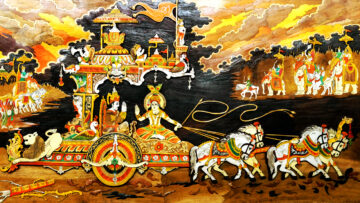
At the opening of the Mahabharata war, Vyasa offers Dhritarashtra the ability to witness the battle. The king declines to see the destruction directly, and Sanjaya is endowed with divya-drishti so that the events of the battlefield will not remain hidden from him and can be narrated to the king.[4] It is a magnificent literary image of expanded perception.
The modern temptation is to call this ‘ancient live broadcasting’. That may be rhetorically attractive, but it misses the more interesting point. Dhritarashtra’s tragedy was never merely a shortage of information. He had Vidura’s counsel before the war. He had Sanjaya’s testimony during it. He repeatedly received warnings about the consequences of attachment to Duryodhana’s course. Expanded access to events could not automatically dissolve attachment, fear, partiality or moral weakness.
This is precisely why the episode is relevant to AI without needing technological equivalence. An LLM can place far more information before us than we could otherwise gather. It can reveal options, simulate objections, summarize evidence and make consequences easier to imagine. Yet no increase in informational visibility guarantees that a person will choose well. A human being can be richly informed and still be governed by attachment.
The bottleneck in consequential decisions is often not access to more information, but freedom from the forces that distort judgment.
Patanjali’s warning: Powers can become obstacles
The Yoga Sutras are even more direct about the ambivalence of extraordinary capability. In the third pada, Patanjali describes unusual forms of perception arising through yogic discipline. Immediately afterward comes a warning: such capacities may be siddhis in an outward-turned condition while functioning as obstacles to samadhi.[5]
For an AI age, the philosophical lesson is stark. A power can be real, useful and impressive and still distract from a higher aim. The danger is not only misuse. It is fascination. A person can become so absorbed in what a tool makes possible that the tool quietly begins to define what is worth doing. Speed becomes a value because speed is available. Production becomes a value because production is effortless. Answers become a substitute for inquiry because answers arrive immediately.
Patanjali’s caution helps us distinguish technological mastery from mastery of attention. If a system can answer every question we formulate, the quality of our life may increasingly depend on our capacity to notice which questions deserve to be asked, which answers should be distrusted, and when silence, uncertainty or patient human thought is superior to instant completion.
The same intelligence, three different uses
The Bhagavad Gita provides perhaps the most useful framework for understanding why the same technology can produce radically different human outcomes. The Gita does not apply sattva, rajas and tamas only to mood. It classifies knowledge, action, the doer, intellect, resolve and other dimensions of life through the three gunas. Chapter 14 describes the gunas as arising from Prakriti and binding the embodied being; Chapter 18 then differentiates knowledge according to their predominance.[6]
Sattvika knowledge, in 18.20, perceives an underlying undivided reality amidst diversity. Tamasika knowledge, in 18.22, is described as clinging to a partial object as though it were the whole, without adequate reason or grounding.[7] Whatever one’s theological interpretation, the epistemic contrast is striking: knowledge is evaluated not merely by possession of content but by the manner of seeing.
That allows a careful contemporary application. The LLM itself need not be labelled sattvika, rajasika or tamasika. The more useful question is: from what disposition is the human being engaging it, and toward what end?
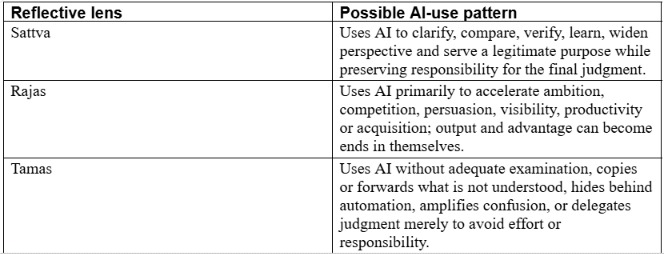
These are not personality labels, and they should not become a moral scoring system. Classical guna theory is dynamic and mixed; sattva itself is not the final goal. The value of the framework is reflective. It asks us to examine the quality of cognition and action surrounding the tool. Two people can receive the same model output and perform morally different acts with it because the technology does not erase motive, attachment, discipline or responsibility.
AI does not erase samskara; it can amplify disposition
Your technology may be new while your tendencies are not. The Gita observes that even a knowledgeable person acts in accordance with his or her prakriti (3.33).[8] In Shankara’s commentary, prakriti in this context is connected to impressions formed by prior action. Patanjali likewise speaks of a karmashaya, a reservoir or latent residue of action rooted in afflictions, whose consequences become manifest in experience.[9]
It would be inappropriate to turn these doctrines into a scientific claim that an AI user’s behaviour can be predicted from a ‘karmic profile’. But within the traditional philosophical frame, they support a subtler proposition: increased capability does not arrive in a psychologically empty person. It arrives in someone already carrying habits, attractions, fears, ambitions, attachments and cultivated strengths.
AI may therefore operate less like a neutral replacement for human nature and more like an amplifier of it. The disciplined researcher can use the model to challenge her assumptions. The ambitious propagandist can use the same model to manufacture persuasion at scale. The thoughtful student can use it as a scaffold; the disengaged student can use it to avoid learning. The difference cannot be explained by model capability alone.
Modern Hindu thinkers did not ask India to flee science
The encounter with modern science and machinery made this old question explicit. Swami Vivekananda did not advocate retreat from technical knowledge. In conversations on education, he called for modern Western science and technical education to be combined with Vedanta and character formation.[10] Elsewhere, however, he challenged the assumption that mastery of external nature is sufficient. His argument is memorable: mastery over the world does not produce happiness without mastery over oneself.[11]
This is not anti-science. It is a demand for symmetry. If education enlarges external power, it must also develop the person who wields that power. An AI curriculum built only around prompting, automation and productivity would therefore be incomplete in Vivekananda’s terms. The student also needs independence of thought, self-confidence, concentration, restraint and a purpose larger than technological display.
Gandhi approached machinery from a different direction: social consequence. He repeatedly clarified that machinery had a place, while opposing forms of mechanization that displaced human beings, concentrated control or undermined livelihoods. One of his clearest tests was that the lawful use of machinery is that which serves the interest of all.[12] The principle shifts evaluation away from novelty and toward welfare.
That test is highly contemporary. An AI system may be technically successful while degrading human autonomy, concentrating informational power, eroding livelihoods without transition, or making institutional decisions less accountable. Gandhi’s question would not be ‘Is it advanced?’ but ‘Whom does its use serve, and at whose cost?’
Sri Aurobindo’s writings and the Mother’s educational reflections add a third dimension. They do not require rejection of material or scientific knowledge; they insist that external knowledge occupies a domain that must be integrated into a larger development of consciousness. In 1965, when asked about science and technology in India, the Mother described their proper contribution as strengthening the material basis for a higher manifestation.[13] Sri Aurobindo also warned that humanity can receive tremendous powers before becoming mentally and morally ready to handle them.[14]
Across these modern voices the formulations differ, but a family resemblance appears. Science is to be learned. Machinery can be used. Material capacity can be strengthened. Yet none of these thinkers treats technological enlargement as self-justifying. The human being, society and consciousness remain the standard by which power must be interpreted.
The LLM as a mirror of an old problem
An advanced language model can now function as tutor, translator, programmer, analyst, editor, brainstorming partner and synthetic research assistant. In scale and accessibility, this is historically unusual. A person without access to elite institutions can converse with a system that can explain subjects across domains at any hour. That democratization deserves to be taken seriously.
But what exactly has been democratized? Primarily, a layer of cognitive capability: the generation, transformation and retrieval of representations of knowledge. The deeper human faculties have not been downloaded with the model. Judgment has not been automated merely because text generation has. Responsibility has not been outsourced merely because reasoning-like output can be produced.
This is why the closest Indic parallel is not ‘AI equals an ancient mystical technology’. The more defensible parallel is structural. Hindu traditions repeatedly imagine circumstances in which ordinary limits of knowledge or power are exceeded, and then ask what kind of person can carry that expansion without being ruled by it.
The LLM may democratize access to knowledge. It does not democratize wisdom automatically.
From digital literacy to Dharmic literacy
The first generation of digital literacy taught people how to operate devices and find information. AI literacy is now teaching people how models work, where they fail, how to verify outputs and how to protect data. All of that is necessary. But a civilization shaped by Dharma can ask for one layer more.
Dharmic AI literacy would ask: What is the purpose of this use? What obligation do I retain after delegating part of the work? What would count as harm even if the output is efficient? What should I know well enough not to outsource? Am I using the system to deepen understanding or to escape the effort required for understanding? Does this action arise mainly from clarity, restless acquisition, or heedlessness? If the tool disappeared tomorrow, what faculty in me would remain?
These are not questions a safety filter can answer for us. They belong to the human layer. Regulation can constrain some uses. Engineering can reduce some risks. Institutions can establish accountability. But at the moment of use, there remains a person whose attention, motive and judgment matter.
The challenge of AI may therefore be less a choice between adoption and rejection than a new arena for an old discipline: use power without becoming possessed by power. Learn without mistaking information for realization. Employ instruments without allowing instruments to determine the ends of life. Preserve the capacity to withdraw. See more without imagining that seeing more is the same as choosing rightly.
An old question at a new scale
Generative AI has made knowledge-like output abundant in a way previous generations could scarcely experience. That deserves excitement. It also demands a more mature account of human agency. If capability continues to accelerate, the decisive human advantage may not be the ability to produce still more content. It may be the ability to discern what is true, what is proportionate, what is one’s responsibility, and what ought not to be done.
The Hindu traditions surveyed here do not give us an AI policy manual. They give us something more durable: a vocabulary for refusing to confuse power with wisdom. The Upanishads distinguish orders of knowledge. Rama learns withdrawal along with deployment. Sanjaya’s expanded sight does not erase Dhritarashtra’s moral burden. Patanjali warns that powers can obstruct the higher aim. The Gita examines the disposition from which knowledge and action arise. Vivekananda, Gandhi and Sri Aurobindo confront modern science without surrendering the primacy of human and spiritual development.
Together they suggest a principle worth carrying into the AI age: civilization has repeatedly learned how to extend human capability; Dharma asks whether the human being extending that capability has also extended the capacity for discernment.
When knowledge becomes abundant, viveka becomes more valuable, not less.
Notes and source references
[1] Alex Nash, ‘The Akashic Records: Origins and Relation to Western Concepts,’ Central European Journal for Contemporary Religion, Vol. 3, No. 2 (2019/2020). The study traces the modern ‘Akashic Records’ formulation through Theosophical adoption and reinterpretation of the Sanskrit term akasha.
[2] Mundaka Upanishad 1.1.4-5. See Government of India, Vedic Heritage Portal, introduction and Mundakopanishad text.
[3] Valmiki Ramayana, Bala Kanda, the episode following Vishvamitra’s transmission of the astras, where Rama requests the withdrawal (samhara) formulae as well.
[4] Mahabharata, Bhishma Parva, Adhyaya 2, on Vyasa granting Sanjaya divine sight so the battle would not remain indirect or hidden from him.
[5] Yoga Sutras of Patanjali 3.36-37. The sutras describe extraordinary perception and then state that these capacities can be impediments to samadhi while appearing as powers in the outward state.
[6] Bhagavad Gita 14.5 and Chapter 18’s threefold analysis. See Gita Supersite, Indian Institute of Technology Kanpur.
[7] Bhagavad Gita 18.20-22, especially the contrast between sattvika knowledge and tamasika knowledge that mistakes a limited part for the whole without adequate grounding.
[8] Bhagavad Gita 3.33: even the knowledgeable act according to their prakriti. Traditional commentaries discuss the role of prior impressions in this nature.
[9] Yoga Sutras 2.12 on karmashaya, the latent reservoir/residue of actions rooted in the kleshas.
[10] Swami Vivekananda, Complete Works, conversations on education: the call to combine Western science and technical education with Vedanta, brahmacharya and shraddha.
[11] Swami Vivekananda, ‘My Master,’ Complete Works, Vol. 4: the distinction between mastery of external nature and conquest of the inner nature.
[12] M. K. Gandhi, writings on machinery collected in Young India and later compilations such as Village Swaraj: machinery has a place, but its legitimate use must serve human welfare rather than displace it.
[13] The Mother, ‘Basic Issues of Indian Education,’ 26 July 1965, Collected Works of the Mother, on science and technology strengthening the material basis for the manifestation of Spirit.
[14] Sri Aurobindo, The Life Divine (quoted in the Mother’s 10 September 1958 class), warning of the danger when humanity is mentally and morally unready for powers released by science.
Disclaimer: The opinions expressed in this article belong to the author. Indic Today is neither responsible nor liable for the accuracy, completeness, suitability, or validity of any information in the article.