

Many of us have read in the purāṇa-s or the Bhagavad Gītā that the gods experience six months of day and six months of night. But could this be describing a real astronomical phenomenon?
The purāṇa-s say that at the center of the world stands Mount Meru, a golden peak of unimaginable height, serving as the dwelling place of the deva-s. It is here, the texts tell us, that a single day and night lasts an entire human year — six months of brilliant sunshine followed by six months of starry twilight.
While many modern readers may dismiss these accounts as mere poetic imagination, the ancient Indian astronomers (the jyotiṣin-s) saw something else. To them, these stories were not just myths; they were descriptions of a physical reality that could be proven through the rigorous laws of bhūgola (spherical astronomy). Without ever needing to set foot in the frozen north, these masters of the siddhānta tradition used mathematical deduction to describe the phenomena of the midnight sun with startling precision.

(Figure 1: Picture of the sun in Nordland, Norway (north of the Arctic Circle) [Credits: Photo by stein egil liland: https://www.pexels.com/photo/a-beautiful-golden-sunset-8864792/])
The Shared Quest for the Polar Light
The mystery of the midnight sun was a pursuit shared across the ancient world. In the West, Greek thinkers from the time of Homer’s epics to the detailed calculations of Ptolemy in the 2nd century CE wrestled with the idea of a sun that never sets. While Indians were not the only ones to contemplate these northerly wonders, their approach was uniquely rooted in a synthesis of sacred narrative and indigenous mathematical structures.
The Spherical Earth: bhūgola
The foundation of this understanding was the clear realization that the Earth is a sphere. In the Āryabhaṭīya (c. 5th century CE), Āryabhaṭa describes the Earth as a globe hanging in space, surrounded by the bhagola (the celestial sphere).
From this spherical model, the jyotiṣin-s deduced that the phenomena at the poles (meru) were a natural consequence of the Earth’s geometry. When the sun moves into the northern half of the apamaṇḍala (ecliptic), beginning with the sign of Meṣa (Aries), it remains visible to the deva-s at the North Pole for its entire six-month journey.
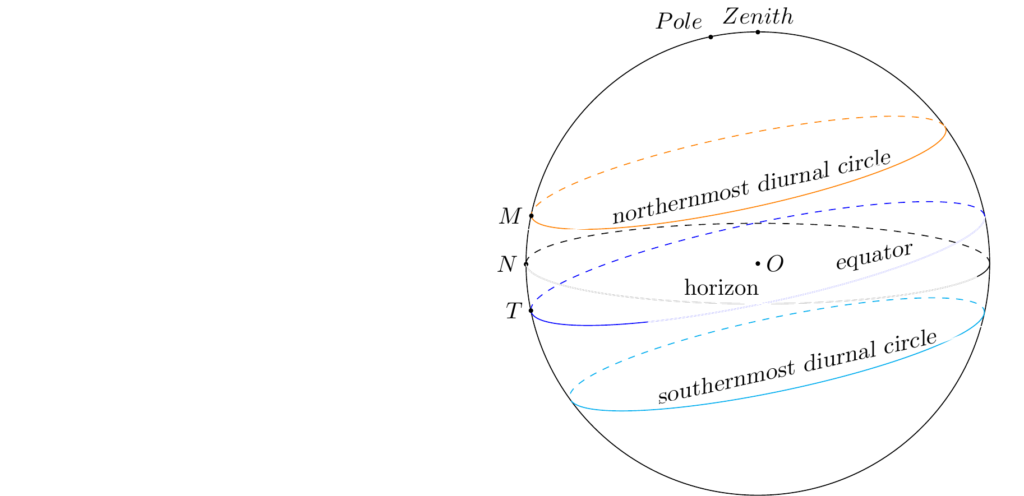
(Figure 2: The celestial sphere as seen at latitude to the north of the Arctic Circle, showing the northernmost and southernmost diurnal circles of the sun. Diurnal circle is the path the sun appears to move in each day. If it’s wholly above the horizon, the sun will be visible for more than 24 hours. If it is below the horizon, the sun will be absent in the sky for more than 24 hours.)
The Genius of Mathematical Deduction
One of the most remarkable aspects of this tradition is the calculation of latitudes south of the pole. While we do not know if any ancient Indians visited the Arctic to witness these phenomena firsthand, they arrived at the same results as modern astronomy through pure mathematical deduction.
The jyotiṣin-s did not just stop at the six-month day of the pole. They identified specific latitudes where the sun would stay above the horizon for two months and four months at a stretch. These intervals were not arbitrary; they likely corresponded to the Indian system of ṛtu-s (seasons), showing a native innovation where the abstract geometry of the sphere was mapped onto the lived experience of the Indian calendar.
Precision in the siddhānta-s
In the Pañcasiddhāntikā, the 6th-century polymath Varāhamihira provides distances north of Ujjayinī where these phenomena begin. He says:
षष्टिर्नाड्यस्तस्मिन् सकृदुदिते दृश्यते दिवसनाथः ।
परतः परतो बहुतरमा षण्मासादिति सुमेरौ ॥
योजनपञ्चनवांशांस्त्र्यधिकांश्च चतुःशतीमुदगवन्त्याः ।
गत्वा न धनुर्मकरौ कदाचिदपि दर्शनं व्रजतः ॥
तस्मादेव स्थानाद्द्व्यशीतियुक्तां चतुश्शतीं साग्राम् ।
नोदयमुपयान्त्यलिमृगघटचापधराः कदाचिदपि ॥
षडशीतिं पञ्चशतीं त्र्यंशोनं योजनं च तत एव ।
गत्वान्त्यं चक्रार्धं नोदेत्याद्यं न यात्यस्तम् ॥
लङ्कास्था भूलग्नां नभसो मध्यस्थितां च मेरुगताः ।
ध्रुवतारामीक्षन्ते तदन्तरालेऽन्तरोपगताः ॥
सकृदुदितः षण्मासान् दृश्योऽर्को मेरुपृष्ठसंस्थानाम् ।
मेषादिषु षट्सु चरन् परतो दृश्यः स दैत्यानाम् ॥
(Pañcasiddhāntikā 13.22-27)
Translation
(At the place (37313 yojanas north of Ujjain), the sun is visible for 60 nāḍīs (1 whole day) having risen only once. It increases further and further [with increase in latitude] until it is for six months at the pole. 40359 yojanas north of Ujjain, Dhanu and Makara are never seen. 482 and a fraction of yojanas north of that place (Ujjain) itself, Vṛścika, Dhanu, Makara and Kumbha never rise. 58623 yojanas [north] from there (Ujjain), the latter half of the zodiac (Tulādi) never rises and the former half (Meṣādi) never sets. Those present at the equator see the pole star on the ground (horizon), while those at the pole see it at the zenith, and those between these two places see it in between. Those present at Meru seen the sun as rising once and remaining visible (risen), when it moves in the six rāśis beginning with Meṣa. The sun is visible [in the same way] for demons when in the other [six rāśis].)
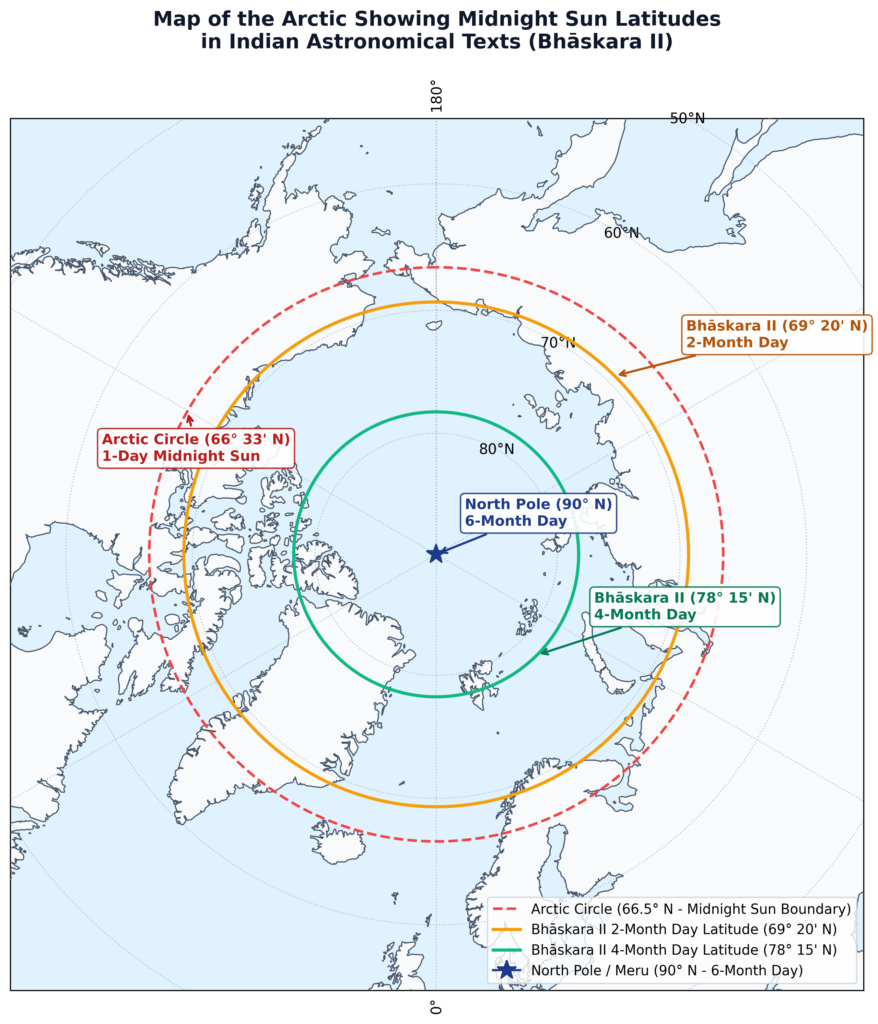
When converted to modern coordinates, his figures for a two-month midnight sun align closely with 6924′ N — remarkably close to the modern value of approximately 6922.5′.
Centuries later, Bhāskara II expressed the governing principle of the midnight sun in a remarkably concise manner:
षट्षष्टिभागाभ्यधिकाः पलांशा यत्राथ तत्रास्त्यपरो विशेषः ।
लम्बाधिका क्रान्तिरुदक् च यावत् तावद्दिनं सन्ततमेव तत्र ॥
(Siddhāntaśiromaṇi, Golādhyāya 6)
Translation
(Where the northern latitude exceeds sixty-six degrees, another remarkable phenomenon occurs. For as long as the Sun’s northern declination exceeds the complement of the latitude (lambāṃśa), that place experiences uninterrupted daylight.)
Rather than listing particular cases, Bhāskara II states the general astronomical principle governing the phenomenon. Beyond about 66° north latitude — the Arctic Circle — the duration of continuous daylight depends on the changing declination of the Sun. As the Sun moves northward during the summer months, it remains above the horizon for progressively longer periods, culminating in six months of uninterrupted daylight at the North Pole.
Elsewhere, in the Tripraśnavāsanā section of the Golādhyāya, Bhāskara II also specifies the latitudes corresponding to different durations of continuous daylight. He states that at a latitude of 69° 20′, the Sun remains continuously above the horizon for two months; at 78° 15′, it does so for four months; and at 90°, the North Pole, it remains continuously visible for six months. These values show remarkable agreement with modern calculations, highlighting the precision achieved by the siddhānta astronomers through mathematical reasoning alone.
A Frontier of Understanding
There remain sections of these ancient śāstra-s that continue to challenge us. Various authors such as Lalla and Vatesvara have also mentioned the midnight sun latitudes in the same format as the authors like Bhāskara. However, their estimates for the latitudes show systematic deviations from the expected latitude. While inaccurate, this deviation could shed light on their assumptions and calculation procedures, which they have not described in detail. This inaccuracy is also therefore valuable from a historical viewpoint.
The following table shows the values that each author specifies for two-month and four-month midnight sun periods:

These “obscure” passages represent the frontier of current research, where the exact development of these ideas from the early Vedic insights into the mature siddhānta system is still being mapped.
Why Did This Matter?
The obvious question that arises is: why did all of this matter? No part of India lies so fart to the north that any effect of the midnight sun is ever visible. The answer comes from the context within which these references are found. As such, these computations formed part of the siddhānta astronomers’ broader effort to understand and explain the varying duration of day and night at different latitudes, a matter that was of important consequence to day-to-day timekeeping, calendar making, seasons, agriculture and other fields.
At the equator, day and night remain nearly equal throughout the year, while the difference gradually increases with latitude. For most parts of India, the maximum difference between day and night ranges from about half an hour in the far south to about an hour and a half at the northern extremities. As we move further north, it ultimately leads to the six-month day and night at the poles.
The second motivation is suspected to have been the Purāṇic references to the day of the gods. This is likely to have provided an additional context for exploring these phenomena mathematically.
Conclusion: The Union of Vision and Logic
The Indian investigation into the midnight sun represents a beautiful union of dṛk (literally: eyes; metaphorically: observation) and gaṇita (mathematics). The jyotiṣin-s took the traditional stories of Mount Meru — the land where the gods live in eternal light — and demonstrated that such a place was not just a spiritual destination, but a physical certainty on a spherical Earth. In doing so, they showed that the human mind, armed with logic and mathematics, can reach the ends of the Earth without ever leaving home.
References
- Āryabhaṭa. Āryabhaṭīya. Edited and Translated by Kripa Shankar Shukla, Indian National Science Academy, 1976.
- Bhāskara II. Siddhāntaśiromaṇi. Edited by Murali Dhara Chaturvedi, Sampurnanand Sanskrit University, 1981.
- Varāhamihira. Pañcasiddhāntikā. Edited by K.V. Sharma, P.P.S.T. Foundation, 1993.
- Ptolemy. Almagest. Translated by G.J. Toomer, Springer, 1984.
- Iyer, V., Pejathaya, R. Representation of the midnight sun in Greek and Indian astronomical texts. Indian J Hist. Sci. 57, 253–264 (2022). https://doi.org/10.1007/s43539-022-00063-z
Feature Image Credit: IStock
Disclaimer: The opinions expressed in this article belong to the author. Indic Today is neither responsible nor liable for the accuracy, completeness, suitability, or validity of any information in the article.