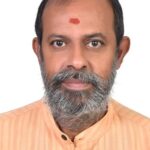

In the sacred town of Srikalahasti, famed as one of the five Pancha Bhoota Siva Kshetras of South India representing the Vayu (Air) Tattwa, lives a quiet and luminous soul — Sadguru Subrahmanyam Garu (‘Garu’ an honorific suffix in Telugu added as a mark of deep respect). His life is a living embodiment of humility, devotion, and realization. To many, he appears as an ordinary householder — a retired teacher who sits calmly beneath a tree before his home. Yet to those who come into his presence, he radiates a rare stillness and peace. In his silent and gracious way, this true jnani continues to awaken hearts and transform lives — not through words, but through the silent power of his being.
Who Is Sadguru?
Born in Konathaneri, in Chittoor district, Andhra Pradesh, into a simple agricultural family, Subrahmanyam inherited from his parents — Sri Siddaiah and Smt. Vijayalakshmi — deep piety and simplicity. Little is recorded about his early childhood or the first stirrings of spiritual awareness, but glimpses preserved in the writings of his foremost disciple, Sri T.V.N. Babu, reveals a nature already steeped in contemplation and compassion.
Married at nineteen to Smt. Padmavati (fondly known as Vayyamma), he lived a modest family life blessed with three sons. While working as a schoolteacher, he spent his spare hours in meditation and the company of saints.
After his father’s death and the division of ancestral property, in 1975, he moved with his family to Srikalahasti — a shift that marked the beginning of his spiritual flowering. There, in his humble home, a stream of seekers would one day gather for what came to be known as Sri Ramana Satsangs. Sadguru’s daily life was one of quiet discipline and compassion. He was undisturbed by life’s ups and downs — a living example of the sthita-prajna of the Gita, equanimous and serene.
Obedience to His Guru
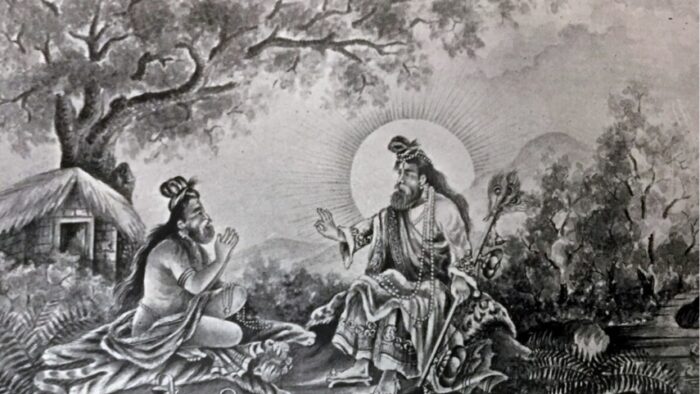
Unlike many seekers, Sadguru did not adopt a formal regimen of spiritual practices. His Guru, Tat Baba Garu (or Thatha Garu Swamy), tested him in ways that defied logic.
One oft-repeated incident reveals Sadguru’s extraordinary patience. Tat Baba, seated before temple deities, would light a pipe of ganja and randomly open a book on the saint Pothuluri Veerabrahmendra Swamy. He would then order Subrahmanyam to read aloud — page after page, hour after hour. Sadguru read without hesitation or complaint. The moment he inwardly resolved to keep reading until told to stop, Tat Baba suddenly said, “Enough!” — as though responding to his very thought.
Even more astonishing, witnesses once saw Tat Baba himself bowing with folded hands before Subrahmanyam — a gesture unheard of in Guru–disciple relationships. Such moments remain shrouded in mystery, hinting at the profound spiritual stature hidden behind Sadguru’s humility.
The Guru–Disciple Bond
Sadguru’s devotion to his Guru was complete. He would simply say, “I had full faith in my Guru. I abided by his word. Everything else happened on its own.” This bond reflects the truth expressed by Mata Jillellamudi Amma (Anasuya Devi): “A true Sadguru draws his disciple on his own. The search for a Guru is itself God’s doing.”
Indeed, it was Tat Baba, not Subrahmanyam, who repeatedly visited the disciple’s home — reversing the traditional order. The Guru saw in the young householder the spark of realized wisdom, and shaped him silently into a Sadguru himself.
Padmavatamma – The Silent Strength
Behind every saint stands a silent pillar of strength. In Sadguru’s life, it was his wife, Padmavatamma, whom devotees affectionately called Vayyamma. Gentle, cheerful, and unassuming, she managed the family with grace even during hardship, treating her husband with the reverence of a disciple.
Her patience was often tested by Tat Baba’s eccentric commands — from sending away relatives abruptly to sheltering stray dogs as divine guests. She bore everything as Guru leela, never questioning.
On 14 January 1999, after years of tireless service to her husband and his Guru, she attained peace, departing with the words “Om Siva” upon her lips. Her body was laid to rest on the banks of the Swarnamukhi River, where a small Samadhi Mandir now stands — a shrine of devotion that continues daily worship. Sadguru said her liberation came through her lifelong Guru Seva.
The Gurus Who Shaped Him
Though established in non-duality and acknowledging no difference between Guru and disciple, two great saints profoundly influenced Sadguru’s life — Veeraiah Garu and Thatha Garu.
The First Guru
Sri Veeraiah Garu, Sadguru’s first spiritual guide, was himself a disciple of Sambhu Guru Swamy, a devotee of Easwaramma, the descendant of the great Siddha Pothuluri Veerabrahmendra Swamy.
A cowherd by birth, Veeraiah spent his days near the Samadhi of Sambhu Guru Swamy. One night, he had a radiant vision of the saint, who initiated him with a mantra. From then, Veeraiah exhibited miraculous insight — predicting futures and healing through divine grace.
Skeptics once mocked his claim of being blessed by a Guru dead for three centuries. Enraged, Veeraiah entered the Samadhi itself, and before the stunned villagers, Sambhu Guru Swamy appeared in living form. The onlookers fell at his feet, begging forgiveness.
Veeraiah was also Sadguru’s brother-in-law — Padmavatamma’s brother. Recognizing his spiritual greatness, Subrahmanyam surrendered completely to him. Veeraiah blessed him, saying, “You will have a son first; name him after our Guru.” Thus, Sadguru’s firstborn became Sambhu Prasad.
When Veeraiah wished to offer Guru Dakshina, Sadguru humbly refused. Veeraiah instead assured him, “My blessings will always remain with you.” Later, Sadguru would often say it was Veeraiah’s grace that guided him toward realization.
Veeraiah’s Samadhi lies at Surayapalem, near the temple of Sri Umameswara Swamy in Nellore district, where devotees still pay homage.
Thatha Garu — The Ascetic Master
If Veeraiah awakened his spiritual longing, it was Thatha Garu Swamy who forged it into illumination. An extraordinary ascetic of Srikalahasti, Thatha Garu was known for his unpredictable ways — sometimes tender, at times fierce, often beyond all conventions.
He revered only a few: his consort Nanamba, Lord Siva, Lord Subrahmanya, and the poet-saint Yogi Vemana. He had once met Shirdi Sai Baba, and declared Baba to be a Madhwa Brahmin.
Thatha Garu’s life itself was a saga of renunciation. Given away as a baby to a mendicant after repeated family tragedies, he grew up wandering. Before dying, the mendicant handed him ochre robes, saying, “I have nothing else to offer you.” The boy donned them — and never turned back.
Even in his centenary years, Thatha Garu walked briskly, smoked beedies, drank tea, and ate biryani once or twice a year — living proof that real renunciation lies not in outer austerity but inner freedom.
Life with Thatha Garu
Under Thatha Garu’s guidance, Sadguru undertook a ninety-day fast, walking barefoot under the blazing sun without feeling heat or hunger. On the final day, he returned home weak and ate soaked rice grains, ending his penance quietly.
He never questioned his Guru, yet his unspoken doubts were often answered spontaneously in casual conversation. Once, when Thatha Garu wrote several mantras for curing ailments, Sadguru tore the paper. “Why did you do that?” asked Thatha Garu.
“It doesn’t appeal to me,” replied Sadguru. “A person’s problems should be resolved just by uttering your name.” Moved by such faith, Thatha Garu blessed him: “Subrahmanyam, only those whose problems can truly be solved will come to you.”
Thatha Garu once revealed that he had been declared dead at thirty, only to revive miraculously — remaining youthful even in old age. When he passed away on 18 October 1990, his body stayed supple and radiant. True to his wish, no Samadhi was built; his remains were cremated on the banks of the Swarnamukhi River — the same sacred stream later to cradle Padmavatamma’s Samadhi.
The Chronicler: Sri T.V.N. Babu
The story of Sadguru Subrahmanyam would remain incomplete without Sri T.V.N. Babu, his lifelong devotee and chronicler.
Babu’s family lived a few houses away from the Master’s. His father was a close friend of Sadguru, and little Babu spent much of his childhood in that divine company. He first saw Sadguru in 1975, when he was barely five, accompanying his classmate Krishna Prasad, Sadguru’s son.
He recalls the Master’s daily puja — performed not to idols but to a few pictures, one inscribed with the word “Nēnu” (“I”). Later, this became the core of Parama Vedam, a teaching revealing the supreme “I” consciousness. Among the sacred objects was also the hand stick of Veeraiah, revered like a relic.
In his book Nenu – Satyam, Babu recounts mystical episodes: flocks of pigeons descending to greet Sadguru, or a goat once offered to Allah visiting him daily to gaze into his eyes as though in communion.
By 1988, Babu and his friend Devi Prasad began spending evenings with Sadguru, listening to his words and basking in his silence. Initiated into the Maha Mantra, Babu practised it with dedication. These intimate gatherings gradually evolved into the famed Sri Ramana Satsangs, named in reverence to Sri Ramana Maharshi, whose teaching of Atma Vichara resonated through Sadguru’s words.
The Sri Ramana Satsangs
What began as informal evening conversations soon drew more seekers. People came not for ceremony but for clarity — to hear the soft-spoken teacher talk about life, ego, and the self. There were no lectures or rituals, only luminous simplicity.
Sadguru often said: “When you look for God outside, you move away from yourself. Turn within — you will find He was never elsewhere.” The Satsangs were initially held before his home, later in a small room on Naikal Street, where deep peace pervaded every word and pause.
Babu, now a mature devotee and writer, recorded these dialogues faithfully. His Telugu books — Sri Ramana Satsangalu, Jnana Prasnalulu, Parama Vedam, and others — preserve the Master’s wisdom for posterity. All are freely available on the Nityasravanam website.
Babu humbly called himself “Jnana Shishu” — the child of wisdom, acknowledging that whatever understanding he gained flowed only from Sadguru’s grace.
The Eternal Message
Sadguru Subrahmanyam never claimed discipleship, never founded an institution. His life was the message — that realization is here and now, within the heart of every being.
He once remarked gently, “Be in the world, but let not the world be in you.”
His humility concealed vast wisdom; his silence conveyed more than words. To see him sitting quietly under the neem tree, a cigarette between his fingers, was to feel the presence of timeless peace.
Legacy of Light
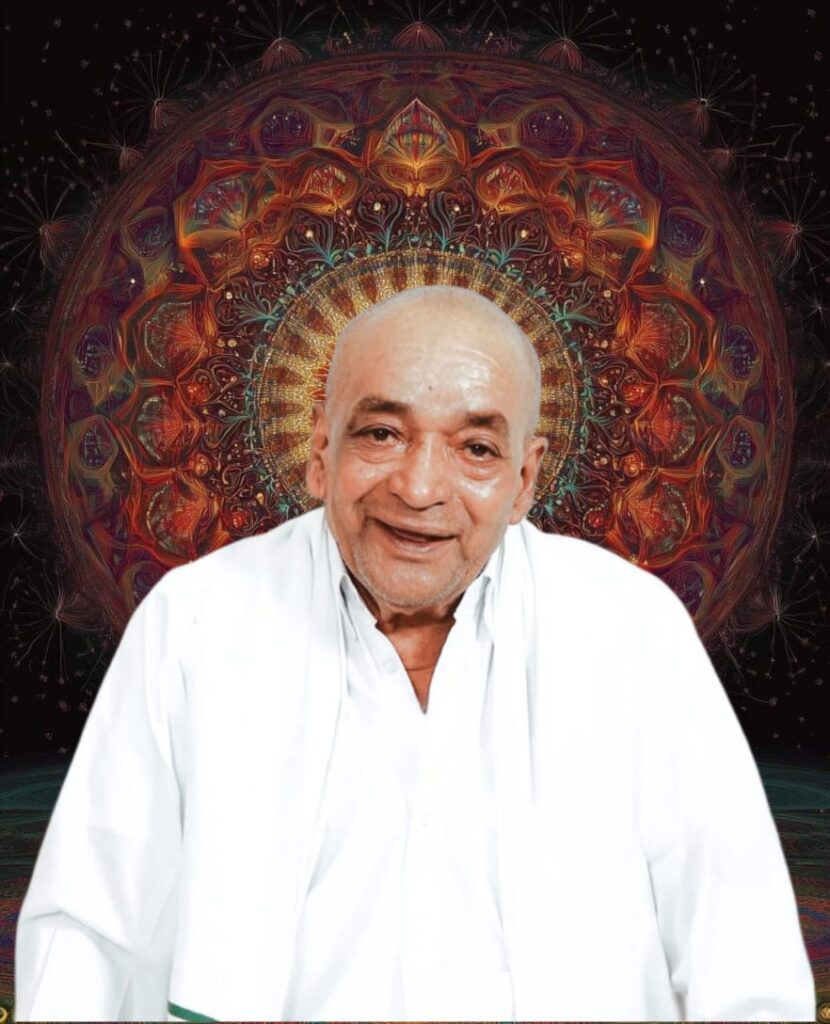
(Figure 1: Sadguru Subrahmanyam)
Under the loving guidance of Sadguru Subrahmanyam Garu, daily satsangs, readings from his books, and meditation gatherings continue to inspire earnest seekers. His teachings — a beautiful synthesis of Sri Ramana Maharshi’s path of self-enquiry and his own deep experiential insight — awaken seekers to turn inward and realize the ever-luminous Self. In his silent presence, many experience peace, clarity, and the gentle touch of true wisdom.
For many, Sri Ramana Satsangs remain not merely a collection of words but a living vibration — an invitation to turn inward and discover the same stillness that shone in their beloved Master of Srikalahasti.
As one of his devotees once said, “He did not teach us how to reach God — he made us aware that we already are That.” And thus, beneath the quiet skies of Srikalahasti, the fragrance of Sadguru Subrahmanyam’s life and message continues to waft — invisible, eternal, and pure as the Self he realized.
(Courtesy: The ‘Fragrance of Wisdom’ by Shri Mohana Krishna Sanagavarapu, published by Athyasramam Trust, Sri Kalahasti)
Feature Image Credit: Wikicommons
Disclaimer: The opinions expressed in this article belong to the author. Indic Today is neither responsible nor liable for the accuracy, completeness, suitability, or validity of any information in the article.