
A concert hall in Chennai, filled with listeners gathered for a devotional evening. It is December, Margazhi, the sacred Mārgaśīrṣa month. As tradition has ordained for generations, the first composition is Purandaradāsa’s Lambōdara Lakumikara, invoking the elephant-headed god who clears obstacles before the music can truly begin. The audience settles into stillness. The tāmpurā finds its pitch. The singer inhales, and the concert opens.
The composition was written in the first decades of the sixteenth century, in a city called Hampi that was sacked in 1565 and has been a ruin for four hundred and sixty-one years. The Kannada that the composer wrote in, is the Kannada the singer trained in. The melodic frame the composer set is the frame the accompanist is playing. Between the composer’s hand and the singer’s voice lie five centuries, three major dynasties, and two languages of colonial administration. Nothing in that interval interrupted the transmission.
This is not unusual for Purandaradāsa. The Carnatic tradition itself calls him Saṅgīta Pitāmaha, the Patriarch of Music. His compositions open Carnatic concerts. They appear on Akāśavāṇi morning broadcasts during Mārgaśīrṣa. They are taught to children before they can read. They are sung at weddings, at the morning ārati, in tens of millions of South Indian households where the singer has never heard the names Śrī Vyāsatīrtha or Śrīman Madhvācārya, never read the Brahmasūtra Bhāṣya, never taught to ask why these songs and not others. The compositions are the medium of a devotional life that was assembled, deliberately, on the other side of the Vijayanagara collapse, and that has not been disassembled since.
So many devotional movements of the medieval Indian centuries have left fragments, scholarly editions, and small lineages of practice. The Haridāsa corpus has left a living daily presence across an entire region of subcontinental life. Why this one, and not the others? Why is it still here?
The question belongs to anyone who has ever designed a system to survive its builder.
The Madhva sampradāya of Karnataka, between roughly 1470 and 1800, answered the question three hundred years before anyone thought to ask it. The answer was a sequence of deliberate design moves, spread across five generations of teachers and composers, each one addressing a distinct problem in long-range transmission of a dense philosophical corpus. The compositions were one layer. The teachers were another. The maṭhas were a third. What held, across five centuries of political collapse and reconfiguration, was the system they built.
This essay names its five parts. Five figures. Five design moves. Five centuries. Each figure made one distinct contribution to the engineering of the system. Together those contributions explain why the system has run continuously for half a millennium and shows no sign of stopping. The compositions are devotional; the system that carries them is engineered. The argument of this essay is that both halves of that sentence deserve attention.
Mulbagal, 1470s: Śrī Śrīpādarāja
Śrī Śrīpādarāja, pontiff of the maṭha at Mulbagal in what is now Kolar district, entered Brindavana around 1480. The Brindavana, in the Madhva sampradāya, is the stone monument that marks the site where a sannyāsi-pontiff takes leave of the body in eternal samādhi. Śrī Śrīpādarāja’s Brindavana stands today at Mulbagal. The maṭha continues. He had lived through most of the fifteenth century. The Madhva commentarial tradition he inherited was in full philosophical bloom. The Brahmasūtra Bhāṣya, the Anuvyākhyāna, the Mahābhārata Tātparya Nirṇaya: all in circulation among the scholars of the tradition. However, none of them reached a grandmother in Mulbagal or elsewhere.
The scholars could read Sanskrit. Most of the people around them could not. This asymmetry is not incidental to religious transmission; it is the central engineering problem of every pre-modern literate tradition. The corpus that is the traditions intellectual spine sits in a language that the traditions intended audience cannot directly access. The standard answer, across many premodern traditions, was to restrict the corpus to the literate and let the rest of the audience receive whatever reached them through ritual and through clan.
An earlier Madhva precedent existed. Śrī Naraharitīrtha, a direct disciple of Śrīman Madhvācārya himself in the late thirteenth century, had composed Kannada devotional hymns. Fragments of those compositions survive. But Śrī Naraharitīrtha’s work did not become a sustained movement. Two centuries passed. The Sanskrit commentarial tradition matured, the polemical literature thickened, and the Kannada channel remained a precedent without a practice.
Śrī Śrīpādarāja made a different move. To carry the traditions intellectual spine to its intended audience, he composed in Kannada. He composed devaranāmas: devotional songs carrying Madhva-Dvaita philosophical content. What distinguishes the devaranāma from generic bhakti verse, which was flowering across medieval India in many languages, is that the devaranāma preserved the tattva: the specific Madhva-Dvaita philosophical content, rendered singable without being diluted. Among the compositions the tradition attributes to him are four longer-form works later called his Gītas: Bhramaragīta, Veṇugīta, Gopīgīta, and Madhvanāma. Madhvanāma in particular compresses Śrīman Madhvācāryas doctrinal corpus into Kannada that a householder can memorize.
One phrase, repeated across many of his compositions, stands in for his method:
ಭೂಷಣಕೆ ಭೂಷಣ
bhūṣaṇake bhūṣaṇa
(the ornament of ornaments)
It is a Sanskrit philosophical concept, the doctrine that Śrī Hari is the source of all goodness that makes anything worth calling beautiful, arriving in the Kannada idiom without losing its spine. A scholar reading Śrīman Madhvācāryas Sanskrit on the relational character of saguṇa brahman arrives at the same content through argument. The grandmother singing bhūṣaṇake bhūṣaṇa’ at ārati arrives at it through image and repetition. Both arrive.
This is the first design move. The doctrine is now available on two channels simultaneously. The scholar has the Sanskrit commentary. The grandmother has the kriti. Both receive the same content, at different bit-depths, on different platforms. The vernacular access layer is additive and permanent.
The Architect at Hampi: Śrī Vyāsatīrtha
Śrī Vyāsatīrtha, also called Vyāsarāja, lived from 1460 to 1539. He was rāja-guru to Krishnadevaraya through the emperors reign from 1509 to 1529, and the philosophical authority across the Madhva institutional landscape from the final years of Śrī Śrīpādarāja’ss life to the middle of the sixteenth century.
Śrī Vyāsatīrtha worked at three layers of the tradition simultaneously. In Sanskrit, he composed the major polemical works that secured the philosophical architecture of Madhva-Dvaita against the Advaita challenge: Nyāyāmṛta, the dialectical response; Tarka Tāṇḍava, the systematic logic; Tātparya Candrikā, the sub-commentary on Śrīman Madhvācāryas Gītā-Bhāṣya’. These are technical works addressed to scholars in Sanskrit debate.
In Kannada, he composed devaranāmas. The most widely known is Krishna Nī Bēgane Bārō, in raga Yamunakalyāni:
ಕೃಷ್ಣಾ ನೀ ಬೇಗನೇ ಬಾರೋ, ಬೇಗನೇ ಬಾರೋ ಮುಖವನ್ನು ತೋರೋ
kṛṣṇā nī bēgane bārō, bēgane bārō mukhavannu tōrō
(Krishna, come quickly, come quickly and show me your face)
The composition is sung today across Karnataka and beyond, in homes and concert halls and films, by Madhvas and non-Madhvas, Brahmins and non-Brahmins, devotees and listeners with no particular sectarian formation. It belongs to whoever sings it. Śrī Vyāsatīrthas compositions sit alongside Śrī Śrīpādarājas and Purandaradāsa’s in the dāsakūṭa.
But his load-bearing contribution to the Haridāsa movement is not at the composition layer. The composition layer would have continued without him. His unique contribution is at the institutional layer, and without that layer, the composition layer would have had nowhere to live.
Under Krishnadevaraya, Vijayanagara developed a patronage arrangement that is rarer in history than it looks in retrospect: state protection of religious institutions without state capture of them. The maṭha received resources. The maṭha did not receive instructions. Śrī Vyāsatīrtha, as senior Madhva pontiff at the emperor’s court, negotiated and held this arrangement. Under it, the maṭhas trained scholars, housed pontiffs, fed pilgrims, archived manuscripts, and protected the Kannada devaranāma tradition that Śrī Śrīpādarāja had opened.
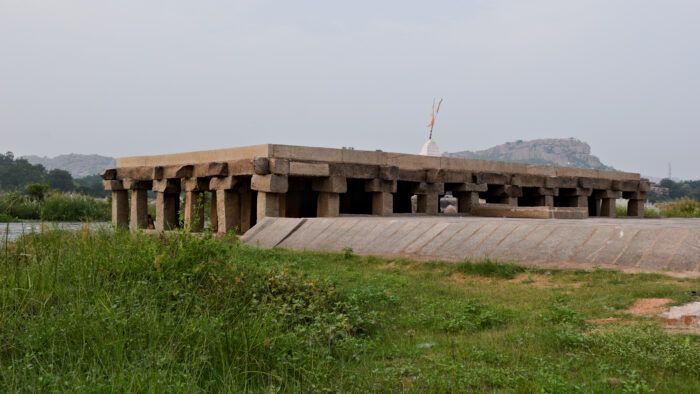
The pivot. In 1525, a merchant from central Karnataka named Śrīnivāsa Nāyaka arrived in Hampi with his wife and children, having walked out of a substantial fortune. Śrī Vyāsatīrtha initiated him. The merchant took the name Purandaradāsa and spent the next thirty-nine years composing the core of the Kannada Haridāsa corpus. The maṇṭapa where he stayed is called Purandara Dāsa Maṇṭapa and still stands in the Hampi ruin.
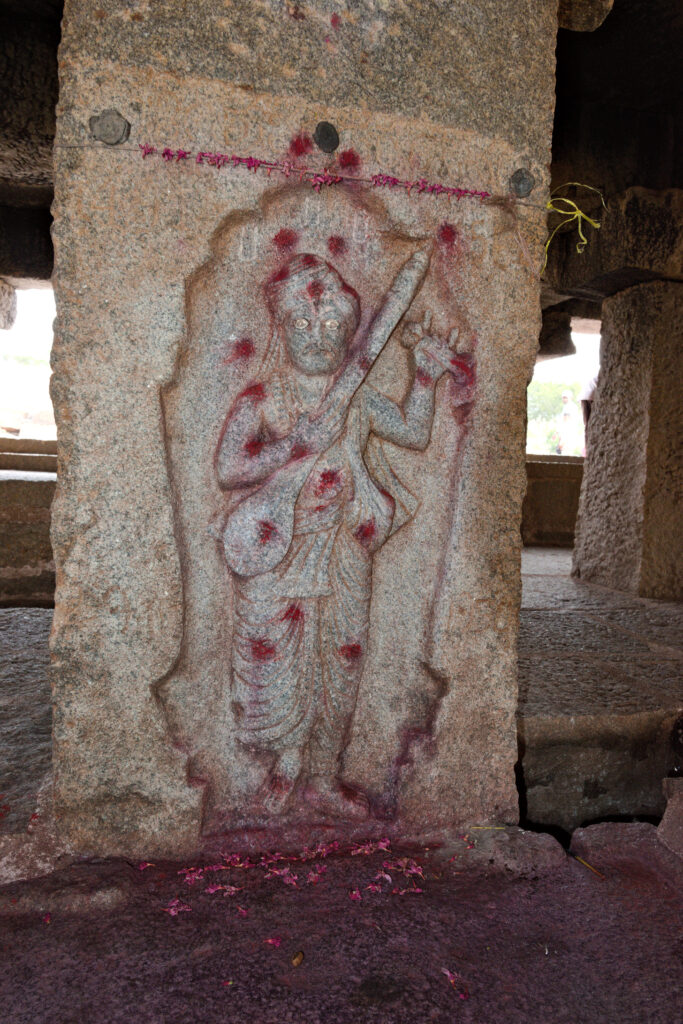
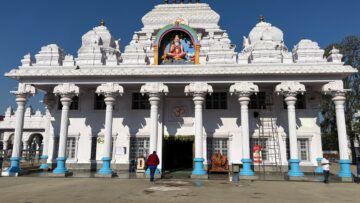
(Figure 1: The Purandaradasa Mantapa is a modest open-pillared pavilion associated with the renowned poet-saint Purandaradasa, who is believed to have spent time in Hampi. A sculpture of the saint holding a tambura can be seen within the structure.)
Śrī Vyāsatīrtha did not write Purandaradāsa’s compositions. What he did was recognize what those compositions would become, and ensured that the institutional frame around them would hold. The maṭha under his successors would train the next generation of Haridāsas. The patronage arrangement he had held would let the institution absorb Purandaradāsa without needing to explain his arrival in political terms. An architect does not paint the frescoes. An architect specifies the load path.
Śrī Vyāsatīrtha entered Brindavana in 1539, at Anegundi. His Brindavana stands today on Nava Brindavana, the river island in the Tungabhadra where nine Madhva pontiffs are remembered together. Pilgrims still take darśana there. When Vijayanagara fell at Talikota twenty-six years later, the maṭha he had built survived. The load path was sound.
This is the second design move. The maṭha is the physical node: the place where compositions can be taught, copied, archived, and corrected. When courts change, when political formations collapse, the maṭha holds. Institutional protection is the redundancy layer. The movement cannot be killed by the collapse of any single political formation, because no single political formation hosts it entirely.
The Merchant’s Turning: Purandaradāsa
Śrīnivāsa Nāyaka, wealthy merchant of gemstones and money-lending in central Karnataka, was known in his town as Navakoṭi Nārāyaṇa, the nine-crore man. The household account book balanced. The family was comfortable. He was approaching forty.
Then the episode the sampradāya records. Lord Hari came to Śrīnivāsa Nāyaka in the form of an aged Brahmin, asking for money for his son’s sacred-thread ceremony. The merchant refused. The Brahmin came again. He was refused again. This went on for months. Eventually the Brahmin went instead to the merchant’s wife, Saraswatī Bāī, at the household. He told her what he was asking for, and she said that she had no money of her own to give. He suggested that perhaps something from her strīdhana would do. She took off the diamond nose-ring her parents had given her at her wedding and handed it to him, asking him to sell it for what he needed.
Later that same day the Brahmin walked into the merchants shop with a diamond nose-ring to sell. Śrīnivāsa Nāyaka recognised it at once as his wife’s. He asked the Brahmin to come back the next day for the payment, locked the ring in his iron safe, shut his shop, and went home prepared for confrontation. He summoned his wife. He asked her, with deliberate calm, to bring him her nose-ring. She went to her ornament box, certain that the ring was no longer there, prepared to confess what she had done. When she opened the box, the ring was inside. She brought it to her husband.
Śrīnivāsa Nāyaka took the ring and went immediately back to the shop. He opened the iron safe. It was empty. The ring he had locked in it an hour ago was no longer there. The Brahmin had not returned. Śrīnivāsa Nāyaka understood, in one moment, who the Brahmin had been and what his ledger was worth. He walked out of the business, out of the town, with his wife and children beside him, toward Hampi.
At Hampi in 1525, Śrī Vyāsatīrtha initiated him. He took the name Purandaradāsa, set up residence in the maṇṭapa that still carries his name, and composed for the next thirty-nine years. He passed on in 1564.
The forms he worked in: the kīrtana, the short song; the sulādi, an extended metrical composition across several rhythmic structures; the ugābhoga, the condensed single-idea stanza. The mudra: every composition closes with the signature Purandara Viṭhala, the self-identifying phrase that lets any later singer know whose voice they are carrying. The mudra is a verbal attestation layer. It does not prevent later additions to the corpus, but it marks provenance wherever it holds.
The hagiographic claim of four hundred and seventy-five thousand compositions is tradition-inflated. The defensible surviving corpus is several thousand. The number is not the point. The method is.
Two compositions stand in for the method. The first:
ಜಗದೋದ್ಧಾರನ ಆಡಿಸಿದಳೆಶೋದಾ
jagadōddhārana āḍisidaḷeśōdā
(Yashoda played with the lifter of the world)
A single phrase compresses the Vedantic tattva that saguṇa brahman is simultaneously paramātman and the child at the mothers lap. A listener without Sanskrit training receives the non-dual identity through the image. A reader of Śrīman Madhvācāryas commentary arrives at the same content through argument. The image does not argue. It demonstrates.
The second:
ರಾಮ ನಾಮ ಪಾಯಸಕ್ಕೆ, ಕೃಷ್ಣ ನಾಮ ಸಕ್ಕರೆ
ವಿಠಲ ನಾಮ ತುಪ್ಪವ ಕಲಸಿ ಬಾಯ ಚಪ್ಪರಿಸಿರೋ
rāma nāma pāyasakke, kṛṣṇa nāma sakkare
viṭhala nāma tuppava kalasi bāya capparisirō
(For the sweet-pudding made of Rāma’s name, Krishna’s name is the sugar;
mix in Viṭhala’s name as ghee, and smack your lips)
The composition is structured as a recipe. The Vaiṣṇava nāma-trayī, the three names that compose the full invocation, arrive as the three ingredients of one pudding: rice-base, sugar, ghee. A grandmother at the grinding stone receives the theology at grinding speed. She does not need the commentary on why the three names constitute one invocation. She knows how pudding is made.
This is the third design move. Doctrinal compression. Dense Vedantic content encoded into metrical forms that can be learned by ear, carried at work, sung at home. The technology is singability. The payload is tattva. The compression is lossy in one direction and faithful in the other: philosophical precision is sacrificed for memorability, but the content arrives intact to any listener who carries it forward. The Sanskrit commentary and the Kannada kriti hold the same idea at different bit-depths. Both are traditions. Neither replaces the other.
The Door at Udupi: Kanakadāsa
Kanakadāsa lived, by conventional reckoning, from 1509 to 1609. The century-long lifespan is hagiographic and is likely shorter in fact. He was born Vīra Nāyaka, in the Kuruba community of Karnataka, initially an army chieftain under a local polity. He later became a Haridāsa, composing in the Kannada devaranāma tradition that Śrī Śrīpādarāja had opened and Śrī Vyāsatīrtha had protected.
The Udupi episode. As the Madhva sampradāya has preserved it, Kanakadāsa stood outside the Krishna temple at Udupi one day and asked to enter. The front gate, by the conventions of the time, was closed to him. He stood at the back wall, facing west, and sang:
ಬಾಗಿಲನು ತೆರೆದು ಸೇವೆಯನು ಕೊಡೊ ಹರಿಯೇ
bāgilanu teredu sēveyanu koḍo hariye
(Open the door, and grant me service, O Hari)
What the tradition records, in the days that followed: an opening appeared in the back wall of the shrine, and the image of Krishna, which had faced east since installation, turned to face west through the opening. Śrī Vādirāja Tīrtha, the senior Madhva pontiff of the period, kept the opening there and had it formalized as a permanent window. It is called Kanakana Kindi. Pilgrims to Udupi still take darśana of the image through it.
Kanakadāsa is not incidental to the movement. He is a full Haridāsa: composer of Mohanataraṅgiṇī, Rāmadhānya-caritre (the allegory of the grain crops, in which rāgi as the humble grain and rice as the proud refined grain each argue their case before Rāma, and rāgi is vindicated), Haribhaktisāra, Nalacaritre, and Nṛsiṁhastava. A full corpus. A full Dāsa.
The Vādirāja Tīrtha detail is load-bearing. Śrī Vādirāja, a Brahmin pontiff of orthodox Madhva lineage, did not merely allow Kanakadāsas presence at Udupi. He formalized it. He kept the window. The class-integration move at the upper end of the tradition matched and validated Kanakadāsas class-position at its receiving end. A Kuruba devotee and a Brahmin pontiff produced, between them, an architectural feature of the Udupi temple that is still there five centuries later.
The structural observation is that Śrī Śrīpādarājas vernacular access layer from the 1470s, and Kanakadāsas access-across-classes from the mid-sixteenth century, are the same design principle operating at two scales. The first opens the channel. The second demonstrates that the channel is genuinely open.
This is the fourth design move. Class distribution. The network does not require the cathedral. The composer does not need to be at the front gate. The composition travels, with the composer’s voice, to wherever the movement’s mechanism reaches. At Udupi in the sixteenth century, the mechanism reached Kanakadāsa at the back wall. At the Chennai hall tonight, it reaches whoever has bought a ticket.
After Talikota
1565. The Krishna river, near a town called Tālikōṭa. The Vijayanagara army meets the combined armies of the Deccan sultanates and is broken. The capital that Purandaradāsa walked, where Śrī Vyāsatīrtha had built institutions, and toward which Kanakadāsa had sung, was sacked in the weeks that followed. The imperial patronage Śrī Vyāsatīrtha arranged is gone. The political geography of the Deccan resets.
But the compositions continue.
Vijaya Dāsa lived from 1682 to 1755. Gopāla Dāsa from 1721 to 1769. Jagannātha Dāsa from 1727 to 1809. Jagannātha Dāsas Harikathāmṛtasāra, composed in the middle decades of the eighteenth century, compresses the full Madhva doctrinal corpus into thirty-two sections of Kannada verse. It is still taught in Uttarādi Maṭha study groups today. Women enter the parampara: Heḷavanakaṭṭe Giriyamma in the late sixteenth century, and others in the generations that follow. The corpus grows through the Mughal presence in the Deccan, through Tipu Sultan’s reconfigurations, through the Anglo-Mysore settlements, through British administration, through Independence. Each generation adds. None subtracts.
This is the fifth design move, the first four presuppose: continuity through parampara. A system whose transmission is carried inside the bodies of its practitioners does not require an empire to underwrite it. It requires teachers. Teachers are a low-bandwidth, high-fidelity substrate. A Vijayanagara can fall without taking Harikathāmṛtasāra with it, because Harikathāmṛtasāra is being taught in a Dharwad courtyard that the Vijayanagara collapse does not reach.
The teacher-to-student transmission is the error-correction layer. The teacher passes not just the song but the interpretive frame: the raga, the gait, the emphasis, the meaning of each word. The student receives it completely, corrects it against the teacher’s ear, and passes it forward. Textual traditions decay over centuries without this redundancy. A manuscript-only text, copied by scribes who do not understand its content, loses fidelity generation by generation. A taught tradition, in which every successor has heard the composition sung by someone trained by someone trained by the composer, does not lose fidelity at the same rate. It loses detail at the edges, and recovers it back from other carriers. The Haridāsa tradition has this redundancy built in.
Dharwad, the morning ārati
In a Dharwad household, the morning of the same December day, a grandmother is singing a Haridāsa composition at the morning ārati in the pūjā room. It may be the Jagadoddhāraṇa that Purandaradāsa wrote at Hampi, or it may be a Harikathāmṛtasāra verse that Jagannātha Dāsa wrote in the 1770s. A child on the mat, half-listening, is already beginning to know the melody. Two platforms, seven hundred and fifty kilometres apart. The morning ārati in Karnataka and the evening concert in Tamil Nadu. The same payload arrives at both.
Nothing in either place would surprise the composers.
Five generations built the channels that hold both scenes in place. Śrī Śrīpādarāja opened the Kannada channel in the 1470s. Śrī Vyāsatīrtha protected the institutional node through the Krishnadevaraya period and beyond. Purandaradāsa compressed the doctrinal corpus into the kriti form. Kanakadāsa demonstrated that the channel reached everyone it had been opened for. Vijaya Dāsa and his successors kept the teaching alive through three centuries of political change. By the time the twenty-first century arrived at the Music Academy Madras and the Dharwad pūjā room within a single Margazhi day, the design had been stress-tested against every political formation the Deccan has produced. It has passed.
The Haridāsa achievement is, finally, an engineering achievement. The compositions are devotional. The system that carries them is engineered. To understand why this tradition has lasted while many of its contemporaries have not, study the design.
What the Haridāsas built was not a school. It was a compiler. It took the philosophical idiom of the Madhva commentaries and compressed it into a form that could run on the processor of daily life: the worshipper’s voice, the grandmother at the grinding stone. The system still runs. An engineering achievement no empire matched. A design lesson for the modern engineer.
Feature Image Credit: Wikicommons
Disclaimer: The opinions expressed in this article belong to the author. Indic Today is neither responsible nor liable for the accuracy, completeness, suitability, or validity of any information in the article.