
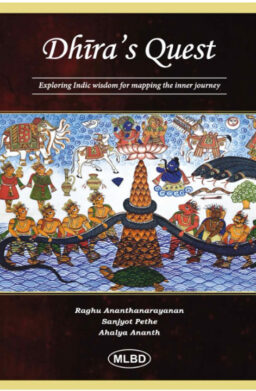
In a time when the “growth” has been reduced to productivity charts and quick-fix mindfulness, Dhira’s Quest: Exploring the Indic Wisdom for Mapping the Inner Journey enters the public conversation with a quiet but unmistakable seriousness. It does not promise happiness in seven steps or success in thirty days. Instead, it asks something far more unsettling—and far more transformative: Are we willing to turn inward and stay there long enough for truth to reveal itself?
Written by Raghu Ananthanarayan, Sanjyot Pethe, and Ahalya Ananth, Dhira’s Quest is not merely a book to be read; it is a book to be entered. Rooted deeply in Indic philosophy, psychology, and sacred storytelling, it offers a contemplative cartography of the inner life—one that draws equally from the Upanishads, Sāṅkhya, Yoga, Itihāsa–Purāṇa narratives, and Indian aesthetic traditions.
What makes this work distinctive is its integrating philosophy with life. Here, wisdom is an inheritance and a living process, shaped through dialogue, introspection, and sustained attention. The book belongs to a growing body of serious Indic scholarship that seeks not to imitate Western psychological models, but to recover India’s own sophisticated science of consciousness.
At its core, Dhira’s Quest unfolds through dialogue—between teacher and seeker, text and experience, story and introspection. The book arises from years of conversations, workshops, and reflective practices undertaken by the authors in diverse contexts: leadership spaces, therapeutic settings, yoga retreats, and artistic explorations.
The quest it depicts is not heroic in the conventional sense. There are no external victories here. Instead, the heroism lies in staying with one’s confusion, resisting premature answers, and learning to witness the mind without being enslaved by it.
Early in the book, the authors articulate a foundational premise: “Self as an instrument of change has been a long-term philosophy of many organizational and leadership development professions. India has a rich tradition of philosophies, practices, and stories to enable inner growth.” This sets the tone. The inner journey is not an escape from life; it is a deeper engagement with it.
One of the book’s strengths is the distinct yet harmonious voices of its authors, a confluence of practice, inquiry and tradition. Raghu Ananthanarayan, a leadership coach, organizational consultant, and co-founder of the Institute of Indic Wisdom, brings decades of engagement with Yoga, Sāṅkhya, and the Krishnamacharya lineage. His contribution is marked by clarity, philosophical rigor, and an insistence that inner work must be grounded in disciplined practice (abhyāsa) and discernment (viveka).

Sanjyot Pethe, whose personal journey forms the narrative spine of the book, offers an honest and vulnerable account of seeking. Her voice is neither romantic nor self-indulgent. Instead, it reveals how introspection unfolds through doubt, resistance, insight, and repeated return to awareness. Through her reflections, the reader encounters the raw texture of transformation.
Ahalya Ananth, a Bharatanatyam dancer and educator, introduces an embodied dimension to the inquiry. Drawing from Indian aesthetic theory (rasa), archetypes, and dance traditions, she demonstrates how movement, rhythm, and story become gateways to self-knowledge. Her contribution reminds us that consciousness is not merely thought—it is lived through the body.
Together, the three authors represent a rare synthesis: intellectual depth, experiential authenticity, and cultural rootedness.
Western Psychology and the Limits of the Outer Gaze
A portion of Dhira’s Quest is devoted to examining the historical trajectory of Western psychology—from Wilhelm Wundt’s introspection to behaviorism, psychoanalysis, and cognitive science. The authors acknowledge these traditions with respect, but also with critical clarity.
Western psychology, they argue, has largely remained confined to behavior, cognition, and pathology. Even when it speaks of selfhood, it often stops short of asking who the self truly is. In contrast, Indic psychology begins with a more radical inquiry. It does not ask merely how to function better, but how to be free.
As the book notes, while Western psychology often seeks adjustment to the world, Yoga seeks liberation from false identification with it. Patañjali’s Yoga Sūtras, with their emphasis on citta-vṛtti-nirodhaḥ (Stilling the fluctuations of the mind), point toward a dimension of consciousness untouched by conditioning.
One striking passage observes: “By staying with meditative observation one ultimately experiences the stillness from which true Self-awareness arises.” Here, introspection is not analysis alone—it is a disciplined witnessing that reveals the ground of awareness itself.
Perhaps the most compelling aspect of Dhira’s Quest is its use of Indic stories as psychological and spiritual maps. The authors revisit well-known narratives—the churning of the ocean (Samudra Manthan), Nachiketas’ dialogue with Yama, Prahlāda’s unwavering devotion—not as mythological curiosities, but as symbolic representations of inner processes.
Of Samudra Manthan, the book notes how the emergence of poison before nectar mirrors the seeker’s own journey: “Like the rainbow, when the moment passes, rests in quietude. To be liberated you must churn with intensity and watch breathlessly as secrets of the self-emerge from the churning.”
This insight is central to the book’s ethos: transformation is not linear or comfortable. The inner ocean must be churned, and what arises first is often discomfort, fear, or disorientation. Stories, the authors suggest, allow us to access truths that rational explanation cannot. They bypass intellectual resistance and speak directly to the psyche.
As Sanjyot Pethe reflects: “The external only triggers something internal. The stories are a bridge for getting in touch with personal essence.”
The Feminine Path of Longing and Maturity
One of the book’s most original contributions is Nāyikā’s Quest, which reframes the inner journey through the lens of the feminine archetype drawn from Indian aesthetics and dance traditions.
The Nāyikā—the heroine—is not passive. Her longing (viraha), devotion, anger, surrender, and patience are all recognized as valid and necessary stages of inner maturation. Drawing from Bharatanatyam and rasa theory, Ahalya Ananth shows how emotional states are not obstacles to awakening, but vehicles for it. This section resonates deeply in a world that often marginalizes emotional intelligence or reduces it to sentimentality. Here, emotion becomes sacred material—raw, instructive, and transformative.
Through Sanjyot’s lived narrative, the reader witnesses how personal suffering, when held with awareness, becomes a crucible for insight.
A Model of Inner Transformation
In its later chapters, Dhira’s Quest attempts something both ambitious and necessary: it offers a conceptual model of the inner journey grounded in Sāṅkhya cosmology.
The authors describe four experiential fields:
- The Entropic Field – marked by fragmentation, restlessness, and suffering
- The Enlivening Field – where insight and curiosity begin to dissolve separation
- The Coherent Field – characterized by clarity, peace, and alignment
- The Generative Field – a space of transcendence, silence, and creative compassion
Importantly, these are not stages to be “achieved” once and for all. They recur cyclically, much like life itself. The journey deepens through repeated movement between them. The book emphasizes that such transformation cannot be undertaken alone. Dialogue (samvāda) with a wise other—teacher, healer, or coach—is essential. Inner freedom, the authors remind us, is relational as much as it is solitary.
For Whom Is This Book?
Dhira’s Quest is not a casual read. It demands time, reflection, and a willingness to pause. It is written for seekers who sense that something essential is missing in purely external success; for yoga teachers and coaches who wish to ground their work in authentic wisdom; for therapists and leaders who recognize that without inner maturity, skill becomes hollow.
As the book gently reminds: “No one can acquire for another—not one. Not one can grow for another—not one.” Each reader must undertake their own quest.
An Invitation to Courageous Stillness
In the end, Dhira’s Quest resists closure. It does not conclude with answers neatly tied up. Instead, it leaves the reader with a deeper silence—and a more refined attention.
In an era addicted to speed, this book restores dignity to slowness. In a culture obsessed with performance, it re-centers being. It reminds us that the most radical act today may be to sit quietly, observe honestly, and allow the self to be revealed rather than constructed.
This is not a book that promises transformation. It invites it—patiently, respectfully, and without spectacle. For those willing to listen, Dhira’s Quest becomes not a guidebook, but a companion. And perhaps that is its greatest achievement: it walks with the reader, steady and unhurried, toward the vast and luminous interior landscape that Indic wisdom has always known to be our true home.
Disclaimer: The opinions expressed in this article belong to the author. Indic Today is neither responsible nor liable for the accuracy, completeness, suitability, or validity of any information in the article.