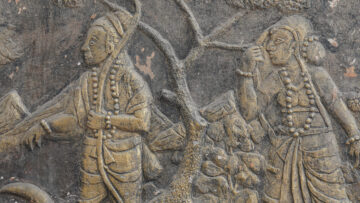

A Historical, Theological, and Philosophical Analysis
Abstract
The question of whether Rāma, the warrior-prince of the Rāmāyaṇa, can be considered a practitioner of ahiṃsā (non-violence) appears paradoxical at first glance. This essay argues that the paradox dissolves once we recover the historical evolution of the ahiṃsā concept and examine evidence often overlooked by conventional scholarship. Tracing ahiṃsā from its Vedic origins through Upaniṣadic transformation, Jain-Buddhist absolutization, epic problematization, and modern political reinterpretation, I demonstrate that Rāma embodies the most sophisticated understanding of non-violence: not as the absence of force but as the presence of perfect discrimination (viveka) within necessary action. Crucially, I present two episodes that reveal Rāma’s practice of a a form structurally anticipatory of later tantric ahiṃsā: his offering of his own lotus-eye as the 108th sacrifice to Devī (substituting self-sacrifice for animal sacrifice), and his acceptance of Śabarī’s tasted berries (ucchiṣṭa)—a transgression of purity norms that resonates ethically with later Mātaṅgī worship. These episodes demonstrate that Rāma’s ahiṃsā extended beyond battlefield restraint to a comprehensive rejection of exploitative sacrifice and caste-based pollution taboos. The evidence suggests that Rāma was not merely compatible with ahiṃsā but was its supreme practitioner—one of the most fully articulated exemplars who demonstrated consciousness operating with full ethical awareness even at the speed of violence while simultaneously transcending orthodox ritual violence through self-offering.
Keywords: Rāma, ahiṃsā, non-violence, Rāmāyaṇa, dharma, viveka, tantra, Mātaṅgī, Śabarī, ucchiṣṭa, sacrifice, self-offering.
1. The Problem: A Warrior and Non-Violence
At first consideration, asking whether Rāma was a practitioner of ahiṃsā seems like asking whether fire is wet. Rāma is, after all, the great warrior of the Rāmāyaṇa—the prince who slew the demon king Rāvaṇa along with countless rākṣasa warriors, who killed Vāli with a concealed arrow, who destroyed the armies of Laṅkā with divine weapons of terrifying power. How can such a figure be associated with non-violence?
Yet the question is not as absurd as it appears. The Mahābhārata, that encyclopedia of dharmic complexity, preserves a verse that has puzzled commentators for millennia: ahiṃsā paramo dharmaḥ dharma-hiṃsā tathaiva ca—’Non-violence is the supreme dharma; violence in service of dharma is equally so.’ [1] This apparent contradiction encapsulates a tension at the heart of Indian ethical thought, one that cannot be resolved by choosing sides but only by ascending to a higher level of understanding.
This essay argues that Rāma represents precisely that higher understanding. Far from being incompatible with ahiṃsā, Rāma embodies its most sophisticated formulation—one that has been progressively obscured as the concept underwent historical transformation. Moreover, I will present evidence from two often-overlooked episodes that reveal Rāma practicing a form of proto-tantric ahiṃsā that transcends even the battlefield: his self-sacrifice in place of animal offering, and his acceptance of ritually ‘polluted’ food from a tribal devotee. To recover this understanding, we must first trace how ahiṃsā emerged and evolved across Indian religious and philosophical history.
2. The Vedic Foundation: Sacrifice, Violence, and Cosmic Order
The earliest stratum of Indian religious literature—the Ṛgveda and associated Saṃhitā texts—presents a world in which ritual violence is not only permitted but cosmically necessary. The Vedic sacrifice (yajña) involved the killing of animals as offerings to the gods, and this killing was understood not as violation but as participation in the cosmic order (ṛta). [2] The Śatapatha Brāhmaṇa explicitly states that animals killed in sacrifice are not truly harmed because they attain heaven through the ritual process. [3]
This is not to say that Vedic culture was indifferent to harm. The texts contain numerous injunctions against injury to cows, Brahmins, and other protected categories. But the organizing principle was not ahiṃsā in the sense of universal non-harm; it was ṛta—the maintenance of cosmic and social order through appropriate action. Violence could be appropriate or inappropriate depending on context, ritual status, and cosmic necessity. The warrior who killed enemies in battle and the priest who slaughtered animals in sacrifice were both fulfilling their designated roles in the cosmic drama. [4]
The term ahiṃsā itself appears rarely in the earliest Vedic literature, and when it does, it functions primarily as an attribute of certain beings or states rather than as an ethical imperative. [5] The gods are described as ahiṃsā—incapable of being harmed—but humans are not commanded to practice non-harm as a fundamental duty. The emphasis falls instead on proper performance of one’s svadharma, which for kṣatriyas explicitly included martial violence.
3. The Upaniṣadic Turn: Internalization and Universalization
A significant shift occurred in the late Vedic period, documented in the Upaniṣads and associated Āraṇyaka literature. As Brian Black has argued, this period witnessed a ‘turning inward’ in which external ritual action was progressively reinterpreted as internal spiritual discipline. [6] The Bṛhadāraṇyaka Upaniṣad famously declares that the entire sacrificial apparatus can be internalized—the breath becomes the oblation, the body the altar, the mind the fire. [7]
This internalization created conceptual space for ahiṃsā to emerge as an ethical principle. If the purpose of sacrifice was not the external killing but the internal transformation, then violence itself became potentially dispensable. The Chāndogya Upaniṣad lists ahiṃsā among the virtues that constitute ‘gifts to the priests’ in the internal sacrifice—alongside truthfulness, austerity, charity, and non-stealing. [8] Here we see ahiṃsā elevated from descriptive attribute to prescriptive virtue, though still embedded within a broader ethical framework rather than standing alone as supreme principle.
Crucially, the Upaniṣadic transformation did not abolish the varṇāśrama system or eliminate the kṣatriya’s martial duty. The Bhagavadgītā, which represents the culmination of this trajectory, explicitly addresses a warrior’s crisis of conscience about violence—and resolves it not by endorsing pacifism but by teaching Arjuna to act without attachment to results. [9] Kṛṣṇa’s teaching is not ‘do not fight’ but ‘fight without desire, fight as offering to the divine, fight knowing that the self cannot truly be killed.’ The Upaniṣadic turn transformed the meaning of action without eliminating action itself.
4. The Śramaṇa Revolution: Jain and Buddhist Absolutization
The most radical reinterpretation of ahiṃsā emerged from the śramaṇa movements—Jainism and Buddhism—which developed partly in reaction to Brahmanical orthodoxy. Both traditions elevated non-violence to a position of supreme ethical importance, though they did so in characteristically different ways.
4.1 The Jain Formulation
Jainism articulated the most absolute version of ahiṃsā in Indian thought. For Jains, violence (hiṃsā) directly causes the influx of karmic matter (āsrava) that binds the soul to the cycle of rebirth. [10] Since all living beings—from humans down to single-sensed organisms (ekendriya jīva) inhabiting earth, water, fire, and air—possess souls capable of suffering, any harm to any being generates negative karma. The path to liberation requires complete cessation of hiṃsā in thought, word, and deed.
This absolutization created a theological problem when Jains sought to appropriate the Rāma narrative for their tradition. The solution, found in texts like Vimalasūri’s Paumacariya (c. 3rd-4th century CE), was radical revision: in Jain Rāmāyaṇas, Rāma does not kill Rāvaṇa. [11] Instead, Lakṣmaṇa performs all necessary violence while Rāma maintains his commitment to ahiṃsā. This narrative solution preserves Rāma’s purity but at the cost of coherence—if violence is absolutely prohibited, how is Lakṣmaṇa’s killing justified? And does Rāma not share in the karma of violence he enables?
4.2 The Buddhist Formulation
Buddhism approached ahiṃsā differently. Rather than treating violence as a metaphysical problem of karmic matter, Buddhism focused on the psychological roots of harm in craving (taṇhā), aversion (dosa), and delusion (moha). [12] The first precept—pāṇātipātā veramaṇī sikkhāpadaṃ samādiyāmi (‘I undertake the training rule to abstain from taking life’)—is formulated as a training discipline rather than an absolute ontological prohibition.
When the Rāma narrative entered Buddhist cultures—in Thailand as the Ramakien, in Laos as Phra Lak Phra Lam, in Cambodia as Reamker—it underwent characteristic softening. Violence was minimized, and new karmic explanations were introduced. In Thai versions, Rāma’s exile is explained as consequence for violence against animals in a previous birth—transforming the narrative into a teaching about karma while reducing the dissonance between heroic warfare and Buddhist values. [13]
5. The Epic Synthesis: Dharma-Hiṃsā and the Problem of Necessary Violence
The great Sanskrit epics—Mahābhārata and Rāmāyaṇa—belong to a different intellectual context than either Vedic ritualism or śramaṇa renunciation. They emerge from the kṣatriya milieu and address the ethical complexities of worldly existence, including the inescapable necessity of violence in maintaining cosmic and social order.
The Mahābhārata’s treatment is characteristically encyclopedic. It presents multiple perspectives: Yudhiṣṭhira’s reluctance to fight, Arjuna’s crisis in the Gītā, Bhīṣma’s elaborate teachings on rāja-dharma from his deathbed, the tragic consequences of war for victors and vanquished alike. [14] The text does not resolve these tensions into a single doctrine but holds them in a dynamic relationship. The verse cited earlier—ahiṃsā paramo dharmaḥ dharma-hiṃsā tathaiva ca—appears in precisely this context of irreducible complexity.
The Rāmāyaṇa, by contrast, presents Rāma as the ideal king (rāja-dharma) and ideal human being (maryādā puruṣottama). This raises the stakes for understanding his relationship to violence. If Rāma is the model, then his conduct in war must be exemplary—not merely permissible but paradigmatic. How then should we understand Rāma’s warfare in relation to ahiṃsā?
6. The Tantric Dimension: Self-Sacrifice and Transcendence of Purity
Before examining Rāma’s conduct in battle, we must consider two episodes that reveal a dimension of his ahiṃsā practice often overlooked by scholars focused on martial ethics. These episodes demonstrate that Rāma’s non-violence extended beyond restraint in warfare to encompass a comprehensive rejection of exploitative sacrifice and caste-based pollution taboos—anticipating tantric principles by centuries.
6.1 The Lotus-Eye Offering: Self-Sacrifice as Supreme Ahiṃsā
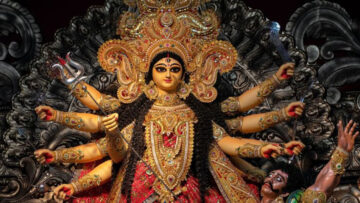
The episode is preserved in the Kṛttivāsa Rāmāyaṇa and related Bengali recensions, though its theological significance extends far beyond regional tradition. [15] Before the final battle with Rāvaṇa, Rāma undertook a ritual worship (pūjā) of Devī, the supreme Goddess, to secure divine blessing for the coming conflict. The ritual required the offering of 108 blue lotuses (nīlotpala)—a number of profound significance in tantric numerology, representing the completeness of cosmic manifestation.
As Rāma proceeded through the ritual, a crisis emerged: only 107 lotuses could be found. The offering was incomplete; the goddess’s blessing remained suspended. What happened next reveals the essence of Rāma’s understanding of sacrifice and non-violence.
Rather than seeking an animal substitute—the standard Vedic solution for ritual incompleteness—or abandoning the worship, Rāma recognized that his own eyes were compared in poetic tradition to blue lotuses (nīlotpala-nayana, ‘lotus-eyed’). He drew his arrow and prepared to offer his own eye as the 108th lotus. Only the Goddess’s intervention, moved by this supreme act of self-sacrifice, prevented the actual blinding—she accepted the intention as equivalent to the deed and granted her blessing. [16]
अष्टोत्तरशतं पुष्पं देव्यै दातुं समुद्यतः ।
सप्तोत्तरशतं लब्ध्वा एकस्याभावतः स्थितः ॥
स्वनेत्रं नीलपद्माभं उत्पाट्य दातुमुद्यतः ।
न पशुं न धनं किन्तु स्वदेहं बलिरूपिणम् ॥
(Ready to offer 108 flowers to the Goddess, having obtained 107, he stood lacking one. His own eye, resembling a blue lotus, he prepared to uproot and offer—not an animal, not wealth, but his own body as sacrifice.)
The theological implications are profound. In Vedic sacrifice, the offering (bali) typically involved something external to the sacrificer—animals, grain, soma, ghee. The sacrificer’s body remained inviolate while other beings bore the cost of cosmic maintenance. Rāma’s act inverted this logic entirely. When the ritual demanded an offering, he turned the demand upon himself rather than seeking another victim. This is ahiṃsā in its most radical form: not merely refraining from harm to others, but actively substituting oneself as the object of sacrificial violence.
This principle—svadeha-dāna or self-offering—would later become central to tantric soteriology, where the practitioner’s own body becomes the sacrificial altar and the distinction between sacrificer and sacrificed collapses. [17] But Rāma enacted this principle centuries before its systematic articulation, demonstrating an understanding of ahiṃsā that transcended the merely negative (refraining from harm) to embrace the radically positive (bearing harm oneself rather than inflicting it on others).
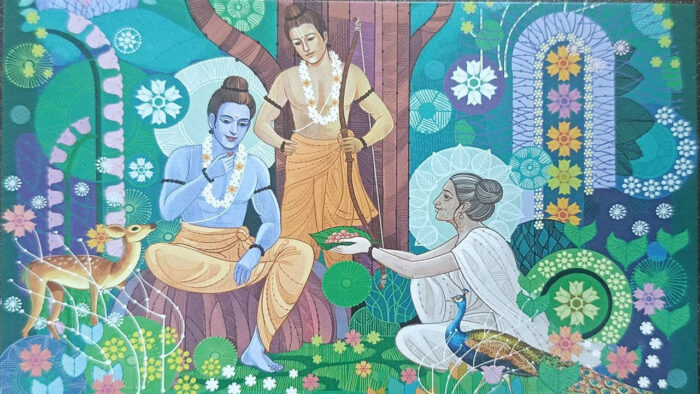
6.2 Śabarī’s Tasted Berries: The Mātaṅgī Parallel
The second episode occurs during Rāma’s forest exile, when he encounters Śabarī—an elderly tribal woman who had spent decades awaiting his arrival. Śabarī belonged to the Bhil community, classified in Brahmanical taxonomy as mleccha (barbarian) or antyaja (outcaste). Her very touch would render a Brahmin ritually impure; her food would be utterly unacceptable to any orthodox practitioner. [18]
When Rāma arrived at her hermitage, Śabarī offered him forest berries—but with a crucial detail that scandalized later commentators. She had tasted each berry herself before offering it, to ensure that only the sweetest fruits reached her beloved Lord. In Sanskrit terminology, this made the berries ucchiṣṭa—’leftover,’ ‘polluted by saliva,’ ritually defiled. [19] No orthodox recipient could accept such an offering without incurring severe pollution.
Rāma not only accepted Śabarī’s ucchiṣṭa berries—he ate them with evident pleasure, praising their sweetness. The text presents this not as compromise or concession but as recognition of the love (bhakti) that transcended ritual categories. Śabarī’s pollution became purity through devotion; her leftovers became prasāda through intention.
शबर्या प्रेमपूर्णानि फलानि उच्छिष्टरूपिणि ।
स्वादितान्यपि तान्येव रामो भक्त्या गृहीतवान् ॥
शुद्धाशुद्धविभागो यः स भक्तौ विलयं गतः ।
प्रेम्णा शुद्धं भवेत्सर्वं जातिर्नार्थवती भवेत् ॥
“The love-filled fruits of Śabarī, though in the form of leftovers, even tasted [by her]—those very ones Rāma accepted through devotion. The division between pure and impure dissolves in devotion; through love everything becomes pure, caste becomes meaningless.”
The tantric parallel here is striking. Among the Daśa Mahāvidyās—the ten great wisdom goddesses of tantric Hinduism—Mātaṅgī occupies a unique position as the goddess of pollution and transgression. [20] She is worshipped specifically with ucchiṣṭa offerings; her devotees deliberately offer leftover food, items touched by menstruating women, substances considered defiling in orthodox practice. Mātaṅgī’s worship inverts the purity hierarchy, finding the sacred precisely where orthodox religion locates the profane.
Śabarī’s offering to Rāma follows exactly this logic—centuries before the systematic articulation of Mātaṅgī worship in tantric texts. Rāma’s acceptance demonstrates that his understanding of dharma transcended the purity codes that would exclude tribal peoples, outcaste communities, and ‘polluted’ offerings from religious participation. This too is ahiṃsā—the non-violence of refusing to harm through exclusion, the recognition that caste hierarchy itself constitutes a form of structural violence against those it marginalizes.
Read together, these two episodes reveal a Rāma whose ahiṃsā operated on multiple levels: he refused to sacrifice animals when he could sacrifice himself; he refused to maintain purity barriers when love demanded their dissolution. The warrior who would kill Rāvaṇa was simultaneously the devotee who offered his own eye and the lord who ate a tribal woman’s saliva-touched berries. This is not contradiction but completion—a comprehensive ahiṃsā that addresses violence in all its forms, from battlefield slaughter to ritual exploitation to caste exclusion.
7. Rāma’s Ahiṃsā on the Battlefield: The Third Way
With the tantric dimensions established, we can now understand Rāma’s battlefield conduct more completely. He represents neither the absolutist ahiṃsā of the Jains (which would preclude any violence) nor the utilitarian violence-acceptance sometimes attributed to Kṛṣṇa at Kurukṣetra (which accepts collateral damage as unavoidable). Instead, Rāma embodies a third position: ahiṃsā as perfect discrimination (viveka) within necessary action.
This position holds that true non-violence is not the absence of force but the presence of consciousness. Violence divorced from awareness, violence that cannot distinguish between the guilty and the innocent, violence that exceeds necessity—this is hiṃsā. But action that preserves full ethical awareness, that discriminates perfectly between appropriate and inappropriate targets, that applies exactly the force required and no more—this is not hiṃsā but dharma, and its practitioner is an ahiṃsaka in the deepest sense.
न सर्वात्मना अहिंसको रामो युद्धे प्रवृत्तः ।
किन्तु आवश्यके स्थाने एव हिंसां प्रयुङ्क्ते ॥
शल्यचिकित्सकवत् कर्तन् रक्षन् च समकालम् ।
हिंसायाः औषधत्वं दुष्टत्वनाशे प्रकटते ॥
(Rāma in war was not completely committed to ahiṃsā [in the absolutist sense], but applied violence only where necessary—like a surgeon, cutting and protecting simultaneously. Violence becomes medicine in destroying evil’s essence.)
8. The Evidence: Rāma’s Conduct in War
What evidence supports this interpretation? Consider Rāma’s conduct throughout the Laṅkā campaign as depicted in Vālmīki’s text.
8.1 Exhaustion of Alternatives
Before resorting to war, Rāma pursued every diplomatic avenue. Hanumān’s embassy offered Rāvaṇa the opportunity to return Sītā peacefully. Aṅgada’s mission to Rāvaṇa’s court repeated the offer. Vibhīṣaṇa’s defection demonstrated that even family members of the demon king recognized the justice of Rāma’s cause. [21] Only after these efforts failed—only after Rāvaṇa had been given every opportunity to avoid conflict—did Rāma proceed to battle. This pattern matches the classical requirements for just war: violence as last resort after peaceful alternatives have been exhausted.
8.2 Proportionality and Precision
Rāma’s warfare was characterized by precision rather than excess. Against Rāvaṇa’s ten heads—representing the manifold aspects of evil—Rāma aimed a single arrow. This is not mere narrative economy but theological statement: the measure of power required to defeat evil, no more and no less. [22] Compare this to the total war of the Mahābhārata, where eighteen akṣauhiṇī (army divisions) were annihilated over eighteen days, where divine weapons destroyed entire battalions, where even the victorious Pāṇḍavas lost their sons and most of their allies.
8.3 The Fly in the Arrow’s Path: Consciousness at Violence-Speed
Most significantly, Rāma maintained ethical discrimination throughout the conflict. Those who actively chose to defend Rāvaṇa—the rākṣasa warriors, Rāvaṇa’s generals, his willing allies—were legitimate targets. But Rāma’s restraint extended to beings who bore no liability: civilians of Laṅkā, animals caught in the conflict’s path, creatures with no stake in the cosmic struggle between dharma and adharma.
The clearest illustration of this principle—and the heart of the argument for Rāma as ahiṃsā’s supreme practitioner—appears in a moment often overlooked by commentators. In the midst of battle, with his bow drawn and divine arrow nocked, with cosmic necessity demanding Rāvaṇa’s destruction, Rāma perceived a tiny fly crossing the arrow’s intended trajectory. What happened next reveals the nature of his consciousness: without losing focus on his primary objective, without compromising the necessity of the strike, Rāma adjusted his aim to spare the inconsequential creature. [23]
सहस्रयोद्धृमध्ये तु रामो एक विशिष्यते ।
यो मां मक्षिकां दृष्ट्वा बाणमार्गं व्यवर्तयत् ॥
एकः क्षणो हि रामस्य सर्वशास्त्रेभ्यो महान् ॥
(Among a thousand warriors, Rāma alone is distinguished—who, seeing me, a fly, turned away the arrow’s path. One moment of Rāma is greater than all scriptures.)
This moment—what I term ‘Rāma’s moment’—demonstrates that consciousness can operate with perfect discrimination even at the speed of violence. It connects directly to the lotus-eye episode: the same Rāma who would sacrifice his own eye rather than harm an animal would adjust his arrow’s path rather than kill a fly. The pattern is consistent: ahiṃsā not as absence of force but as presence of comprehensive awareness, extending from ritual sacrifice to battlefield combat.
8.4 Rāma Beyond Religion: Strategy, Restraint, and Ethical Action
In this sense, Rāma is best understood not as a religious icon defined by ritual or belief, but as a model of ethical intelligence: strategy before force, restraint during force, and renunciation after victory. His life demonstrates that dharma is not preserved by passivity, nor by domination, but by measured action guided by accountability.
Finally, Rāma’s example challenges later absolutist readings of ahiṃsā, including those that retroactively project modern pacifist ethics onto the epic. What later came to be known as ‘Rāma’s non-violence’ was, in many cases, a selective reinterpretation that emphasized restraint while neglecting responsibility. Rāma’s ahiṃsā did not consist in refusing force under all circumstances, but in refusing unnecessary force, refusing excess, refusing conquest, and refusing to let morality become an excuse for avoidable suffering.
The clearest proof that Rāma’s war was not driven by ambition lies in its aftermath. Upon victory, he reclaimed only what had been unjustly taken, restored order, and withdrew. He did not annex Laṅkā, did not rule it, and did not convert military success into empire. Instead, governance was restored to local authority, and Rāma returned home. This voluntary renunciation of power after decisive victory is exceedingly rare in historical warfare and marks the completion of his ethical restraint. Violence, in his framework, was strictly instrumental and terminated the moment its purpose was fulfilled.
Equally significant is Rāma’s treatment of his own forces. He never regarded his allies as expendable instruments, nor did he permit their mass sacrifice in the name of moral symbolism. He intervened to prevent unchecked slaughter and structured the conflict to minimise loss on both sides. This refusal to outsource suffering distinguishes ethical restraint from passive non-resistance. Allowing one’s own people to be destroyed under the guise of non-violence was not, for Rāma, a moral option.
When force became unavoidable, Rāma calibrated it with precision. He neither indulged in excess nor allowed violence to escalate beyond necessity. His warfare was goal-oriented rather than attritional: the objective was to neutralize a specific source of adharma, not to annihilate an enemy society. This ethical calibration is symbolically reflected in the defeat of Rāvaṇa with a single decisive strike rather than disproportionate destruction. Power, for Rāma, was a tool to end injustice, not a means of display.
Rāma’s ethical framework is most clearly visible in his approach to violence. Contrary to interpretations that equate ahiṃsā with the total absence of force, Rāma practiced a discriminative ahiṃsā grounded in responsibility and restraint. Force was never his first resort. Before engaging in war, he exhausted strategic alternatives: diplomacy, warning, negotiation, and psychological assessment of the adversary. These were not gestures of weakness, but deliberate strategies aimed at preventing unnecessary destruction. Only when it became evident that Rāvaṇa was incapable of responding to moral language did Rāma resort to armed action, recognizing that continued non-coercive protest would merely prolong suffering.
Modern representations often project Rāma primarily as a religious or ritual icon, yet a close reading of the Rāmāyaṇa reveals a fundamentally different figure: not a preacher of religion, nor an exponent of ritual theology, but an ethical agent who embodied karma and dharma through action. Rāma neither founded a religious system nor articulated doctrines of worship, purity, or salvation. His authority derived not from revelation or ritual sanctity, but from disciplined conduct under moral pressure. Dharma, in his case, was not something taught but something enacted.
9. Post-War Restoration: The Completion of Ahiṃsā
Rāma’s practice of ahiṃsā extended beyond the conduct of war to its aftermath. His installation of Vibhīṣaṇa as king of Laṅkā—rather than annexing the territory or installing a puppet—demonstrated commitment to the flourishing of the defeated. [24] He did not treat Rāvaṇa’s subjects as collectively guilty; he did not impose punitive conditions; he did not engage in the victor’s prerogatives of plunder and humiliation. The goal of his warfare was not conquest but restoration of dharmic order, which required the healing of Laṅkā no less than the destruction of its tyrant.
युद्धं समाप्य विजेता पुनर्निर्माणे प्रवर्तते ।
न केवलं विनाशाय किन्तु सृष्ट्यै च युध्यते ॥
शत्रुनगरं स्वनगरवत् पालयेत् धर्मवीरः ॥
(Having completed war, the victor engages in reconstruction. He fights not merely for destruction but also for creation. A dharmic hero should protect the enemy’s city as his own.)
10. The Modern Distortion: Absolutization and Its Limits
The twentieth century witnessed another transformation of ahiṃsā—its political deployment by Mahatma Gandhi in the Indian independence movement. Gandhi explicitly invoked classical sources while developing a distinctive interpretation that emphasized passive resistance, willingness to suffer rather than inflict harm, and near-absolute rejection of violence even in self-defense. [25]
Gandhi’s ahiṃsā was enormously influential and remarkably effective as a political strategy against an adversary (the British Raj) that possessed both a conscience and sensitivity to international opinion. However, Gandhi himself acknowledged limitations: ‘Where there is only a choice between cowardice and violence, I would advise violence.’ [26] This concession indicates that Gandhian ahiṃsā was contextually calibrated—a position closer to Rāma’s discrimination than to Jain absolutism, despite Gandhi’s rhetoric.
Nevertheless, Gandhi’s interpretation has come to dominate popular understanding of ahiṃsā, such that the term now connotes complete rejection of force. This represents a historical narrowing—the loss of the sophisticated discrimination exemplified by Rāma. What was also lost was the tantric dimension: Rāma’s willingness to sacrifice himself rather than others, his transcendence of purity taboos in the service of love. These elements have no place in the Gandhian framework, which retained Brahmanical assumptions about purity and pollution while radicalizing non-violence.
10.1 Gandhian Ahiṃsā: A Distinct Ethical Construction
One might summarize the distinction thus: Gandhi moralized restraint into a principle; Rāma moralized power into responsibility.
Gandhi’s nonviolence stands as a coherent and influential moral system in its own right. The conceptual error arises only when it is retroactively labeled as Rāma’s ahiṃsā. What Gandhi practiced was Gandhian ahiṃsā—inspired by Rāma’s moral stature, but not identical to Rāma’s ethical framework.
The difference may be stated succinctly: Gandhian ahiṃsā seeks to replace violence through moral suffering. Rāma’s ahiṃsā seeks to limit violence through strategy, precision, and timely cessation.
Rāma’s ahiṃsā operates on a different ethical logic. It is not absolute but discriminative and responsibility-based. Rāma employed persuasion first, but abandoned it once the adversary proved incapable of moral dialogue. He refused to let restraint become an excuse for avoidable death, protected allies from being sacrificed for moral symbolism, and applied calibrated force to end violence decisively. Most importantly, Rāma renounced power after victory, restoring order without conquest.
This ethic was deliberately designed for a specific political context—colonial rule—where the adversary retained moral sensitivity, public accountability, and concern for legitimacy. In such conditions, nonviolent suffering functioned as an effective moral lever. Gandhi therefore elevated restraint into a universal rule and treated the acceptance of suffering as a transformative instrument.
Mahatma Gandhi articulated a form of ahiṃsā that was ethically powerful but historically and philosophically distinct from that embodied by Rāma. Gandhian ahiṃsā was an absolutized principle of non-violence, grounded in voluntary suffering, moral persuasion, and the belief that self-sacrifice could awaken the conscience of the oppressor. Its core method was satyāgraha: resistance through truth, endurance, and refusal to retaliate, even at great personal or collective cost.
11. Conclusion: Rāma as Ahiṃsā’s Supreme Practitioner
We began with a paradox: how can a warrior be a practitioner of non-violence? The paradox dissolves once we recognize that ahiṃsā, in its most sophisticated formulation, is not the absence of force but the presence of discrimination. Rāma killed when killing was necessary, restrained when restraint was possible, and maintained consciousness of all affected beings throughout. His ahiṃsā was not passive but active, not withdrawal from the world but perfect engagement with it.
But Rāma’s ahiṃsā extended beyond the battlefield to ritual and social domains. In offering his own eye rather than an animal sacrifice, he demonstrated that true non-violence means bearing cost oneself rather than imposing it on others—a principle that resonates ethically with later tantric self-offering. In accepting Śabarī’s ucchiṣṭa berries, he demonstrated that love transcends purity codes and caste barriers—a principle that parallels Mātaṅgī worship and challenges the structural violence of social exclusion.
To answer our initial question: yes, Rāma was a practitioner of ahiṃsā—and not merely a practitioner but its supreme exemplar. He demonstrated what no other figure in Indian religious literature achieved: consciousness discriminating perfectly at the speed of violence, self-sacrifice replacing animal sacrifice, love dissolving pollution taboos, and post-war restoration completing what battlefield victory began. This comprehensive ahiṃsā—martial, ritual, and social—represents the fullest expression of non-violence in Indian tradition.
स्वनेत्रं बलिदानाय शबर्या उच्छिष्टभक्षणम् ।
मक्षिकायाः कृते मार्गपरिवर्तनमद्भुतम् ॥
एतत्त्रयं समालोक्य कः कथयेद्धिंसको हि सः ।
अहिंसायाः परं रूपं रामो एव प्रदर्शितम् ॥
“His own eye for sacrifice-offering, eating Śabarī’s leftovers, the wonderful path-diversion for a fly’s sake—seeing these three, who would call him violent? The supreme form of ahiṃsā was demonstrated by Rāma alone.”
Comparative Analysis: Rāma and Other Traditions
The ethical distinctiveness of Rāma becomes clearer when his conduct is placed in comparative perspective with other mythological figures, historical warriors, and modern theories of non-violence.
Comparison with Other Mythological Warriors
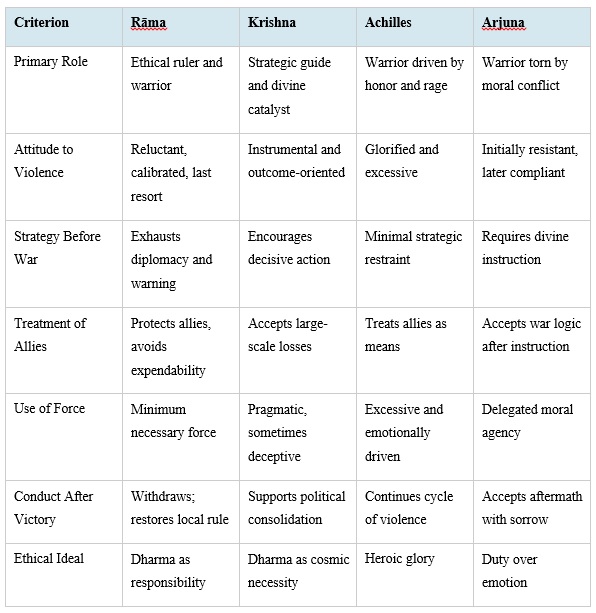
Table 1 compares Rāma’s ethical framework with three other prominent warrior figures from Indian mythology: Krishna, Achilles, and Arjuna.
Comparison with Historical Warriors
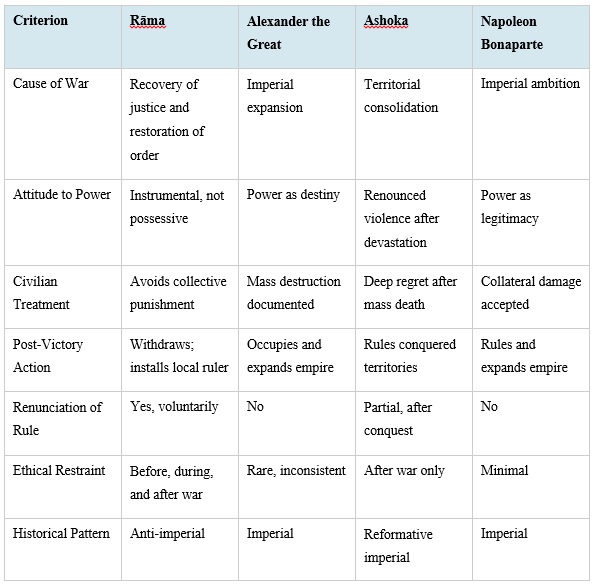
Table 2 compares Rāma’s conduct with that of historical warrior-rulers, revealing the distinctiveness of his approach to power, conquest, and post-war governance.
Rāma’s Ahiṃsā versus Gandhian Ahiṃsā
Table 3 clarifies the distinction between Rāma’s discriminative ahiṃsā and Gandhi’s modern reinterpretation, showing how they address different historical circumstances.
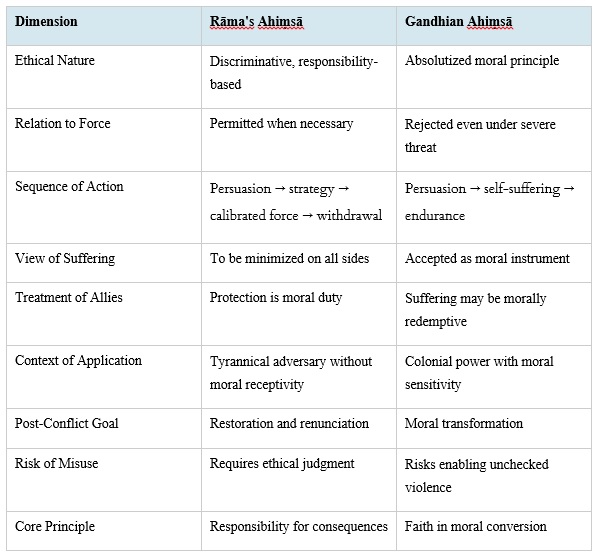
The fundamental difference can be summarized thus: Gandhian ahiṃsā seeks to replace violence; Rāma’s ahiṃsā seeks to contain and terminate it.
Notes
[1] Mahābhārata, Anuśāsana Parva 116.37-38. The verse appears in the context of Bhīṣma’s teachings on dharma.
[2] For comprehensive treatment of Vedic sacrifice, see Jan Heesterman, The Broken World of Sacrifice: An Essay in Ancient Indian Ritual (Chicago: University of Chicago Press, 1993).
[3] Śatapatha Brāhmaṇa 3.8.1.15.
[4] On varṇa-dharma and kṣatriya violence, see Patrick Olivelle, Dharmasūtras (Oxford: Oxford University Press, 1999).
[5] Ludwig Alsdorf, The History of Vegetarianism and Cow-Veneration in India (London: Routledge, 2010).
[6] Brian Black, The Character of the Self in Ancient India (Albany: SUNY Press, 2007).
[7] Bṛhadāraṇyaka Upaniṣad 3.1.1-6.
[8] Chāndogya Upaniṣad 3.17.4.
[9] Bhagavadgītā 2.19-21, 3.19-26, 18.59-66. See Angelika Malinar, The Bhagavadgītā: Doctrines and Contexts (Cambridge: Cambridge University Press, 2007).
[10] On Jain karma theory, see Paul Dundas, The Jains, 2nd ed. (London: Routledge, 2002), 84-106.
[11] Vimalasūri, Paumacariya. See John Cort, ‘An Overview of the Jain Purāṇas,’ in Purāṇa Perennis, ed. Wendy Doniger (Albany: SUNY Press, 1993).
[12] On Buddhist psychology of violence, see Peter Harvey, An Introduction to Buddhist Ethics (Cambridge: Cambridge University Press, 2000).
[13] On Southeast Asian Rāmāyaṇa traditions, see Paula Richman, ed., Many Rāmāyaṇas (Berkeley: University of California Press, 1991).
[14] On the Mahābhārata’s ethical complexity, see Bimal Krishna Matilal, Ethics and Epics (Delhi: Oxford University Press, 2002).
[15] Kṛttivāsa Rāmāyaṇa, Laṅkā Kāṇḍa. For critical edition, see Haraprasād Śāstrī, ed., Kṛttivāsī Rāmāyaṇa (Calcutta: Bangiya Sahitya Parishad, 1957).
[16] The episode appears in multiple Bengali and Odia recensions. For analysis, see W.L. Smith, Rāmāyaṇa Traditions in Eastern India (Stockholm: Department of Indology, 1988).
[17] On svadeha-dāna in tantric practice, see David Gordon White, The Alchemical Body: Siddha Traditions in Medieval India (Chicago: University of Chicago Press, 1996).
[18] On Bhil communities and their relationship to Brahmanical categories, see David Hardiman, The Coming of the Devi: Adivasi Assertion in Western India (Delhi: Oxford University Press, 1987).
[19] On ucchiṣṭa in Hindu law, see Patrick Olivelle, ‘Food in India,’ Journal of Indian Philosophy 23 (1995): 367-380.
[20] On Mātaṅgī and ucchiṣṭa worship, see David Kinsley, Tantric Visions of the Divine Feminine: The Ten Mahāvidyās (Berkeley: University of California Press, 1997), 213-230.
[21] Vālmīki Rāmāyaṇa, Yuddha Kāṇḍa, sargas 18-41.
[22] On the final battle, see Yuddha Kāṇḍa, sargas 108-111.
[23] This moment is preserved in traditional commentarial literature. See also Samanta, ‘The Jātismara Fly of Rāmāyaṇa’ (forthcoming).
[24] Vālmīki Rāmāyaṇa, Yuddha Kāṇḍa, sarga 116.
[25] M.K. Gandhi, Non-Violent Resistance (Satyagraha) (New York: Schocken Books, 1961).
[26] M.K. Gandhi, Young India, August 11, 1920.
References
Alsdorf, Ludwig. 2010. The History of Vegetarianism and Cow-Veneration in India. London: Routledge.
Black, Brian. 2007. The Character of the Self in Ancient India. Albany: SUNY Press.
Dundas, Paul. 2002. The Jains. 2nd ed. London: Routledge.
Hardiman, David. 1987. The Coming of the Devi: Adivasi Assertion in Western India. Delhi: Oxford University Press.
Harvey, Peter. 2000. An Introduction to Buddhist Ethics. Cambridge: Cambridge University Press.
Heesterman, Jan. 1993. The Broken World of Sacrifice. Chicago: University of Chicago Press.
Kinsley, David. 1997. Tantric Visions of the Divine Feminine: The Ten Mahāvidyās. Berkeley: University of California Press.
Malinar, Angelika. 2007. The Bhagavadgītā: Doctrines and Contexts. Cambridge: Cambridge University Press.
Matilal, Bimal Krishna. 2002. Ethics and Epics. Ed. Jonardon Ganeri. Delhi: Oxford University Press.
Olivelle, Patrick. 1999. Dharmasūtras. Oxford: Oxford University Press.
Richman, Paula, ed. 1991. Many Rāmāyaṇas. Berkeley: University of California Press.
Smith, W.L. 1988. Rāmāyaṇa Traditions in Eastern India. Stockholm: Department of Indology.
White, David Gordon. 1996. The Alchemical Body: Siddha Traditions in Medieval India. Chicago: University of Chicago Press.
Feature Image Credi: pinterest.com
Disclaimer: The opinions expressed in this article belong to the author. Indic Today is neither responsible nor liable for the accuracy, completeness, suitability, or validity of any information in the article.