
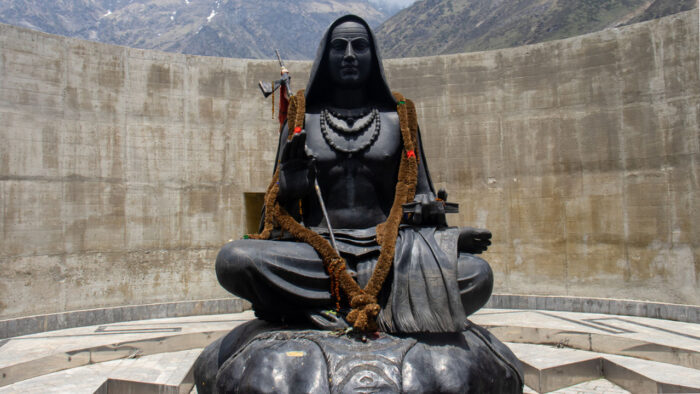
Ādi Śaṅkara’s Method of Bhāratīya Darśana Integration
Modern presentations of the Bhāratīya jñāna-paramparā often portray the darśanas as mutually “competing schools” of thought, each advancing a self-contained worldview. Read through this lens, Ādi Śaṅkara’s Brahmasūtra Bhāṣya is frequently taken to represent a sustained contest between Vedānta and systems such as Sāṅkhya, Yoga, and Vaiśeṣika. Such a reading, however, mislocates both the shared śāstric ground of the darśanas and the specific task Śaṅkara undertakes.
Śaṅkara approaches Sāṅkhya–Yoga as positions articulated within a common Vedic paramparā. All the views examined in the Brahmasūtra Bhāṣya accept the Veda as pramāṇa and orient inquiry toward mokṣa. The question is whether darśanic accounts conform to śruti on origination and causality.
This methodological stance is stated explicitly by Śaṅkara at the outset of his examination (Brahmasūtra Bhāṣya 2.1.1):
स एव च सर्वेषां न आत्मा इत्येतद्वेदान्तवाक्यसमन्वयप्रतिपादनेन प्रतिपादितम् ।
प्रधानादिकारणवादाश्चाशब्दत्वेन निराकृताः ।
sa eva ca sarveṣāṁ na ātmā ity etad vedānta-vākya-samanvaya-pratipādanena pratipāditam |
pradhānādi-kāraṇa-vādāś ca aśabdatvena nirākṛtāḥ |
Śaṅkara’s treatment of Sāṅkhya and Yoga thus proceeds within a disciplined śāstric order. Disagreement, where it arises, is a matter of epistemic scrutiny rather than polemical opposition.
The governing principle of this inquiry is pramāṇa-maryādā. Claims are examined according to the means of knowing appropriate to their subject matter. In questions concerning Brahman and the origin of the world, śruti alone is self-establishing. Smṛti, tarka, and systematic reasoning are employed only insofar as they serve to clarify the meaning of śruti; when they exceed that role, they lose determinative force. What may appear as disagreement is, in fact, disciplined scrutiny, testing specific explanatory claims against the highest acknowledged pramāṇa.
This mode of analysis presupposes a shared śāstric terrain. Śaṅkara’s engagement in Brahmasūtra Adhyāya 2 therefore proceeds neither by wholesale rejection nor by uncritical acceptance of Sāṅkhya and Yoga, but by isolating a precise point of examination. That point is narrowly defined: the manner in which sṛṣṭi-kāraṇa is understood and articulated in explanatory accounts.
The Fixed Axis of Inquiry: Brahman as Conscious Jagad-kāraṇa
The inquiry of Adhyāya 2 rests on the siddhānta decisively established in Adhyāya 1: Brahman alone is the jagad-utpatti-kāraṇa—that from which the world arises, by which it is sustained, and into which it is resolved. This is presented as the settled tātparya of the Upaniṣads. The second adhyāya examines other darśanic explanatory accounts in the light of this determination.
What remains fixed in Śaṅkara’s ordering is that Brahman is a conscious cause—sarvajña and sarveśvara. The Upaniṣads do not describe the world as emerging from an inert substrate, but from a knowing reality that is at once the source of origination and the inner Self (antarātman) of all beings. Origination, sustenance, and resolution are thus traced to a cause that is not merely material, but conscious and self-revealing.
It is from this fixed axis that Śaṅkara examines alternative accounts. Certain presentations of Sāṅkhya posit pradhāna—prakṛti or avyakta—as an insentient, independent cause. Śaṅkara states this claim precisely and without caricature:
तासु ह्यचेतनं प्रधानं स्वतन्त्रं जगतः कारणमुपनिबध्यते।
tāsu hi acetanaṁ pradhānaṁ svatantraṁ jagataḥ kāraṇam upanibadhyate
(—an insentient pradhāna is proposed as an autonomous cause of the world.)
The difficulty is not that such an account belongs to another darśana, but that it assigns ultimacy to an unconscious principle, thereby displacing the role that śruti assigns to consciousness as the source of origination. An insentient principle cannot function as the governor of origination, order, and reabsorption. Any account that treats such a principle as self-sufficient therefore exceeds what śruti allows.
It is in this precise and limited sense that Śaṅkara states:
प्रधानादिकारणवादाश्चाशब्दत्वेन निराकृताः।
pradhānādi-kāraṇa-vādāḥ aśabdatvena nirākṛtāḥ
(—accounts that posit pradhāna and similar principles as ultimate causes are set aside due to lack of śruti support.)
The exclusion is not systemic but surgical. It concerns only the claim of svatantra jagad-kāraṇatva, not the entirety of Sāṅkhya analysis. Adhyāya 2 thus proceeds from a settled axis rather than an open contest. Brahman, as the conscious ground of origination and sustenance, remains fixed throughout.
What follows is a clarification of why no account that removes consciousness from the status of ultimate cause can be reconciled with the Upaniṣadic understanding of sṛṣṭi. The inquiry remains narrowly focused, rigorously pramāṇa-bound, and internal to the Vedic paramparā.
Smṛti under Śruti: Kapila Honoured within Pramāṇa-Order
Having fixed Brahman as the conscious jagad-kāraṇa, Śaṅkara next addresses a natural objection: if śruti alone is taken as decisive, does this not undermine the authority of revered smṛtis, especially those attributed to Kapila? The opening of the Smṛtyadhikaraṇa (2.1.1–2) raises precisely this concern. Sāṅkhya texts are understood to teach that an insentient pradhāna functions as the independent cause of the world; if this claim is set aside, are not the words of an ancient seer and an honoured lineage thereby displaced?
Śaṅkara’s response is neither dismissive nor defensive. He does not deny the authority of smṛti, nor does he question the stature of Kapila. What he insists upon is a clear ordering of pramāṇas. In matters concerning Brahman and ultimate causality, śruti alone is independent; smṛti derives its authority from conformity to śruti. This principle is not asserted ad hoc, but follows a rule of śāstric reasoning articulated within the Mīmāṃsā tradition itself:
दर्शितं तु श्रुतीनामीश्वरकारणवादं प्रति तात्पर्यम्।
विप्रतिपत्तौ च स्मृतीनामवश्यकर्तव्येऽन्यतरपरिग्रहेऽन्यतरपरित्यागे च श्रुत्यनुसारिण्यः स्मृतयः प्रमाणम्, अनपेक्ष्या इतराः।
तदुक्तं प्रमाणलक्षणे—विरोधे त्वनपेक्षं स्यादसति ह्यनुमानम् इति।
darśitaṁ tu śrutīnām īśvara-kāraṇa-vādaṁ prati tātparyam |
vipratipattau ca smṛtīnām avaśyakartavye anyatara-parigrahe anyatara-parityāge ca śruty-anusāriṇyaḥ smṛtayaḥ pramāṇam, anapekṣyā itarāḥ |
tad uktaṁ pramāṇa-lakṣaṇe—virodhe tv anapekṣaṁ syāt, asati hi anumānam iti |
(Jaimini–Mīmāṃsā–sūtra 1.3.3)
The intended purport of śruti—that Īśvara is the cause—has already been established. When smṛtis conflict and a choice must necessarily be made, only those that follow śruti are authoritative; the others are set aside in that specific respect. This follows directly from the definition of pramāṇa: in cases of contradiction, what is independent of śruti lacks determinative force, since inference cannot operate where its conditions are absent.
Two features of Śaṅkara’s reasoning are especially significant. First, smṛti is not a single, uniform voice. Alongside Sāṅkhya passages that present pradhāna as the cause, there exist numerous smṛti texts—Purāṇic, epic, and Gītā-like—that explicitly affirm a supreme conscious principle as the source, sustainer, and resolution of the world. To treat Kapila’s account as the definitive smṛti position is therefore unwarranted. Taken as a whole, smṛti does not compel acceptance of an unconscious ultimate cause.
Second, Śaṅkara clarifies that respect for a ṛṣi does not entail unconditional acceptance of every teaching attributed to him. The Upaniṣads themselves may acknowledge the insight of particular figures, but such recognition does not license the acceptance of views that conflict with their central teaching. Were smṛti permitted to override śruti, the order of Veda-pramāṇa would collapse. Accordingly, where a smṛti accords with what the Upaniṣads teach, it is received; where it diverges, it is set aside in that specific respect.
What is rejected, then, is not Kapila as a knower, nor Sāṅkhya as a discipline of inquiry, but the elevation of pradhāna to the status of an autonomous, ultimate cause. The rejection is confined to cosmological ultimacy; it does not extend to other analyses found within the Sāṅkhya tradition.
In this way, Śaṅkara exemplifies a mode of engagement that is neither uncritical reverence nor polemical dismissal. Kapila is honoured within the bounds of śāstric order. His insights may illuminate aspects of bondage and release, but they cannot displace the Upaniṣadic affirmation of Brahman as the one conscious ground. Smṛti is thus not negated; it is re-situated—retained where it accords with śruti, and limited where it exceeds its proper scope.
This disciplined placement of smṛti under śruti establishes the pattern governing Śaṅkara’s entire treatment of Sāṅkhya–Yoga in Adhyāya 2. What follows is not an attack on these traditions as such, but a careful determination of the level at which their teachings may rightly operate within a Vedāntic understanding of reality.
Yoga Re-situated: Sṛṣṭi-kāraṇa-Vāda Limited, Sādhana Preserved
Following the examination of Sāṅkhya, Śaṅkara extends the same discipline of analysis to Yoga in the Yogapratyuktyadhikaraṇa (2.1.3). This extension is deliberate. Yoga, like Sāṅkhya, is widely honoured as a means toward mokṣa and is often supported by passages that resonate closely with Vedic language and practice.
Śaṅkara’s assessment is precise. Wherever Yoga shares the same foundational claim attributed to Sāṅkhya—namely, that an unconscious prakṛti or pradhāna functions as a self-sufficient cause of the world—it is set aside in that respect. The Upaniṣads do not admit an ultimate source of origination that is other than conscious. Pradhāna is therefore rejected only insofar as it is presented as svatantra sṛṣṭi-kāraṇa; it is never admitted as the independent ground of origination.
At the same time, Śaṅkara recognises Yoga’s distinctive standing. The Upaniṣads themselves enjoin hearing, reflection, and sustained assimilation (śravaṇa–manana–nididhyāsana), and they describe disciplines of bodily steadiness, sense-restraint, and meditative absorption. Where Yoga teaches mastery of the senses, inward orientation, freedom from distraction, and sustained attentiveness, it stands in harmony with śruti and is fully admissible. The limitation applies only where such discipline is coupled with a causal account that assigns ultimacy to an unconscious principle.
Śaṅkara formulates the governing principle succinctly:
येन त्वंशेन न विरुध्येते तेनेष्टमेव सांख्ययोगस्मृत्योः सावकाशत्वम्।
तत्त्वज्ञानं तु वेदान्तवाक्येभ्य एव भवति।
yena tv aṁśena na virudhyete tena iṣṭam eva sāṅkhya-yoga-smṛtyoḥ sāvākāśatvam |
tattva-jñānaṁ tu vedānta-vākhyebhya eva bhavati |
To the extent that they do not conflict, space for the Sāṅkhya and Yoga smṛtis is accepted; knowledge of reality, however, arises only from Vedāntic statements.
Accordingly, Yoga is not dismissed as a way of life. What is set aside is only the claim that disciplined practice, when detached from knowledge grounded in śruti, can independently yield mokṣa. Yoga is thus preserved as sādhana—a means of preparation and inward orientation—while final release is secured through the Upaniṣadic recognition of Brahman as the one conscious ground.
Pradhāna under Brahman: Racanā and the Necessity of Conscious Governance
Śaṅkara’s acceptance of pradhāna is strictly conditional. What is excluded is not pradhāna as a functional or material principle, but its inference as an independent cause of the world. This limitation is stated decisively in the opening sūtra of the Racanānupapatti-adhikaraṇa:
रचनानुपपत्तेश्च नानुमानम् ।। 2.2.1 ।।
racanānupapatteś ca nānumānam
(Because orderly construction is untenable [otherwise], it cannot be inferred.)
Śaṅkara’s Bhāṣya clarifies the force of this reasoning. Wherever determinate structure (viśiṣṭākāra-racanā) is observed, conscious governance is necessarily presupposed:
मृदादिष्वपि कुम्भकाराद्यधिष्ठितेषु विशिष्टाकारा रचना दृश्यते।
तद्वत् प्रधानस्यापि चेतनान्तराधिष्ठितत्वप्रसङ्गः।
न च मृदाद्युपादानस्वरूपव्यपाश्रयेणैव धर्मेण मूलकारणमवधारणीयम्…
प्रत्युत श्रुतिरनुगृह्यते चेतनकारणसमर्पणात्।
अतो रचनानुपपत्तेश्च हेतोर्नाचेतनं जगत्कारणमनुमातव्यं भवति।
mṛd-ādiṣu api kumbhakāra-ādi-adhiṣṭhiteṣu viśiṣṭa-ākārā racanā dṛśyate |
tadvat pradhānasya api cetana-antara-adhiṣṭhitatva-prasaṅgaḥ |
na ca mṛd-ādi-upādāna-svarūpa-vyapāśrayeṇa eva dharmeṇa mūla-kāraṇam avadhāraṇīyam …
pratyuta śrutir anugṛhyate cetana-kāraṇa-samarpaṇāt |
ataḥ racanā-anupapatteḥ ca hetoḥ na acetanaṁ jagat-kāraṇam anumātavyaṁ bhavati |
The reasoning is precise. Even material causes such as clay give rise to ordered form only when governed by an intelligent agent, such as a potter. Likewise, if pradhāna is invoked to account for the structured emergence of the world, it necessarily stands under the governance of a conscious principle. There is no rule that the ultimate cause must be fixed by material substratum alone, nor by an external agent considered in isolation. On the contrary, śruti is upheld precisely by affirming a conscious cause that orders and directs material principles.
Accordingly, Śaṅkara does not eliminate pradhāna altogether. He allows it only when subordinated to Brahman and operating under conscious direction. What is ruled out by racanānupapatti is the inference of an insentient, autonomous pradhāna as svatantra jagat-kāraṇa. Pradhāna may function instrumentally or materially, but the role of nimitta-kāraṇa belongs irrevocably to Brahman.
Tarka Re-ordered: Auxiliary to Śruti, Not an Independent Pramāṇa
After examining Sāṅkhya and Yoga in the light of śruti and smṛti, Śaṅkara turns to a deeper challenge: tarka when it claims independent authority. Even if śruti affirms Brahman as the conscious cause of the world, it may be argued that reasoning can yield an alternative account—perhaps one grounded in an unconscious principle, or one that denies any determinate account of origination. The Na-vilakṣaṇatvādadhikaraṇa and the succeeding sūtras (2.1.4–11) address this claim directly.
Śaṅkara does not repudiate tarka as such. Reflection and examination are indispensable for clarifying meaning, resolving apparent contradictions, and guarding against misreading. Indeed, śruti itself enjoins not only hearing but also reflection and sustained assimilation (śrotavyaḥ, mantavyaḥ, nididhyāsitavyaḥ). Yet Śaṅkara draws a decisive boundary: tarka may assist understanding, but it cannot function as an independent pramāṇa in matters that transcend perception and inference.
Śaṅkara’s central diagnosis is that unaided reasoning lacks final grounding. He formulates this succinctly:
अयमेव च तर्कस्यालंकारः यदप्रतिष्ठितत्वं नाम।
ayam eva ca tarkasya alaṅkāraḥ yad apratiṣṭhitatvaṁ nāma |
The apratiṣṭhitatva of tarka is not an incidental weakness but a structural feature of reasoning when severed from śruti. Reasoned positions arise from human construction: one thinker establishes a view, another refutes it, a third overturns both, and so on without end. Because conjecture has no intrinsic limit, no purely rational account can claim finality in matters concerning the origin of the world, the nature of the Self, or the means to mokṣa.
Appeals to revered thinkers do not alter this condition. Figures such as Kapila or Kaṇāda are honoured, yet their accounts diverge. Their divergence itself shows that independent reasoning yields no settled knowledge. If truth were to depend on argumentative ingenuity or personal authority, knowledge would fluctuate indefinitely.
Śaṅkara anticipates a possible misunderstanding at this point: if tarka lacks final authority, does meaningful inquiry itself collapse? His response is to distinguish domains. Tarka is effective and necessary in worldly affairs, where objects are available to perception and inference. But Brahman, the Self, and the ultimate source of the world are not objects of ordinary cognition. That which is the ground of all knowing cannot itself be approached as an object of knowing. In this domain, śruti alone discloses what cannot otherwise be known.
To reinforce this ordering, Śaṅkara himself cites Manusmṛti, not to elevate smṛti over śruti, but to show that even smṛti admits tarka only when it operates in conformity with the Veda and as an auxiliary:
प्रत्यक्षमनुमानं च शास्त्रं च विविधागमम्।
त्रयं सुविदितं कार्यं धर्मशुद्धिमभीप्सता इति॥
आर्षं धर्मोपदेशं च वेदशास्त्राविरोधिना।
यस्तर्केणानुसंधत्ते स धर्मं वेद नेतरः॥
pratyakṣam anumānaṁ ca śāstraṁ ca vividha-āgamam |
trayaṁ suviditaṁ kāryaṁ dharma-śuddhim abhīpsatā iti ||
ārṣaṁ dharma-upadeśaṁ ca veda-śāstra-avirodhinā |
yaḥ tarkeṇa anusandhatte sa dharmaṁ veda na itaraḥ ||
(Manusmṛti 12.105–106, as cited in BSB 2.1.11)
(For one who seeks clarity and purity in dharma, three means must be properly understood and employed—direct perception (pratyakṣa), inference (anumāna), and śāstra drawn from multiple Vedic traditions. Among these, the instruction on dharma given by the ṛṣis must never contradict the Veda. One who examines dharma through reasoning (tarka) in conformity with the Veda and śāstra truly understands dharma; one who does not, does not understand it.)
Reasoning is thus preserved, but only when it operates in conformity with the Veda and never as an independent arbiter.
The decisive consequence of relying on tarka alone is stated unambiguously in Brahmasūtra 2.1.11:
तर्काप्रतिष्ठानादप्यन्यथाऽनुमेयमिति चेदेवमप्यविमोक्षप्रसङ्गः॥
tarkāpratiṣṭhānād api anyathā anumeyam iti ced evam api avimokṣa-prasaṅgaḥ ||
Even if one argues that alternative conclusions may be inferred due to the instability of reasoning, the result remains avimokṣa-prasaṅgaḥ—the impossibility of mokṣa. Mokṣa arises from samyag-jñāna, right knowing, which must be one and the same for all, since it concerns what is truly real. Knowledge that is endlessly disputed cannot serve as the ground of mokṣa.
By contrast, śruti is nitya and niyata in its purport. Because it reveals a reality not constructed by human thought, the knowledge that arises from it is not subject to revision by past, present, or future disputants. For this reason alone, knowledge born of śruti qualifies as samyag-jñāna. If such knowledge were sought elsewhere, mokṣa would remain unattainable.
This does not render tarka superfluous. Śaṅkara explicitly preserves its role as anugrāhaka, a clarifying aid. Reasoning serves to remove misunderstanding, articulate coherence, and expose inconsistency, but it must always operate under the guidance of śruti, never in independence from it. What is set aside is not thought itself, but the claim of thought to independent sovereignty.
Thus, through 2.1.4–11, Śaṅkara completes the ordering of means of knowing: śruti as the self-established revealer of the highest truth; smṛti as valid where it accords with śruti; and tarka as a servant of understanding, never an independent pramāṇa. On this basis, the conclusion stands firm: the world arises from Brahman, who is conscious and the inner Self of all, and no path to mokṣa lies apart from the knowledge that śruti alone imparts.
Conclusion: Integration through Śāstric Ordering
Śaṅkara’s engagement with Sāṅkhya and Yoga in the Brahmasūtra Bhāṣya is neither a contest among rival systems nor a rejection of inherited disciplines. It is an exercise in śāstric ordering. Proceeding from the settled Upaniṣadic siddhānta that Brahman alone is the conscious jagad-kāraṇa, Śaṅkara examines alternative explanatory accounts solely to determine whether they conform to śruti in matters of origination and ultimate reality.
What is set aside throughout is not Sāṅkhya or Yoga as modes of inquiry or practice, but only those claims that displace consciousness from ultimacy—whether in the form of an autonomous pradhāna or of tarka operating as an independent authority. What is preserved is equally clear: smṛti where it follows śruti, Yoga as sādhana ordered toward knowledge, and reasoning as an anugrāhaka that serves understanding without claiming sovereignty.
Seen in this light, Adhyāya 2 of the Brahmasūtra Bhāṣya clarifies the internal architecture of the Bhāratīya jñāna-paramparā. Śaṅkara’s concern is to secure the conditions under which samyag-jñāna—and therefore mokṣa—remains possible. The result is not rivalry but coherence: a disciplined alignment of explanation, practice, and knowledge under the primacy of śruti and the Upaniṣadic understanding of Brahman as the one conscious ground of all.
Acknowledgements
I sincerely thank Prof. G. Narahari Sastry, Dean, IIT Hyderabad, for his constant guidance and for helping me balance traditional Indian thought with contemporary perspectives. His support has been invaluable in shaping the direction and depth of this essay.
I am deeply grateful to Mrs. G. Songeeta for her insightful discussions, which significantly enhanced the clarity and philosophical precision of this work.
My daughter, Ms. Akanksha Garikapati (Masters in Performing Arts), offered a thoughtful and meticulous editorial review of the article.
References
- Ādi Śaṅkara. (n.d.). Brahmasūtra Śaṅkara Bhāṣyamu (M. V. Subrahmanya Śāstri, Ed.). Tenāli: Sādhana Grantha Maṇḍali.Śaṅkara. (2020). Brahmasūtra Śaṅkara Bhāṣyamu (M. V. Subrahmanya Śāstri, Ed.). Tenāli: Sādhana Grantha Maṇḍali.
Feature Image Credit: istockphoto.com
Disclaimer: The opinions expressed in this article belong to the author. Indic Today is neither responsible nor liable for the accuracy, completeness, suitability, or validity of any information in the article.