
All seekers on the path of Advaita Vedanta eventually encounter a profound spiritual challenge. Advaita consistently asserts through its arguments that Jnana (knowledge) alone is the direct means to liberation, while all forms of action, including Bhakti (devotion), serve only as auxiliary support to Jnana.
बोधः अन्यसाधनेभ्यः हि साक्षान् मोक्षैकसाधनम् ।
पाकस्य वह्निवत् ज्ञानं विना मोक्षः न सिध्यति ॥ २॥ Atma Bodha
(In comparison with other means, knowledge indeed is the only direct means for liberation. As fire is essential for cooking, so without knowledge, liberation is not possible.)
वदन्तु शास्त्राणि यजन्तु देवान्
कुर्वन्तु कर्माणि भजन्तु देवताः ।
आत्मैक्यबोधेन विनापि मुक्तिः
न सिध्यति ब्रह्मशतान्तरेऽपि ॥ ६॥Viveka Choodamani
(Let people recite the scriptures, sacrifice to the gods, perform rituals, and worship the deities, but without the realization of one’s identity with the Self, there is no liberation—not even in the lifetime of a hundred Brahmas.)
सर्वं कर्माखिलं पार्थ ज्ञाने परिसमाप्यते॥4.33॥ Bhagavad Gītā
(O son of Pṛthā, all actions in their totality culminate in Knowledge.)
यथैधांसि समिद्धोऽग्निर्भस्मसात्कुरुतेऽर्जुन।
ज्ञानाग्नि: सर्वकर्माणि भस्मसात्कुरुते तथा॥4.37॥Bhagavad Gītā
(O Arjuna, as a blazing fire reduces pieces of wood to ashes, similarly the fire of Knowledge reduces all actions to ashes.)
ज्ञानं लब्ध्वा परां शान्तिमचिरेणाधिगच्छति॥4.39॥
(Achieving Knowledge, one soon attains supreme Peace.)
ज्ञानेन तु तदज्ञानं येषां नाशितमात्मन:।
तेषामादित्यवज्ज्ञानं प्रकाशयति तत्परम्॥5.16॥
(But in the case of those of whom that ignorance of theirs becomes destroyed by the knowledge (of the Self), their Knowledge, like the sun, reveals that supreme Reality.)
Yet, there is something within Bhakti itself that resists being reduced to a mere assistant to knowledge. Hence, we have a great Acharya like Adi Shankara writing numerous devotional compositions. Hence, we have a Madhusudana Saraswati saying,
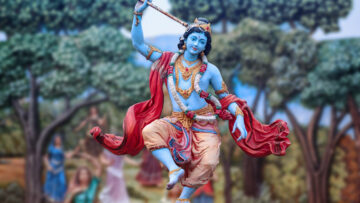
वंशीविभूषितकरान्नवनीरदाभात् पीताम्बरादरुणबिम्बफलाधरोष्ठात् ।
पूर्णेन्दुसुन्दरमुखादरविन्दनेत्रात् कृष्णात्परं किमपि तत्त्वमहं न जाने ॥
This verse appears at the conclusion of Chapter 18 and Chapter 15, of his Bhagavad Gītā commentary Gūḍhārtha Dīpikā. This represents the culmination of his entire Gītā commentary, showing how even after expounding Advaita philosophy throughout, his devotion to Krishna’s Saguna (with-form) aspect remains supreme. This friction between Bhakti and Jnana is inevitable for all who walk this path. For this reason, every seeker must clearly figure out the place of Bhakti within their overall scheme of Sadhana if they are to progress further.
This issue has occupied the minds of many post-Shankara Advaitins, most notably Sri Madhusudhana Saraswati who tried to harmonise the two in his seminal work Bhagavad Bhakti Rasayanam. Having faced the same inner tension in my own study and Sadhana, this work is the result of my personal inquiry into the relationship between Bhakti and Jnana. Many Acharyas before me have dealt on this subject with great depth, so there is nothing new that I claim to contribute. My effort, rather, is to approach the question by contrasting the perspectives of the Bhakti schools of Vedanta with that of Advaita Vedanta. Since our modern conceptions of Bhakti have been shaped by the Bhakti schools, it is essential to understand their standpoint. The Bhakti schools themselves vary on the nuances, while agreeing on some broader points. It is equally important to see how Advaita interprets Bhakti while supporting the supremacy of Jnana.
The Bhakti Schools of Vedanta: Eternal Devotion Unveiled
In the Bhakti schools of Vedanta, Bhakti is understood as an intrinsic expression of the eternal relation that pre-exists between the Jeeva (individual soul) and Bhagavan (Supreme God). This Bhakti naturally manifests once the veils of Maya, ignorance, and karma are removed. Bhakti takes the form of intense love for God not as a mere mental mode, but as something that is fundamental to the Jeeva nature itself. Bhakti is revealed spontaneously when the obstacles fall away. This ontological grounding of Bhakti as an eternal reality gives a strong metaphysical foundation to the Bhakti practice, distinguishing it from mere psychological states.
Building on this, the Bhakti expressed in this material world (bhuloka) is viewed by these schools as an imperfect form of the perfect Bhakti that is experienced in Vaikuntha, the divine realm. In bhuloka, bodily needs such as hunger, thirst, sleep, karma, klesha, and Trividhataapa-s etc disturb and limit the uninterrupted expression of Bhakti. In contrast, in Vaikuntha, devotees enjoy divine, imperishable bodies free from these limitations, enabling continuous and unhindered Bhakti. The Bhakti done here is conscious and requires effort. The result of such a Bhakti is the grace of Bhagavan, which allows the devotee to enter the eternal spiritual realm where Bhakti appears spontaneously.
However, it is acknowledged that even in this world some beings who have transcended Maya by earning Bhagavan’s grace can experience unobstructed Bhakti. Scriptural and saintly examples testify that pure devotional love can be spontaneously expressed despite worldly conditions. Grace plays a vital role in removing obstacles, allowing a few advanced devotees to embody ideal Bhakti here and now providing a glimpse of what true, deep, and continuous love for God looks like.
Thus, the Bhakti Schools understand Bhakti not as a temporary emotional and psychological state but as an eternal dimension of the Jeeva’s relation to Bhagavan. The Jeeva and Bhagavan remain ever separate yet related, and that creates a permanent framework for a continued devotional practice. Spiritual practices including worship and contemplation are aimed primarily at overcoming worldly distractions in the form of Maya and Karma. The quality of Bhakti approaches its ideal state either here or in the divine realm gradually by practice and grace. Divine grace is not just supplementary, but essential; human effort alone cannot guarantee success. Worldly saints and sages who reach this ideal become models for others, providing tangible proof and encouragement that liberation and divine love are attainable.
Advaita Vedanta: Bhakti Transcends Duality
Bhakti is typically categorized into two forms: Sadhana Bhakti, practiced with conscious effort by worship and contemplation, and Phala Bhakti, the fruit or reward of devotion received through divine grace without effort. Sadhana Bhakti is instrumental for purifying the mind in preparation for Jnana (knowledge), which is considered the final means of Mukti in Advaita. This much is like the Bhakti Schools, which also consider Sadhana Bhakti as a preparatory stage. This Sadhana Bhakti is a mental exercise because the seeker actively tries to always contemplate upon Bhagavan, under all circumstances. Multiple verses in the Gītā support this division.
Bhakti is listed among qualities that are required for Jnāna.
मयि चानन्ययोगेन भक्तिरव्यभिचारिणी।13.10।।Bhagavad Gītā
(And unwavering devotion to Me with single-minded concentration.)
Only the devotee becomes eligible for knowing the true nature of Bhagavan.
इति क्षेत्रं तथा ज्ञानं ज्ञेयं चोक्तं समासत:।
मद्भक्त एतद्विज्ञाय मद्भावायोपपद्यते॥13.18॥Bhagavad Gītā
(Thus, has been spoken of in brief the field as also Knowledge and the Knowable. By understanding this My devotee becomes qualified for My state.)
मां च योऽव्यभिचारेण भक्तियोगेन सेवते।
स गुणान्समतीत्यैतान् ब्रह्मभूयाय कल्पते॥14.26॥Bhagavad Gītā
(And he who serves Me through the unswerving Yoga of Devotion, he, having gone beyond these qualities, qualifies for becoming Brahman.)
तमेव चाद्यं पुरुषं प्रपद्ये यत: प्रवृत्ति: प्रसृता पुराणी॥15.4॥Bhagavad Gītā
(I take refuge in that Primeval Person Himself, from whom has ensued the eternal Manifestation.)
पुरुष: स पर: पार्थ भक्त्या लभ्यस्त्वनन्यया।
यस्यान्त:स्थानि भूतानि येन सर्वमिदं ततम्॥8.22॥Bhagavad Gītā
(O son of Pṛthā, that supreme Person—in whom are included (all) the beings and by whom all this is pervaded—is, indeed, reached through one-pointed devotion.)
मन्मना भव मद्भक्तो मद्याजी मां नमस्कुरु।
मामेवैष्यसि युक्त्वैवमात्मानं मत्परायण:॥9.34॥Bhagavad Gītā
(Having your mind fixed on Me, be devoted to Me, sacrifice to Me, and bow down to Me. By concentrating your mind and accepting Me as the supreme Goal, you shall surely attain Me who am thus the Self.)
Phala Bhakti on the other hand transcends mental modes. Phala Bhakti or Para Bhakti is the result of a lifetime of Sadhana Bhakti and is earned exclusively through the Divine Grace of Bhagavan. The contemplation which was achieved by effort in Sadhana Bhakti, now spontaneously arises within the devotee.
ब्रह्मभूत: प्रसन्नात्मा न शोचति न कांक्षति।
सम: सर्वेषु भूतेषु मद्भक्तिं लभते पराम्॥18.54॥Bhagavad Gītā
(One who has become Brahman and has attained the blissful Self does not grieve or desire. Becoming the same towards all beings, he attains supreme Bhakti to Me.)
सर्वकर्माण्यपि सदा कुर्वाणो मद्व्यपाश्रय:।
मत्प्रसादादवाप्नोति शाश्वतं पदमव्ययम्॥18.56॥Bhagavad Gītā
(Ever engaging even in all actions, one to whom I am the refuge, attains the eternal, immutable State through My grace.)
तमेव शरणं गच्छ सर्वभावेन भारत।
तत्प्रसादात्परां शान्तिं स्थानं प्राप्स्यसि शाश्वतम्॥18.62॥Bhagavad Gītā
(Take refuge in Him alone with your whole being, O scion of the Bharata dynasty. Through His grace you will attain the supreme Peace and the eternal Abode.)
दैवी ह्येषा गुणमयी मम माया दुरत्यया।
मामेव ये प्रपद्यन्ते मायामेतां तरन्ति ते॥7.14॥Bhagavad Gītā
(Since this divine Māyā of Mine which is constituted by the guṇas is difficult to cross over, (therefore) those who take refuge in Me alone cross over this Māyā.)
Note the difference in language. Here the message is that the devotee attains Bhakti. Unlike the previous Shlokas pointing to Sadhana Bhakti, where the devotee was being instructed to perform Bhakti. This Para Bhakti can be attained only by the Grace of Bhagavan. Once attained there is no going back. This Para Bhakti is in fact indistinguishable from Jnana.
भक्त्या मामभिजानाति यावान्यश्चास्मि तत्त्वत:।
ततो मां तत्त्वतो ज्ञात्वा विशते तदनन्तरम्॥18.55॥Bhagavad Gītā
(Through devotion he knows Me in reality, as to what and who I am. Then, having known Me in truth, he enters (into Me) immediately after that (Knowledge)).
तेषां सततयुक्तानां भजतां प्रीतिपूर्वकम्।
ददामि बुद्धियोगं तं येन मामुपयान्ति ते॥10.10॥Bhagavad Gītā
(To them who are ever devoted and worship Me with love, I grant that possession of wisdom by which they reach Me.)
तेषामेवानुकम्पार्थमहमज्ञानजं तम:।
नाशयाम्यात्मभावस्थो ज्ञानदीपेन भास्वता॥10.11॥Bhagavad Gītā
(Out of compassion for them alone, I, residing in their hearts, destroy the darkness born of ignorance with the luminous lamp of Knowledge.)
In the Bhagavad Gītā , Krishna identifies the Jnani, the One who knows Brahman as the best among all Bhaktas and the dearest to him because the Jnani sees Bhagavan as his own Atman (Self). Krishna adds that even He sees the Jnani as his very Atman.
चतुर्विधा भजन्ते मां जना: सुकृतिनोऽर्जुन।
आर्तो जिज्ञासुरर्थार्थी ज्ञानी च भरतर्षभ॥7.16॥ Bhagavad Gītā
(O Arjuna, foremost of the Bharata dynasty, four classes of people of virtuous deeds adore Me: the afflicted, the seeker of Knowledge, the seeker of wealth and the man of Knowledge.)
तेषां ज्ञानी नित्ययुक्त एकभक्तिर्विशिष्यते।
प्रियो हि ज्ञानिनोऽत्यर्थमहं स च मम प्रिय:॥7.17॥Bhagavad Gītā
(Of them, the man of Knowledge, endowed with constant steadfastness and one-pointed devotion, excels. For I am very much dear to the man of Knowledge, and he too is dear to Me.)
उदारा: सर्व एवैते ज्ञानी त्वात्मैव मे मतम्।
आस्थित: स हि युक्तात्मा मामेवानुत्तमां गतिम्॥7.18॥Bhagavad Gītā
All of these, indeed, are noble, but the man of Knowledge is the very Self. (This is) My opinion. For, with a steadfast mind, he is set on the path leading to Me alone who am the super-excellent Goal.
The Jnani has Eka-Bhakti i.e. a continuous contemplation of Bhagavan, because in his experience there is nothing other than Bhagavan. Thus, the highest Bhakti is knowledge itself. The Jnani’s devotion is nothing but an expression of his profound realization where not only the entire universe is realized as Bhagavan, but his very Atman is seen as non-different from Bhagavan.
बहूनां जन्मनामन्ते ज्ञानवान्मां प्रपद्यते।
वासुदेव: सर्वमिति स महात्मा सुदुर्लभ:॥7.19॥Bhagavad Gītā
(At the end of many births the man of Knowledge attains Me, (realizing) that Vāsudeva is all. Such a high-souled one is very rare.)
यो मां पश्यति सर्वत्र सर्वं च मयि पश्यति।
तस्याहं न प्रणश्यामि स च मे न प्रणश्यति॥6.30॥Bhagavad Gītā
(One who sees Me in everything and sees all things in Me—I do not go out of his vision, and he also is not lost to My vision.)
It is a devotion beyond mere worship and contemplation and is expressed as the very experience of Being itself. From this non-dual standpoint, the bliss or rasa experienced in Para Bhakti is the expression of the intrinsic Ananda (bliss) of the Self (Satchidananda).
युञ्जन्नेवं सदात्मानं योगी नियतमानस:।
शान्तिं निर्वाणपरमां मत्संस्थामधिगच्छति॥6.15॥Bhagavad Gītā
(Concentrating the mind thus for ever, the yogī of controlled mind achieves the Peace which culminates in Liberation, and which abides in Me.)
Bhakti does not have an independent ontological existence as an eternal relation between two beings. Instead, it expresses the blissful nature of Bhagavan as one with one’s own Self. Advaita philosophy thus transcends distinctions entirely, viewing all forms and relations as ultimately Brahman alone. Bhakti and Jnana unify here, with devotional bliss understood as the Self’s own transcendental nature expressing itself.
Importantly, the theological and relational aspects are not overlooked but comprehended in a transformed way by the Jnani. The Jnani’s consciousness is fundamentally different. The Jnani abandons seeing Bhagavan and the Self as distinct and with form and attributes. It is for this reason the Jnani has no difficulty in seeing the same Bhagavan as Vishnu, as Siva or as Devi. He has no problem in identifying God as his master, or friend or lover. All distinctions culminate in an expansive oneness of Bhagavad Anubhava. This vision marks a radical transformation from that of the Sadhana Bhakti practitioner, whose devotion is dualistic and personal. This is the vision of Ramana Maharishi, who could simultaneously express the highest truth of the Self in his Upadesha Saram while simultaneously expressing his deep devotion to Arunachala in Akshara Manamalai. This is the vision of Madhusudana Saraswati, who could say that Krishna is worth worshipping with imagined duality even if his real nature is non-dual Truth. This is the vision of Sri Adi Shankara who was adept at imparting Knowledge of the oneness of Atman and Brahman in his Prasthana Traya commentaries while writing moving devotional Stotras in praise of all major Devatas.
Bhakti schools emphasize eternal dualistic relations and the ontological primacy of Bhakti, including its full expression in spiritual realms like Vaikuntha. Advaita Vedanta incorporates Bhakti as a preparatory discipline but ultimately dissolves Bhakti into Jnana and oneness, viewing the highest Bhakti as self-realized knowledge and bliss. This synthesis reveals the profound dialectic between Bhakti and Jnana. Hence, we see through a nuanced understanding, both paths acknowledge their shared goals of divine love and liberation, yet also their distinctive philosophical premises and ultimate visions. Bhakti in Advaita Vedanta is not ancillary to Jnana, but a grace-bestowed experiential state that elevates the devotee to the state of a Jnani. And the Bhakti of the Jnani is thus not devotion to a separate God, but the experiential unity with the non-dual Self, transcending all distinctions in an inclusive, absolute vision.
Feature Image Credit: wikipedia.org
Disclaimer: The opinions expressed in this article belong to the author. Indic Today is neither responsible nor liable for the accuracy, completeness, suitability, or validity of any information in the article.