
Distributed Liberation: A Structural Theory of Ego-Dissolution
Preamble: What This Work is Not
A Phenomenological-Formal Model of Systematic Integration Practice: This paper does not ask the reader to believe anything. It does not rely on faith, devotion, worship, ritual obedience, or divine revelation for its claims. It makes no assertion about the historical intentions of Puranic authors. Gods, myths, and sacred geography appear in these pages solely because they compress complex phenomenological operations with exceptional efficiency. The method itself is secular, experiential, and repeatable.
The mathematical models presented here do not explain liberation. They formalize an orientation shift repeatedly observed after sufficient ego-dissolution incidents. Complex numbers model existential orientation, not consciousness itself. The number 51 reflects an empirically sufficient stabilization range, not sacred numerology.
A parallel, non-doctrinal articulation of this framework appears in the author’s Sanskrit mahākāvya Muktiyātrā (The Liberation Journey). Although composed in classical literary form and employing mythic imagery, the work is explicitly non-religious and models liberation as a sequence of phenomenological tests rather than faith-based practice. It is referenced here only as an alternative expressive medium. [1]
This work does not ask the reader to believe anything. It asks the reader to test identity under increasing load and observe what survives. The language of gods, myths, and sacred geography is retained only because it compresses complex phenomenological operations with exceptional efficiency. The method itself is secular, experiential, and repeatable.
Operational Definition of Liberation
Liberation, as used throughout this paper, refers strictly to the irreversible collapse of ego-based identification, including the witnessing position itself, with full functional continuity in the world. No metaphysical surplus is claimed. No divine ground is posited. No ultimate Self is preserved. What remains after the process is complete is ownerless consciousness—awareness functioning without a centre, without possession, without a resident “I.”
Abstract
This paper proposes that the 51 Saktipitha pilgrimage tradition in Hindu Tantra supports a reproducible consciousness integration trajectory rather than representing purely devotional topography. It defines a Significant Ego-Dissolution/Integration Incident (SEDI) as meeting at least two of three phenomenological criteria: ego permeability, affective re-binding, and trait shift. Drawing on cross-traditional convergence data suggesting approximately 50 consolidated SEDIs correlate with stable threshold attainment, the paper demonstrates formal correspondence between this empirical pattern and the traditional count of 51 body parts and sites.
Using complex number theory as a formal descriptive language—not claiming ancient authors employed this mathematics—the model positions the threshold as phase rotation to the −i orientation on the unit circle, where life-attachment (+1) and death-fear (−1) become geometrically equidistant. This equidistance corresponds phenomenologically to reported dissolution of existential polarity at transformation threshold. The model further demonstrates that Kālī’s 51-skull garland functions as a parallel iconographic encoding of the same integration-count logic. [2]
Keywords
Saktipitha, ego-dissolution, integration incidents, complex numbers, witness consciousness, death-anxiety, phenomenological threshold, distributed liberation
1. Introduction
1.1 The Problem of Sacred Numerology
Hindu tradition exhibits remarkable precision in sacred counts: 51 Saktipithas, 51 skulls on Kālī’s garland, and related patterns in the 108-bead mala (54×2). Scholarly treatments have typically fallen into three categories: dismissal as arbitrary mysticism, [3] symbolic interpretation linking numbers to cosmological principles, [4] or acknowledgment of pattern without explanatory framework. [5]
What existing scholarship has not adequately addressed is whether these counts preserve empirically-discovered thresholds in consciousness transformation—not as what the ancients believed, but as what becomes reproducibly possible through systematic practice engagement. This paper reframes the question: rather than asking what the 51 sites mean symbolically, it asks what transformation trajectory they support functionally.
1.2 Model Status and Scope
The present account is a phenomenological-formal model. It does not claim that Puranic authors used modern complex-number theory. Rather, it proposes that a recurring traditional count preserves a practice-relevant threshold: across sufficiently many consolidated ego-dissolution and integration incidents, a stable witness stance emerges in which the existential poles of life-attachment and death-fear lose their asymmetrical grip on behaviour and perception. Complex numbers provide a compact formal language for describing this shift, especially the geometric symmetry expressed by the −i orientation on the unit circle.
The model is falsifiable through prospective tracking of practitioners using operationalised SEDI criteria, measurement of death-anxiety and equanimity at different accumulation levels, cross-traditional comparison of reported threshold frequencies, and neuroimaging of practitioners before and after threshold crossing.
1.3 Central Claims
Six propositions structure the argument. First, the 51 Saktipitha sites function as a distributed curriculum for systematic consciousness fragment integration. Second, each body part represents one major fragmentation category—perceptual, motor, cognitive, emotional, and so forth. Third, the number 51 preserves an empirically-discovered threshold: approximately 50 consolidated integration incidents correlate with stable witness consciousness across multiple traditions. Fourth, this threshold can be formally modelled as phase rotation to the −i position on the complex unit circle, where life-death polarity dissolves geometrically. Fifth, Kālī’s 51-skull garland provides parallel iconographic encoding of the same threshold-count logic. Sixth, the so-called 52nd site—the site within yourself—represents post-threshold recognition of original non-fragmentation.
This reading transforms pilgrimage from devotional tourism to systematic consciousness technology, with testable predictions about transformation trajectories.
2. Operational Definitions
2.1 Defining the Core Unit: SEDI
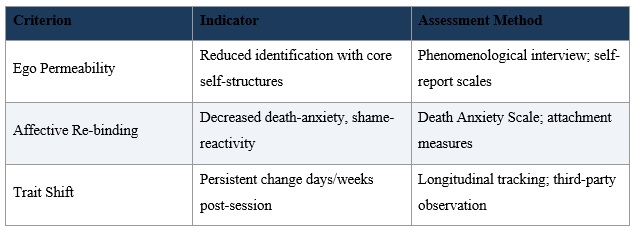
To make claims about 51 incidents coherent and testable, this paper defines the Significant Ego-Dissolution/Integration Incident (SEDI) as an experience meeting at least two of three phenomenological criteria.
Criterion 1: Ego Permeability. Reduced identification with a core self-structure—role-identity, narrative self, body-image, sense of agency. The practitioner experiences temporary dissolution or transparency of what previously seemed solid and defining.
Criterion 2: Affective Re-binding. Measurable decrease in fear, grasping, or compulsion related to existential concerns. Specifically: reduced death-anxiety, shame-reactivity, or compulsive self-protection behaviours. This can be assessed through validated scales (Death Anxiety Scale, attachment measures) or reliable first-person reporting. [6]
Criterion 3: Trait Shift. Changes persist beyond the immediate session, ritual, or retreat context. Effects observable days to weeks later, not merely peak experience. Friends and family might notice behavioural changes without prompting. This represents consolidation at trait level, not merely state. [7]
2.2 Exclusion Criteria
Pleasant meditative states without ego-permeability do not qualify. Neither do intellectual insights without affective re-binding, peak experiences that fade within hours without trait consolidation, drug-induced states lacking subsequent integration work, nor dissociative episodes that produce dysfunction rather than liberation. The SEDI definition ensures that the count of 51 incidents refers to consolidated trait-level transformations—not tourist visits to geographic sites or transient altered states.
(Table 1: SEDI Qualification Matrix)
3. The Sati Narrative as Fragmentation Map
3.1 The Myth as Practice Template
In the Puranic narrative, Satī’s intact body represents integrated, non-fragmented awareness—the baseline potential rarely accessed in ordinary life. [8] The traumatic immolation models ego-shattering experience without integration support. Śiva’s grief-wandering represents consciousness carrying fragmentation without knowing how to re-integrate. Viṣṇu’s dismemberment represents the analytical mind categorising unified experience into discrete aspects. The 51 body parts scattered across the subcontinent model consciousness distributed across major identification sites.
The pilgrimage practice that follows is, on this reading, systematic work visiting each fragmentation site, recognising and integrating what was dispersed. The 52nd site—the site within oneself—represents the recognition that fragmentation was perceptual, and that integration reveals original wholeness.
Important clarification: The death of Satī is not an event to be believed, mourned, or revered. It is a model for what occurs when identity collapses under sufficient structural load. Fragmentation is a safety mechanism: total ego collapse without distribution risks functional breakdown. The narrative preserves procedural wisdom, not doctrinal truth. [9]
3.2 The 51 Body Parts as Fragmentation Categories
Analysis of traditional Saktipitha lists reveals systematic distribution across consciousness domains. The 51 count represents major fragmentation categories requiring explicit integration work, not exhaustive enumeration (consciousness fragments infinitely) nor arbitrary selection.
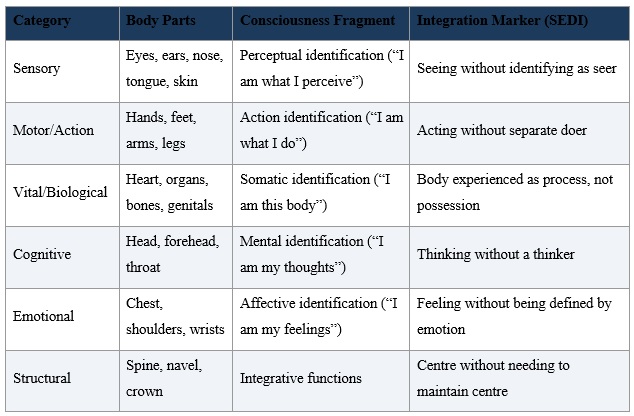
(Table 2: Saktipitha Sites and Corresponding Fragmentation Categories)
4. Mathematical Modelling: Phase Rotation to −i Threshold
4.1 The Phenomenology-Geometry Bridge
Before introducing mathematical formalism, the phenomenological observation deserves clear articulation. In the pre-threshold experience (positions 1 through 50), life is desperately desired and death feared. Existential polarity is asymmetric: life functions as positive attractor, death as negative repulsor. Behaviour organises itself around maximising pleasure and minimising pain. Anxiety is generated by the asymmetry itself.
At threshold—approximately position 51, after some 50 consolidated SEDIs—life and death are viewed from a perpendicular stance. Neither pole dominates. Death-anxiety is markedly reduced, as multiple cross-traditional reports confirm. Behaviour reorganises around values and dharma rather than polarity-avoidance. Stable witness consciousness becomes accessible not as achievement but as baseline.
The geometric interpretation is direct: consciousness has rotated from operating on the real axis—where life-death opposition is maximal—to operating from the imaginary axis, a perpendicular position where both poles are equidistant. The formal language of complex numbers describes this shift with precision. [10]
4.2 Complex Number Model: Stance as Phase Angle
Let zn represent the practitioner’s dominant existential stance after n consolidated SEDIs: zn = eiθn, where |zn| = 1. Magnitude is fixed (the model does not address the amount of consciousness). Only the angle θn is variable, modelling existential orientation.
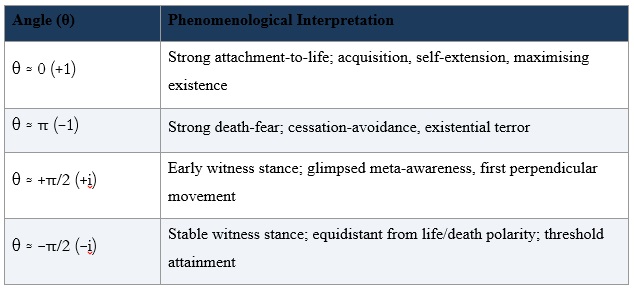
(Table 3: Key Phase Angles and Their Phenomenological Correlates)
4.3 Why −i Corresponds to Life-Death Equidistance
On the complex plane, the distance from −i to +1 equals |−1 − i| = √2. The distance from −i to −1 equals |1 − i| = √2. Both distances are identical. From the −i stance, existence (+1) and cessation (−1) are geometrically symmetric attractors—neither dominates. The phenomenological correlate is a marked reduction in death-anxiety and grasping, stable witness consciousness, diminished compulsive selfing, and equanimity toward gain and loss.
4.4 The i⁵¹ = −i Relationship
The mathematical relationship i51 = −i should be framed as a canonical discrete case of repeated transformations, not a literal claim of uniform 90° rotations. If one models SEDIs as standardised unit rotations for illustrative purposes (Δθ constant), then a traditional count of 51 lands precisely on −i, the equidistance stance. In actual practice, Δθ varies; nevertheless, traditions converge on approximately 50 consolidated incidents to stabilise this threshold stance. [11]
Mathematically, any n ≡ 3 (mod 4) yields −i when calculating iⁿ. So 3, 7, 11, 15, 19, 23, 47, 51, 55 all reach −i. The significance of 51 specifically is threefold: cross-traditional empirical reports cluster around 50 ± 10 SEDIs for threshold; the count 51 appears repeatedly in Hindu sacred enumeration; and this convergence suggests that 51 is the traditional instantiation of the observed threshold, not the only path to −i.
4.5 The 52nd Position: Return with Transformation
After stabilisation at −i (position 51), some traditions describe a return. The 52nd Saktipitha is said to be within yourself. Mathematically: i52 = i51 × i = (−i) × i = 1. This return to unity should not be interpreted as a literal return to the starting position, but as a spiral: operating from +1 orientation again, but with transformed relationship—presence in ordinary life without re-identification with polarity.
5. Cross-Traditional Convergence on ~50 Incidents
The clustering of threshold reports around 50 incidents across traditions that developed independently constitutes perhaps the strongest evidence for a reproducible threshold in human consciousness architecture. The following survey is necessarily brief, but the convergence is striking.
Theravāda Buddhism. The sotāpanna (stream-enterer) represents the first irreversible awakening stage, characterised by permanent reduction in self-view (sakkāya-diṭṭhi) and greatly reduced death-anxiety. Western practitioners report stream-entry typically after 40 to 60 intensive meditation retreats meeting similar phenomenological criteria. [12]
Christian Contemplatives. Teresa of Ávila, John of the Cross, and later contemplatives describe progression through purgative, illuminative, and unitive stages. Contemporary practitioners maintaining detailed journals report 50 to 65 major experiences of divine union over decades before stable unitive consciousness. [13]
Islamic Sufism. After repeated experiences of fanā (ego-annihilation) through dhikr and meditation, practitioners report around 40 to 60 genuine dissolutions before stable baqā (subsistence in the divine) establishes. [14]
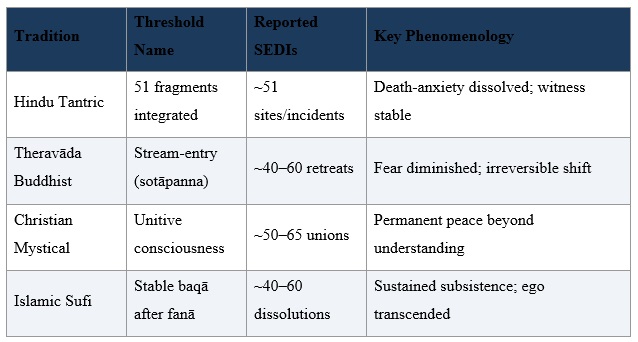
(Table 4: Cross-Traditional Threshold Convergence)
6. Kālī’s 51 Skulls as Parallel Integration-Count Device
6.1 Iconography as Redundant Encoding
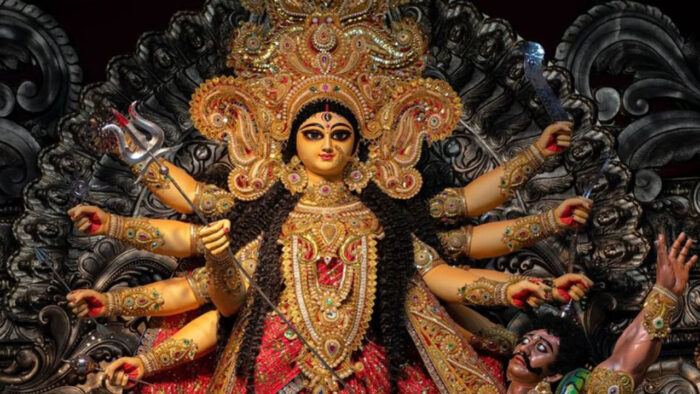
The Saktipitha geographic network is not the only 51-count in Hindu tradition. Kālī’s skull garland provides parallel iconographic encoding. Traditional interpretation reads the skulls as demons defeated, time devouring all, death’s inevitability. The proposed functional reading is different: each skull represents one death of a self-structure—a major identification that has been seen through and no longer governs behaviour. The garland is not about killing others; it is an iconographic counter of ego-deaths.
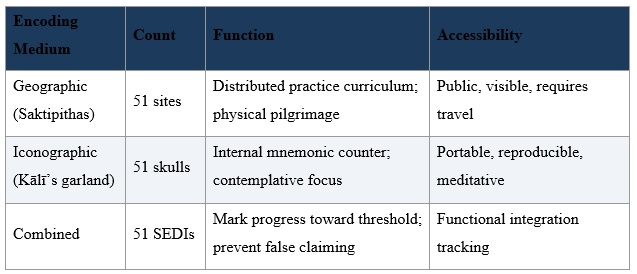
(Table 5: Two Independent Encodings of the Same Threshold)
The redundancy serves multiple purposes. If one system is lost or corrupted, the other preserves the count. Geographic encoding serves those who can travel; iconographic encoding serves those who cannot. Independent systems arriving at the same number suggest empirical discovery rather than arbitrary choice. Different learning styles are accommodated—kinesthetic through pilgrimage, visual-meditative through iconographic contemplation.
6.2 The Wearer as the 52nd
In Kālī iconography, 51 skulls hang on the garland—the integrated fragments, the deaths counted. The goddess wearing them represents the 52nd position: integrated wholeness, the wearer of all deaths. This parallels the 51 external sites to visit and the 52nd site within yourself. The practitioner works through 51 fragmentations and, at the 52nd recognition, becomes the wearer—consciousness recognising itself as what was always whole, never actually fragmented.
7. Comparative Frameworks: Distributed Liberation vs. Classical and Modern Traditions
The following comparison situates the present framework relative to influential classical and modern approaches to liberation. The intention is not polemic or hierarchy, but clarification. While many traditions dissolve the ego, few explicitly dismantle the witnessing position or describe post-liberation embodiment without metaphysical ownership. The present model departs from prior systems precisely at this point.
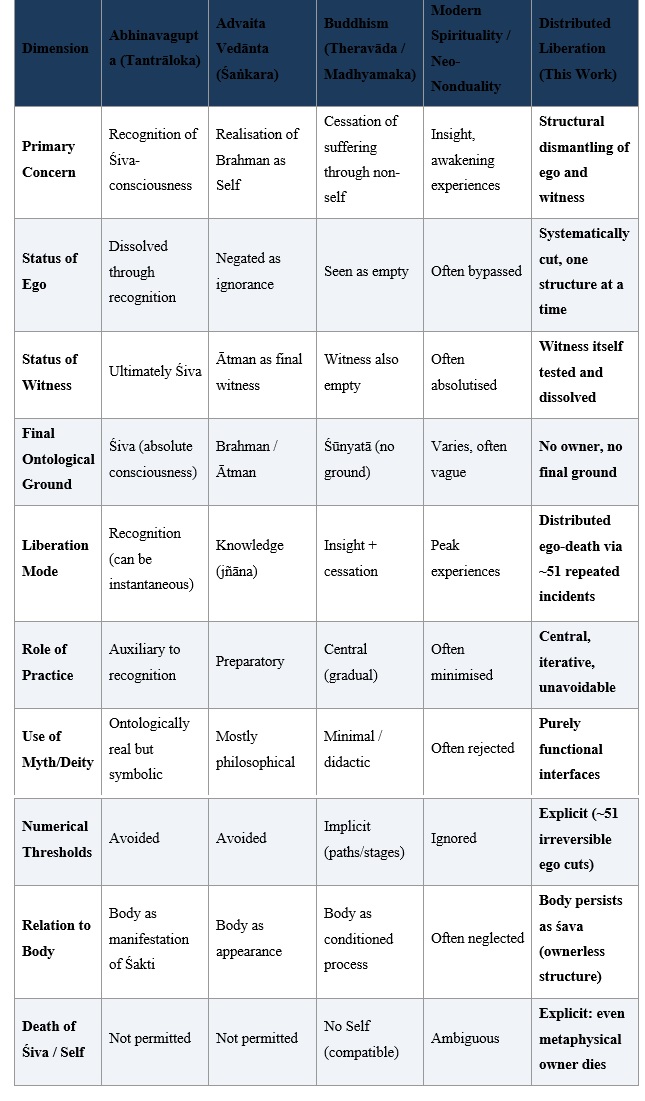
(Table 6: Distributed Liberation vs. Classical and Modern Traditions)
Post-liberation embodiment. The following table highlights a decisive divergence: while most traditions preserve either an ultimate witness or an absolute ground, the present framework explicitly dismantles even the witnessing position. Post-liberation embodiment is described not as divine animation of the body, but as ownerless continuation—Śiva revealed as śava.
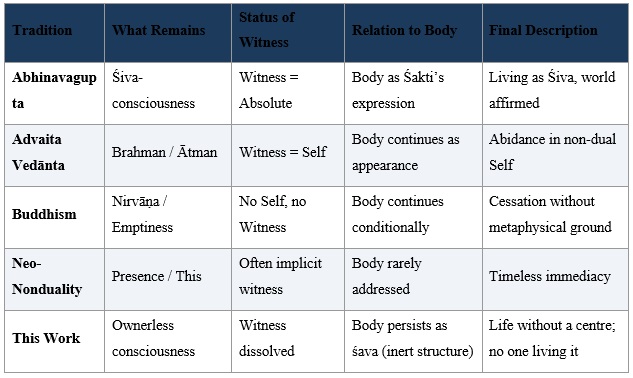
(Table 7: Post-Liberation State Across Traditions)
Post-liberation, the body persists without a resident ego, witness, or metaphysical owner. In this state, Śiva is revealed as śava—an inert structure no longer animated by identity. Consciousness remains present, but no longer interiorised as “I”; it functions externally, like Vāsuki coiled around the body, animating without possession. The history of ego dissolution does not disappear: it is carried as residue, symbolised by the fifty-one skulls now worn by Kālī—consciousness itself bearing the completed deaths of identification. Life continues, but no one is living it. [15]
Liberation does not make the body divine; it makes it ownerless. Consciousness remains, but no longer belongs to anyone.
8. Testable Predictions
Even speculative models gain epistemic status if they generate falsifiable predictions. This model predicts seven specific outcomes.
Prediction 1: Discontinuous threshold effects. Practitioners should show non-linear changes in death-anxiety scales around 50 SEDIs, not gradual linear improvement—a step-function change rather than continuous slope.
Prediction 2: Trait stability post-threshold. Changes after approximately 50 SEDIs should be more resistant to regression than changes at 20–30 SEDIs. The threshold represents phase transition to a stable attractor.
Prediction 3: Equanimity asymmetry reversal. Before threshold, asymmetric reactivity—stronger response to loss and threat than to gain and safety. After threshold, symmetric equanimity toward both poles.
Prediction 4: Self-referential processing reduction. Neuroimaging should show decreased activity in default-mode network self-referential regions after approximately 50 SEDIs, with further reduction after threshold crossing. [16]
Prediction 5: Meta-awareness stability. After threshold, witness consciousness should be accessible without effortful practice—present as baseline rather than achieved state.
Prediction 6: Cross-traditional consistency. When using standardised SEDI criteria, different traditions should show threshold clustering around 45–55 incidents, despite different practices and frameworks.
Prediction 7: Count accuracy correlation. Practitioners who carefully track SEDIs using the three-marker criteria should show better threshold prediction than those using loose criteria or no tracking.
9. Research Design Proposal
9.1 Prospective Longitudinal Study
Participants would include 100 to 200 beginning contemplative practitioners across traditions—Buddhist, Hindu, Christian contemplative, secular mindfulness. Duration: 5 to 10 years, allowing time for SEDI accumulation. Quarterly assessments would include the Death Anxiety Scale, Five Facet Mindfulness Questionnaire, and equanimity scales. After each intensive practice period, SEDI verification using the three-marker interview protocol. Annual fMRI during rest and self-referential tasks. Continuous daily practice logs and experience journals.
Analysis would test for discontinuity around 50 SEDIs using piecewise regression and change-point detection, compare trait stability before and after threshold, examine neural reorganisation patterns, and assess cross-traditional threshold convergence.
9.2 Retrospective Cross-Sectional Comparison
Groups of practitioners at different stages—0–20 SEDIs, 20–40 SEDIs, 40–50 SEDIs (approaching threshold), and 50+ SEDIs (post-threshold)—would complete the Death Anxiety Scale, an adapted Ego-Dissolution Inventory for trait rather than state measurement, equanimity measures (CHIME, PES), and self-reported functioning. The central test: whether the 50+ group shows step-change rather than linear progression.
10. Limitations and Alternative Explanations
Several limitations warrant explicit acknowledgment. Puranic texts describe the Satī myth and enumerate sites but do not explicitly state that these represent consciousness fragments requiring integration; this interpretation is inferential. [17] The mathematical model, while coherent, may function as a useful metaphor rather than literal mechanism. Most current data comes from retrospective reporting; prospective tracking would be more rigorous. Individual variation means some practitioners may stabilise at 40 SEDIs, others at 65—the model proposes an approximate band of 50±10, not a rigid boundary. Even with operational definition, SEDI criteria involve judgment; inter-rater reliability needs establishing.
Alternative explanations include cultural diffusion (traditions borrowing from a common source), confirmation bias, expectation effects, and numerological coincidence. Against diffusion, temporal and geographic separation makes direct borrowing unlikely for some comparisons. Against confirmation bias, the mathematical convergence is objective and cross-traditional data independently documented. Against expectation effects, prospective tracking starting before theory exposure would provide control. Against coincidence, 51 is unusually specific, appearing precisely where threshold prediction expects it.
11. Discussion
11.1 Reframing Sacred Geography
This model transforms understanding of pilgrimage from devotional tourism to systematic practice-field engagement. The 51 sites function simultaneously as a distributed curriculum (each site represents work with one fragmentation category), progress tracking mechanism (completion of sites marks integration advancement), community network (pilgrimage routes create practitioner support systems), and knowledge preservation system (geographic encoding survives textual loss). Other pilgrimage traditions merit similar analysis: do Christian pilgrimage routes, Islamic hajj circuits, or Buddhist sacred site networks preserve practice-relevant counts?
11.2 Integration as Core Mechanism
Rather than acquiring special states, transformation may primarily involve recovering and integrating what fragmented. This shifts focus from attainment to restoration. Practice becomes archaeological—uncovering what is buried—rather than acquisitive. The goal is recognition of what already is, not achievement of what is not yet. [18]
11.3 Multiple Encoding Systems
The convergence of 51 geographic sites, 51 skulls, 51 letters (some Sanskrit alphabet counts), and related patterns (108 = 51 + 51 + 6) suggests a sophisticated redundant preservation strategy. If geographic sites are destroyed or forgotten, iconography preserves the count. If iconography is lost, geography preserves it. If both are corrupted, the empirical threshold would be re-discoverable through systematic practice. This is knowledge engineering: designing multiple independent systems to preserve critical information across cultural disruptions.
12. Conclusion
This paper has proposed a phenomenological-formal model wherein the 51 Saktipitha tradition supports a reproducible integration trajectory, each site corresponding to a major consciousness fragmentation category. Systematic engagement accumulating approximately 50 Significant Ego-Dissolution/Integration Incidents correlates with threshold attainment. This threshold can be formally modelled as phase rotation to the −i position on the complex unit circle, where life-attachment and death-fear become geometrically equidistant. This equidistance corresponds phenomenologically to death-anxiety dissolution and stable witness consciousness. Kālī’s 51 skulls provide parallel iconographic encoding. The 52nd site within yourself represents post-threshold recognition of original wholeness.
The model’s status is that of a formal phenomenological framework, not a historical claim about ancient mathematics. It proposes that the traditional 51-count preserves an empirically-discovered threshold that can be described using modern mathematical tools. Its significance, if valid, is considerable: Hindu pilgrimage tradition reframed as sophisticated consciousness technology, ancient practitioners recognised as empirical researchers, and contemporary practitioners provided with an actionable integration framework.
The 51 sites have been on the map for millennia. The 51 skulls have hung on the garland for centuries. Perhaps they have been encoding a reproducible threshold that systematic practice makes accessible. Whether this interpretation captures what the tradition preserved, or imposes modern frameworks on ancient symbols, requires empirical investigation. But the convergence of mathematical modelling, phenomenological reports, cross-traditional thresholds, and redundant traditional encoding suggests something worth taking seriously.
Notes
[1] A parallel, non-doctrinal articulation of this framework appears in the author’s Sanskrit mahākāvya Muktiyātrā (The Liberation Journey). Although composed in classical literary form and employing mythic imagery, the work is explicitly non-religious and models liberation as a sequence of phenomenological tests rather than faith-based practice. It is referenced here only as an alternative expressive medium.
[2] The model generates testable predictions regarding death-anxiety reduction, equanimity measures, and self-referential processing changes after approximately 50 SEDIs.
[3] Weber, M. (1958). The Religion of India. Free Press; Staal, F. (1979). The meaninglessness of ritual. Numen, 26(1), 2–22.
[4] Guénon, R. (1946). The Metaphysical Principles of the Infinitesimal Calculus. Sophia Perennis; Eliade, M. (1954). The Myth of the Eternal Return. Princeton University Press.
[5] Kinsley, D. (1997). Tantric Visions of the Divine Feminine. University of California Press; McDaniel, J. (2004). Offering Flowers, Feeding Skulls. Oxford University Press.
[6] Hood, R. W. (2001). Dimensions of mystical experiences. Journal for the Scientific Study of Religion, 40(4), 691–705.
[7] Griffiths, R. R., et al. (2011). Psilocybin occasioned mystical-type experiences. Psychopharmacology, 218, 649–665.
[8] Bhattacharyya, N. N. (1996). History of the Sakta Religion. Munshiram Manoharlal; Coburn, T. B. (1991). Encountering the Goddess. SUNY Press.
[9] Sircar, D. C. (1973). The Sakta Pithas. Motilal Banarsidass; Shastri, D. N. (1963). Sakti Pithas. Bharatiya Vidya Prakashan.
[10] Rosen, S. M. (2008). The Self-Evolving Cosmos. World Scientific; Kauffman, L. & Sabelli, H. (1998). The process equation. Cybernetics & Systems, 29, 345–362.
[11] Ifrah, G. (2000). The Universal History of Numbers. Wiley; Schimmel, A. (1993). The Mystery of Numbers. Oxford University Press.
[12] Kornfield, J. (1993). A Path with Heart. Bantam; Ingram, D. M. (2008). Mastering the Core Teachings of the Buddha. Aeon Books.
[13] Brown, D. (1986). The stages of meditation in cross-cultural perspective. In K. Wilber, J. Engler & D. Brown (Eds.), Transformations of Consciousness. Shambhala.
[14] Goleman, D. (1977). The Varieties of Meditative Experience. Dutton; Stace, W. T. (1960). Mysticism and Philosophy. Macmillan.
[15] This formulation represents the decisive departure of the present model from all traditions that preserve an ultimate witness or absolute ground. See comparative Table 7.
[16] Carhart-Harris, R. L., et al. (2014). The entropic brain: A theory of conscious states. Frontiers in Human Neuroscience, 8, 20.
[17] Pintchman, T. (1994). The Rise of the Goddess in the Hindu Tradition. SUNY Press; Erndl, K. M. (1993). Victory to the Mother. Oxford University Press.
[18] Schwartz, R. C. (1995). Internal Family Systems Therapy. Guilford Press; Wilber, K. (1995). Sex, Ecology, Spirituality. Shambhala.
References
Bhattacharyya, N. N. (1996). History of the Sakta Religion. Munshiram Manoharlal.
Brown, D. (1986). The stages of meditation in cross-cultural perspective. In K. Wilber, J. Engler & D. Brown (Eds.), Transformations of Consciousness. Shambhala.
Carhart-Harris, R. L., et al. (2014). The entropic brain: A theory of conscious states informed by neuroimaging research with psychedelic drugs. Frontiers in Human Neuroscience, 8, 20.
Coburn, T. B. (1991). Encountering the Goddess: A Translation of the Devi-Mahatmya. SUNY Press.
Eliade, M. (1954). The Myth of the Eternal Return. Princeton University Press.
Erndl, K. M. (1993). Victory to the Mother: The Hindu Goddess of Northwest India. Oxford University Press.
Goleman, D. (1977). The Varieties of Meditative Experience. Dutton.
Griffiths, R. R., et al. (2011). Psilocybin occasioned mystical-type experiences. Psychopharmacology, 218, 649–665.
Guénon, R. (1946). The Metaphysical Principles of the Infinitesimal Calculus. Sophia Perennis.
Hood, R. W. (2001). Dimensions of mystical experiences. Journal for the Scientific Study of Religion, 40(4), 691–705.
Ifrah, G. (2000). The Universal History of Numbers. Wiley.
Ingram, D. M. (2008). Mastering the Core Teachings of the Buddha. Aeon Books.
Kauffman, L. & Sabelli, H. (1998). The process equation. Cybernetics & Systems, 29, 345–362.
Kinsley, D. (1997). Tantric Visions of the Divine Feminine. University of California Press.
Kornfield, J. (1993). A Path with Heart. Bantam.
McDaniel, J. (2004). Offering Flowers, Feeding Skulls. Oxford University Press.
Pintchman, T. (1994). The Rise of the Goddess in the Hindu Tradition. SUNY Press.
Rao, S. B. (2005). Indian Mathematics and Astronomy. Jnana Deep.
Rosen, S. M. (2008). The Self-Evolving Cosmos. World Scientific.
Schimmel, A. (1993). The Mystery of Numbers. Oxford University Press.
Schwartz, R. C. (1995). Internal Family Systems Therapy. Guilford Press.
Shastri, D. N. (1963). Sakti Pithas. Bharatiya Vidya Prakashan.
Sircar, D. C. (1973). The Sakta Pithas. Motilal Banarsidass.
Staal, F. (1979). The meaninglessness of ritual. Numen, 26(1), 2–22.
Stace, W. T. (1960). Mysticism and Philosophy. Macmillan.
Subbarayappa, B. V. (2008). The Tradition of Astronomy in India. Centre for Studies in Civilizations.
Weber, M. (1958). The Religion of India. Free Press.
Wilber, K. (1980). The Atman Project. Quest Books.
Wilber, K. (1995). Sex, Ecology, Spirituality. Shambhala.
Feature Image Credit: istockphoto.com
Disclaimer: The opinions expressed in this article belong to the author. Indic Today is neither responsible nor liable for the accuracy, completeness, suitability, or validity of any information in the article.