
When Professional Scholarship Becomes Epistemic Violence
Few days ago, a European scholar of religion and teacher of yoga told the author of this article that Bhagavad Gītā and Patañjali’s Yoga Sūtra are not Hindu texts because she does not “think it would necessarily be historically correct to call those texts Hindu seeing that the word Hinduism came into use much later and as consequence of colonialism.” (May 21, 2026)
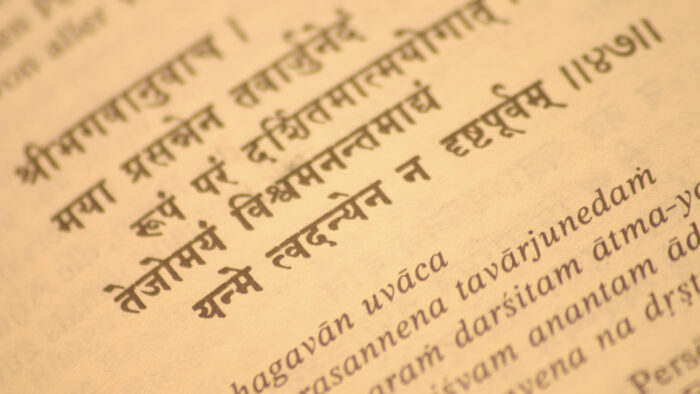
This statement demands critical deconstruction as it exemplifies a broader pattern of epistemic erasure in academic discourses. In an Instagram essay on what do yogic and Tantric traditions say about activism and engagement in the world, the scholar wrote “historians of religion confirm Buddhism, Jainism and asceticism as precursors of yoga.” The Instagram post further employed svātantrya, Śiva, Śakti, the Gītā, and Yoga Sūtras as resources for theorizing engaged action in the world. This inconsistency is glaring. Buddhism, Jainism, and the śramaṇa traditions are nāstika paths that developed alongside in dialogue with Hindu āstika traditions. To position them as yoga’s “precursors” misconstrues a complex civilizational conversation as linear genealogy. Further, Buddhism and Jainism–categories consolidated in nineteenth century European scholarship–are freely used yet Hinduism alone is denied citational legitimacy. The erasure “Gītā and Yoga Sūtra does not belong to Hinduism” by a European scholar is inseparable from what Edward Said demonstrated in Orientalism. Said asserted that the West produces knowledge about the Orient to dominate it, not to understand it. The colonial project was never about understanding facts and native traditions. It was about the authority to name, un-name and to own. Gayatri Spivak in her essay “Can the subaltern speak?” argues that the subaltern remains structurally silent because dominant epistemes script the very condition of speech. The subaltern cannot speak, not from muteness but because the subaltern is primarily heard through the language of the elite or powerful. The case being how freely a Western or a European scholar gets to decide and create a double identity for Gītā and Yoga Sūtra: Hindu or not Hindu texts. Such erasure is not historiography; it is an epistemic violence.
Today, the binary of East/West has been relabeled as “Global North” and “Global South.” The hierarchy persists where “Global North” retains epistemic dominance and decides what counts as global, what counts as theory and universal truth? One must interrogate what is “Global” in these binaries and who gets to decide this? Have we merely accepted neatly packaged Eurocentric definitions that reinscribe the North’s structural superiority and the South’s manufactured inferiority? If these categories remain extremely imposed, then it demands for a radical interpellation. As academic discourses transition to decolonial frameworks, one must ask why the Global North academics are hostile towards Global South scholars naming their own inheritance? The decolonial frameworks demand what Walter Mignolo terms “epistemic disobedience.” The delinking from the rules of the colonizer’s knowledge system. It means refusing to measure Dharmic traditions through Western standards and theorize from within Indigenous frameworks. This disobedience becomes imperative, now more than ever, as the colonizer’s logic enters through digital platforms, academic conferences and journals.
To be clear, not all Western or white scholars think with an imperial intent of cultural appropriation, but the powerful nexus of select few in Western academia has created conditions where native scholars cannot be heard unless their voices rise to the level of a howl or they situate themselves within the Western academia. In this context, Data and Capital emerge as new forms of neo-colonialism. Data in the form of academic consensus produced within closed epistemic circles of Western scholars. The claim like Gītā and Yoga Sūtra does not belong to Hinduism is not an intellectual position but part of a longer history of epistemic textual extraction, a structural robbing that began when the colonial gaze first fell on Hindustan and continues today under the guise of academic authority. To grasp the structure of this academic violence perpetuated by Global North scholarship, one may turn to the Mahābhārata’s Sabhā Parva. Draupadī is dragged into the Kuru court and disrobed. The more Duḥśāsana pulls, the more her sari extends—dharma sustained by Kṛṣṇa becomes infinite in form of a sari. This episode is not merely mythic; it is structural. For centuries, Dharmic traditions of Bhārata have been subjected to the same logic of vastraharan by Western epistemes. The more our śāstras are stripped of their civilizational context, the more they reveal themselves as sanātana (eternal) and irreducible to neat colonial categories.
This is precisely what Sri Aurobindo identified as the colonial strategy of denying a civilization by renaming it. He wrote in Renaissance in India “Hinduism…is itself a vast and many-sided synthesis,” and “the thing itself is as old as the oldest records of our race.” Aurobindo mentioned “whatever in the religious thought and practice of that vast, rich, thousand-sided, infinitely…firmly structured system we call Hinduism.” It means Hinduism is always evolving with varied expressions of all individuals while maintaining structured philosophy. Similarly, M.K. Gandhi’s political assertion in Hind Swaraj did not merely reject the British rule; rather, he rejected the “Western civilization” that underwrote it. His condition was unambiguous, “if the English become Indiansed, we can accommodate them, if they wish to remain in India along with their civilization, there is no room for them.” Gandhi understood that one cannot claim the land while disrobing its civilization.
Lastly, the ṛṣis and ācāryas who carried these traditions forward for millennia, along with the families who have stewarded them across generations, would be called Hindu today. Therefore, the Gītā and Yoga Sūtra stand at the very core of Hinduism.
Disclaimer: The opinions expressed in this article belong to the author. Indic Today is neither responsible nor liable for the accuracy, completeness, suitability, or validity of any information in the article.